




Abstract

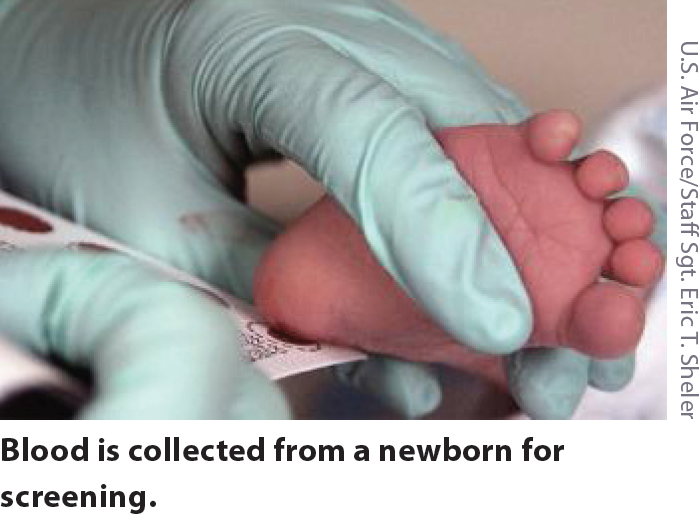
Now that nearly half of the nation's states have added a test for severe combined immunodeficiency (SCID) to their newborn screening panels, researchers have taken the opportunity to evaluate the test's usefulness. The test, researchers say, appears to contribute to higher survival rates because it detects the condition prior to the onset of life-threatening infections.
Delving into data from 11 newborn screening programs, a research team led by Jennifer Puck, M.D., of the University of California, San Francisco, found that the test reliably identifies infants with SCID, prompting life-saving, immune-restoring treatments such as transplants of blood-forming stem cells or gene therapy. Without such interventions, infants afflicted with SCIDs usually perish within the first year or two of life.
The researchers, who published their results August 20 in JAMA, in an article entitled, “Newborn Screening for Severe Combined Immunodeficiency in 11 Screening Programs in the United States,” also discovered that SCID affects approximately 1 in 58,000 newborns, indicating that the disorder is less rare than previously thought.
The SCID newborn screening test uses the polymerase chain reaction (PCR) to measure circular DNA molecules. These molecules, which are called T cell receptor excision circles (TRECs), are a byproduct of T-cell development.
Normal infant blood samples have 1 TREC per 10 T-cells, reflecting the high rate of new T-cell generation early in life. An absence of TRECs may indicate SCID. The TREC test also may help doctors identify infants with non-SCID T-cell deficiencies.
Although the TREC test is testing is DNA-based, it is not a test for gene mutations. Infants with SCID have few or no T cells, regardless of the underlying genetic defect.
U.S. Air Force/Staff Sgt. Eric T. Sheler
Conceivably, the TREC test could be supplemented or even superseded by extensive testing for DNA mutations or sequencing of the entire genome. The possibility has been raised by the Immune Deficiency Foundation (IDF). “Even predisposition to the more common multifactorial immune disorders with later onset may become possible through deep sequence analysis of DNA from newborns,” the IDF had indicated. “However, since the mere presence of a mutation does not fully predict phenotype for these conditions, much more needs to be learned about the true predictive value of each proposed type of screening.”
Despite this caution, the TREC test has been considered in a broader testing context. For example, some of the investigators in the current study were also participants in a 2012 study that used sequencing to evaluate an infant that had low T cell numbers but lacked defects in genes known to be associated with SCID. This study, entitled “SCID Newborn Screening and Exome Sequencing Identifies Ataxia Telangiectasia and Low T Cells Early in Life,” was presented at the annual meeting of the American Society of Human Genetics.
By filtering variants against a list of genes associated with T cell development, these researchers found two damaging heterozygous ATM mutations. “With 63 exons, ATM is efficiently analyzed by exome sequencing,” they noted. “TREC newborn screening offers early diagnosis not only for SCID, but also for secondary targets such as AT, providing an opportunity to define the spectrum of conditions associated with low T cells early in life.”
The current study, as indicated previously, was primarily interested in documenting TREC test outcomes. For example, the JAMA paper noted that 49 out of 52 SCID infants received immune-restoring therapies. (Three infants died before treatment was given.) Of the patients who received transplantation, enzyme replacement, and/or gene therapy, 45 (92%) survived.
Besides establishing the TREC test as a valuable addition to population-based screening panels, the current study also raised more detailed genetic considerations. For example, X-linked SCID, a form of the disorder caused by mutations in a gene on the X chromosome, had been thought to account for half of SCID cases, but the researchers found that only 19% of newborn-screened SCID infants had X-linked disease. Also, the proportion of SCID infants without a known genetic defect (15%) was higher than anticipated, indicating that widespread screening presents opportunities to discover previously unknown genes implicated in SCID.
TREC screening may benefit infants with non-SCID T-cell deficiencies. Overall, the screening test identified 411 infants with T-cell defects not attributable to SCID. One third of these infants had other inherited conditions in which T-cell impairment can be profound, such as DiGeorge syndrome, which is caused by defects in chromosome 22 that can affect multiple organs. The screening test also identified some infants with other medical conditions that can accelerate loss of T cells, such as congenital heart defects.