




Abstract

When it comes to diagnosing and treating disease, the big names like cancer and heart disease tend to draw the majority of media attention. Yet it's estimated that there are over 80 different autoimmune diseases affecting approximately 23.5 million Americans1, and there is neither a definitive understanding of the cause nor an effective cure.
Autoimmune diseases, like rheumatoid arthritis (RA), systemic sclerosis (SSc), and systemic lupus erythematosus (SLE), can affect multiple organs and tissues, cause long-term pain and discomfort, and will progress through phases of remission interrupted by unpredictable flares or relapses, accompanied by significantly elevated morbidity and mortality. It is this inherently complex, syndrome-like nature and numerous overlapping symptoms that make diagnosis such a challenging endeavor for clinicians. In the early stages of these diseases, patients can present with uncommon features, often suggestive of an entirely different autoimmune disease, yet remain undiagnosed due to an inadequate number of qualifying criteria2. Despite the array of diagnostics (Dx) available, a biomarker capable of predicting autoimmune diseases with sufficient accuracy remains to be identified3.
The Diagnostic Demand
In order to achieve a diagnosis, clinicians conduct multiple laboratory tests that can include a complete blood count, comprehensive metabolic panel, immunologic studies, serologies, flow cytometry, and cytokine analysis4. However, unless the disease pathology and pathways have been clearly identified, a single test is unlikely to be the solution. New Dx are being developed, but given the frequently poor reimbursement opportunities5 and high risks associated with devising new Dx, many large developers have been deterred, leaving much of the innovation in the hands of smaller, academic, or biotechnology labs. This has resulted in only a handful of novel Dx reaching the autoimmune disease market over the past decade.
Genome-wide associated studies (GWAS) have shown how autoimmune diseases are genetically complex: individuals have different combinations of genetic risk and protective factors, in addition to a myriad of nongenetic risk factors6,7. This complexity means that autoimmune diseases may not benefit to a great extent from genetic Dx, although genetic variations that could contribute to the development of SLE have been identified8. This is in contrast to other rare diseases that follow a Mendelian pattern of inheritance, where the analysis by molecular biology technologies is the dominant therapy-driving principle7. Instead, Dx for autoimmune diseases make use of autoantibodies as their appearance is indicative of defects in the immune system and a risk of progression to clinical onset of an autoimmune disease. These serological assessments, although useful, can lack sensitivity and specificity. RA for example, can be diagnosed in part by the presence of rheumatoid factor (RF) autoantibodies in the patient's serum. These RF autoantibodies are present in around 75% of RA patients, yet they are also detectable in 60% of patients with Sjogren syndrome and in 3–5% of healthy patients. Assessing additional autoantibodies can improve diagnostic accuracy and support the clinical management of patients.
Multimarker Tests: Plugging the Diagnostic Gap
A strategy to address today's unmet clinical demands in diagnosing patients while supporting the development of better medicines in autoimmune diseases, is the analysis of established and novel autoantibody markers in a multimarker context. Recently, a multimarker test has been developed based on the analysis of more than 1,500 patients with SLE, RA, SSc, and other autoimmune diseases (NavigAID, from Protagen). This array includes 87 autoantigens, including over 40 novel ones, and measures autoantibody markers linked to SLE pathologies and different clinical manifestations. At the same time, a broad differential diagnosis against other autoimmune diseases is achieved. Results generated from novel studies have already led to the classification of four distinct categories of SLE patients.
Multimarker tests can successfully combine different markers, such as single nucleotide polymorphisms (SNPs), cytokines, and autoantibodies, into a single, powerful diagnostic tool. Tests like this enable specific differential diagnosis and a powerful disease stratification approach that could be beneficial to future clinical programs. Although multimarker tests represent a significant investment and incentive structures are currently complicated5, they have the potential to provide the basis for treatment-specific companion diagnostics (CDx).
Using Diagnostic Tools to Personalize Treatment
The challenges of dealing with autoimmune diseases extend far beyond a diagnosis: the one-size-fits-all approach to prescribed drugs is of growing concern, with most drugs used in the treatment of autoimmune diseases showing a maximum response rate of 50%9.
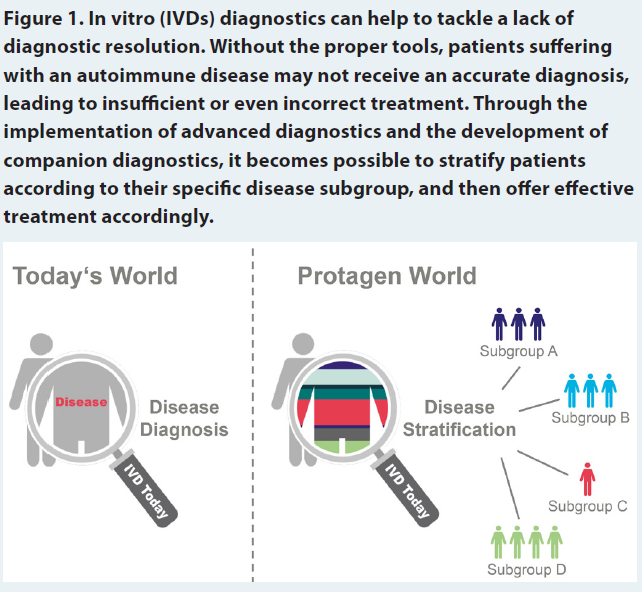
To combat this, CDx can help to evaluate and define patient subgroups with respect to their unique profile and personalized responses to a particular drug. CDx allow for better patient stratification and can contribute significantly to improve patient wellbeing, quality of life and long-term prognosis when paired with effective, personalized therapeutics (Figure 1). CDx have already been used to great effect in the case of treating lung, colon, and breast cancers among others. In just one example from breast cancer, the drug Herceptin® is used only in conjunction with its CDx, HER-2/neu. A patient that is positive for HER-2/neu has a greatly improved chance of benefiting from treatment with Herceptin.
CDx Provide Benefits Beyond the Patient
Adopting CDx development early on has additional benefits beyond improving patient outcomes. Patient selection during clinical trials would be based on biomarker data for example, meaning that the primary trial endpoints are more likely to be achieved. This in turn increases the chance that a drug will gain regulatory approval, ultimately saving significant time and financial costs. In addition, reimbursement campaigns and pricing issues are improved by demonstrating the combined effect of CDx and the associated drug10.
Dx in the form of CDx therefore have the power to stratify patients, facilitate response prediction, and mitigate the high levels of ineffective treatments. The use of CDx not only leads to a wave of personalized treatment options for patients, but also offers multiple benefits for the industry in terms of improved success rates in clinical trials and even reduced times to market.
Conclusions
Autoimmune diseases have been a long-standing diagnostic thorn in the side of clinicians, presenting with complex symptoms that often are not specific to a particular disease. A diagnosis frequently relies upon matching clinical criteria and systematically excluding the least likely possibilities. Laboratory tests have been vital in assisting with reaching a diagnosis, yet when used in isolation may fail to present a complete picture. However, with advances in both the biology and technology, it has become possible to identify whole autoantibody profiles based on a suite of Dx rather than isolated assays, enabling accurate diagnoses and treatment response-prediction.
We are already beginning to see advanced Dx that afford a greater insight into autoimmune diseases and the beginnings of a framework on which to advance CDx. In time, it is hoped that companies will begin to align the development of CDx with novel drug development for autoimmune diseases as standard practice. Ultimately, the partnership between Dx and CDx promotes a more in-depth understanding of autoimmune diseases, prompting earlier diagnosis, better treatment and improved levels of healthcare.