




Abstract

Because sepsis is characterized by nonspecific symptoms and can progress quickly—with fatal results—biomarkers that can characterize the condition are dearly needed. Ultimately, multiple biomarkers may serve to characterize different aspects of the disease. With an eye toward this multibiomarker possibility, researchers at Lund University and the University of Zurich have been using mass spectrometry to measure hundreds of proteins and reveal protein patterns that could be analyzed to determine the severity of a patient's sepsis condition. Their technique, which requires just a single blood sample, could also be used to show which patient organs have sustained sepsis-related damage.
The researchers, led by Lund University's Johan Malmström, Ph.D., published their results January 6 in the journal Nature Communications, in an article entitled, “Large-scale inference of protein tissue origin in gram-positive sepsis plasma using quantitative targeted proteomics.” The work is, essentially, a protein-mapping project. It shows how the researchers constructed a comprehensive protein tissue atlas from cells and highly vascularized organs using shotgun mass spectrometry.
Lund University & University of Zurich, Nature Communications
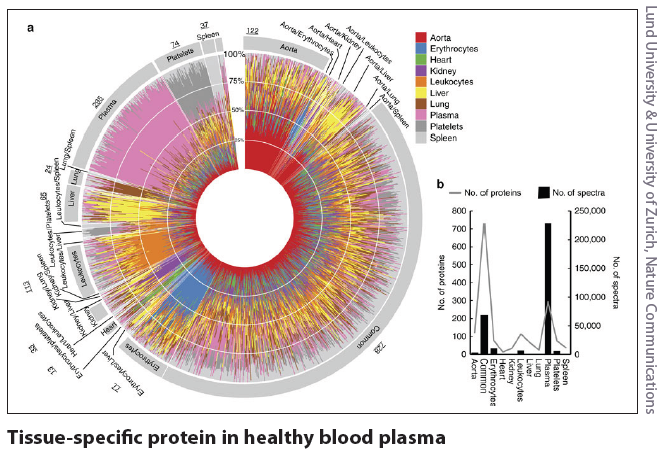
“Protein mapping like this has never been done before,” said Dr. Malmström. “The method can also be applied to other diseases for studying how pathological changes in various organs are reflected in a blood sample.”
Dr. Malmström explained that if you see in a blood sample that the amount of proteins from a specific organ increases, it indicates damage to this organ. “The method,” he continued, “provides an understanding of the molecular events that take place during the course of a disease, and the possibility, using the same analysis, to study how different organs are affected.”
The Malmström group's study of hundreds of different proteins could eventually be used to select other important proteins that can serve as biomarkers for different aspects of sepsis. “We show that the method can determine drastic changes of tissue-specific protein profiles in blood plasma from mouse animal models with sepsis,” the authors of the Nature Communications article wrote. “The strategy can be extended to several other species advancing our understanding of the complex processes that contribute to the plasma proteome dynamics.”
The researchers point out that they are extending their work to human tissue. Through a collaboration with surgeons at Skåne University Hospital, they have obtained samples of healthy tissue from all organs concerned. Protein patterns of these samples can then be compared with the corresponding tissue in sepsis patients.
“There is so much we don't know about sepsis,” stated Erik Malmström, Ph.D., the lead author of the study. “Why do not all patients react the same way—why do some organs suffer the most damage in some patients and not in others? Do different bacteria cause the disease to progress? Can you divide patients into different subgroups, or bacteria, or does each new combination of patients and bacteria lead to a specific form of sepsis?”
At least some of these questions may become more tractable with the development of spectral libraries that can be used to quantify tissue-specific proteins in human plasma. Such libraries, as indicated in the current study, may be used to track multiple biomarkers and reveal the degree to which sepsis has progressed. That is, mass spectrometry analysis of septic blood plasma may be used to reveal a drastic reorganization of the blood plasma proteome related to disease severity. This approach could also be generalized to other conditions.
“We predict that the strategy outlined here can be extended to measure how tissue proteins are regulated in many other pathological conditions improving our understanding of how surrounding tissues and cells can influence blood plasma as a consequence of disease,” concluded the study's authors. “This information can be useful to increase our knowledge of how different pathophysiological processes distort the protein composition of healthy plasma to further explore the underlying pathophysiological mechanisms.”