




Abstract


Obtaining patient samples for the development and validation of new genomic tests is the greatest single barrier to the wide-scale implementation of precision medicine.
Precision medicine, evidence based medicine, and personalized medicine all describe the concept of using molecular diagnostic and other patient specific information to determine the optimal treatment for a patient. While precision medicine looks to harness a wide array of health and lifestyle information, much of the growing excitement is being fueled by advances in technologies that make in-depth characterization of an individual's genome possible for less than $3,000 dollars, and rapidly approaching $1,000.
While the cost of sequencing an individual's genome has dropped dramatically, the real challenge for companies is completing the studies needed to demonstrate the clinical validity and utility of promising tests. Most genomic tests are delivered as laboratory developed tests (LDTs). Historically, LDTs are single analyte tests in which the clinical utility or validity isn't in question, and there is often a known standard that a laboratory can use to validate against. However, many of the newest, most promising tests for precision medicine are multi-gene panels that rely upon a complex algorithm to make a non-obvious medical determination. There often isn't a standard to compare to. In many instances, clinical validity and/or utility is not easily demonstrated without running a large-scale clinical study.
Commercialization Roadblocks
Unfortunately, with the recent U.S. Supreme Court ruling that genetic tests are not patentable and the trend towards significantly reduced health insurance reimbursement rates, many investors and companies are reluctant to invest in large-scale validation studies for new genomic tests. As a result, the development of several promising diagnostic tests are stuck in the valley of death between discovery and commercialization. In other instances, tests are commercialized with insufficient or subpar clinical evidence, leading to poor acceptance and significant push back from the FDA, insurance providers, and medical community at large.
The recent commercialization of several insufficiently validated—and suspect—diagnostic tests are at the heart of the on-going argument between the FDA and the clinical testing industry. The FDA feels that there is a lack of oversight of LDTs, and are arguing it is their right to increase regulation on the clinical testing industry. Conversely, the clinical testing industry does not want increased regulation and argues that the FDA does not have the authority, and that these rare instances of problem tests can be effectively policed using an enhanced CLIA licensing system that is administered by the Centers for Medicare & Medicaid Services (CMS). While the final outcome of the FDA's push for more oversight of LDTs is unclear, it is becoming increasing evident that the industry is in need of a rapid and affordable solution for running large-scale clinical studies.
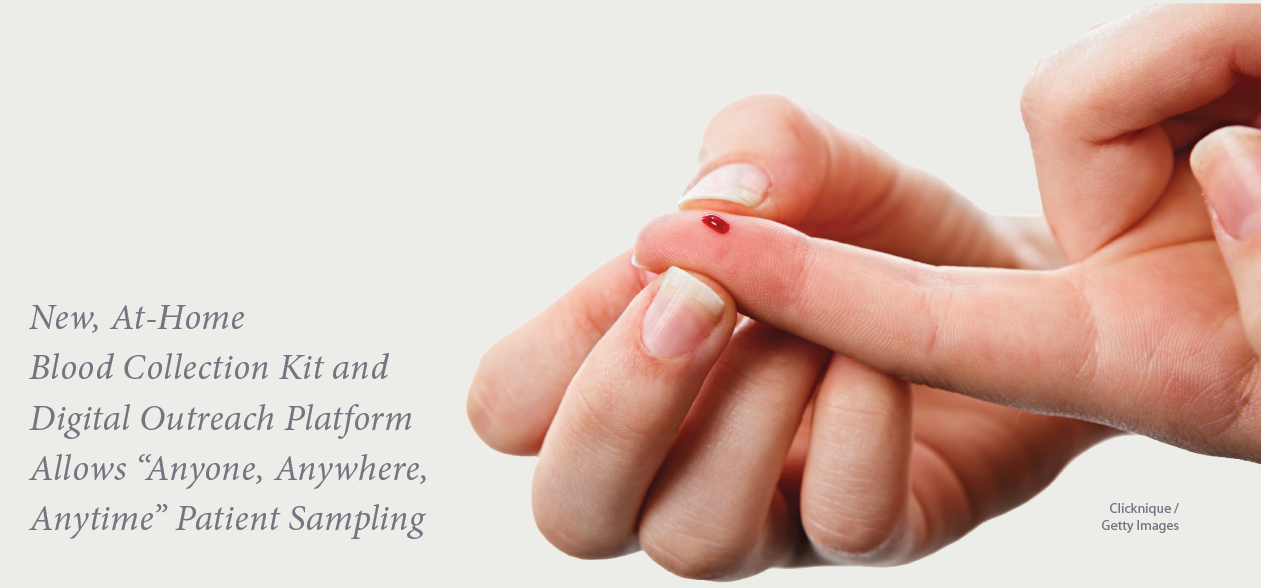
New, At-Home Blood Collection Kit and Digital Outreach Platform Allows “Anyone, Anywhere, Anytime” Patient Sampling
Clicknique / Getty Images
Traditionally, genomic studies employ a “physician-centric” study model popularized by the pharmaceutical industry for drug development. It relies upon doctors to identify, recruit, and enroll patients in a study. While very scientifically sound, this model is limited by patient throughput and also requires paying for the physician's time and expertise. Recruiting thousands of patients for a large-scale study often requires 50 or more study sites across a broad geographical area, and each site requires individual contract negotiations, protocol training, Institutional Review Board (IRB) approval, and monitoring. A study can take several years and can cost between $10 million and $100 million to complete.
PMI Tackles Test Validation costs
The Precision Medical Initiative (PMI), announced in 2015 by the Obama Administration, is a step in the right direction toward improving the economics of test validation. The PMI cohort program seeks to extend precision medicine to all diseases by building a national cohort of one million or more U.S. participants. The goal is to accumulate actionable information to significantly increase the accuracy of scientific predictions both during research and in the clinic.
In addition to providing a large, public dataset that can be used to support the discovery of promising genomic tests, the PMI cohort program also will investigate new modalities for recruiting and monitoring patients with a focus on patient engagement.
A key aspect of the PMI cohort is the shift from a “physician-centric” model to a “patient-centric” model. In today's internet-connected, mobile-phone-carrying, electronic-medical-record-enabled world, much of the patient and medical information that previously required physician interaction now can be obtained directly from the patient. Combine this with advances in genomic technologies that enable full genome and transcriptome analysis for a drop of blood, and it is now possible to go directly to the patient for many studies.
A Direct-to-Patient Research Model
Consistent with the goals of PMI, Los Angeles-based DxTerity Diagnostics recently launched is Direct-to-Patient (D2P) Platform, which streamlines qualification, consenting, genomic profiling and patient monitoring, and allows the whole process to occur from the convenience and privacy of a patient's home. Patients are recruited using a combination of social media, health websites, Google, and research foundations as well as physician organizations, if available. Patients are directed to a website that describes the study and asked a series of questions to determine eligibility.
Qualified patients are digitally consented, and sent a blood collection kit that the patient uses to self-collect 100 microliters (about 4 drops) of blood from a fingertip. The patient returns the sample by standard mail. No refrigeration is required. Electronic Data Capture (EDC) monitors and tracks patient samples, and Patient Reported Outcome (PRO) data is collected via a web interface.
Upon receipt of the samples by DxTerity, a full range of genomic analysis is possible, as well as testing of a limited menu of protein markers. Importantly, unlike saliva collection or cheek swabs that only support DNA analysis, blood enables transcriptome analysis (RNA), which is particularly useful for monitoring immune response. An added benefit of D2P is the ability to perform more frequent monitoring of patients, enabling researchers to characterize and monitor populations very closely and at any frequency (even daily), rather than the standard two- to four-month intervals. This increased monitoring frequency is particularly useful for characterizing a patient's response to a treatment change or for autoimmune diseases like rheumatoid arthritis, lupus, and multiple sclerosis that are prone to cycles of remission and flare.
Overall, patient-centric clinical studies like those empowered by DxTerity's Direct-to-Patient platform are an important innovation in genomic research, and should lead to significant advances in precision medicine. The potential cost savings and health benefits of precision medicine are exciting. The first rule of medicine, however, is still to do no harm, and new genomic tests need to be validated prior to incorporation into routine medical care.