




Abstract

The White House Cancer Moonshot Task Force in the Vice President’s Ceremonial Office in the Eisenhower Executive Office Building of the White House, Feb. 1, 2016.
The White House / Pete Souza

The National Cancer Institute (NCI) recently accepted 10 research goals crafted by a 28-member Blue Ribbon Panel, formed by NCI’s National Cancer Advisory Board to advance Vice President Joe Biden’s “Cancer Moonshot.”
The Panel’s recommendations included a national “Ecosystem” through which researchers, clinicians, and patients can contribute, share and analyze cancer data. The ecosystem would link now-scattered localized efforts, foster development of computational tools and infrastructure, and promote data sharing.
Creating that ecosystem would require surmounting numerous challenges, noted George D. Demetri, MD, senior vice president for experimental therapeutics, Dana-Farber Cancer Institute, and a member of the American Association of Cancer Research (AACR)’s Board of Directors.
One challenge is how to ensure patients drive advancement of research through participation and easy, yet effective, ways of volunteering to donate their data. Another is how to promote contribution of data by physicians. Still another is how to federate that data.
“It may take a Biden to convene different regulatory agencies to say, ‘You know what? Patients are the owners of their own data. They have a right to their data in an interoperable format.’ We may need to pass a law to give that to them,” Dr. Demetri added.
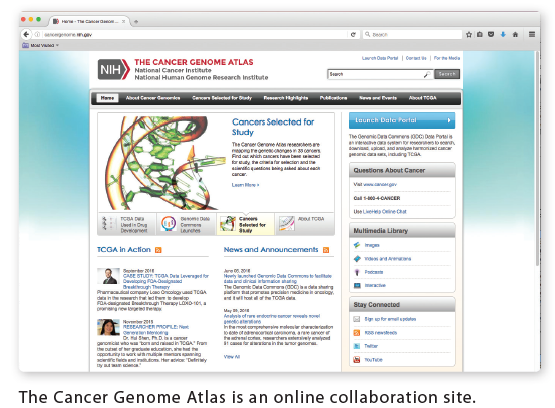
He said The Cancer Genome Atlas, a collaboration of NCI and the National Human Genome Research Institute, showed that a cancer genome project could create rules by which large institutions can collaborate nationally to share data.
Networks such as the Flatiron Health OncologyCloud platform have also federated data—as has AACR’s Project GENIE (Genomics, Evidence, Neoplasia, Information, Exchange), an international, multi-phase, multi-year project that aggregates and links cancer genomic data with clinical outcomes from tens of thousands of patients. Another source, the American Society of Clinical Oncology (ASCO)’s CancerLinQ (see article p. 32), has enrolled more than 66 practices and more than 1,000 oncologists, with more than 850,000 individual patient records stored.
“This effort represents the first version of CancerLinQ, but our goal is to evolve and expand with future versions that include successively more powerful quality improvement tools,” ASCO president Daniel F. Hayes, MD, told Clinical OMICs.
“I’m pleased that the Blue Ribbon Panel addressed the topic of interoperability,” Dr. Hayes added. “In oncology, we routinely work with a variety of other medical providers, such as radiation therapy, surgery, imaging, pathology, etc., and sharing critical health information is more difficult than it needs to be.”
The Panel also recommended developing a network of databases to boost patient engagement by enabling them to directly gather information about tumor profiles and treatment outcomes, and preregister for clinical trials. Another recommendation called for establishing expanded networks of cancer researchers and clinicians that would conduct retrospective analyses of archival tumor samples from cancer patients treated with standard of care, and whose outcomes are known.
Both recommendations could help reduce disparities in research data, he said, while the retrospective analysis could make cancer treatments more economically effective. “If we define patients who are particularly sensitive, or who don’t benefit, then we will have done something terrific. We will spare patients toxicities. We’ll spare the country wasteful costs, Dr. Hayes concluded.”
The Cancer Genome Atlas is an online collaboration site.
Such initiatives cannot be funded individually by all institutions, noted Dr. Demetri, who served on the Panel’s Expanding Clinical Trials working group. At Dana-Farber, philanthropic funding from its Board of Trustees enabled creation of its “Profile” enterprise-wide genomic screening research program, which has data on more than 15,000 patients.
Sharon Terry, president and CEO of Genetic Alliance, told Clinical OMICs the Moonshot can build on existing efforts to engage individuals, families, and communities. Community identity, she said, helped drive the success of the Framingham Heart Study, launched in 1948, and has successfully driven use of the Alliance’s Platform for Engaging Everyone Responsibly, a customizable registry system for collecting privacy-assured health information, currently used by some 40 communities.
Terry said implementing the Panel’s recommendations will require strong leadership across all stakeholders. Leaders need to view their initiatives not as entire solutions, but as components of a broader anti-cancer effort.
“All of these projects are going to have to compromise, change, retool, redesign for a system that actually learns, and that engages people,” Terry said.