




Abstract

HudsonAlpha Institute for Biotechnology researchers, in a cooperative effort with an international team of collaborators from six countries, recently identified a new genetic variant in the EBF3 gene that causes intellectual and developmental delay in children. The research “Mutations in EBF3 Disturb Transcriptional Profiles and Cause Intellectual Disability, Ataxia, and Facial Dysmorphism” was published online in the American Journal of Human Genetics (AJHG).
“Essentially, we did experiments to understand how variants in the EBF3 gene might change its function during development,” said Drew Hardigan, a graduate student at HudsonAlpha and a co-lead author. “The role of EBF3 had been studied in terms of neural development, but had not been previously described as a gene in which mutations cause intellectual and developmental delay. We were able to demonstrate that changes to the gene are the cause of a clinical disorder.”
Greg Cooper, Ph.D., HudsonAlpha Institute
HudsonAlpha
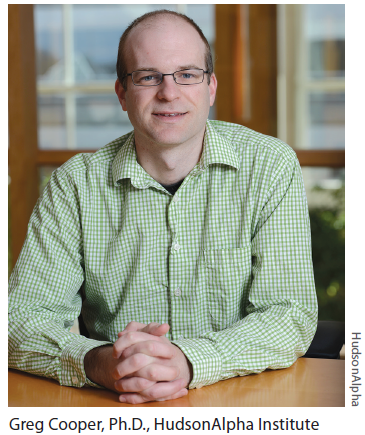
The finding arose from the lab of HudsonAlpha faculty investigator Greg Cooper, Ph.D., who was the senior author for the report. Through ongoing work under an NHGRI grant for the diagnosis of unexplained intellectual and developmental disabilities, Cooper’s team identified two separate patients via genomic sequencing and analysis that had EBF3 variations.
When the HudsonAlpha team could not find any similar cases or publications to confirm the EBF3 variations were causing the patients’ symptoms, they turned to GeneMatcher to connect with researchers around the world who were also interested in variations of unknown significance in EBF3.
Once connected, the international group performed a statistical analysis confirming the gene was very likely the cause of the symptoms for 10 patients. The experiments showed that the genetic changes to EBF3 disrupt important functions required for normal development. They also found that changes in this gene were likely the cause of about one in every 1,000 patients with unexplained neurodevelopmental disorders.