




Abstract

The ability to work outside of the typical microbiological paradigm for adapting bacteria to laboratory culturing systems always has excited researchers about metagenomics—which analyzes microbial DNA directly from environmental communities.
“It allows us to identify the array of resistance genes in a complex matrix without the need to culture organisms in the lab on artificial growth media,” explains Patrick McDermott, Ph.D., director of the U.S. National Antimicrobial Resistance Monitoring System (NARMS) for enteric bacteria at the FDA. “For the purposes of NARMS, this represents a tremendous advancement. By indexing what we find, to the resistance in human pathogens, we essentially will be conducting reconnaissance of the environmental microbiome and assessing its evolving risks based on changing resistome patterns in the clinical setting.”
While previous work in metagenomics had been done to not only show that the concept was feasible, scientists consequently discovered that gene diversity in the microbial world varied tremendously. However, traditional sequencing techniques made the genomic analysis process difficult and labor intensive. It wasn’t until next-generation sequencing techniques became more mainstream and cost-effective that investigators began to give metagenomics a second look.
“Metagenomics really was a game changer, as it allowed us to look at resistance genes in various habitats,” stateds-Gautam Dantas, Ph.D., associate professor in the department of molecular microbiology at Washington University School of Medicine “What’s clinically relevant about this, is that it’s been pretty well established that the evolutionary antecedents of resistance are in the soil—and almost certainly that next new resistance gene discovered in the clinic will come from these environmental microbes.”
Additionally, it’s a strong bet that if new resistance genes are found in the soil, so too are ways to combat them. The future will see metagenomic applications leading the way on the resistance surveillance and drug discovery fronts.
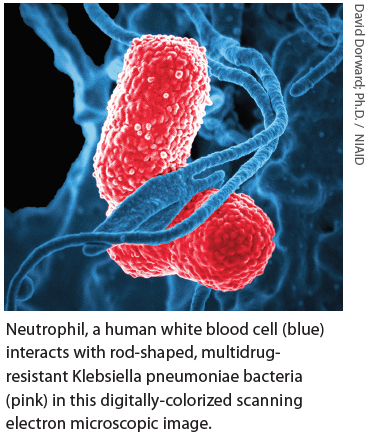
Neutrophil, a human white blood cell (blue) interacts with rod-shaped, multidrug-resistant Klebsiella pneumoniae bacteria (pink) in this digitally-colorized scanning electron microscopic image.
David Dorward; Ph.D. / NIAID
“The impact of genomics is that it allows us to see a much larger part of the pie,” Dr. Dantas added. “What I would claim with functional metagenomics, it’s not that we just expanded how much of the pie we could now describe, we realized that the pie was substantially larger than we initially imagined.”