




Abstract
Not so long ago, the ability to deliver precision therapy fell in narrow band. “You could answer very specific questions, just not very well,” says Bryan Spielman, evp of strategy and corporate development with Seven Bridges. “You could answer some of the questions for a particular patient, if you knew exactly what biomarker you were looking for.”
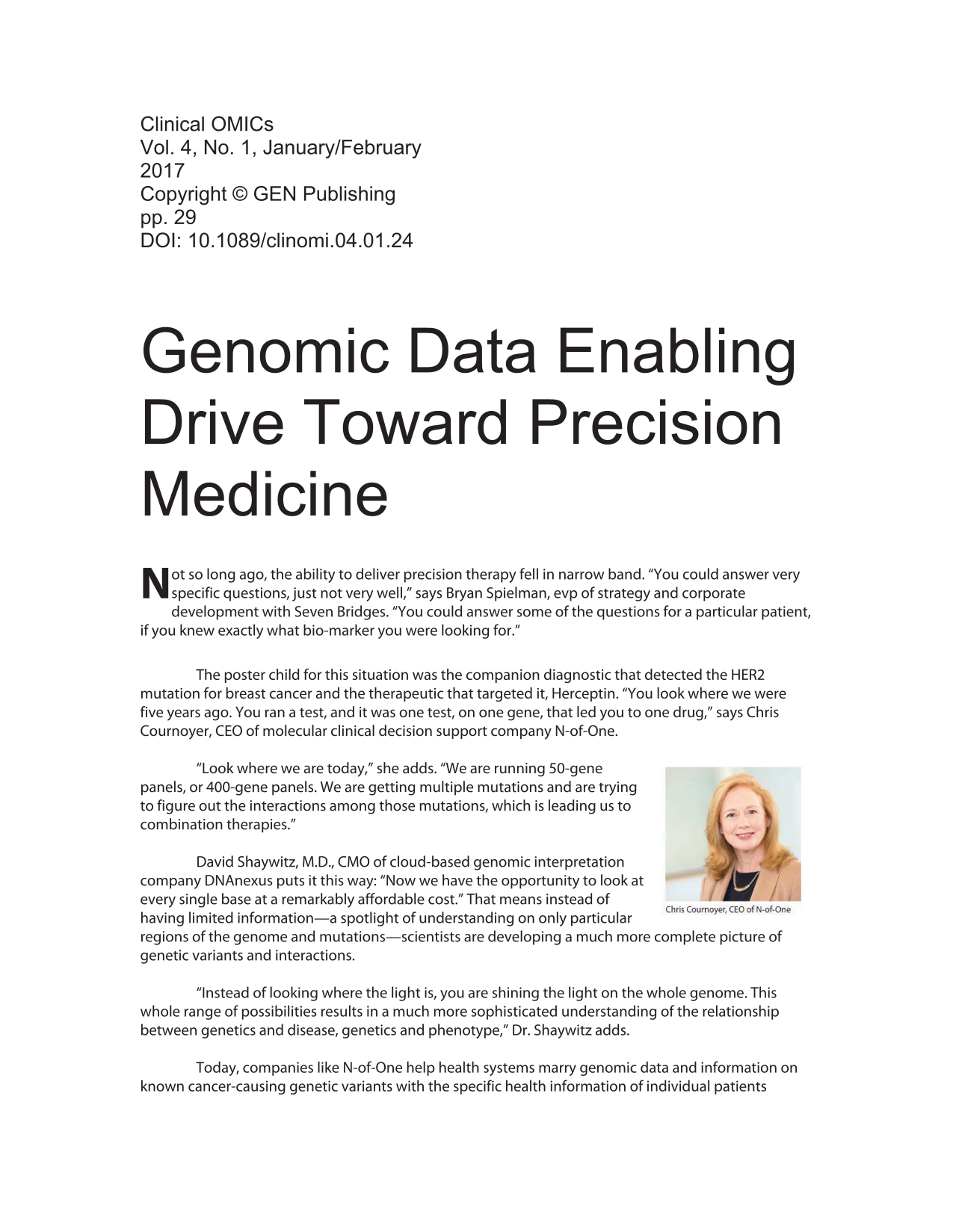
The poster child for this situation was the companion diagnostic that detected the HER2 mutation for breast cancer and the therapeutic that targeted it, Herceptin. “You look where we were five years ago. You ran a test, and it was one test, on one gene, that led you to one drug,” says Chris Cournoyer, CEO of molecular clinical decision support company N-of-One.
“Look where we are today,” she adds. “We are running 50-gene panels, or 400-gene panels. We are getting multiple mutations and are trying to figure out the interactions among those mutations, which is leading us to combination therapies.”
Chris Cournoyer, CEO of N-of-One

David Shaywitz, M.D., CMO of cloud-based genomic interpretation company DNAnexus puts it this way: “Now we have the opportunity to look at every single base at a remarkably affordable cost.” That means instead of having limited information—a spotlight of understanding on only particular regions of the genome and mutations—scientists are developing a much more complete picture of genetic variants and interactions.
“Instead of looking where the light is, you are shining the light on the whole genome. This whole range of possibilities results in a much more sophisticated understanding of the relationship between genetics and disease, genetics and phenotype,” Dr. Shaywitz adds.
Today, companies like N-of-One help health systems marry genomic data and information on known cancer-causing genetic variants with the specific health information of individual patients contained in their electronic health record (EHR). This allows for a significantly more sophisticated, and nuanced, approach to providing clinical guidance.
While combining genomic data and data from EHRs may be the holy grail of precision medicine, there remain significant hurdles. These include integration of the data and the reliability of the data contained in EHRs, which can often be misleading or incomplete, says Spielman.
With EHRS “we have a system that was designed for what it needed to be designed for at the time, it wasn’t designed for where the puck was going,” he says. “But people like to think technology is infinite. It’s not. How often do people change their iPhone? So, hopefully, EHR/EMRs will be improved.”
But even having limited information from a patient’s EHR to provide insight about their past health issues, current health, and medications is better than no data at all, Cournoyer contends, especially when combined with the annotated set of known cancer-causing genetic variants and which medications are approved to fight against these driver mutations. In the future, she believes molecular diagnostics will bring even more data to the table in the fight against cancer.
“In five years, we will regularly sequence the genome. But I think we will augment that with a variety of other tests,” Cournoyer says. “We will be augmenting that with RNA data, protein expression data, and copy-number analysis. We will be bringing all of these various testing [results] to provide a more complete patient profile.”