




Abstract

Almac Diagnostics recently published the results of a validation study demonstrating the effectiveness of their “Prostate Metastatic Cancer Assay” for identifying prostate cancer patients at a higher risk of metastatic disease following surgical resection.
While standard treatments for localized prostate cancer, including surgical removal of the prostate gland and radical radiotherapy, cure the majority of patients, approximately 10% to 20% will develop metastatic disease that will eventually limit their lifespan. The ability to identify high-risk patients would make it possible for clinicians to offer additional, potentially life-saving, treatment options. “The problem we have is that current clinical factors are informative, but they don’t tell us the whole story,” Richard Kennedy, M.D., Ph.D., vice president and medical director of Almac Diagnostics, commented on the motivation behind the assay’s development.
“We had the hypothesis that there may be a molecular subgroup of prostate cancers that have the ability to metastasize,” Kennedy elaborated. To test this hypothesis, Almac Diagnostics analyzed large archives of formalin-fixed paraffin-embedded (FFPE) tissue from primary tumors that led to either metastatic or non-metastatic disease. These analyses revealed a gene expression signature of seventy genes that formed the basis of the Prostate Metastatic Cancer Assay.
The study, published in the Journal of European Urology, details a collaborative, multi-center effort to independently validate the assay using 322 radical prostatectomy samples. The study’s authors used a measurement termed hazard ratio (HR) to assess the assay’s ability to identify high-risk patients. The assay, independent of any additional clinical factors, had a HR of 3.2; thus, a patient who tested positive for the gene expression signature identified by the assay would be approximately three times more likely to develop metastatic disease. When applied to the validation study dataset, the standard risk model used in the U.S., CAPRA-S, which combines multiple clinical factors, had a HR of 2.7. Combined the two prognostic tools achieved an overall HR of 7.5 — indicating a much greater ability to identify high-risk patients.
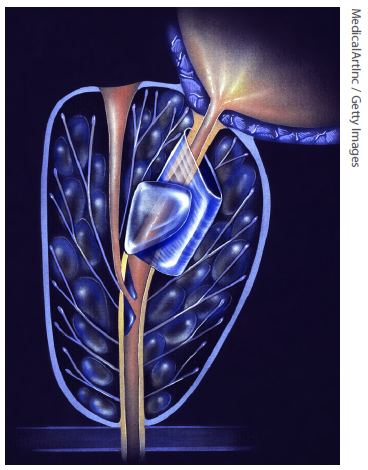
MedicalArtInc / Getty Images
Almac intends to publish additional studies that will demonstrate the assay’s effectiveness when used with biopsy samples collected prior to radical radiotherapy, and the ability to transfer the assay to different commercial platforms.