




Abstract

Genetic data is valuable to physicians, but often difficult to move around because it is so unwieldy. To address that challenge, the Office of the National Coordinator for Health Information Technology (ONC) has launched a 5-pilot project called Sync for Genes. The project will look for ways to use the latest standards being drafted by the Health Level Seven International (HL7), a group that sets standards, formats, and definitions for exchanging and developing electronic health records (EHRs).
HL7’s set of standards for application program interfaces (APIs), called Fast Healthcare Interoperability Resources (FHIR), is critical for the effective selection and exchange of discreet pieces of data, making genetic data exchange easier and, indeed possible, between EHRs, researchers and laboratories.
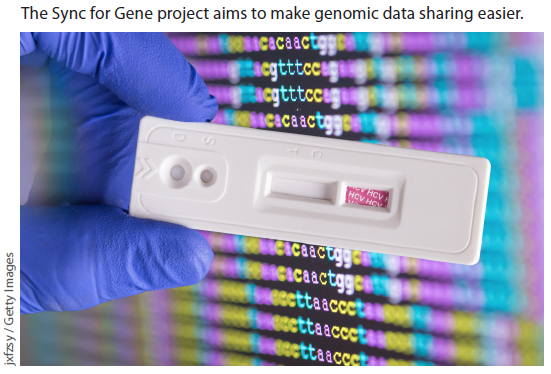
The Sync for Gene project aims to make genomic data sharing easier.
jxfzsy / Getty Images
In January 2017, ONC launched the Sync for Genes project, selecting five common use cases. The pilots are:
Counsyl, a genetic health IT company, will work with Intermountain Healthcare, on family health history genetics;
The Food and Drug Administration is working on sequencing quality and regulatory genomics;
Foundation Medicine is partnering with Vanderbilt University Medical Center, on somatic and tumor testing;
Illumina, a manufacturer of genomic sequencing instruments, is working on next-generation sequencing solutions; and
The National Marrow Donor Program is partnering with Be The Match on tissue matching.
Sync for Genes falls under the leadership of Teresa Zayas Cabán, acting chief of staff and the director of the Office of the Chief Scientist (OCS). The program is a collaboration between ONC and the National Institutes of Health, with ONC managing it, she told ClinicalOMICs in an interview.
”Feedback from the pilots will be used for open-source validation scripts and guidance to make it easier to share genomic information for clinical care and for research,” Zayas Cabán said. “The next steps will be to work directly with the developers to see if they can begin to use the standards to enable integration of genomic information into EHRs.”
The program is fully funded, and will be completed by this summer. The organizations chosen to participate were a mixture of those that were able to participate, along with those that could work on one of the five selected use cases ONC selected for the project, Zayas Cabán said.
elenabs / Getty Images
“The field of genetics has exploded in recent decades generating very powerful information and insights to help manage patient health,” said Rishi Kacker, co-founder and vice president of engineering at Counsyl. “However, we continue to uncover just how much we don’t yet understand about genetics.”
According to Kacker, Counsyl has experience gathering and reporting family history and genomic information for nearly a million patients. “We’ve developed methods to deliver genomic information at a very large scale across all types of providers, health systems and patients—all with different needs.”
In doing so, Counsyl has discovered that physicians and researchers are often limited by the size and quality of genomic data sets available for investigations. “Electronic health records promise to overcome this barrier, but data is not captured in any standard form and is very difficult to share,” Kacker said adding that Sync for Genes will help make collaboration more possible.
Jeremy Warner, M.D., assistant professor of medicine and biomedical informatics at Vanderbilt University and medical director of the Vanderbilt Cancer Registry said the pilot will help solve the problems Vanderbilt has faced working on precision cancer medicine.
“FHIR is different because it’s a pull technology, not a push technology,” Dr. Warner said. “The current standard for moving data around is for the sender to push it to the receiver. APIs make data-sharing a pull technology, in that, receivers ask for the data when they need it, and they only ask for the data they need.
“This matters a lot in genomics because the raw sequence data is quite substantial,” Dr. Warner said. “It can bog it down. HL7 is a clinical standard originally meant for clinicians. But FHIR allows it to be used by researchers.”
One of the biggest roadblocks is that the genetic reports are huge, sometimes 30 pages long, on one patient, Dr. Warner said. It’s impossible for a doctor to consume a report that size. One of the ways Sync for Genes will help is to allow for a structured app-based solution to help clinicians focus on what matters most to them and to their patients.
“The whole idea is to get discreet data into an EHR, so it can be used for clinical decision support,” said Grant Wood, senior IT strategist at Intermountain Healthcare. PDFs won’t allow that.
“The FHIR standards will allow us to store the information in EHRs and hopefully mingle it with other clinical and family history data to allow physicians to use advanced decision support,” he said. But the process isn’t easy.
“We have to take it in steps. It’s quite advanced work,” Wood said.
Gil Alterovitz, M.D., principal investigator for Sync for Genes, said the project “is essentially the first step toward enabling clinical genomics through APIs. APIs are already commonly used in many consumer scenarios, such as Facebook and Uber, but it’s a capability that the medical community hasn’t had until recently. APIs are important for the practice of medicine because they “really enable you to have context and to be able to focus in on your patient and to ask specific questions in a standard way.”
“There’s this idea that when this data is available, it will empower patients, if they choose to share the data. It’s about patient engagement. It’s about enabling the ways we share this information,” Dr. Alterovitz said. “Once we have that infrastructure available, there’s so much we can do. What we learn in one setting can be used in other settings.”