




Abstract

Molekuul / Getty Images
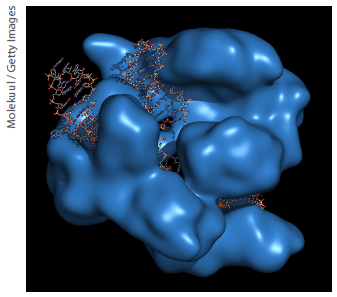
Scientists from the University of Texas at Austin took an important step toward safer gene-editing cures for life-threatening disorders, from cancer to HIV to Huntington’s disease, by developing CHAMP, which stands for chip-hybridized association-mapping platform. It repurposes next-generation sequencing chips to enable the massively parallel profiling of protein–nucleic acid interactions.
The scientists used CHAMP to provide the first comprehensive survey of DNA recognition by a type I-E CRISPR/Cas (Cascade) complex and Cas3 nuclease. CHAMP, the scientists showed, was able to simultaneously measure the interactions between proteins and ~107 unique DNA sequences.
“Analysis of mutated target sequences and human genomic DNA reveal that Cascade recognizes an extended protospacer adjacent motif (PAM),” wrote the authors of the article “Massively Parallel Biophysical Analysis of CRISPR-Cas Complexes on Next Generation Sequencing Chips,” which appeared in the journal Cell. “Cascade recognizes DNA with a surprising 3-nt [nucleotide] periodicity. The identity of the PAM and the PAM-proximal nucleotides control Cas3 recruitment by releasing the Cse1 subunit.”
Essentially, the findings led to a model for the biophysical constraints governing off-target DNA binding. This model, for example, suggests that Cascade pays less attention to every third letter in a DNA sequence than to the others. Knowing such rules could lead to better computer models for predicting which DNA segments a specific CRISPR molecule is likely to interact with. And that can save time and money in developing personalized gene therapies.