




Abstract

Recent research suggests that cfDNA tests are more accurate than standard noninvasive prenatal screening, at least for the main aneuploidies. They have a lower rates of false positives and a higher positive predictive value (PPV).
The PPV, or likelihood that a positive result on a test is a true positive, is an important measure for genetic tests. It is significantly affected by the prevalence of a disease in a population. This means that in a low-risk population, a greater number of positive test results will be false positives.
For example, the chance of a true positive result for Down syndrome in a 40-year-old woman undergoing prenatal screening is higher than the chance of a true positive result in a 20-year-old woman.
The low population prevalence of the deletion syndromes such as DiGeorge means that, at present, most of the cfDNA tests that cover them have very low PPV (~5%) and are very unlikely to produce a true positive result.
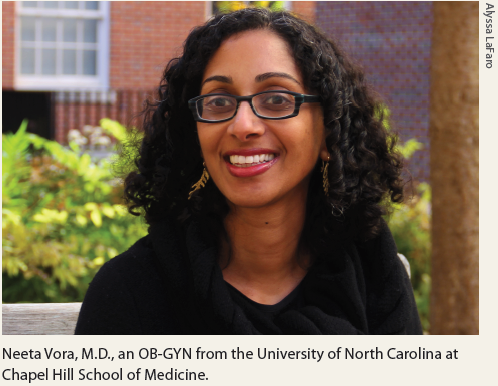
Neeta Vora, M.D., an OB-GYN from the University of North Carolina at Chapel Hill School of Medicine, has been working to improve the knowledge of both patients and providers about PPV and calculation of risk from cfDNA test results for a number of years.
Neeta Vora, M.D., an OB-GYN from the University of North Carolina at Chapel Hill School of Medicine.
Alyssa LaFaro
“What we found for many providers was that there was a misunderstanding about the difference between a diagnostic test and a screening test. A lot of providers thought that cell-free DNA was just as accurate as a diagnostic test and they were counselling patients that their fetus was affected. In reality, they all need confirmation with diagnostic testing because false positives and false negatives have been recorded,” she explained.
Dr. Vora’s Cell Free DNA Calculator can be found at: www.med.unc.edu/obgyn/Patient_Care/specialty-services/maternal-fetal-medicine/nips_calc.html.

This widespread lack of understanding is concerning considering that a 2014 study showed that 6.2% of women who received a positive cfDNA screening test had a pregnancy termination without confirming the results with a diagnostic test.
To combat misunderstanding and make it easier for patients and providers to interpret cfDNA test results, Dr. Vora and colleagues have developed an online calculator that takes into account a number of factors before calculating maternal risk for Down, Patau, and Edwards syndromes. These factors include maternal age and gestational age, as well as the type of test used (Harmony, Panorama, Verifi or Materniti21). It then calculates age-related risk, sensitivity (extent to which true positives are not missed), specificity (extent to which positives really represent condition of interest), and PPV.
In addition to PPV, other factors can also affect cfDNA test accuracy. These include the presence of placental mosaicism, where the placenta may have a genetic abnormality not seen in the fetus; high maternal BMI; multiple births and the presence of a disappearing co-twin.