




Abstract

Biometric data from higi will be integrated with clinical, claims, and genomic data from Interpreta under a partnership designed to enable physicians and insurers to create personalized-care “roadmaps” for patients.
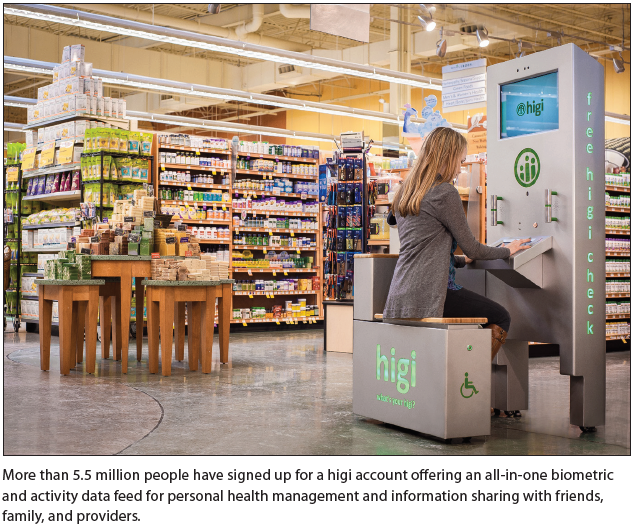
The partnership will rely on data collected by higi at its nearly 11,000 FDA-cleared, self-screening health stations—the largest such network in North America, the company says. The stations are designed to capture biometric data from shoppers at locations within food, chain drug, mass merchant, and club retailers.
According to higi, 78% of the U.S. population lives within 5 miles of one of its health stations, which have been used by more than 43 million consumers.
Data collected from those stations includes blood pressure, pulse, BMI, weight, body composition, and self-screening questions. Through the collaboration, that data can be accessed by users through higi’s mobile and web app, then interpreted and integrated with clinical, claims and genomic data in real time by Interpreta, a San Diego-based healthcare analytics company.
“Interpreta and higi hope to transform the way healthcare is delivered,” Interpreta CEO and cofounder Ahmed Ghouri, M.D., said. “In addition to bio-metric data, there is a strong thesis that continuous engagement with patients, outside of the 15-minute annual office visit, will provide a way for patients to stay aware of their health and for providers to stay in touch with them.”
More than 5.5 million people have signed up for a higi account offering an all-in-one biometric and activity data feed for personal health management and information sharing with friends, family, and providers.
Ghouri and Khan Siddiqui, M.D., higi’s CTO and CMO, said their companies aim to close gaps in healthcare by promoting greater engagement and sharing of data by physicians and their patients.
Interpreta and higi seek to help physicians and insurers create personalized-care “roadmaps” designed to inform decisions on patient care as well as increase physician engagement with those patients. The companies say the data is completely private, and exchanged only if patients choose to share it.
“Health plans and large provider groups currently use Interpreta to prioritize members, calculate gaps in care, predict and suggest opportunities for risk adjustment, and understand pharmacy-related opportunities for intervention. The addition of higi data for specific members and patients can further enrich and inform the analytics that Interpreta performs,” Siddiqui said. “In turn, higi provides the means to engage the consumer in retail to act on their personalized care roadmap, informing care decisions and more effectively closing gaps in care.”
Interpreta synchronizes clinical and genomics data from a variety of sources, including health plans, provider offices, pharmacies, labs, and molecular instruments.
“Interpreta and higi are unifying direct-to-consumer data and all traditional health data,” Ghouri said. “The massive growth of data and need for real-time interpretation is overwhelming providers who are already inundated by clinical priorities and ever-changing standards of medical practice, such as in genomics.”
Interpreta translates the data into action items, then orchestrates and advances care for provider organizations, with the goal of improving their pay-for-performance scores.
“Like computer-assisted flight guidance in space and aviation, increasingly, the physician and his/her team need real-time, dynamic systems to keep their patient population in flight and healthy,” Ghouri added.
By locating the higi stations at retail and adjacent to pharmacies, Siddiqui said, “higi has a unique ability to help its users connect to the products and services they need right at the pharmacy, which is increasingly becoming an important point of service for healthcare.

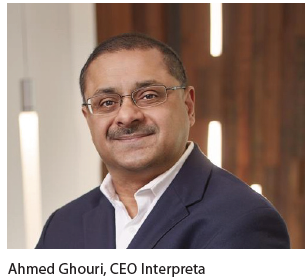
Ahmed Ghouri, CEO Interpreta
“These capabilities are important because very few people regularly visit a doctor’s office. It is much more convenient and less costly to go to the pharmacy or grocery store to access basic healthcare services,” he added.
A 2010 study by Booz & Co. (acquired by PwC in 2014) offered four advantages offered by pharmacists compared with physicians as deliverers of healthcare: greater contact and thus more trust; greater access; increasing services such as clinics on premises; and reduced costs.
Siddiqui added that higi is also expanding the location of its health stations to include employer work-places, community centers, places of worship, airports, senior living centers, and airports.
Founded in 2012, Chicago-based higi operates a community platform linking its health stations to more than 80 health devices, activity trackers, and apps. To date, higi says, its health stations have conducted more than 228 million biometric screenings, while more than 5.5 million people have signed up for a higi account offering an all-in-one biometric and activity data feed for personal health management and information sharing with friends, family, and providers.