




Abstract

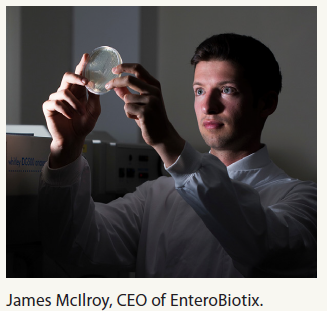
James McIlroy has still to complete his medical training at the University of Aberdeen, Scotland, but is already CEO of his own company EnteroBiotix. Speaking to Clinical Omics, he shared his motivations and inspirations.
“In 2013, I took a year out of medicine to study an Intercalated Degree at the University of Edinburgh. During that year, I became really interested in the bacteria that live on and inside of us.”
Inspired by the 2013 NEJM paper using fecal transplants to treat C. difficile infection, but disappointed by the methods he observed being used to carry out these procedures, McIlroy decided to take matters into his own hands.
James McIlroy, CEO of EnteroBiotix.
“In the hospital, I’d seen blood-derived products being ordered from the blood bank and I couldn’t understand why we didn’t have something similar in place for fecal transplantation. There was no licensed facility the doctors could order from. Also, it was administered through a variety of invasive medical procedures like colonoscopy, enema, and nasal duodenal tubing.”
He added: “I thought if we could encapsulate this and manufacture it in a facility that held a license by a competent authority, then we would solve a lot of problems for these doctors; hopefully treating a lot of patients and also potentially saving the [U.K.’s National Health Service] quite a bit of money.”
This led to the birth of EnteroBiotix. Several years down the line and a large amount of hard work later, the progress that McIlroy and his colleagues have made has recently been recognized by the injection of a £500,000 (US$655,652) seed investment.
The company is developing a closed system to allow processing and storage of fecal samples without exposure to the environment. “We plan to do that all within the collection device. This will allow us to process the sample in an oxygen-free environment and means we can add bugs in or add products into donations to knock certain bugs out,” explained McIlroy.
A secondary application the company is developing is a process that allows encapsulation of the fecal microbiome in a scalable and standardized manner.
“Our focus is on making fecal transplants as safe and effective as possible for patients and as accessible as possible for researchers that wish to use the results of successful fecal transplant studies to inform the design of their next-generation microbial therapies,” said McIlroy.
When asked about how EnteroBiotix fits into the microbiome space, he commented: “There is a spectrum of different strategies that are being piloted and developed. Some companies are working on small molecules, some on defined cocktails of bugs and some on single strains. As far as I am aware, none of these strategies has successfully been through a Phase III clinical trial, however, which shows that the field really is in its infancy.”