




Abstract

New research published in PNAS on a critical step in DNA replication will provide new insights into a fundamental process of life and driver of many different diseases, including cancer.
“Previous studies have described how enzymes assemble and gather around DNA to prepare it for replication. Here, we describe what these enzymes do to DNA once they are in place,” says Huilin Li, Ph.D., a professor in the Center for Epigenetics at the Van Andel Research Institute and senior author of the paper “Cryo-EM Structure of Mcm2-7 Double Hexamer on DNA Suggests a Lagging-Strand DNA Extrusion Model.”
DNA replication is a tightly choreographed process that copies the genetic code, allowing its instructions to be passed on from one generation of cells to the next. In diseases like cancer, these mechanisms can fail, leading to uncontrolled or faulty replication with devastating consequences, noted Li adding that “how this complex process starts is not well understood at the molecular level. Our hope is that the more mechanistic detail we learn about how replication works, the better able others will be in developing new treatments for cancer and other diseases.”
Before replication can take place, a pair of structures, heterohexameric minichromosome maintenance (Mcm2-7) helicases, are assembled head to head on the DNA double helix as a double hexamer. They eventually separate into two functional helicases and, in the process, each push out one strand of the double helix. Later, when DNA replication starts, the two helicases each move on one strand of DNA in opposite directions to unwind the helix.
ttsz / Getty Images
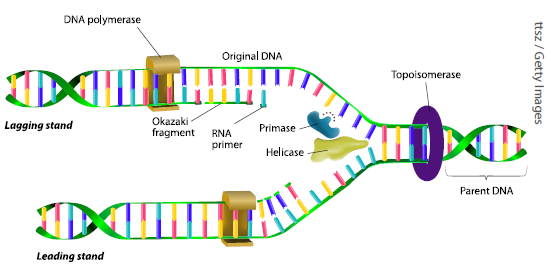
Computational rendering of the cryo-EM images revealed the 3D structure of these helicase enzymes. Imaging from the team’s study shows the helicase enzymes binding to 60 base pairs of the DNA double helix. Li likens it to a spring-loaded mechanism that puts pressure on either side of DNA, bending the helix into a zig-zag shape. This positions the DNA strands toward two side-way gates, ready to be pushed out in the next stage when the two Mcm2-7 hexamers disjoin, going opposite directions to “unzip” the double helix.
“These are processes at the very foundation of life that have largely remained a mystery to biologists since the discovery of DNA double helix more than 60 years ago,” said Li. “Thanks to technologies like cryo-EM, we are able to ‘see’ the operational mechanism in action, which gives us valuable knowledge to improve health for people around the world.”
The research is part of a long-time collaboration between Li, Cold Spring Harbor Laboratory, and Imperial College London.