




Abstract

Looking back to the publication of the first draft human genome in Nature and the official declaration of the completion of the Human Genome Project (HGP) 15 years ago, it is easy to overlook, based on the power of today’s sequencing technology, how monumental a task the project was when it was formally launched in 1990. Today, we take the prodigious power of next-gen sequencing for granted, but the human genome was assembled using trusty Sanger sequencing.
“In graduate school lectures I ask the students to imagine that there was no Internet or computers, or cells phones when we started,” said Richard Gibbs, Ph.D., founder and director of the Human Genome Sequencing Center (HGSC), established at Baylor College of Medicine, and one of the five sequencings sites worldwide funded for the HGP. “Then I show them pictures of some of the old sequencing machines where we could run 16 samples and have them divide 16 into 60 million, or however many [bases] it was we had to do, and they begin to understand.”
Jane Rogers, Ph.D., who rose to be head of sequencing at the Wellcome Trust Sanger Institute in Cambridge, U.K.—the single largest contributor to the HGP—put it a different way: “Nowadays, you assume you can sequence all four bases at a time. At that time, we were sequencing with primers and we were only essentially doing a reaction for one base at a time.” In the mid 1990s, many of the chemistries were also still being perfected. “When the terminators first came out, the chemistry and the enzymes weren’t particularly great. So we were doing all the separations on gels that separated 250 bases. We could run 36 lanes of 250 bases, in 12 hours,” she added. “It was slow.”
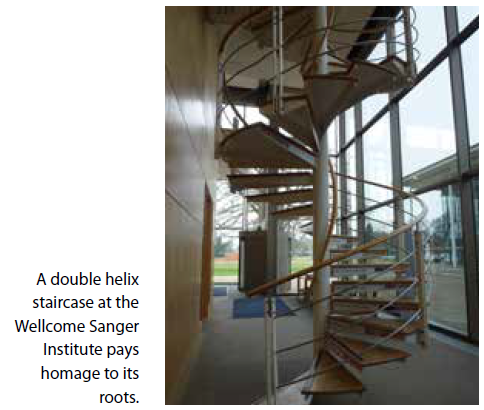
A double helix staircase at the Wellcome Sanger Institute pays homage to its roots.
With roughly 3 billion bases to sequence over the projected 15-year timeline, the sequencing centers of the HGP needed to adopt a production mindset—essentially turning their research facilities and campuses into genome sequencing factories. That’s how Elaine Mardis, Ph.D., currently co-executive director, Institute for Genomic Medicine at Nationwide Children’s Hospital in Ohio, became involved with the work at HGP consortium member Washington University, St. Louis.
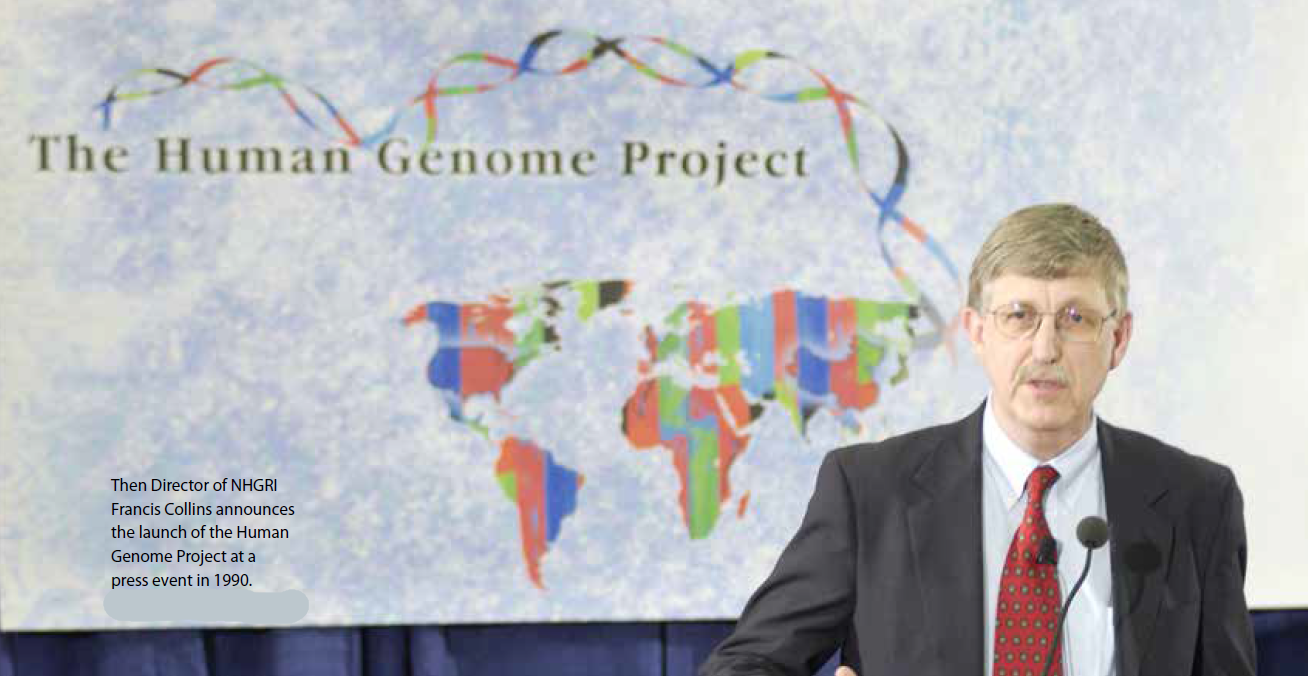
Then Director of NHGRI Francis Collins announces the launch of the Human Genome Project at a press event in 1990.
After working in industry for four years with Bio-Rad Laboratories, leveraging her experience in enzymology and DNA sequencing automation, Mardis was lured back to academia by Bob Waterston at Washington University in 1993. Waterston was just beginning his work to sequence the Caenorhabditis elegans genome and Mardis’ background in molecular biology and automation made her a top choice to scale up the university’s sequencing operation.
“Those were interesting days just because sequencing wasn’t a big industry like it is today. Mundane things that needed automation, like the ability to harvest plaques or colonies off plates, weren’t available as things you could buy, we had to build them,” Mardis said. “So, my early technology development group included engineers as well as molecular biologists who worked together to develop robotics and automation that were highly customized.”
Elaine Mardis, Institute for Genomic Medicine at Nationwide Children’s Hospital
Mardis’ activities in the U.S. mirrored the work Rogers was performing at the Sanger, whose founding director, the late Sir John Sulston, was collaborating with Waterston on C. elegans (work that earned Sulston a share of the Nobel Prize in 2002). For both institutions sequencing the model organism provided the ultimate springboard to working on the human genome.
“We had a sense of how important this work was—how having a completed C. elegans sequence gave a huge boost to researchers who now had a template to research their own specific [C. elegans] phenotype,” Mardis said. “We understood we were moving to a much more complicated organism, but that these same type of biological inquiries were going to be greatly accelerated through the human genome.”
Team of Rivals
In retrospect, it seems almost inevitable that as the HGP progressed there would be a splintering within the groups of scientists involved. For the HGP, that moment came along with the viability of whole-genome shotgun sequencing, which promised to significantly increase the speed of sequencing the genome versus the hierarchical sequencing method used by the publicly funded labs.
Mark Adams, Ph.D., director, microbial genomic services at the Jackson Laboratory’s genomics facility in Farmington, CT, was a principal investor for a pilot phase of the Human Genome Project in the mid 1990s at The Institute for Genomic Research (TIGR) alongside Craig Venter. Adams worked with Venter on TIGR’s work with expressed sequence tags (ESTs) and also on the landmark sequencing of the first bacterial (Haemophilus) genome in 1995—completed using shotgun sequencing.
Self-described as impatient, it seems natural that Adams would be drawn to a faster method of sequencing. “Around 1997, Craig and I had an acute appreciation for how difficult it was going to be to sequence the human genome. At the time we were making maps and working with Mel Simon’s group at Caltech—the originators of that BAC [bacterial artificial chromosome] technology, which was very good. But the map-making was difficult and the sequencing was very slow,” he said.
When PerkinElmer approached Venter and his team about setting up a private enterprise using its new automated capillary sequencing technology, the interest was palpable. “It didn’t take much convincing for me to see this would be a viable strategy that would be much faster, easier more amenable to automation and scale up and much more suitable to getting the sequencing done faster,” Adams noted.
Venter’s commercial ambitions were announce in a front-page New York Times article in May 1998 (the company and name Celera Genomics came later). Adams and others from TIGR also joined the company, as well as Gene Myers, Ph.D., a computational biologist from the University of Arizona, who one year earlier had co-authored a controversial commentary published in Genome Research singing the virtues of whole-genome shotgun sequencing.
There was rancor immediately within the sequencing community as Venter, an effective self-promoter, predicted Celera would sequence the entire genome in half the time as the international HGP consortium. From Adams’ view inside the walls at Celera, while the debate about the viability of shotgun sequencing had been percolating before Celera was formed, some of the resistance was grounded in the organizational structure of the HGP itself, which assigned individual chromosomes to specific sequencing operations.
“Shotgun sequencing is nicely designed for a single big production factory and a single big analytical engine to do the assembly,” Adams said. “That didn’t fit the model that NIH was funding, let alone one an international consortium could support scientifically. The shotgun sequence is simply difficult to allocate over a number of co-equal labs.”
In addition, the heavy private investment in Celera reignited fears about whether the company would seek to assert ownership over regions of the genome such as clinically relevant genes, which could restrict research. (Venter had courted controversy on the topic of gene patenting in previous spells at NIH and TIGR.) Celera suggested that while it would eventually release its sequence data to the public, early access would be afforded the privileged pharma companies willing to pay a hefty licensing fee.
Most researchers involved in the public genome effort were ardent in their commitment to create a free, open data source available to all scientists. Indeed, two years before Celera was founded, the group had taken the unprecedented step of agreeing to release all DNA sequence data by the project to a publicly accessible database within 24 hours of generation. The Bermuda Principles were developed at a 1996 project summit held in Bermuda with the backing of influential group members including Sulston. The principles went against the traditional grain of releasing data only after publication and set the stage for today’s pre-publication data releases.
These efforts helped established a balance between the forprofit and non-profit sectors seeking to extract value from the human genome whether purely financial or as the basis for additional public efforts like the HapMap Project. While not exactly by design, but also not left to serendipity, since the announcement of the HGP 15 years ago, the two sectors have achieved some measure of homeostasis.
“We should be grateful for the ways things have unfolded because, in fact, we have this very healthy tension between profiteering and biotechnology and free public data release,” noted Gibbs in a 2004 video interview with Cold Spring Harbor Laboratory. “So on the one hand we have this flood of data that anybody can get to, on the other hand we have some very successful biotechnology enterprises. So I think the system is actually working. It’s not perfect, but it’s not too bad.”
Venter’s love of genome sequencing hasn’t diminished over the past 15 years (Venter would say 17 years, referencing Celera’s genome report in Science in 2001). In February 2018, his colleagues at Human Longevity published a major report in Nature Genetics on regions of variability in non-coding DNA. We have taken “the next step in harnessing the power and possibility of the genome to benefit our understanding—and ideally eradication of disease,” said Venter.
A quest that will keep him and the other genome pioneers plenty busy over the next 15 years.