




Abstract
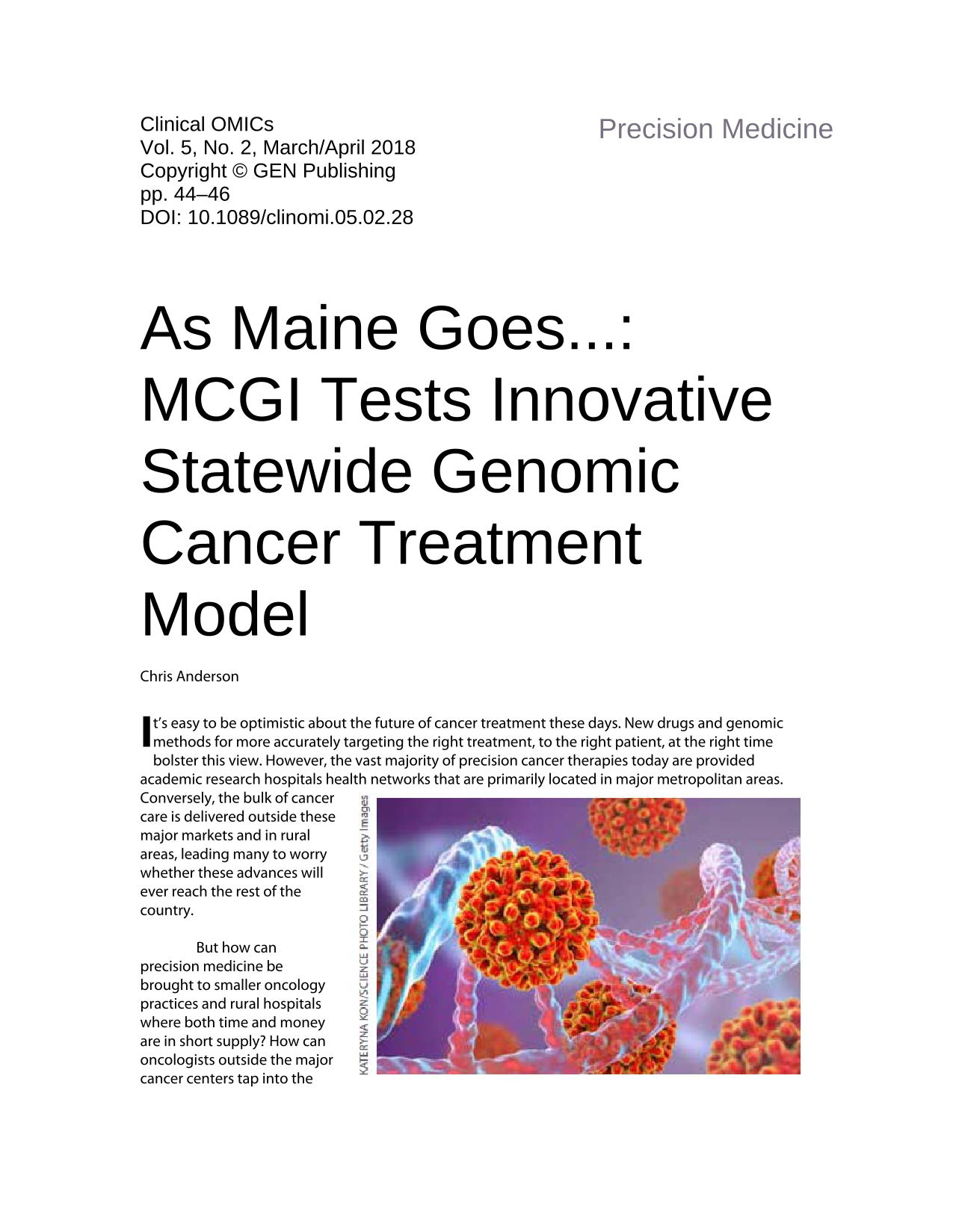
It’s easy to be optimistic about the future of cancer treatment these days. New drugs and genomic methods for more accurately targeting the right treatment, to the right patient, at the right time bolster this view. However, the vast majority of precision cancer therapies today are provided academic research hospitals health networks that are primarily located in major metropolitan areas. Conversely, the bulk of cancer care is delivered outside these major markets and in rural areas, leading many to worry whether these advances will ever reach the rest of the country.
KATERYNA KON/SCIENCE PHOTO LIBRARY / Getty Images

But how can precision medicine be brought to smaller oncology practices and rural hospitals where both time and money are in short supply? How can oncologists outside the major cancer centers tap into the specialized world of genomic cancer care? And how will the genomic testing be made available to cancer patients, when many insurers both public and private won’t pay for the?
Those are questions a year-old initiative called the Maine Cancer Genomics Initiative (MCGI) is hoping to answer. MCGI spans the entire state of Maine and is the brainchild of Edison Liu, M.D., CEO of The Jackson Laboratory (JAX). It is funded by roughly $12 million from JAX and an $8.4 million grant from the Maine-based Harold Alfond Foundation. MCGI’s mission is to provide 1,800 genomic tests, free of charge, to cancer patients across the state to help inform treatment decisions. The initiative is also serving as a petri dish of sorts to uncover potential methods for establishing a de-centralized model of care that can bring the latest in cancer care to areas not currently participating in the genomic medicine revolution.
“The challenge is health disparities. In the U.S. we have one of the greatest medical systems in the world, except most people don’t have access to it,” said Liu. “It is an implementation problem that we have, and I take what might have been considered a deficit of being in a rural, geographically dispersed state that has some very significant economic challenges, as an opportunity to experiment in what I consider to be the next important phase of genomic medicine.”
While JAX might seem a surprise player to be leading such a program, Liu considers this an advantage for potentially identifying a new care model since JAX doesn’t “have the institutional baggage” as established medical centers.
The program tested its first patient in July, 2017, and since then has enrolled more than 110 patients. Genomic sequencing is provided by the JAX genomics facility in Farmington, CT, using its ActionSeq Plus, a targeted panel of 212 cancer related genes and 53 genes known to form fusions. Data from each test and potential personalized therapy options are delivered back to the ordering oncologist in two to three weeks.
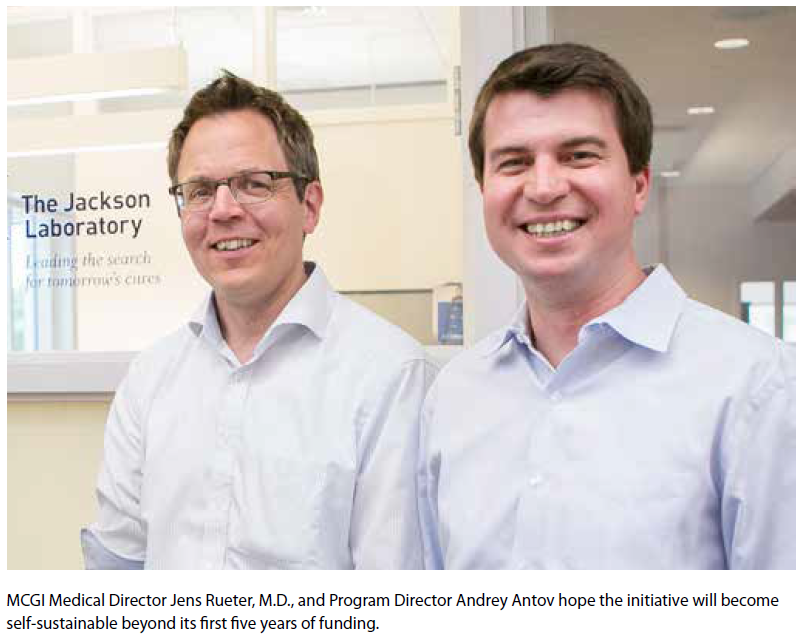
In order to ensure physicians have the support to make use of the data returned after testing, MCGI brought on board practicing oncologist Jens Rueter, M.D., as medical director, and Andrey Antov, Ph.D., as program director. Under their guidance, MCGI has built an infrastructure to provide the education, training, and expertise necessary for each doctor to implement genomics-guided cancer care.
Antov noted that it took a full year of development work to meet with the all the oncology practices and health systems in the state to get their buy in for participation.
“The first time you bring new technology to places, many want to see if it works and to understand it. We needed to educate a lot of the participants on the subject of clinical genomics and its applications,” Antov said. “All of a sudden the doctors are no longer only surgeons or oncologists, they become molecular biologists. They need to dive into the cell and understand how the molecules interact.”
MCGI Medical Director Jens Rueter, M.D., and Program Director Andrey Antov hope the initiative will become self-sustainable beyond its first five years of funding.
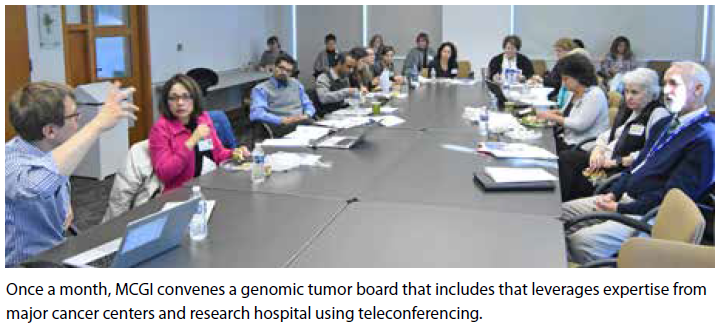
Central to the support provided to the community of oncologists in the program is a virtual genomic tumor board, which Rueter leads via teleconference every month. In addition to participating MCGI physicians, the tumor board leverages expertise from leading oncologists and researchers at national centers—such as the Dana-Farber Cancer Institute and Johns Hopkins—who can provide in-depth analysis and recommendations to their Maine colleagues.
“The idea is to build a new model of delivering information and having that discussion among the community,” said Rueter. “It is not just an opportunity to learn and to connect, but also to learn how to get in touch with other experts around the country, and how to access clinical trials. It opens up a lot of doors that likely would remain shut, because the doctors wouldn’t have the information.”
In addition, Rueter also works with a 16-member steering committee that provides advice from participants on how to continually improve the program. One member of that committee is Rueter’s former colleague Tony Harb, M.D., head of medical oncology and hematology at Eastern Maine Medical Center.
“Since the initiative started enrolling patients, we have been providing feedback about how it should be working from our clinicians’ view. That includes things that need to be corrected, or areas we think we should be spending more time on,” Harb said.
Harb regards JAX as a perfect partner for this kind of program, since it is a research organization and much of the work of MCGI is researching both patient outcomes and whether doctors use the resources provided by the initiative in their daily practice.
Once a month, MCGI convenes a genomic tumor board that includes that leverages expertise from major cancer centers and research hospital using teleconferencing.
“The other thing that is important is that [JAX] could bring everyone together,” Harb noted. “Before this initiative, there wasn’t a lot of interaction between the different hospitals and cancer centers in the state. Through this initiative, we have been able share more ideas and to interact with each other in ways we wouldn’t have without it.”
As Liu sees it, this is critical. “The natural tendency for [other organizations] would be to do a clinical study on the efficacy of the test itself. But with only 1,800 samples, there is no way to do that. The creativity we brought was understanding that is not the question. The question is: Is the community learning? Will we be more prepared three years from now than when we first started?”
Patients also play a critical role in the work of MCGI. In exchange for receiving the genomic testing at no cost, the patients are surveyed at enrollment and again later in their treatment. This helps the MCGI collect data on the patient experience, a critical component of value-based reimbursement schemes.
Currently, MCGI expects to remain active through the middle of 2021, though Rueter noted much of the last year will be devoted to collecting and analyzing data from both the patients and their doctors.
“Our goal is to make this sustainable over time,” Antov said. “We want to use the initiative as a platform for additional research projects and as a precedent that would change current practices and the barriers that exist for ordering genomics tests.”
For Liu, he sees the program as a proof-of-concept of how to properly leverage remote technology to speed adoption of genomic medicine. JAX may be uniquely suited to this challenge he noted, since its remote location in Bar Harbor, ME made it an early adopter of teleconferencing and other remote technologies. Baked into the organizational DNA of JAX is how to best leverage these technologies while also understanding their practical limits.
This is vital, if the model of delivering care is to be changed. “The truth is, healthcare as currently constructed, is not scalable, and unless you take advantage of some of these IT capabilities, it will never be scalable,” Liu noted.