




Abstract

LeoWolfert / iStock / Getty Images

Around the time the human genome was sequenced, Adam Margolin, Ph.D., was a student at The Wharton School who spent two summers interning at Bear Stearns. After the second summer, Margolin refocused his data analysis training to work with DNA sequencing data.
“I thought that the same types of approaches that I was being trained on, and could apply to analyzing hedge-fund data, or high-yield bond data, could be applied in a much more interesting, challenging, and meaningful way to analyzing data from cancer patients,” Margolin told Clinical OMICs. “Rather than try to predict the future appreciation of a bond, I could use the same types of approaches to try to predict the future severity of a cancer that can be used to gain insights that can help patients.”
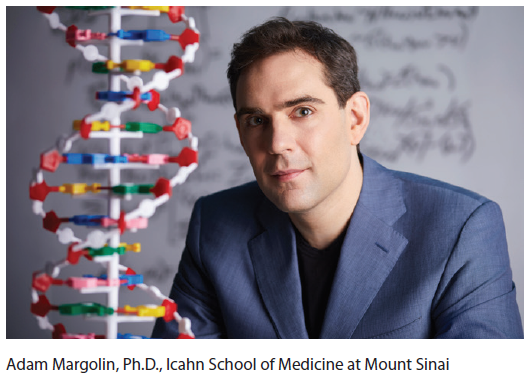
Margolin, a computational biologist, now pursues insights into cancer and other diseases at Icahn School of Medicine at Mount Sinai, which recruited him from Oregon Health & Science University. At Mount Sinai, he leads what is now the Icahn Institute for Data Science and Genomic Technology, formerly the Icahn Institute for Genomics and Multiscale Biology.
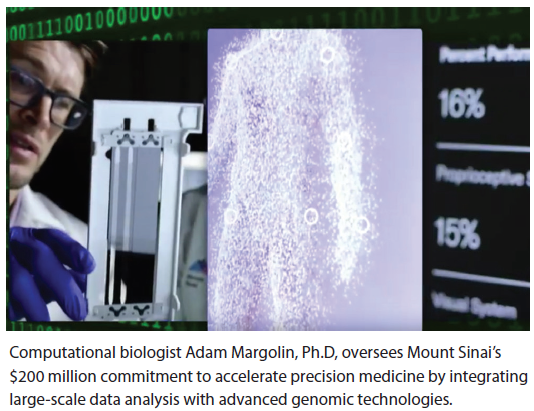
The renaming is part of a $200 million commitment by Mount Sinai to accelerate precision medicine by integrating large-scale data analysis with advanced genomic technologies.
“There’s an institutional commitment to really push the boundary on how we leverage large-scale datasets that will be emerging from studies all around the world, coupled with development of advanced genomic technologies for testing therapies, and use that as the basis of how we discover new breakthroughs going forward,” said Margolin, professor and chair of the Department of Genetics and Genomic Sciences and senior associate dean of precision medicine.
Multiple Challenges
Precision medicine, he asserted, poses multiple challenges that Mount Sinai intends to surmount. First is leveraging large-scale data to predict new therapies, and bringing them to patients quickly. Second is navigating the cultural change within research from individual projects to global teams working to analyze, integrate, and derive insights from data. Third is the need to add and improve computational hardware.
Data and implementation are as much challenges to precision medicine as science and research, said Harry Glorikian, senior executive, board director, and consultant in the life sciences/healthcare industry.
Despite claims about open data and interoperability, much of the healthcare data that exists is isolated in silos, said Glorikian, who detailed the impact of precision medicine on patients, in his book “Moneyball Medicine: Thriving in the New Data-Driven Healthcare Market.” He cited a recent article by Atul Gawande, M.D., in The New Yorker detailing how increasingly complex healthcare IT has upped the workload of physicians at the expense of patients.
“We need to have a reckoning about the state of healthcare IT and what we really need our IT systems to do,” Glorikian said. “Keeping the data in silos isn’t the answer, particularly without true interoperability or standards beyond FHIR [Fast Healthcare Interoperability Resources], but neither is an EHR that tries to do everything but fails to do any of it well.”
Among healthcare institutions effectively harnessing technology for precision medicine, Glorikian said, is Geisinger, a health services organization serving more than 1.5 million patients in Pennsylvania and New Jersey.
Geisinger’s MyCode Community Health Initiative has attracted more than 200,000 participants and returned actionable results to more than 1,000 patients for genetic variants that cause one or more of 25 conditions, including hereditary breast and ovarian cancers, cystic fibrosis, and cardiovascular conditions such as familial hypercholesterolemia.
Mendelian Precision
David H. Ledbetter, Ph.D., Geisinger executive vice president and chief scientific officer said health systems have found success in precision medicine—he prefers “precision health”—through specialization (see sidebar “At Inova, Precision Med Started with Baby Steps”). One approach emphasizes oncology, choosing the best drug based on a tumor’s genomic profile. Another approach focuses on pharmacogenomics.
Geisinger focuses on inherited Mendelian single-gene diseases where there’s an intervention known to improve patient outcomes.
“Not everybody’s interested in that group, because each disease is individually rare,” Ledbetter said. “Collectively those rare diseases, we think, make up a significant minority of our healthcare population, and we can take actions to improve their outcomes and reduce mortality associated with some of these life-threatening conditions.”
Geisinger recently aggregated all two petabytes of its imaging data system wide, and has generated another one petabyte of genomics data from sequencing almost 100,000 Geisinger patients through its DiscovEHR collaboration with Regeneron Pharmaceuticals, launched in 2014. In May, Geisinger began offering patients DNA sequencing as part of routine clinical care.
Adam Margolin, Ph.D., Icahn School of Medicine at Mount Sinai
Geisinger’s staff includes some 15 M.D./Ph.D.–level research faculty, four M.D.–level medical geneticists, two lab genetics experts, and 25 genetic counselors, including Erica Ramos, president of the National Society of Genetic Counselors (NSGC), and her successor, president-elect Amy Sturm. Totaling the costs of recruiting professionals and capital investment, mainly around its biobank launched in 2007, “we’ve probably invested around $50 million over the period,” Ledbetter said.
“At the same time, we’ve leveraged those people and expertise and infrastructure to where we now receive external grants and contracts from NIH and other federal funding of about $45 million a year. A large portion of that is related to our data resources and our genomics resources and expertise.”
Upscaling and Recruiting
Margolin said Mount Sinai plans to scale up its supercomputing capacity, deploy advanced computational and data science approaches, and develop a hybrid model of on-premise and cloud-based resources.
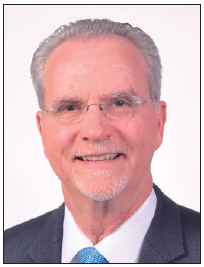
David Ledbetter, Ph.D., EVP and CSO, Geisinger Health.
Over the next decade, Mount Sinai also plans to recruit 30 tenure-track academic faculty focused on data science and developing and applying genomic technologies toward precision medicine. In addition, it will add 25 professional-staff data scientists who will lead projects to interpret large-scale biomolecular data, and launch cross-institutional, cross-disciplinary projects to discover new precision therapies in core disease areas.
The added staff are also expected to build computational infrastructure to enable integration and analysis of data throughout and beyond The Mount Sinai Health System—which includes the Icahn School, seven hospital campuses, more than 7,000 primary and specialty care physicians, and 12 minority-owned free-standing ambulatory surgery centers. Staff scientists will also build technology platforms for molecular profiling and therapeutic testing; and launch programs to train Ph.D.–and Masters–level students in biomedical data science.
Recently hired faculty members include Alexander Tsankov, Ph.D., formerly of The Broad Institute of MIT and Harvard; and Laura Huckins, Ph.D., an expert in psychiatric genetics, who was named an assistant professor in genetics and genomic sciences. More faculty will be hired in coming months, Margolin said.
Also newly appointed is Joseph Finkelstein, M.D., Ph.D., who oversees Mount Sinai’s research-related IT needs as chief research informatics officer and senior associate dean at Icahn School of Medicine.
Margolin said Mount Sinai will work comprehensively on all diseases—mostly complex diseases, but also continuing research on rare diseases. Also, each year one disease area will be selected for a concerted cross-institutional effort to drive a key question and advance research in that area, using big data and genomic technologies.
“The first one that we’re doing, starting in 2019 will be in cancer,” he said. “After that, we likely plan to launch priority initiatives in immunologic diseases, brain diseases, cardiovascular diseases, among others.”
Multiple Cancers
Mount Sinai plans to focus on multiple cancers based on criteria now being finalized, he said. Those include clinical need, the ability to impact patient care, institutional strength in a given cancer type, and ability to access biological samples.
“One area that we are quite strong in and we’ll pursue is multiple myeloma. Beyond that, we’ll choose to prioritize a few more cancer types that we will really want to make a focused effort to advance,” Margolin added.
Margolin started at Mount Sinai April 1, inheriting positions held by Eric Schadt, Ph.D., founder and CEO of Sema4, a molecular testing company spun out of Mount Sinai. Sema4 collaborates with Mount Sinai on diagnostics, and genetic testing to give doctors information about risk of disease based on genetic information or disease diagnostics based on genetic information. Schadt remains at Mount Sinai as dean of Precision Medicine and professor of Genetics and Genomic Sciences at the Icahn School of Medicine.
Computational biologist Adam Margolin, Ph.D, oversees Mount Sinai’s $200 million commitment to accelerate precision medicine by integrating large-scale data analysis with advanced genomic technologies.
Under Schadt, the precision medicine program was recognized as one of the world’s 10 most innovative data science organizations by Fast Company. Mount Sinai’s genetics department rose to fourth in the nation in NIH funding.
The precision medicine program also began leveraging big data in biomedical research, and built the Minerva supercomputer, among the largest supercomputing facilities of any U.S. academic medical center. Minerva has more than 12,000 compute cores, a number Margolin said will be expanded significantly.
“Eric Schadt contacted me when he knew he would be transitioning to Sema4 and was looking for people who could succeed him. He knew about my work and thought that I might be a good person to carry on what he built before me,” Margolin recalled. “We always shared the same philosophy of promoting open science and trying to push the boundaries of big data as applied to medical research.”