




Abstract

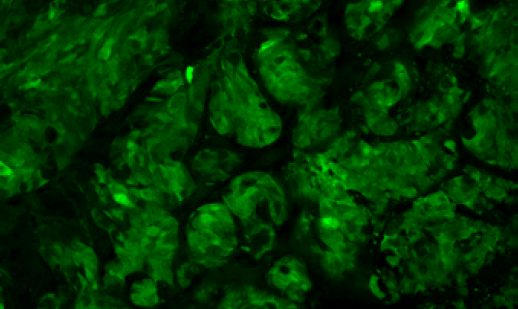
Confocal microscopy image of a metastatic estrogen receptor positive patient-derived xenograft genetically tagged to express green fluores-cent protein constitutively.
For nearly fifteen years, Michael Lewis, Ph.D., professor at Baylor College of Medicine, has been collaborating with his colleagues to create patient-derived xenograft (PDX) breast cancer models. Baylor College of Medicine is a member the PDX Development and Trial Centers Research Network, which the National Cancer Institutes launched in 2017 to accelerate translational research.
Now, Lewis and his colleagues have more than 70 breast cancer models at Baylor that represent the diverse patient population the institution serves, with approximately half being of Hispanic origin, a quarter African-American, and a quarter Caucasian. James Rae, Ph.D., associate professor of pharmacology, University of Michigan, said that Lewis makes the models “readily available to all of us in the community” and that they are “a great resource.”
The purpose of the models is to essentially replace patients in early-stage drug development and help identify which drugs should move into clinic, Lewis explained. “We’ve shown that a lot of the biology of the tumor of origin is recapitulated in the PDX, including genomics, transcriptomics, proteomics, histology, and biomarkers. Those kinds of things don’t change when you take the tumor from people and put them into mice,” he said. “We can demonstrate that whatever grows, arose from the tumor that we transplanted because we can do genetic fingerprinting, and then we follow it over time and make sure that that fingerprint doesn’t change.”
To share these models with the research community, Lewis and his colleagues launched the PDX portal in April 2019. The PDX portal is a website that features dozens of PDX breast cancer models and the models are annotated with various demographic and clinical information, such as age, race, hormone receptor, and stage. “This will allow anybody in the world who has access to the Web to browse our collection of PDX models that we’re able to make public,” he said.