




Abstract

The revolution in DNA sequencing over the past two decades has transformed our understanding of the human genome. But the Holy Grail of linking genotype to phenotype and elucidating the role that human genetics plays in complex diseases still evades researchers. A new initiative—the International Common Disease Alliance (ICDA)—hopes to make a difference. Formed over the past 12 months and launched in late September with a meeting in Potomac, MD, co-hosted by the National Institutes of Health, the alliance vows to use “human genetics to propel the understanding and treatment of common diseases.”
Eric Lander, Ph.D., president and founding director of the Broad Institute and a co-chair of the ICDA Organizing Committee, described the ICDA as “people coming together to identify the roadblocks to progress in the field.” The current plan is to organize meetings to bring the community together, define barriers to progress, identify opportunities for new projects, organize working groups to drive progress, and so on. The goal is to define the barriers to progress, propose solutions (including new technologies and scientific methodologies), coordinate with funders, and engage with both the international scientific community and the general public. Indeed, the launch meeting brought together stakeholders across academia, medicine, tech and biopharma companies and biomedical funders, with representation from 19 countries, and six continents.
Mark Daly, Ph.D., director, Institute for Molecular Medicine Finland

There are 83 founding members of the ICDA who have worked together to define the ICDA's vision and launch. The overarching goal is summarized in the ICD slogan: “From maps to mechanisms to medicine,” which isn't wildly different from other maxims such as “from gene to drug” or “from bench to bedside”.
The ICDA says it has working groups focused on topics such as learning from human cohorts; developing general approaches for connecting variants to genes, cellular pathways, and molecular mechanisms; advancing disease-specific methodologies to prioritize drug development targets; and addressing issues of data access, security, sharing, and ethics.
“Rather than a project,” declared Mark Daly, Ph.D., director, Institute for Molecular Medicine Finland and former co-director of the medical and population genetics program at the Broad, “we see ICDA as an ecosystem that could support, and ensure interoperability between, many critical activities that will help us overcome traditional barriers to progress in moving from maps to mechanisms and ultimately to medicine.” He added that “whatever activities ICDA does decide to advocate for the development of will come from consensus among a diverse community of geneticists—rather than a top down, monolithic edict.”
Nipitpon Singad / EyeEm / Getty Images

Some have their doubts
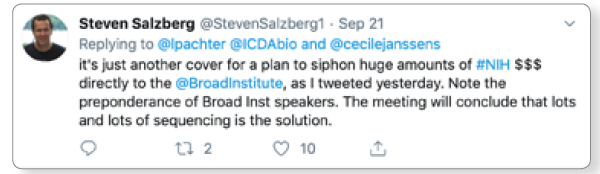
The ICDA's “Maps to Mechanisms to Medicine” tagline is reminiscent of earlier projects born out of the Broad Institute that have attracted a considerable amount of federal funding. In fact, Steven Salzberg, Ph.D., Bloomberg Distinguished Professor of Biomedical Engineering at Johns Hopkins University, tweeted that the ICDA is “just another cover for a plan to siphon huge amounts of NIH funding directly to the Broad Institute.” One tweet noted a “preponderance of Broad Inst speakers” at the launch meeting and predicted it would conclude with “lots and lots of sequencing” as the inevitable solution.
Steven Salzberg, Ph.D., Bloomberg distinguished professor of Biomedical Engineering at Johns Hopkins University took to Twitter with his skepticism of the formation of ICDA.

Salzberg is not wrong that the ICDA and the Broad are closely linked. All but one of the five members of the “executive office” work at the Broad. The fifth executive office member, who is not associated with the Broad, is Cecilia Lindgren, Ph.D., professor of genomic endocrinology & metabolism at the University of Oxford.
Lander dismisses Salzberg's criticism. “The ICDA isn't spending any money except [to] host meetings and write papers,” he said. Lindgren told Clinical OMICs that the launch meeting attendees paid for their own accommodations. Lander says that they want to host meetings and talk about science. “That's it.”
But Salzberg contends that the ICDA seems a lot like the International HapMap and the Encyclopedia of DNA Elements (ENCODE) projects of a decade ago. According to Salz-berg, these are all “clever and well described schemes to generate lots of sequence data” that result in padding the Broad Institute's pockets. Indeed, the Broad is one of the top recipients of NHGRI funding.
Eric Lander, Ph.D., president and founding director of the Broad Institute and a co-chair of the ICDA organizing committee, describes the ICDA as “people coming together to identify the roadblocks to progress in the field.”

Salzberg is not suggesting that big biology projects do not have value and agrees that some good may come from these projects. But he said, “if you want to understand disease, the community is filled with scientists with the same goals. This is already happening.” And, he wonders if the millions of dollars that could otherwise be used to fund 15-20 individual investigators is worth potentially losing to this type of endeavor.
Lander told Clinical OMICs that the “ICDA is not asking for money and will not be asking for money.” They want to exchange ideas on using human genetics to propel the understanding and treatment of common diseases and to share bottlenecks and opportunities. The product, Lander asserts, is “clear thinking” that others may build on to create projects. The ICDA does not have large projects but rather, aims to create a vibrant ecosystem. And while many agree that the need to go from maps (or sequence) to mechanisms is a crucial next step in genomic medicine, time will tell what role the ICDA can and will play in that transition.