




Abstract

In a surprising result, a new clinical genomic trial in neonates in the NICU setting found no major difference in the diagnostic rate between whole-genome sequencing (WGS) and whole-exome sequencing (WES). The randomized clinical study, “A Randomized Controlled Trial of the Analytic and Diagnostic Performance of Singleton and Trio Rapid Whole Genome and Exome Sequencing in Ill Infants,” found that while WGS was technically more complete and accurate than data provided by WES, the two methods were equivalent in terms of the diagnostic rate—approximately 20% of the neonates tested in each group received a genetic diagnosis.
Additionally, the time to diagnosis was the same, approximately 11.8 days. The paper was published September 26, 2019 in the American Journal of Human Genetics.
“We are at an early stage right now in terms of international implementation of genome sequencing as part of the care of acutely ill infants who are hospitalized and might have a genetic disease,” said first author Stephen Kingsmore, M.D., president and CEO of the Rady Children's Institute for Genomic Medicine (RCIGM), which was established as a pediatric research institute within Rady Children's Hospital in San Diego. “People have been doing it in different ways and there has not been a consensus if there is a single best method nor how best to use this new exciting technology.”
This new research is the first report of the second study in the NIH Initiative called Newborn Sequencing Genomic Medicine and Public Health (NSIGHT). NSIGHT is composed of four separate research projects, including RCIGM's project, “Clinical and Social Implications of 2-day Genome Results in Acutely Ill Newborns.” This trial, known as NSIGHT2, focused on babies immediately admitted to NICU centers within the Rady Children's Hospital San Diego (RCHSD) system.
Dr. Stephen Kingsmore stands outside Rady Children's Hospital in San Diego, which he has helped turn into one of the leading centers in the world for diagnosing critically ill newborns using whole-genome sequencing.

“In this study, we wanted to use a genome test as early in the hospital course as possible,” Kingsmore added. “If you're using a genome as a test of last resort, it's not going to change treatment that much, so we wanted to test babies very soon after admission to the NICU.”
For RCGIM's research, all babies within the Rady Children's NICU system were screened for inclusion as an attempt to generalize any findings to the NICU setting at large. For that purpose, over a 15-month period between 2017-2018, all babies admitted to the NICUs were screened for trial inclusion. In total, 1,248 babies were screened during that time and 578 infants (46%) were deemed eligible for study inclusion. To be included, infants had to have been admitted to a NICU within the past 96 hours or within 96 hours of a new clinical finding.
Sharon McCutcheon / Unsplash

Nearly one-third of eligible participants, or 213 infants, were enrolled in the trial. However, 24 babies (11% of the total enrolled) were deemed extremely ill and received ultra-rapid WGS instead of randomization. The remaining 89% of the enrolled infants were tested with WGS (94) or WES (93).
Superior WGS analytic performance
By multiple measures, data provided by WGS was significantly more complete and more accurate than that from WES. Whole-genome sequencing compared to whole-exome sequencing resulted in 12% more coding variants, 37% more variants of types likely to have a functional affect or be the cause of disease, and 6.5-fold more variants with splice-altering consequences.
“And we found twice as many variants as were in the database of variants that we all use of known pathogenic or likely pathogenic variants,” said Kingsmore referring to ClinVar P and LP variants. “It's important to note WGS was superior across all measures compared with WES in this study because there has been debate whether they are the same or is one superior over the other.”
Commenting on that debate, Heidi Rehm, medical director of the Clinical Research Sequencing Platform at the Broad Institute, and chief genomics officer at Massachusetts General Hospital said, “For detecting most coding sequence variants, exome sequencing should be sufficient, but there are regions of the coding sequence that are more difficult to cover with exome sequencing because of GC richness.” She is referring to variants such as in Exon 1, the start of the gene, which tends to be GC rich. “The GC rich areas are more difficult to sequence by hybridization capture methods, which is what exome is. In comparison, PCR-free genome platforms aren't subject to that issue of GC richness so there is more even coverage.”
A nurse tends to a newborn at Rady Children's Hospital in San Diego
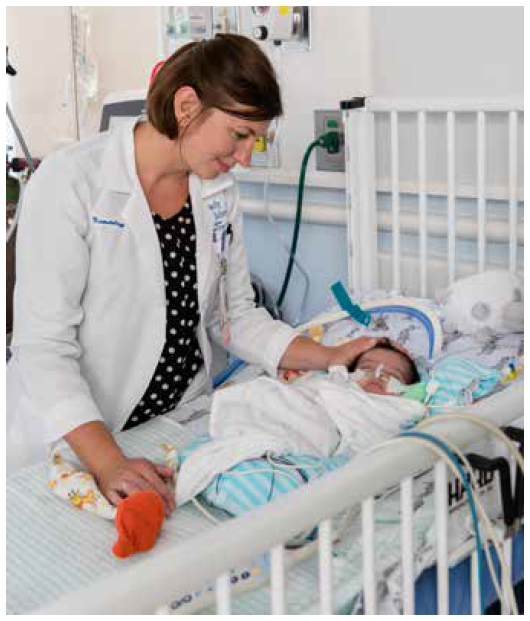
Looking to the larger world of genomic testing, Rehm cautioned that “not all genomes are created equally right now.” Quality can differ depending on the site performing the testing. “For example, they may or may not have structural variant quality and most have not implemented triplet repeat expansion (TRE) testing.”
TRE testing involves detecting a stretch of 3 base pair repetitions which are susceptible to expansion, ranging from a handful of repeats to thousands of repeats. Fragile X and a number of ataxia disorders are due to triple repeat expansions. “I do think that whole genome, for sure, will be the best platform for that.”
Genetic disease diagnosis
In total, 24% of the 213 enrolled infants (52) were found to have a simple genetic disease and a total of 54 genetic diseases were identified in the new study. If one assumes these 213 infants were representative of the 578 babies eligible for the trial, the team suggested that the prevalence of genetic diseases in infants in regional NICUs to be 14%. “This figure is higher than the proportion currently tested, and a lot higher than people would have suggested,” said Kingsmore.
Diagnosis rate and time comparable
Both WGS and WES had a nearly identical time to diagnosis of 11.8 days. But despite its superiority in terms of technical performance, the diagnostic rates were similar between those randomized to WGS and those who received WES. Eighteen of 94 babies (19%) tested with WGS had a genetic diagnosis compared with 19 of 95 infants (20%) receiving WES.
Mark Garlick / Science Photo Library / Getty Images

“This finding was surprising to us because previous studies have found genomes have a higher diagnostic rate than an exome, and our own study found WGS was superior in terms of analytic accuracy,” noted Kingsmore, who attributed this finding to the small study size. The authors referenced four other studies comparing WES and WGS finding a 4% to 7% increased diagnostic difference with WGS. “Our study was not powered to identify such a change,” he said. It should be noted that the overall trial's primary endpoints are not diagnosis rate or time to diagnosis but acute clinical utility and outcome (1-year survival) which will be reported at a later time.
Other researchers in the field are not as surprised by the comparable diagnosis rates, though.
“I'm not terribly surprised that exome and genome sequencing were similar in this context,” said Robert Green, M.D., of the Brigham and Women's Hospital and co-leader of the BabySeq Project, another NSIGHT project, which focuses on genetic testing of healthy newborns. “Most of the population we are dealing with mostly have Mendelian disease which involve changes in the genes and the exome sequences all of the genes, it's the working part of the genome.”
Green does, however, find it impressive that the percentage of babies diagnosed in either arm is around 20%. “That is remarkable that using either exome or genome they were able to get clarification of molecular diagnosis in one-fifth of the sick babies in the study,” he said. “If you think of all the diagnostic testing we do, if you had a test that gives you the answer in one-fifth of the time, that's incredible.”
Singleton and trio testing roughly equivalent
The study also compared singleton testing of the infant and trio testing of infant, mother, and father. Earlier studies from the Kingsmore group suggested that genetic testing in the neonatal setting should include trio testing. In this study, however, the research team discovered only a 1% difference between singleton infant testing and trio testing. “From this study, it's probably not worthwhile in most children to do a trio. The additional cost is not going to be matched with a higher diagnostic rate,” added Kingsmore.
Ultra-rapid whole-genome sequencing superior
In those 24 critically ill infants tested with ultra-rapid WGS, 11 (46%) were found with a simple genetic disease, which is more than double the diagnostic rate in WGS or WES, though this was not unexpected since these babies were sicker, more were receiving antibiotics, and they had a higher short-term death rate than other babies in the trial. The time to result was also much faster; 2.3 days compared with almost 12 days. “There are fewer steps in genome sequencing because you don't have to do a capture step like in exome,” said Rehm. “You could argue that it is going to be the more rapid turnaround time for that reason which is why the ultra-rapid protocols are done on genomes.”
Heidi Rehm, medical director of the Clinical Research Sequencing Platform at the Broad Institute, and chief genomics officer at Massachusetts General Hospital

“The ultra-rapid WGS is the way to go in our opinion. Focus on that technology and get a two- to three-day turnaround for every baby,” said King-smore, who added his own institution's data within the Rady Children's community includes an average turnaround time in July and August of this year of 60 hours and 58 hours, respectively. “We have demonstrated that ultra-rapid WGS, when performed as a first-tier test completed in about 58 hours provides early diagnostic information that may lead to improvements in clinical management of seriously ill babies very early in life when it could yield significant, or life-saving outcomes.”
Added Rehm: “I do think the ability of their platform to turn this these tests around more rapidly is both innovative and important for our field pushing it further,” referring to Kingsmore's team's success creating ultra-fast genomic technology. “Their focus on rapid turnaround time is really important.”
Towfiqu Photography / Moment / Getty Images

But in the everyday NICUs around the country, cost remains the reason why exomes are mostly ordered over genomes. “They are just about as good and they are about cheaper,” said Green. “In general, an interpreted exome is somewhere around $800-1,200. An interpreted genome is $1,000-2,500; a step up for sure.” And regardless of the type of sequencing used, Green attributed cost as “one more piece of evidence in a medical care system that has been extraordinarily slow to acknowledge the power of genomic sequencing, and to make arrangements for reimbursement.” In this trial, Kingsmore confirmed that the cost of WES per patient was $1,500 less costly than WGS.
Although it was not possible at the time of the study to perform ultra-rapid WGS on all infants, the Illumina sequencing technology Rady's has used for a number of years for this work has progressed to where the cost of an ultra-rapid WGS is the same as a WES in Kingsmore's experience. While this study did not involve babies randomized either to ultra-rapid WGS or WES, Kingsmore suggested this type of direct comparison is warranted.