




Abstract
In one of the largest studies of its kind, a research collaboration led by the University of Adelaide has confirmed earlier findings that around 14% of cerebral palsy cases could be genetic in origin.
The researchers carried out exome sequencing on 250 samples from cerebral palsy children and their parents and compared the sequences to those of 1,800 control families without the condition. The team identified eight genes that contained multiple spontaneous mutations in children with the condition. Two in particular, TUBA1A and CTNNB1, had genome-wide significance.
Overall, the analysis confirmed that around 14% of cases of cerebral palsy could be genetic in origin. The team believes that around 12% of these cases are likely to occur spontaneously and around 2% could represent rare recessive mutations, which could also be causative for some cases of cerebral palsy.
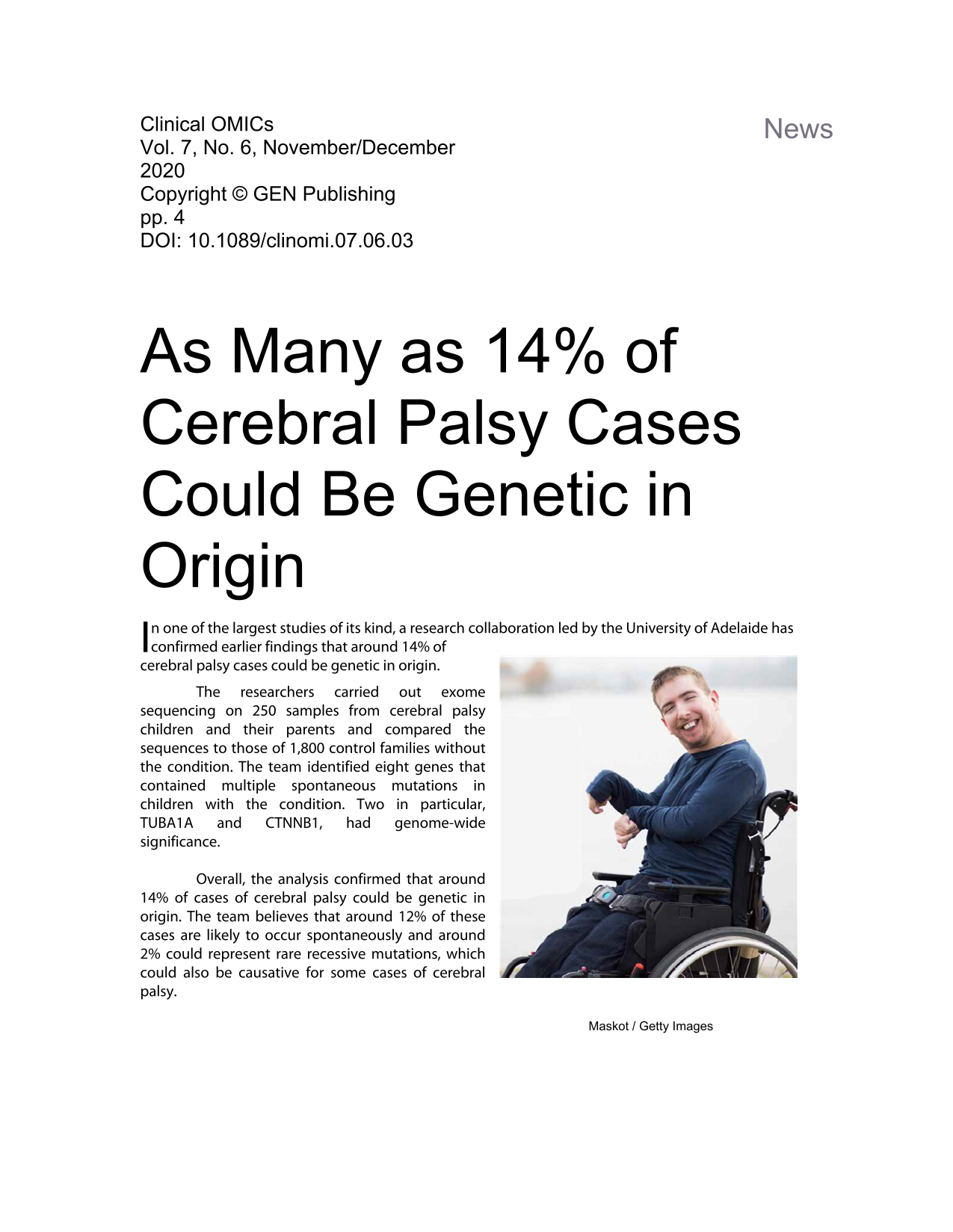
Maskot / Getty Images
