




Abstract
Abstract
1. Introduction
Utilizing a wide range of computational techniques, bioinformaticians analyze several different biological topics, they ask biological questions, and they bring computational solutions to them. Some of the topics investigated by bioinformaticians include analysis of genome/transcriptome sequence data, high-throughput sequences, gene expression data, structures of molecules, building protein-portein inteactions, and analysis of gene expression regulation and cellular processes such as transcription and alternative splicing. Through these analyses, bioinformatics, as an interdisciplinary field, has greatly influenced the development of biomedical sciences in general.
Bioinformatics has an increasing impact on biomedical sciences and thus on societies. By establishing the very first international conference in bioinformatics education, organizers of Research in Computational Molecular Biology (RECOMB) Bioinformatics Education (BE) initiated a timely discussion among prominent educators and reserachers in the field (RECOMB-BE, 2009). Current bioinformatics education curriculum covers, in general, the fields of computer science, molecular biology, systems biology, applied mathematics, and statistics. Depending on the degree offered, the courses are either spread over 4 years as part of an undergraduate program, or they are covered at a higher level in a shorter period of time in a Master's or Ph.D. program. Participants of RECOMB-BE 2009 discussed the challenges in existing bioinformatics education, and organizers Pevzner and Shamir highlighted the main issue in the field, which involves incorporation of computer science components into undergraduate biology education (Pevzner and Shamir, 2009).
As evident from the outcome of RECOMB-BE 2009, researchers and educators in bioinformatics have generally been concerned with bridging the gap between biology and computer science. However, there has been very little attention devoted to ethics courses as part of the main bioinformatics education. In most programs, in both Europe and the United States, either there is no ethics component within the curriculum, or it is offered as a seminar or workshop instead of a full course. This is the case for both undergraduate and graduate bioinformatics education programs.
Integration of ethics components into bioinformatics education is becoming increasingly important with the emergence of the personal genomics era (Church, 2005; Personal Genome Project, 2010). Bioinformaticians from different parts of the world will soon have online access to enormous amounts of personal genomic data. They will gather, store, and analyze the raw data on personal genomes. The knowledge uncovered from these sequences will pave the way to further development of various aspects of biomedical sciences. High-throughput comparative analyses of genome data will ensure the increase of current scientific knowledge on genomic variation, and will help decipher the relationship of sequence variation with certain human diseases. Particularly, the data generated by the bioinformaticians will be applicable to personalized pharmacogenomics and personalized medicine. It is now recognized that bioinformatics is one of the key fields leading the way to personalized medicine. As Yang et al. (2008) point out, eminent institutions and journals in the field promote education in bioinformatics emphasizing its role in the development of personalized medicine.
Along with promised advantages, personal genomics brings certain ethical, legal, and social issues (ELSI). In recent years, ethical aspects of the research on whole genomes have been under consideration. One of the main issues is the privacy of the person whose genome is under investigation. Other issues include ownership of the sequence data, access to the data, potential (mis)use of the data, consent, confidentiality, and return of results. Intensive work on establishing ethical standards and initiating ethical regulations relevant to the personal genome data analysis is already underway (Caulfield et al., 2008; Manasco, 2005; McGuire et al., 2008; Wasson 2009). As genomics is an integral part of bioinformatics, ELSI relevant to the genome sequence analysis is directly of concern to bioinformaticians. Therefore, building awareness on such ethical questions must be incorporated into bioinformatics education. It is noteworthy that bioinformatics students currently being educated will be the ones facing different ethical challenges in the personal genome era, compared to those who graduated in the post-genome era and performed analyses on the Human Genome Project data.
Genome analysis is not the only part of bioinformatics requiring ethical attention. Several other ethical challenges arise when bioinformaticians face issues such as data security, personal data storage and transmission, data mining for personal knowledge discovery, error management in databases, patenting, open sourcing, and intellectual property. Unique ethical questions await bioinformaticians as well as those ethical issues, such as individual privacy, that have been addressed in other frameworks.
Here, a two-level analysis is presented. Firstly, status of ethics within bioinformatics research publications is assessed. Secondly, the curricula of a subset of existing undergraduate and graduate bioinformatics programs, both in Europe and the United States, are analyzed with regards to their ethics components. The results presented here point to the lack of emphasis given to ethics both within bioinformatics education and within bioinformatics research. In light of these findings, discussions on bioinformatics ethics as a separate field of study and on unique ethical questions relevant to bioinformatics are provided. In the face of the wide range of complex moral issues awaiting bioinformaticians, an urgent curriculum revision is proposed in order to incorporate ethics courses within bioinformatics education. Further, a template for an “Ethics in Bioinformatics” course is suggested.
2. Methods
2.1. (Bio)ethics and bioinformatics publications
National Center for Biotechnology Information (NCBI)'s PubMed database was queried using the search term set provided below (NCBI, 2010): Bioinformatics, Bioinformatics and ethics, and Bioinformatics and bioethics. Initial query was performed as follows: (“2000/01/01”[Publication Date]: “2009/12/31”[Publication Date]) AND (“bioinformatics”). The results reported in Figures 1 and 2 are obtained via queries such as the following: (“2004/01/01”[PDAT]: “2004/12/31”[PDAT]) AND (“bioinformatics”[All Fields] AND “ethics”[All Fields]). The same keywords were used to repeat the query on the database for each year between 2000 and 2009, inclusive. The query above was repeated for the keywords bioinformatics and bioethics, for the years 2000–2009, inclusive.

PubMed entries retrieved for “Bioinformatics and Ethics” query for the years 2000–2009, inclusive. (The y-axis denotes absolute numbers of publications.)
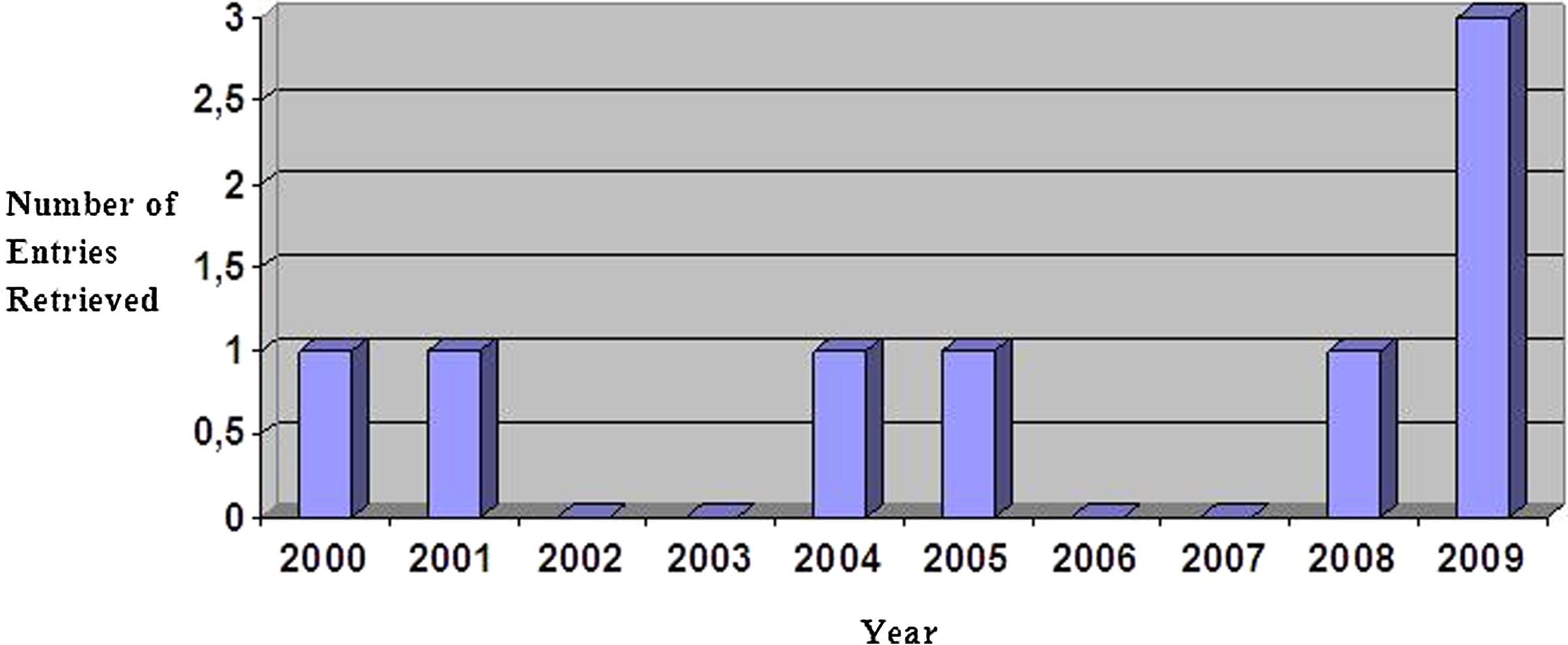
PubMed entries retrieved for “Bioinformatics and Bioethics” query for the years 2000–2009, inclusive. (The y-axis denotes absolute numbers of publications.)
2.2. (Bio)ethics component within bioinformatics curricula
A sample of undergraduate and graduate bioinformatics programs were selected from International Society for Computational Biology (ISCB)'s degree/certificate programs list (ISCB, 2010). A subset of programs from Europe and from the USA were included in the analysis. Those programs with online curricula have been screened for any (bio)ethics components. In this analysis, no distinction has been made between ethics seminars, short courses, compulsory courses, or elective courses. The information gathered is solely based on the latest postings on the program websites as of end of December 2009. Therefore, any ethics components of a given curriculum not listed online could not be identified. The programs analyzed have been randomly selected. 1
U, undergraduate level; M, Master's level; P, Ph.D. level.
3. Results
A query on National Center for Biotechnology Information's PubMed database reveals that bioinformatics and (bio)ethics together take up a very small percentage of bioinformatics publications available in this database through the years of 2000–2009, inclusive. Table 1 shows that when PubMed is queried for the keyword bioinformatics only, 19,569 entries are retrieved. Only 0.13% of all these publications discuss ethics, and only 0.04% of the total bioinformatics publications discuss bioethics (Table 1). (A total of six publications out of the eight retrieved for the bioinformatics and bioethics query are within the 26 publications retrieved for the bioinformatics and ethics query.) Figures 1 and 2 demonstrate the yearly distribution of the publications for the years 2000 through 2009, inclusive. As seen from these figures, the number of publications covering bioinformatics and ethics (Fig. 1) and those covering bioinformatics and bioethics (Fig. 2) has not increased during the last decade. It is evident that the analysis described in Table 1 and Figures 1 and 2 does not cover all the bioinformatics publications available in PubMed, given that most of the publications discussing bioinformatics analyses do not necessarily include the word “bioinformatics.” However, the queries are performed to illustrate the limited discussion of ethics within the context of bioinformatics research and publications.
The second part of the analysis included a brief survey of the ethics components of selected bioinformatics education programs. A limited number of undergraduate and graduate programs available in the United States and Europe were analyzed. The majority of the undergraduate programs analyzed do not inlcude an ethics component. Only two out of seven (29%) of the analyzed undergraduate programs mention ethics as part of their curricula. (Specifically, one out of six U.S. undergraduate programs, and one out of one European undergraduate programs investigated include an ethics component.) Here, an ethics component could be listed in any of the following formats: seminars, short courses, compulsory courses, or elective courses. Results are similar for graduate programs. Of the 14 programs investigated, only four (29%) of them include ethics within the education they provide. (Specifically, two out of eight U.S. graduate programs, and two out of six European graduate programs investigated include an ethics component.) Although preliminary, these results reveal that only a few undergraduate and graduate bioinformatics programs mention ethics within their curricula. Any ethics components embeded within the content of other courses of programs could not be identified in this study, as the analysis was solely based on the information available online.
4. Discussion
4.1. Lack of ethics within the framework of bioinformatics
The results presented here highlight the minimal number of research publications relevant to (bio)ethics and bioinformatics. These findings reveal the limited attention given to ethics in bioinformatics research presently. When the ethics education provided within the existing bioinformatics programs are analyzed, the minimal emphasis given to this component both in undergraduate and in graduate education is identified. These findings indicate the lack of emphasis placed on ethics within bioinformatics education presently.
In corroboration with the results presented here, several reserachers in the field have recently articulated the inadequacy of emphasis given to ethics within the context of bioinformatics. Goodman and Cava (2008) discussed the lack of importance placed on ethics regarding bioinformatics, particularly genome analyses. They identified many relevant ethical issues and called for attention of the researchers to these points. Some of the issues listed by Goodman and Cava (2008) include “privacy, confidentiality, practices for data management, appropriate users and uses, and error management.” In a recent publication, Marturano (2009) points to the same issue and states that “discussions of ethical tensions and public policy choices in this field have not yet fully emerged.” Marturano emphasizes the “urgent need for a serious debate in the field,” as he highlights “the range of ethical questions that bioinformatics opens up is very wide, as bioinformatics itself is a multidisciplinary field” (Marturano, 2009).
4.2. Major ethical questions relevant to bioinformatics
One of the major components of bioinformatics is genomics. There are several companies in the United States that currently provide personal genome sequencing at a certain cost. The report from the genome of the person who purchases this service is provided to the person only. In contrast, participants of the Personal Genome Project have their genomes published online (Personal Genome Project, 2010). As the bioinformaticians well know, the raw genome data might not require any ethical considerations. However, at the hands of a bioinformatician, a couple of genomes turn into very valuable information sources. Comparative analyses, along with experimental information, might reveal several sequence variations that could lead to deciphering information relevant to the physical and behavioral traits of an individual, their race, and their ethnicity. Do the bioinformaticians need to get consent from the individuals prior to their study? Do bioinformaticians have the responsibility to share the results of their research with the owner of the genomes? Do they have the right to publish results on an analysis performed on a personal genome? Are the ethical standards expected for bioinformaticians different than those who actually generate the sequence data? These ethical issues must be addressed, as the personal genomics era is here, and bioinformaticians have the necessary skills and education to uncover the information hidden in the personal genomes.
Ethical aspects of genome research, particularly whole genome analysis, have not received much attention until recently. However, with the emergence of personal genome sequencing, a whole new phase in genomics has emerged. In recent years, researchers started devoting attention to ELSI of personal genomics and proposing regulations in this field. Many scientists in genomics and medical communities recognize that personal genomics will bring several challenges to the society, and point to the possible ELSI that could arise due to personal genomics (Borry, 2009; McGuire and Burke, 2008; Patch et al., 2009; Gurwitz and Bregman-Eschet, 2009). The ethical challenges found in personal genomics directly translate to bioinformatics research and applications. Some of these ethical challenges, which are complex and various, include privacy of individuals, ownership of genome data, access and use of genome data, and genome patents. Hongladarom (2006) highlights genetic/genomic privacy as one of the main ethical concerns for bioinformaticians. Nonetheless, within the bioinformatics community, the ethics of genomics has not received the required attention.
Caulfield et al. (2008) organized a workshop to introduce a set of ethical guidelines for the field of whole genome analysis. Some of the ethical issues highlighted at this workshop included consent, right to withdraw from research, return of research results, and public data release. Caulfield and colleagues provide detailed recommendations to be considered for regulation of possible ethical issues involved in whole-genome research. In addition to consent, return of results to participants and potential use of the data pose certain issues. McGuire and Burke (2008) point to the importance of ethical considerations in whole-genome research, relevant to return of research indications to participants as well as participant's relatives, and the future use of data obtained. Such ethical issues and policies on the regulations of them are of importance to bioinformaticians as analyzers of the genome data.
In addition to ethical issues of genome analysis, several other ethical challenges face bioinformatics. These challenges have to do with the use of computer as the medium for biological data analysis from the human body, and with the magnitude of the analyses performed. For example, storage of personal data, access to this data, potential use of this data in different arenas, transmission of the data, security and confidentiality of personal data, data mining, and personal knowledge discovery about the individual are certain issues. On a larger scale information discovery about populations becomes an issue.
4.3. Ethics in current bioinformatics education
On one hand, as underscored above there are several ethical issues identified relevant to bioinformatics. On the other hand, there is a lack of attention devoted to ethics both in bioinformatics research and in bioinoformatics education. As presented in the Results section, the current status of ethics within existing bioinformatics education programs is minimal. There could be several reasons as to why ethics is not currently incorporated into the curricula of the majority of existing bioinformatics programs, both at the undergraduate and at the graduate levels. One of the main reasons could be the interdisciplinary structure of the program, which requires intensive education combining different fields in a limited amount of time. In fact, limited amount of time has been reported as one of the reasons for lack of ethics instruction within the curricula of other sciences, such as genetics (Booth and Garrett, 2004). Studies are underway to redesign certain science curricula in order to integrate ethics education. For example, Garrett and Triman (2009) offer extensive strategies for incorporating ELSI into undergraduate genetics curricula.
A workshop presented by bioninformatics educators and researchers could be held in order to devise strategies for integration of ethics courses both to undergraduate and to graduate bioinformatics education programs. Such an integration is already in place for the newly designed contemporary bioinformatics eduation programs. Authors discussing the curriculum design for contemporary bioinformatics education are in agreement that ethics should be a complusory and core component of education in this field. Gerstein et al. (2007) introduced the Yale perspective on graduate education in the interdisciplinary field of computational biology; students in this program are required to take one-semester of research ethics seminar. Altman and Klein (2007) introduced the Stanford program titled “Medical Information Sciences,” which covers fields including bioengineering. The curriculum has five core areas—“medical informatics,” “computer science,” “probability and statistics,” “domain biology,” and “ethical/legal/social implications”—and places importance on ethics. Hersh and Williamson (2007) introduced the first online medical informatics course and discussed in detail the curriulum for this program; one of the 12 units of the online portion of this course covers “Standards: privacy, confidentiality and security.”
4.4. Teaching ethics in bioinformatics
Due to the abovementioned ethical issues identified relevant to bioinformatics, and due to the current status of ethics within the bioinformatics programs, an overview of an actual course, “Ethics in Bioinformatics,” is presented here. It should be noted that there are already existing, effective “Ethics in Bioinformatics” courses that are being successfully taught in several institutions. University of Colorado, School of Medicine, Computational Bioscience Program's “Ethics for Bioinformaticians” course sets a good example (University of Colorado, 2010). Table 2 details the aims, description, learning outcomes, content, learning/teaching methods, and grading criteria and assessment, while providing a template for an “Ethics in Bioinformatics” course. The course proposed here is intended as a template to be tailored for develeoping either an undergraduate and/or a graduate course depending on the needs of specific institutions.
4.5. Differences of proposed ethics in bioinformatics course from ethics for biologists' courses
Although teaching and learning methods remain similar, an “Ethics in Bioinformatics” course is different from an “Ethics for Biologists” course in the topics that it covers. For instance, an “Ethics for Biologists” course includes topics such as reproductive cloning, genetically modified foods, gene therapy and clinical trials, experiments on animals, experiments on human subjects, human stem cell experimentation, experiments on aborted embryos or fetal tissues, patenting molecules, biological weapons, transgenic technologies, tissue engineering and regenerative medicine, and assisted reproduction, which are not imminently of concern for bioinformaticians.
On the other hand, there are topics unique to the “Ethics in Bioinformatics” course that relate to the analysis of human data on the computer. Such unique topics include ownership of personal biological data, storage and transmission of data, data sharing over the Internet, access and use of data, error management in data handling and processing, personal knowledge discovery from biological databases, deciphering information relevant to an individual's ethnicity, behavioral or medical traits, or a population's race and ethnicity.
There certainly remains an overlap. For example, genetic differences in various races is a topic covered in “Ethics for Biologists” courses and is expected to be of relevance to bioinformaticians, even though here scientists investigate this topic at different levels. Further, overlaps exist in other areas such as ownership. Tissue ownership could be an ethical issue for biologists, whilst ownership of sequence data is an ethical issue for bioinformaticians. Another example is genetic testing and screening, which could scale up to genomic testing and screening. As Goodman and Cava state (2008), “the magnitude of the effect of information technology” itself necessitates that concentrated attention is given to ethical questions relevant to bioinformatics. Uniqueness of the moral problems addressed by bioinformatics ethics and the necessity of the field will become apparent as more bioinformatics-related technologies have increasing impacts on the society.
4.6. Bioinformatics ethics
As previously noted by Hongladarom, “ethics of bioinformatics will undoubtedly emerge,” and it will entail the convergence of bioethics and computer ethics (Hongladarom, 2006). Here, a synopsis of bioinformatics ethics is presented to have three main components. As illustrated in Figure 3, it certainly covers some aspects of ethical issues both from biomedical ethics and from computer ethics. Additionally, this field covers unique ethical issues relevant to bioinformatics, which actually necessitates its existence (Fig. 3).
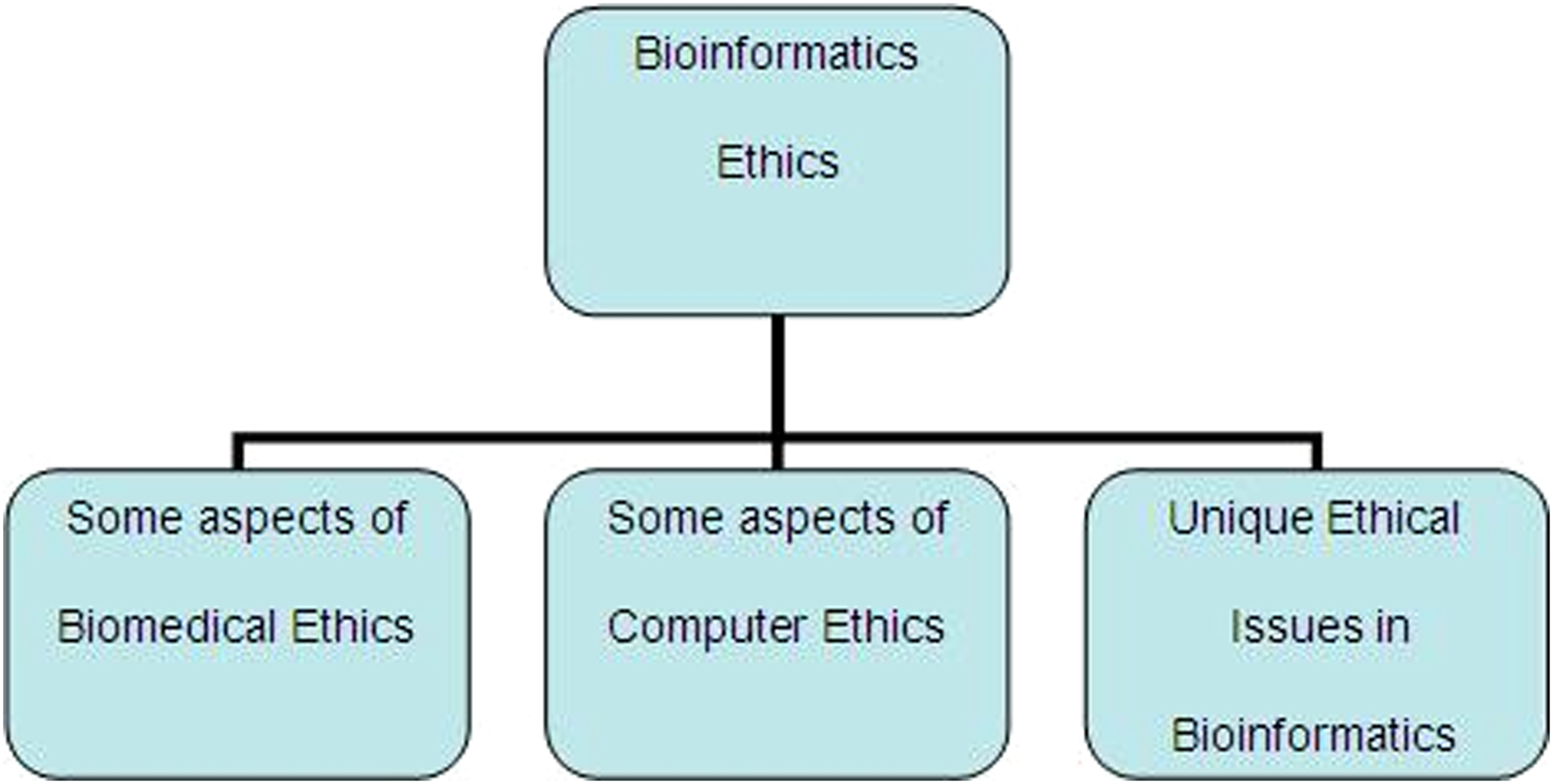
Bioinformatics ethics.
As highlighted in the previous section, an “Ethics in Bioinformatics” course is easier to define when compared to an “Ethics in Biology” course. However, when it comes to medical informatics ethics, health informatics ethics, or biomedical informatics ethics, identification of ethical issues unique to each of these fields becomes more difficult. The main reason for this is because “there is still no universally accepted definition of medical, health, bio- or biomedical informatics,” as stated by Bernstam et al. (2010). However, bioinformatics ethics is distinguished by a concern with a broader range of ethical issues based on its definition of “application of computational techniques to understand and organise information associated with biological macromolecules” (Luscombe et al., 2001). Just as applications of bioinformatics could range from basic science to medical applications, ethical issues of bioinformatics research also range widely. As seen in Figure 3, biomedical ethics is within the scope of bioinformatics ethics. There certainly is some overlap of ethical issues between (bio)medical informatics ethics and bioinformatics ethics, as well as unique ethical issues to both fields. Nonetheless, researchers in the field of bioinformatics recognize the need for specific ethical education for bioinformatics researchers (Hanes and Ramachandran, 2008).
Similar to the development of computer ethics, biomedical ethics or more specialized fields such as neuroethics and nanoethics, bioinformatics ethics is yet to develop as a philosophical field of study. Norms and frameworks will be established over the years tackling the ethical, legal, and social issues pertinent to bioinformatics. In parallel, teaching strategies and course contents will evolve. New cases are to be identified for discussion as the technologies in the field develop and their implications on the society increase. Presently, there is a lack of teaching resources. However, as the field develops and as more bioinformaticians and ethicists appreciate the importance of the field, resources such as articles and textbooks are going to be increasingly available. Even a new set of vocabulary could evolve as ethics in bioinformatics develop (Hongladarom, 2006).
In addition, teaching strategies and curriculum design for ethics courses in biosciences is still under debate. As suggested by Downie and Clarkeburn (2005), there is no single defined way for approaching ethics teaching within biosciences. This translates to bioinformatics as well, in that teaching strategies and course content are needed to be fit to the departmental goals. Therefore, the course content and teaching strategies presented here should merely be treated as an overview of what currently could be included in Ethics in Bioinformatics education.
5. Conclusion
It is better to set out the norms and framework for bioinformatics ethics as the technologies develop and issues are foreseen but not yet realized. Scientists in the field need to be prepared. In 1985, when James Moor wrote his article on computer ethics, the World Wide Web did not exist. Similarly, Dolly was cloned decades after bioethics emerged in 1970s to tackle other ethical questions relevant to biological sciences. Timely integration of ethics courses into bioinformatics curricula is of importance in order to prepare the next-generation bioinformaticians for the ethical challenges awaiting them. As more and more undergraduate and graduates are encouraged to go into the field of bioinformatics (Hersh and Williamson, 2007), bioinformatics educators must take into account the ethical challenges these students would face once they graduate. Educators and researchers must take proper measurements in revising the existing curricula in order to integrate the necessary component of ethics. In parallel with ethics in bioinformatics education, comprehensive research efforts should be in place for establishing and further studying the unique ethical problems of bioinformatics (Goodman and Cava, 2008).
More room should be made for ethics.
Dedication
This article is dedicated to the loving memory of Fehmi Taneri.
Footnotes
Acknowledgments
B.T. acknowledges Emmanuel Taiwo of Eastern Mediterranean University for his contributions to data collection.
Disclosure Statement
No competing financial interests exist.