




Abstract
Abstract
Genome browsers are useful not only for showing final results but also for improving analysis protocols, testing data quality, and generating result drafts. Its integration in analysis pipelines allows the optimization of parameters, which leads to better results. New developments that facilitate the creation and utilization of genome browsers could contribute to improving analysis results and supporting the quick visualization of genomic data. D3 Genome Browser is an interactive genome browser that can be easily integrated in analysis protocols and shared on the Web. It is distributed as an R package, a Python module, and a WordPress plugin to facilitate its integration in pipelines and the utilization of platform capabilities. It is compatible with popular data formats such as GenBank, GFF, BED, FASTA, and VCF, and enables the exploration of genomic data with a Web browser.
1. Introduction
G
Lower costs and the extensive nature of next generation techniques have led to new challenges for displaying genomes. De novo sequencing of several species or indeed pangenomes is becoming a common practice. These projects require genome browsers with quick and scriptable configurations, which enable the visualization of several genomes without wasting time on loading or sharing. Full integration of genome browsers in analysis pipelines is also a current challenge. This integration allows the optimization of analysis parameters through visualization, guiding the analysis to obtain better results.
Here, we present D3GB (D3 Genome Browser), a new genome browser, for quick and in-browser visualization of genomic data. This software project is available as an R package and a Python module to enable its easy integration in analysis pipelines. It is also distributed as a WordPress plugin, which allows the integration of D3GB in websites with functionalities of WordPress and third-party plugins. D3GB is Web based, requiring only a Web browser to view interactive visualization of genomes. It can be shared with an Apache application server or used in the user local machine without the installation of additional software. (See the first Reference for availability details.)
2. Methods
D3GB has been implemented in JavaScript, R, Python, and PHP programming languages. The front-end is developed with D3, which offers multiple visualization features, vectorial graphs, and an adequate performance for an agile exploration. Two different back-ends were implemented in PHP (for server mode) and JavaScript (for the local mode), which allows the efficient accession to genome sequence and tracks. D3GB uses the following JavaScript libraries: (1) D3.js library (Bostock et al., 2011) for the graphical interface in the front-end, (2) sql.js for the connection between the back-end and the database, and (3) jsPDF for exporting graphics in PDF.
In addition, we developed R, Python, and WordPress setting up interfaces distributed as a package, module, or plugin, respectively. These interfaces generate D3 genome browsers processing popular genomic data formats such us BED, GFF, GenBank, FASTA, or VCF.
3. Results
The present project has fulfilled the initial objective of creating a Web-based interactive genome browser, which facilitates its integration with analysis pipelines. The current version of D3GB implements this integration with Python and R, which are popular programming languages in bioinformatics research. These interfaces allow the configuration of visualization parameters and the generation of genome browsers with the execution of R or Python functions. In this way, analysts can automate the visualization of results and integrate this step in their analysis scripts.
D3GB follows the current developing trends of generating interactive graphs with JavaScript. This technology only needs a current Web browser to view the resulting graphs, and can be shared online with an application server. Figure 1 shows an example of the D3GB graphical interface, and the project website contains some live examples, reference manual, and tutorials. The main features of D3GB are as follows:
(1) Easy integration with analysis protocols and pipelines developed with R or Python. (2) Web-oriented application that allows local and remote accession and avoids the use of third-party software or application servers in the local mode. (3) Supports popular genomic data entry formats such as GFF, BED, GenBank, VCF, and FASTA. (4) Ready for the representation of de novo sequenced species and custom genomic data. (5) Multiple visual track types for representing genes, sequence features, variants, variant effect predictor annotations (McLaren et al., 2016), and qualitative and quantitative values. (6) Export vectorial images in PDF and SVG formats for use in scientific publications or reports. (7) Interactive exploration of genomes with zoom, movement, and hide/reorder track shows feature information and search functions. (8) WordPress plugin available, which allows the integration of D3GB in WordPress websites. (9) Multiplatform (interfaces and resulting genome browser are suitable for Windows, Mac OS, and Linux platforms).
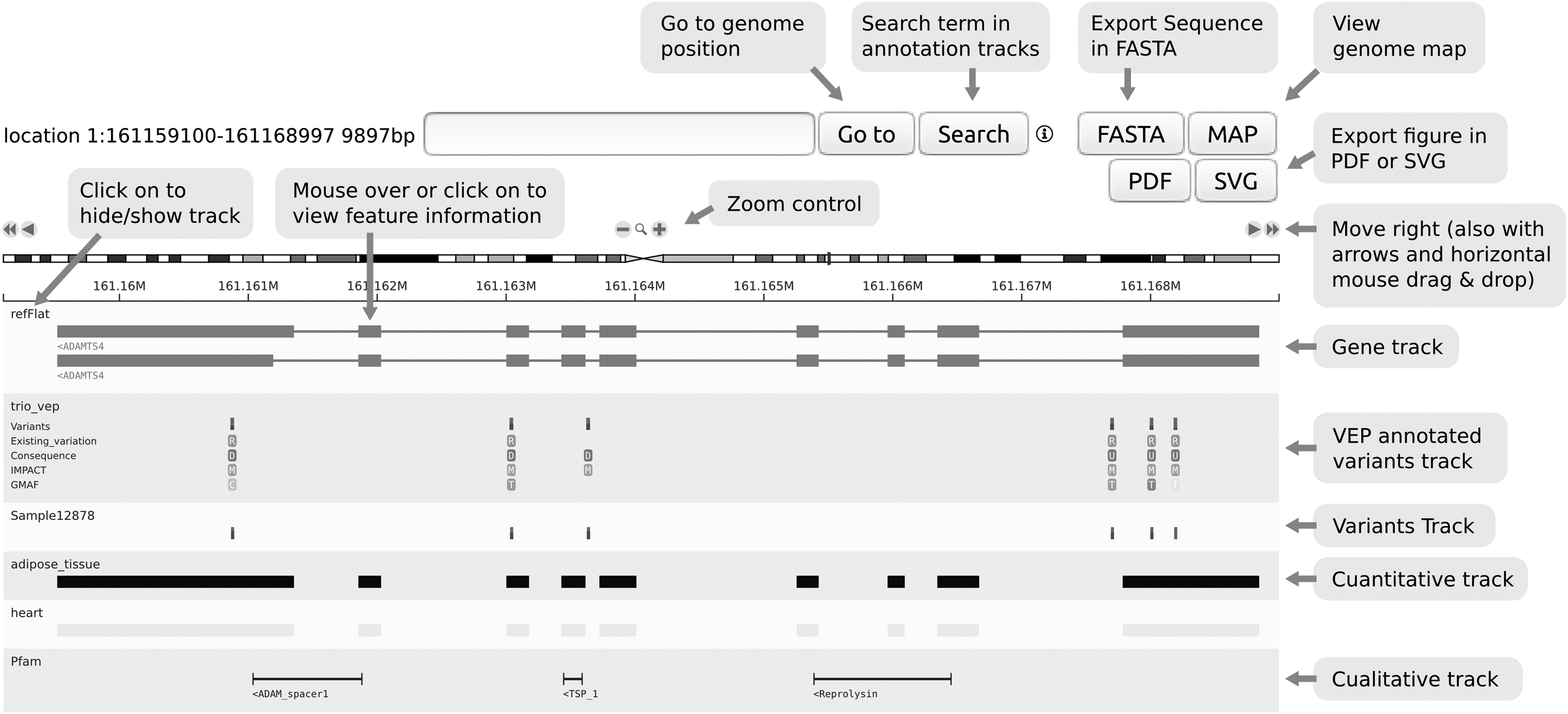
D3GB visual interface. The figure shows a D3GB human genome browser displaying genes, domains, variants with VEP annotation, and expression values. Live example and tutorials for its generation are available on the project website (http://d3gb.usal.es). VEP, variant effect predictor.
D3GB was designed under the idea of easing the automatic generation of genome browsers for computational biologists and simplifying the visualization of genomic data for the final users. From our experience, it is very useful for testing protocols, reporting analysis results, and allowing the exploration of results to nonbioinformatic users. D3GB is a live project that is open to suggestions and external contributions to adapt the project to new scientific requirements.
Footnotes
Acknowledgments
D.B. was supported by Operational Programme of Youth Employment, European Social Fund (ESF), Junta de Castilla y Leon (JCyL). C.P. was supported by the PTA fellowship (PTA2015-10483-I) of the Spanish Ministry of Economy, Industry and Competitiveness (MINECO).
Author Disclosure Statement
No competing financial interests exist.