




Abstract
Abstract
1. Introduction
T
In an earlier proof-of-concept Beacon workshop that employed a beta version of the Beacon Editor, ∼20 biologists learned SBGN-AF and the editor, constructed a number of signal transduction pathways in SBGN-AF, and provided feedback on the usability of the beta version. Prompted by the feedback, we have developed a full-featured SBGN-AF editor with numerous extensions to support the biologists' needs and convenience (Section 2) and written a complete user manual available with the editor at the Beacon Project web site (https://bioinformatics.cs.vt.edu/beacon). See Figure 1 for an example pathway in SBGN-AF. The drawing elements are called glyphs and correspond to nodes (mostly biological activities) and edges (influences) in the pathway graph. The Beacon Editor also fully supports SBGN-AF submaps and compartments.
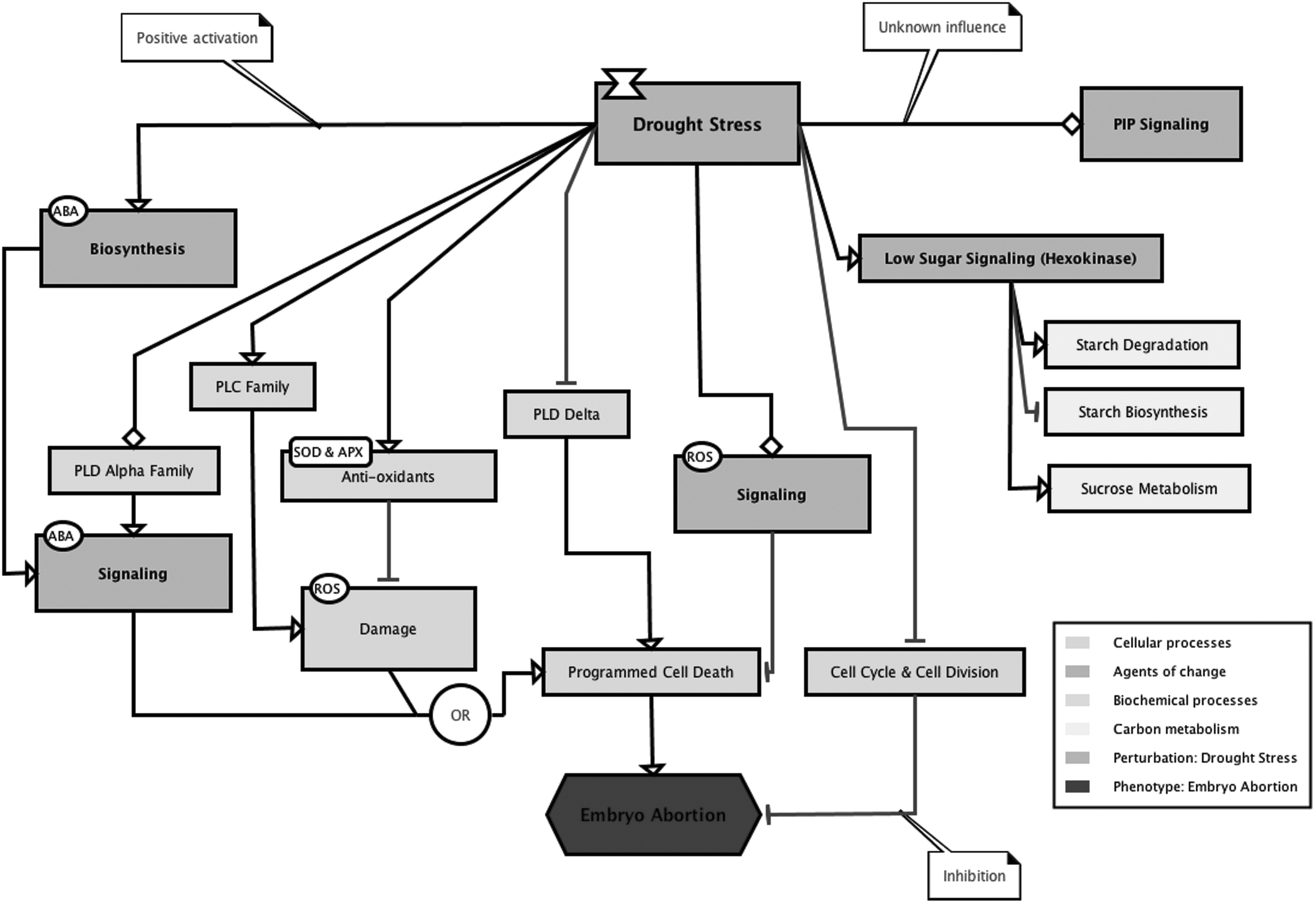
Drought stress effects on the transcriptome of maize ovary tissue at 1 day after pollination. Modified from Kakumanu et al. (2012). Shaded colors group glyphs with similar processes or events. The relationships, or arcs, express the nature of the influence (positive, negative, or unknown) between the glyphs, as indicated. The relationships depicted are inferred from RNA-Seq data presented in Kakumanu et al. (2012) and from literature cited therein.
Two other editors support SBGN-AF. First, SBGN-ED (Czauderna et al., 2010) is a VANTED (Visualization and Analysis of Networks containing Experimental Data) plug-in that supports the SBGN-AF language but requires VANTED to operate (Rohn et al., 2012) and does not have as intuitive a user interface as ours. Second, Biographer (Krause et al., 2013) is a web-based editor for creating SBGN-AF diagrams. It does not support submaps, and users cannot export maps (pathways) in XML (SBGN-ML markup language) format (van Iersel et al., 2012).
2. Methods
The Beacon Editor is a Java application that is opened by double clicking on the JAR file or by installing and running the Mac or Windows version. The user interface has menus, a glyph palette, a drawing canvas, a layer browser, and a map browser. A pathway is built by incrementally selecting a glyph from the palette and placing it on the canvas. The ability to import and export SBGN-ML files (van Iersel et al., 2012) completes the basic drawing features required of any SBGN-AF editor.
Additional features have been incorporated to enhance the usability for biologists. The Beacon Editor is layer based so that there are some layers (user controlled) on which glyphs can be placed and each layer can be shown or hidden to support uncluttered drawing or presentation. Layers are selected through the integrated layer browser, which always identifies available layers.
Although submaps are a standard feature of SBGN-AF, the Beacon Editor goes a step further and collects all the submaps, along with the main map, in the map browser. This allows easy selection and editing of each individual submap in a separate canvas.
Biologists expressed a clear need to assign appropriate gene names to activity nodes (glyphs) in a pathway. In a pop-up gene window, the user can enter a gene identifier, as well as a PubMed ID for a corresponding publication. The user can click on the gene or PubMed ID to go directly to PubMed in their browser.
Often an SBGN-AF diagram will be used in an article as a pathway illustration. The Beacon Editor can export a pathway in BMP, JPEG, PNG, and GIF formats. It is also able to generate a legend for a figure that documents how colors (see next paragraph) are used to convey meaning in the drawing.
A number of convenience features are present in the Beacon Editor. A grid can be placed on the canvas. A user can copy and paste multiple glyphs and has access to undo and redo functions. Zoom in and zoom out are provided. Other functions include glyph alignment, shape color, line color, line thickness, font selection, font style, and font color. A user can customize the font, color, and other parameters and save their preferences. In this way, they do not need to change the default style each time the editor executes. Typical saving and loading of a pathway employ the libSBGN library for compatibility (van Iersel et al., 2012). The standard SBGN-ML has been seamlessly extended to capture the additional metadata required by the Beacon Editor's extended features.
3. Discussion and Conclusion
We have developed the Beacon Editor for the SBGN-AF language with numerous new biologist-requested features. Although the Beacon Project was designed for plant biologists, the Beacon Editor is a general tool suited to signal transduction pathways in any organism. It has already been deployed to construct networks presented in our publications. We developed the Beacon inference engine designed to predict interactions occurring during seed development in Arabidopsis thaliana, based on a support vector machine model (Ni et al., 2016); the Beacon Editor was employed to capture the resulting network. In a study of networks involved in the regulation of metabolism in Sitka spruce needles during winter hardening, metabolic pathways were drawn using the Beacon Editor to represent activities that displayed temporal changes in the expression of relevant genes (Collakova et al., 2013). In Aghamirzaie et al. (2015), an investigation of proposed novel regulatory influences of coding and noncoding (antisense) transcripts on seed development in A. thaliana inferred that signaling pathways were drawn in the Beacon Editor.
Specifically, the Beacon Editor was used to depict proposed interactions among plant hormonal signaling pathways involving post-transcriptional regulation by antisense transcripts during the desiccation phase of development and/or seed germination. In Kakumanu et al. (2012), the Beacon Editor was used to integrate drought stress effects on maize ovary tissue, obtained from an RNA-Seq time course series, together with related functional information on abscisic acid (ABA) effects obtained from the literature (Fig. 1). In future work, the Beacon Editor will have the ability to convert from SBGN to a Systems Biology Markup Language (SBML) Qualitative Model for use in boolean simulation. Finally, the source code for the Beacon Editor is freely available for anyone to adapt to specific needs.
Availability and Implementation
The Beacon Editor has been released under the LGPL v3.0 license and is available at (https://bioinformatics.cs.vt.edu/beacon/). It is implemented in Java and supported on Linux, Windows, and Mac OS X. The source code is available at (https://github.com/marakeby/beacon).
Footnotes
Acknowledgments
We appreciate the assistance of Andy Pereira, Delasa Aghamirzaie, Mahdi Nabiyouni, Curtis Klumas, and Farzaneh Tabataba. This work was supported by National Science Foundation grant DBI-1062472.
Author Disclosure Statement
No competing financial interests exist.