




Abstract
Dr. Degong Mu, one of the co-corresponding authors of the article entitled, “Screening of Clinical Factors Related to Prognosis of Breast Cancer Based on the Cox Proportional Risk Model,” (by Wan Tang, Degong Mu, Ling Han, Xianmin Guo, Bing Han, and Dong Song; J Comput Biol. 2021;28(1):89–98; doi: 10.1089/cmb.2019.0110) has requested a full retraction of the published paper based on the following reasons:
We could not prove that the clinical characteristics listed in Table 1 were independent prognostic factors using a
p value <0.05. Further, we could not prove that patients with younger age and lower stage showed better overall clinical survival according to the column map in Figure 2. We thus cannot ensure the reliability of our conclusions, and we have to retract the article. We apologize to the editors and readers of the journal. [sic]
The Publisher secured all coauthors' agreements to officially retract the article.
1. Introduction
In recent years, breast cancer has been the first in female malignant tumors, the disease is one of the sex hormone receptor-dependent tumors, and the presence of estrogen can promote the growth and appreciation of the cancer cells (Müller et al., 2001; Veronesi et al., 2005; Elston and Ellis, 2010; Higa and Fell, 2013). The etiology of breast cancer is not very clear, the pathogenesis is very complex, and the risk factors of breast cancer are hormones (DrPH, 1984; Lu et al., 2000), genetics (Nathanson et al., 2001), immunization (Gilewski et al., 2001; Longenecker et al., 2010), physiology (Shao et al., 2011; Budde et al., 2012), and so on. Although the domestic and foreign scholars have carried out a lot of research, there are still not sure which one of the risk factors is the main pathogenic factor of breast cancer. However, it is agreed that the overlap of multiple risk factors is bound to increase the risk of breast cancer (Sestak et al., 2018).
With the continuous maturation of radiotherapy technology, its role in the field of breast cancer is becoming more and more prominent, especially the reduction of recurrence and metastasis rate of breast cancer showed obvious effect (Hickey et al., 2013; Efird et al., 2018). Screening and identifying the clinically significant factors associated with breast cancer can help predict the risk of disease and, if not treated, the risk of dying from breast cancer, to identify and anticipate the outcome of a specific treatment regimen for the patient.
Proper evaluation of the relevant clinical factors for the prognosis of breast cancer is particularly important in the selection of appropriate therapeutic strategies. The follow-up data of intact breast cancer patients were downloaded from METABRIC (Molecular Taxonomy of Breast Cancer International Consortium) database, and the prognostic factors correlated with radiotherapy factors were screened using the Cox risk regression model analysis of prognostic factors. The response of different clinical features to radiotherapy was also evaluated by survival prognosis analysis and prediction.
2. Methods
2.1. Patients
A total of 1980 breast cancer patients were enrolled in this study, including 1173 patients who received the radiotherapy treatment (with radiotherapy group) and 807 patients without radiotherapy treatment (without radiotherapy group). The clinical data of the breast cancer patients were downloaded from the METABRIC database (http://molonc.bccrc.ca) (Milioli et al., 2015). The median age of patients was 61.09 years (21.93–96.29 years), and the median follow-up time was 125.13 months (0.1–355 months). In all patients, the survival rate was 42.27%. In addition, the claudin subtype, chemotherapy, hormotherapy, grade, stage, estrogen receptor (ER), progesterone receptor (PR), and overall survival time of all patients were collected for the subsequent analysis.
2.2. Clinical prognostic factors screening
The clinical prognostic factors were screened using the single factor and multivariate Cox regression analysis in the survival package version of the R3.4.0 language (https://cran.r-project.org/web/packages/survival/index.html) (Wang et al., 2016), and log-rank p-value <0.05 was considered as the significant threshold for screening. Then, the independent prognostic factors that are significantly correlated with the overall survival prognosis (overall survival) were selected, and the Kaplan–Meier curve (Lacny et al., 2015) was analyzed for the clinical prognostic factors of the screening.
2.3. The correlation between clinical factors and survival prognosis
To further study the correlation between the clinical prognostic factors and the overall survival, the RMS package Version 5.1–2 (https://cran.r-project.org/web/packages/rms/index.html) in the R3.4.0 language was used to build the column map (nomogram) (Anderson et al., 1989; Eng et al., 2015). The graph is essentially the visualization of the regression equation, according to the size of all the self-variable regression coefficients to set the scoring criteria, give each of the independent variables of the level of a score, each sample can be calculated to obtain a total score, and then the probability of the outcome of each sample by the conversion function to calculate the probability of the occurrence of each specimen. We predict the survival rate of different clinical indicators based on the prognostic significance of independent prognostic clinical factors using the Nomogram method.
3. Results
3.1. Characteristics analysis
A total of 1980 breast cancer patients were enrolled in this study, including 1173 patients who received the radiotherapy treatment and 807 patients without radiotherapy treatment. The demographic and baseline characteristics of patients are shown in Table 1. The age was 59.71 ± 12.87 years in the with radiotherapy group and 63.09 ± 12.82 years in the without radiotherapy group. A total of 857 patients who received the radiotherapy treatment were ER positive and 316 were ER negative, and a total of 649 patients without radiotherapy treatment were ER positive and 158 were ER negative. A total of 150 patients who received the radiotherapy treatment were human epidermal growth factor receptor 2 (HER2) positive and 1023 were HER2 negative, and a total of 97 patients without radiotherapy treatment were HER2 positive and 710 were HER2 negative. A total of 592 patients who received the radiotherapy treatment were PR positive and 581 were PR negative, and a total of 448 patients without radiotherapy treatment were PR positive and 359 were PR negative. Overall survival time of the patients who received the radiotherapy treatment was 124.83 ± 75.06 months, and the overall survival time of the patients without radiotherapy treatment was 125.56 ± 77.69 months. For the characteristic data of patients, the age, radiotherapy, chemotherapy, hormotherapy, grade, stage, ER, HER2, and PR were independent prognostic factors that were significantly correlated with the overall survival (p < 0.05, Table 1).
Clinical Characteristics of All Breast Cancer Patients
Group t test.
Fisher's exact test.
ER, estrogen receptor; HER2, human epidermal growth factor receptor 2; PR, progesterone receptor; SD, standard deviation.
3.2. Clinical prognostic factors analysis
To further study the correlation between the clinical prognostic factors and the overall survival, the single factor and multivariate Cox regression analysis were performed using the survival package version of the R3.4.0 language. For univariable Cox regression analysis, age (hazard ratio [95% confidence interval]: 1.036 [1.031–1.041], p = 2E-16), radiotherapy (0.851 [0.758–0.957], p = 0.006757), grade (1.283 [1.166–1.411], p = 3.128E-07), stage (1.812 [1.626–2.019], p = 2E-16), and HER2 (1.465 [1.237–1.736], p = 1.02E-05) were significantly correlated with the overall survival (p < 0.05, Table 2). For multivariable Cox regression, age (1.043 [1.035–1.05], p = 2E-16), radiotherapy (0.825 [0.709–0.961], p = 0.0134), grade (1.172 [1.034–1.327], p = 0.0129), stage (1.599 [1.410–1.813], p = 2.31E-13), and HER2 (1.481 [1.195–1.835], p = 3.39E-04) were significantly correlated with the overall survival (p < 0.05, Table 2). These results further suggested that age, radiotherapy, grade, stage, and HER2 were independent prognostic factors that were significantly correlated with the overall survival (p < 0.05, Table 2). In addition, the Kaplan–Meier curve analysis for the clinical prognostic factors implied that the patients with age <60 years, receiving radiotherapy, grade 1, stage 0–1, or HER2 negative had a better overall clinical survival (Fig. 1). The column map also implied that the patients with younger age, receiving radiotherapy, grade lower, stage lower, or HER2 negative showed a better overall clinical survival (Fig. 2).
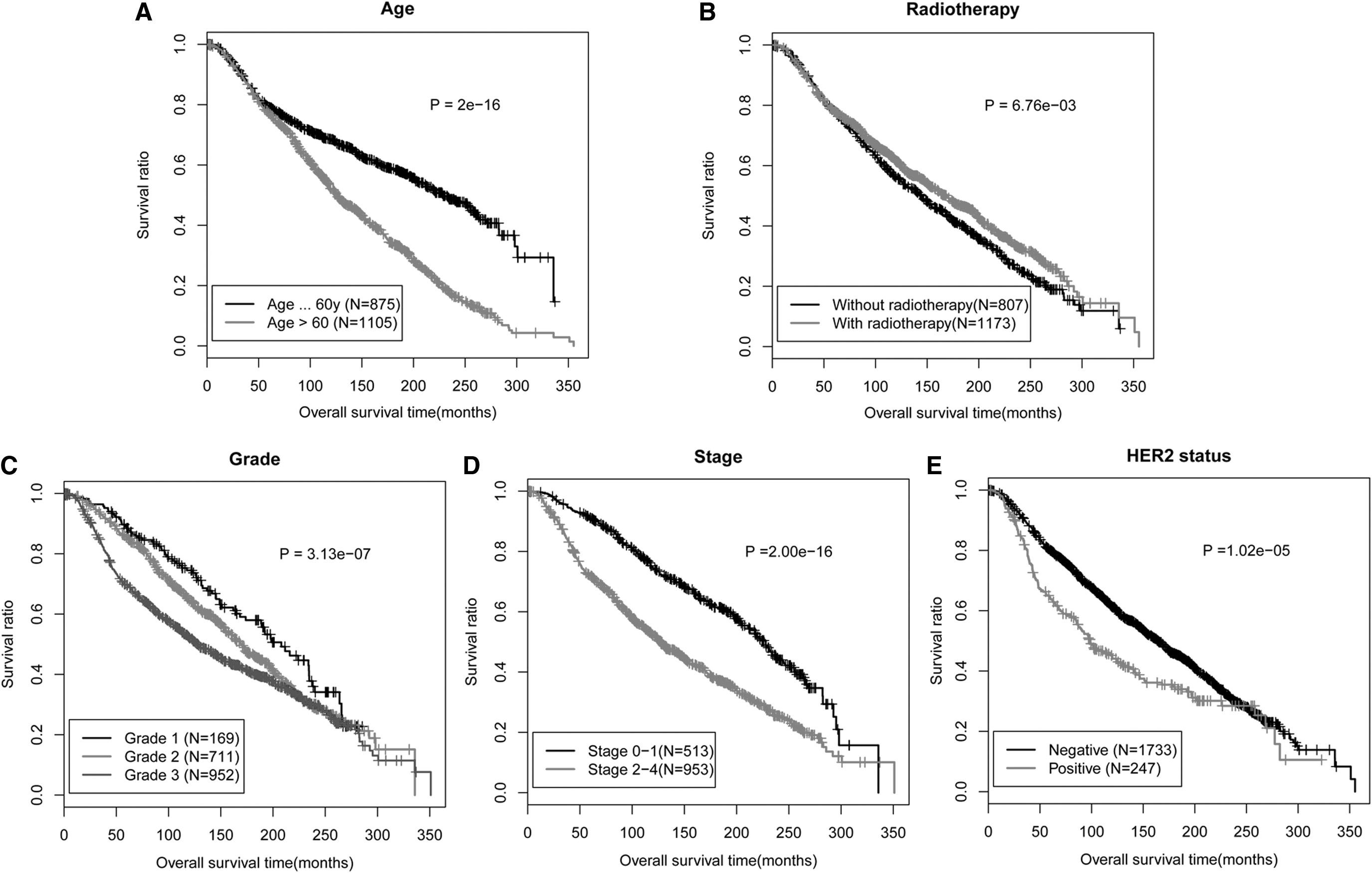
The Kaplan–Meier curve analysis for the clinical prognostic factors.
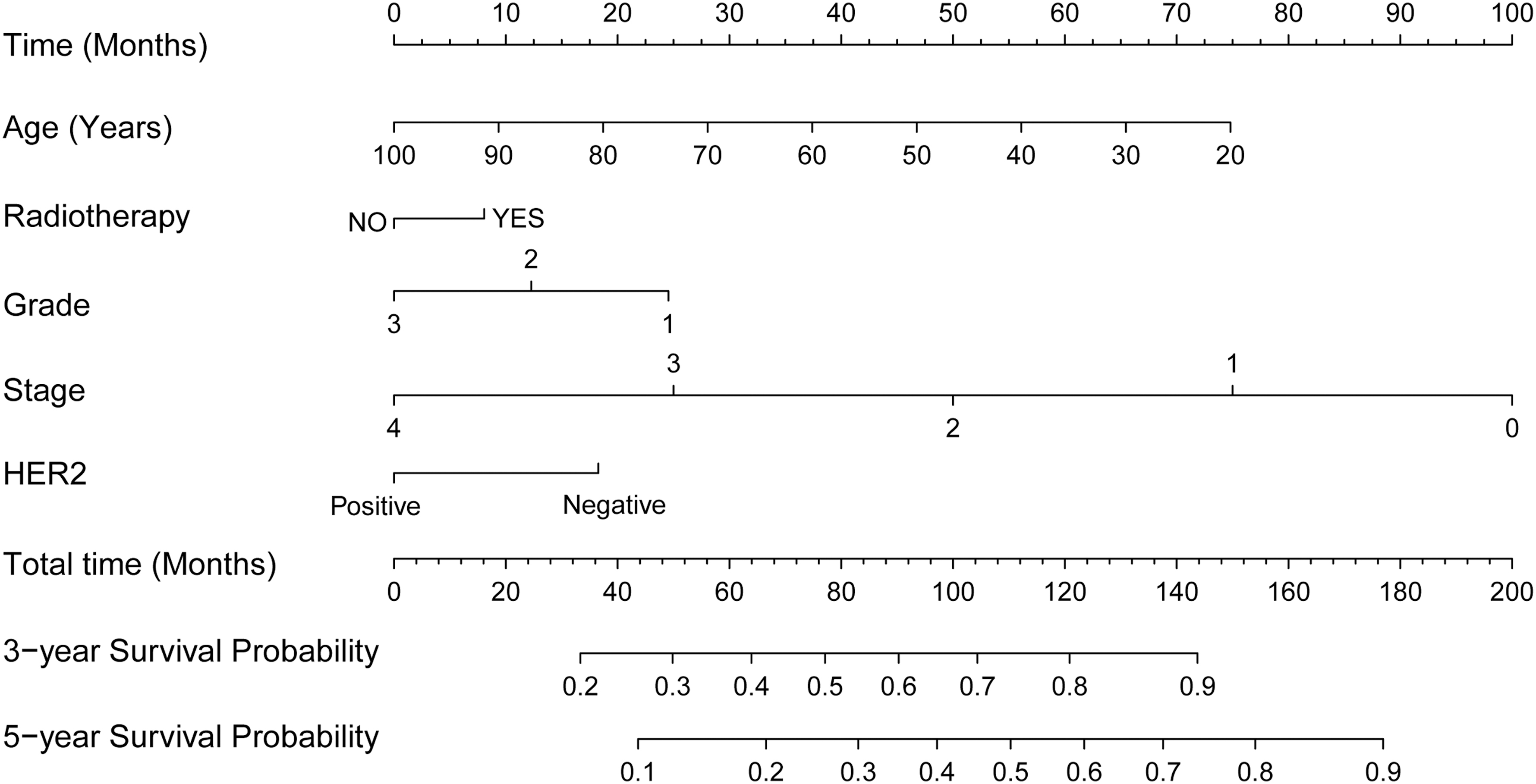
The column map of 3-year survival probability and 5-year survival probability for five clinical prognostic factors, including age, radiotherapy, grade, stage, and HER2.
Clinical Prognostic Factors Analysis of All Breast Cancer Patients
HR, hazard ratio; CI, confidence interval.
3.3. Analysis of clinical prognostic factors correlated with radiotherapy
To further study the correlation between the radiotherapy treatment and the clinical prognostic factors, the single factor and multivariate Cox regression analysis of the patients with radiotherapy treatment group and the patients without radiotherapy treatment group was performed using the survival package version of the R3.4.0 language. For the patients without radiotherapy treatment group, age (1.845 [1.521–2.239], p = 3.013E-10) and stage (2.365 [1.865–3.00], p = 2.74E-13) in univariable Cox regression analysis were significantly correlated with the overall survival (p < 0.05, Table 3). In addition, age (2.282 [1.705–3.053], p = 2.85E-08) and stage (2.216 [1.698–2.892], p = 4.79E-09) in multivariate Cox regression analysis were significantly correlated with the overall survival (p < 0.05, Table 3).
Analysis of Clinical Prognostic Factors Correlated with Radiotherapy
For the patients with radiotherapy treatment group, age (1.984 [1.684–2.338], p = 1.11E-16), stage (1.786 [1.461–2.184], p = 9.97E-09), and HER2 status (1.603 [1.288–1.995], p = 1.97E-05) in univariable Cox regression analysis were significantly correlated with the overall survival (p < 0.05, Table 3). In addition, age (2.331 [1.881–2.889], p = 1.12E-14) stage (1.518 [1.206–1.910], p = 0.000373), and HER2 status (1.506 [1.164–1.949], p = 0.00186) in multivariate Cox regression analysis were significantly correlated with the overall survival (p < 0.05, Table 3). The Kaplan–Meier curve analysis for the clinical prognostic factors implied that the patients with age <60 years, receiving radiotherapy, grade 1, stage 0–1, or HER2 negative had a better overall clinical survival (Fig. 3). The column map also implied that the patients with younger age, stage lower, or HER2 negative showed a better overall clinical survival, and the patients who received radiotherapy had a better 3-year survival probability and 5-year survival probability (Fig. 4).
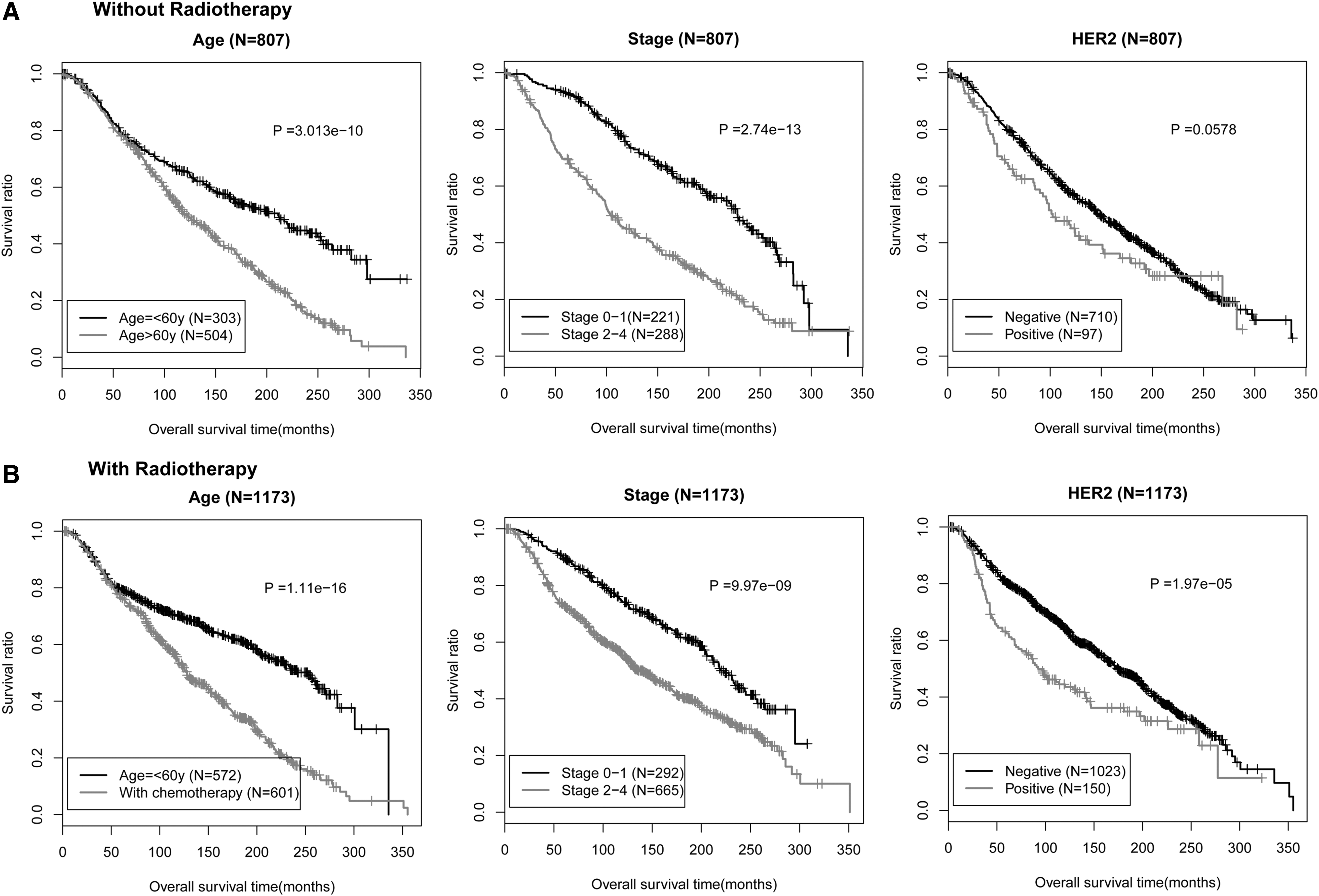
The Kaplan–Meier curve analysis for the without radiotherapy group
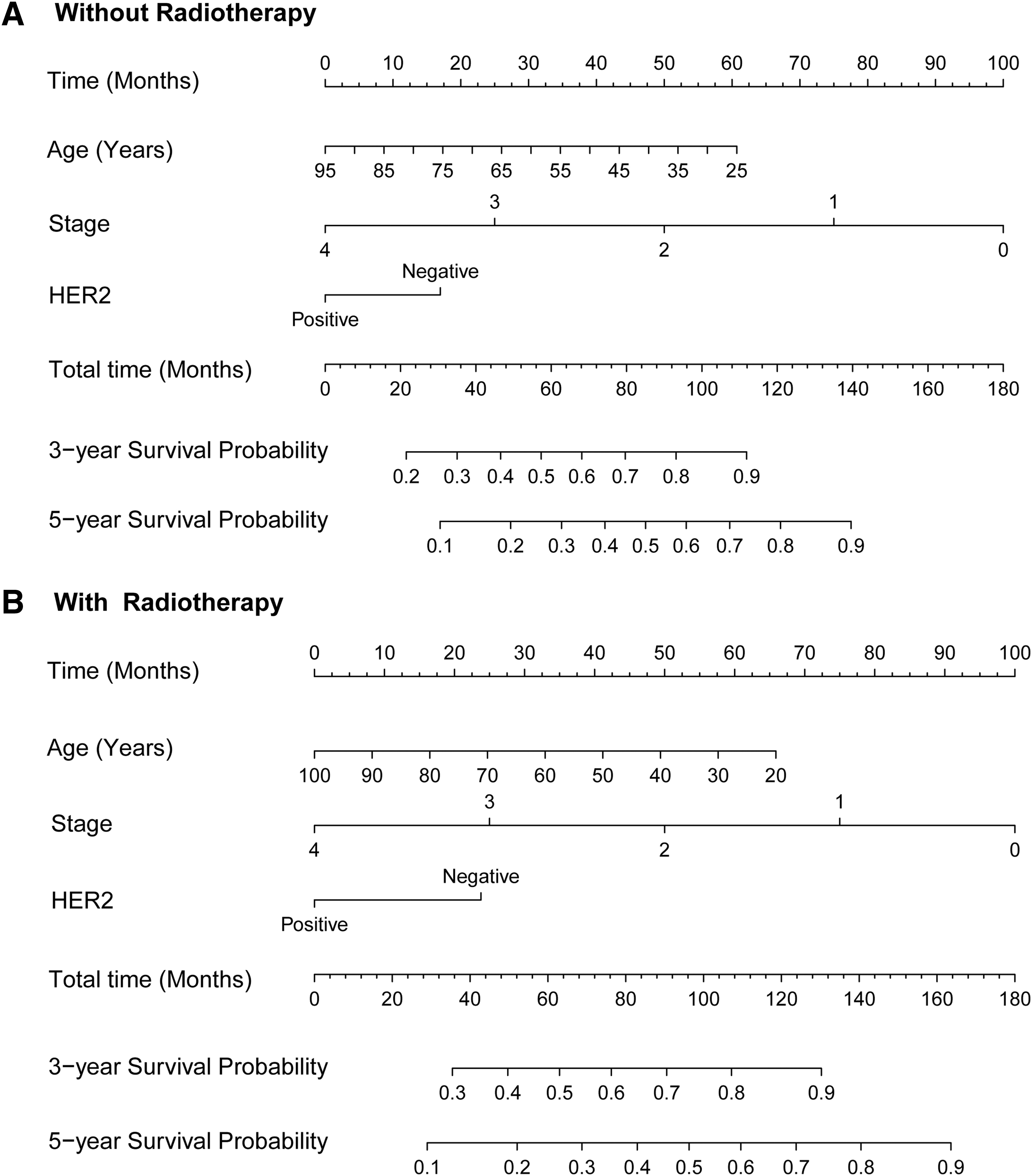
The column map of 3-year survival probability and 5-year survival probability for five clinical prognostic factors, including age, stage, and HER2.
4. Discussion
Proper evaluation of the relevant clinical factors for the prognosis of breast cancer is particularly important in the selection of appropriate therapeutic strategies. Screening and identifying the clinically significant factors associated with breast cancer can help predict the risk of disease. To further screen and identify the clinically significant factors associated with breast cancer, the prognostic factors correlated with radiotherapy factors were screened using the Cox risk regression model analysis of prognostic factors. The follow-up data of breast cancer patients were downloaded from METABRIC database, a total of 1980 breast cancer patients were enrolled in this study, including 1173 patients who received the radiotherapy treatment and 807 patients without radiotherapy treatment. The correlation implied that the patients with younger age receiving radiotherapy, grade lower, stage lower, or HER2 negative showed a better clinical survival. Radiotherapy for breast cancer reduces disease recurrence and breast cancer mortality and is an essential part of the multimodality treatment of breast cancer (Recht et al., 1988; Bese et al., 2010; Gonzalez et al., 2010). The response of different clinical features to radiotherapy was also evaluated by survival prognosis analysis and prediction.
The association analysis of the radiotherapy treatment and the clinical prognostic factors implied that the patients with younger age, stage lower, or HER2 negative showed a better overall clinical survival, and the patients who received radiotherapy had a better 3-year survival probability and 5-year survival probability. HER2/erbB-2 belongs to a family of four transmembrane receptors involved in signal transduction pathways that regulate cell growth and differentiation. Overexpression/amplification of HER2 is associated with malignancy and a poor prognosis in breast cancer. HER2 acts as a networking receptor that mediates signaling to cancer cells, causing them to proliferate. HER receptors exist as monomers but dimerize on ligand binding (Harari and Yarden, 2000; Yarden, 2001). Trastuzumab, which was a humanized monoclonal antibody against HER2, has been shown to improve disease-free survival after chemotherapy in women with HER2-positive breast cancer (Piccart-Gebhart et al., 2005; Smith et al., 2007; Arteaga et al., 2011; Cameron et al., 2017). Bevacizumab, a monoclonal antibody against vascular endothelial growth factor A, has shown clinical efficacy in patients with HER2-negative metastatic breast cancer (Von et al., 2012; JPOG, 2014).
In conclusion, screening and identifying the clinically significant factors associated with breast cancer can help predict the risk of disease. Age, stage, or HER2 status was prognostic factors correlated with radiotherapy treatment.
Footnotes
ETHICAL APPROVAL AND CONSENT TO PARTICIPATE
This study was approved by Ethics Committee of The First Hospital of Jilin University.
Authors' Contributions
Conception and design and article writing: W.T. and D.M. Administrative support: L.H. Provision of study materials or patients: X.G. Collection and assembly of data: B.H. Data analysis and interpretation: D.S. Final approval of article: all authors.
Author Disclosure Statement
The authors declare they have no competing financial interests.
Funding Information
No funding was received for this article.