




Abstract
The colored de Bruijn graph (cdbg) and its variants have become an important combinatorial structure used in numerous areas in genomics, such as population-level variation detection in metagenomic samples, large-scale sequence search, and cdbg-based reference sequence indices. As samples or genomes are added to the cdbg, the color information comes to dominate the space required to represent this data structure. In this article, we show how to represent the color information efficiently by adopting a hierarchical encoding that exploits correlations among color classes—patterns of color occurrence—present in the de Bruijn graph (dbg). A major challenge in deriving an efficient encoding of the color information that takes advantage of such correlations is determining which color classes are close to each other in the high-dimensional space of possible color patterns. We demonstrate that the dbg itself can be used as an efficient mechanism to search for approximate nearest neighbors in this space. While our approach reduces the encoding size of the color information even for relatively small cdbgs (hundreds of experiments), the gains are particularly consequential as the number of potential colors (i.e., samples or references) grows into thousands. We apply this encoding in the context of two different applications; the implicit cdbg used for a large-scale sequence search index, Mantis, as well as the encoding of color information used in population-level variation detection by tools such as Vari and Rainbowfish. Our results show significant improvements in the overall size and scalability of representation of the color information. In our experiment on 10,000 samples, we achieved >11 × better compression compared to Ramen, Ramen, Rao (RRR).
Introduction
The colored de Bruijn graph (cdbg) (Iqbal Zamin et al., 2012), an extension of the classical de Bruijn graph (dbg) (Pevzner and Tang, 2001; Pevzner et al., 2001; Chikhi et al., 2014), is a key component of a growing number of genomics tools. Augmenting the traditional dbg with “color” information provides a mechanism to associate meta-data, such as the raw sample or reference of origin, with each k-mer. Coloring the dbg enables it to be used in a wide range of applications, such as large-scale sequence search (Solomon and Kingsford, 2016, 2017; Bradley et al., 2017; Sun et al., 2017; Pandey et al., 2018) [although some (Solomon and Kingsford, 2016, 2017; Sun et al., 2017) do not explicitly couch their representations in the language of the cdbg], population-level variation detection (Holley et al., 2016; Almodaresi et al., 2017; Muggli et al., 2017), traversal and search in a pan-genome (Holley et al., 2016), and sequence alignment (Liu et al., 2016a). The popularity and applicability of the cdbg have spurred research into developing space-efficient and high-performance data-structure implementations.
An efficient and fast representation of cdbg requires optimizing both the dbg and the color information. While there exist efficient and scalable methods for representing the topology of the dbg (Bowe et al., 2012; Chikhi and Rizk, 2012; Chikhi et al., 2014; Salikhov et al., 2014; Crawford et al., 2018; Pandey et al., 2017a) with fast query time, a scalable and exact representation of the color information has remained a challenge. Recently, Mustafa et al. (2019) have tackled this challenge by relaxing the exactness constraints—allowing the returned color set for a k-mer to contain extra samples with some controlled probability—but it is not immediately clear how this method can be made exact.
Specifically, existing exact color representations suffer from large sizes and a fast growth rate that leads them to dominate the total representation size of the cdbg with even a moderate number of input samples (Fig. 3b). As a result, the color information grows to dominate the space used by all these indexes and limits their ability to scale to large input data sets.
Iqbal et al. (2012) introduced cdbgs and proposed a hash-based representation of the dbg in which each k-mer is additionally tagged with the list of reference genomes in which it is contained. Muggli et al. (2017) reduced the size of the cdbg in VARI by replacing the hash map with BOSS (Bowe et al. 2012) [a BWT-based (Burrows and Wheeler, 1994) encoding of the dbg that assigns a unique ID to each k-mer] and using a Boolean matrix indexed by the unique k-mer ID and genome reference ID to indicate occurrence. They reduced the size of the occurrence matrix by applying off-the-shelf compression techniques Ramen, Ramen, Rao (RRR) (Raman et al., 2002) and Elias-Fano (Elias, 1974) encoding. Rainbowfish Almodaresi et al. (2017) shrank the color table further by ensuring that rows of the color matrix are unique, mapping all k-mers with the same color information to a single row and assigning row indices based on the frequency of each occurrence pattern. However, despite these improvements, the scalability of the resulting structure remains limited because even after eliminating redundant colors, the space for the color table grows quickly to dominate the total space used by these data structures.
We observe that, in real biological data, even when the number of distinct color classes is large, many of them will be near each other in terms of the set of samples or references they encode. That is, the color classes tend to be highly correlated rather than uniformly spread across the space of possible colors. There are intuitive reasons for such characteristics. For example, we observe that adjacent k-mers in the dbg are extremely likely to have either identical or similar color classes, enabling storage of small deltas instead of the complete color classes. This is because k-mers adjacent in the dbg are likely to be adjacent (and hence present) in a similar set of input samples. In the context of sequence search, because genomes and transcriptomes are largely preserved across organs, individuals, and even across related species, we expect two k-mers that occur together in one sample to be highly correlated in their occurrence across many samples. Thus, we can take advantage of this correlation when devising an efficient encoding scheme for the cdbg's associated color information.
In this article, we develop a general scheme for efficient and scalable encoding of the color information in the cdbg by encoding color classes (i.e., the patterns of occurrence of a k-mer in samples) in terms of their differences (which are small) with respect to some “neighboring” color class. The key technical challenge, solved by our work, is efficiently searching for the neighbors of color classes in the high-dimensional space of colors by leveraging the observation that similar color classes tend to be topologically close in the underlying dbg. We construct a weighted graph on the color classes in the cdbg, where the weight of each edge corresponds to the space required to store the delta between its end points. Finding the minimum spanning tree (MST) of this graph gives a minimal delta-based representation. Although reconstructing a color class on this representation requires a walk to the MST root node, abundant temporal locality on the lookups allows us to use a small cache to mitigate the performance impact, yielding query throughput that is essentially the same as when all color classes are represented explicitly.
An alternative would have been to try to limit the depth (or diameter) of the MST. This problem is heavily studied in two forms: the unrooted bounded-diameter MST problem (Raidl, 2008) and the rooted hop-constrained MST problem (Althaus et al., 2005). Neither is in APX, that is, it is not possible to approximate them to within any constant factor (Manyem and Stallmann, 1996). Althaus et al. (2005) gave an
We showcase the generality and applicability of our color class table compression technique by demonstrating it in two computational biology applications: sequence search and variation detection. We compare our novel color class table representation with the representation used in Mantis (Pandey et al., 2018), a state-of-the-art large-scale sequence-search tool that uses a cdbg to index a set of sequencing samples, and the representation used in Rainbowfish (Almodaresi et al., 2017), a state-of-the-art index to facilitate variation detection over a set of genomes. We show that our approach maintains the same query performance while achieving over
Methods
This section describes our compact cdbg representation. We first define cdbgs and briefly describe existing compact cdbg representations. We then outline the high-level idea behind our compact representation and explain how we use the dbg to efficiently build our compact representation. Finally, we describe implementation details and optimizations to our query algorithm.
Colored de Bruijn graphs
The dbgs are widely used to represent the topological structure of a set of k-mers (Pevzner et al., 2001; Zerbino and Birney, 2008; Simpson et al., 2009; Grabherr et al., 2011; Schulz et al., 2012; Chang et al., 2015; Liu et al., 2016b; Pandey et al., 2017a). The dbg induced by a set of k-mers is defined below.
Cdbgs extend the dbg by assigning a color class
- Sometimes, U is a set of reference genomes, and
- Sometimes, U is a set of reads, and
- Sometimes, U is a set of sequencing experiments, and
The goal of a cdbg representation is to store E and C as compactly as possible
1
, while supporting the following operations efficiently:
- Point query. Given a k-mer x, determine whether x is in E. - Color query. Given a k-mer
Given that we can perform point queries, we can traverse the dbg by simply querying for the eight possible predecessor/successor edges of an edge. This enables us to implement more advanced algorithms, such as bubble calling (Iqbal Zamin et al., 2012).
Many cdbg representations typically decompose, at least logically, into two structures: one structure storing a dbg and associating an ID with each k-mer, and one structure mapping these IDs to the actual color class (Almodaresi et al., 2017; Muggli et al., 2017; Pandey et al., 2017b). The individual color classes can be represented as bit vectors, lists, or using a hybrid scheme (Yu et al., 2018). This information is typically compressed (Ziv and Lempel, 1977; Raman et al., 2002; Ottaviano and Venturini, 2014).
Our article follows this standard approach and focuses exclusively on reducing the space required for the structure storing the color information. We propose a compact representation that, given a color ID, can return the corresponding color efficiently. Although we pair our color table representation with the dbg structure representation of the counting quotient filter (CQF) (Pandey et al., 2017b) as used in Mantis (Pandey et al. 2018), our proposed color table representation can be paired with other dbg representations.
A similarity-based cdbg representation
The key observation behind our compressed color-class representation is that the color classes of k-mers that are adjacent in the dbg are likely to be very similar. Thus, rather than storing each color class explicitly, we can store only a few color classes explicitly and, for all the remaining color classes, we store only their differences from other color classes. Because the differences are small, the total space used by the representation will be small.
Motivated by the observation above, we propose to find an encoding of the color classes that takes advantage of the fact that most color classes can be represented in terms of only a small number of edits (i.e., flipping the parity of only a few bits) with respect to some neighbor in the high-dimensional space of the color classes. This idea was first explored by Bookstein and Klein (1991) in the context of information retrieval. Bookstein and Klein showed how to exploit the implicit clustering among bitmaps in Information Retrieval (IR) to achieve excellent reduction in storage space to represent those bitmaps using an MST as the underlying representation. Unfortunately, the approach taken by Bookstein and Klein cannot be directly used in our problem, since it requires computing and optimizing upon the full Hamming distance graph of the bit vectors being represented, which is not tractable for the scale of data we are analyzing. Hence, what we need is a method to efficiently discover an incomplete and highly-sparse Hamming distance graph that, nonetheless, supports a low-weight spanning tree. We describe below how we apply and modify this approach in the context of the set of correlated bit vectors (i.e., color classes) that we wish to encode.
We construct our compressed color class representation as follows (Fig. 1). For each edge x of the dbg, let  and edge set reflecting the adjacency relationship implied by the dbg. In other words, there is an edge between color classes c1 and c2 if there exist adjacent edges (i.e., incident on the same node) x and y in the dbg such that
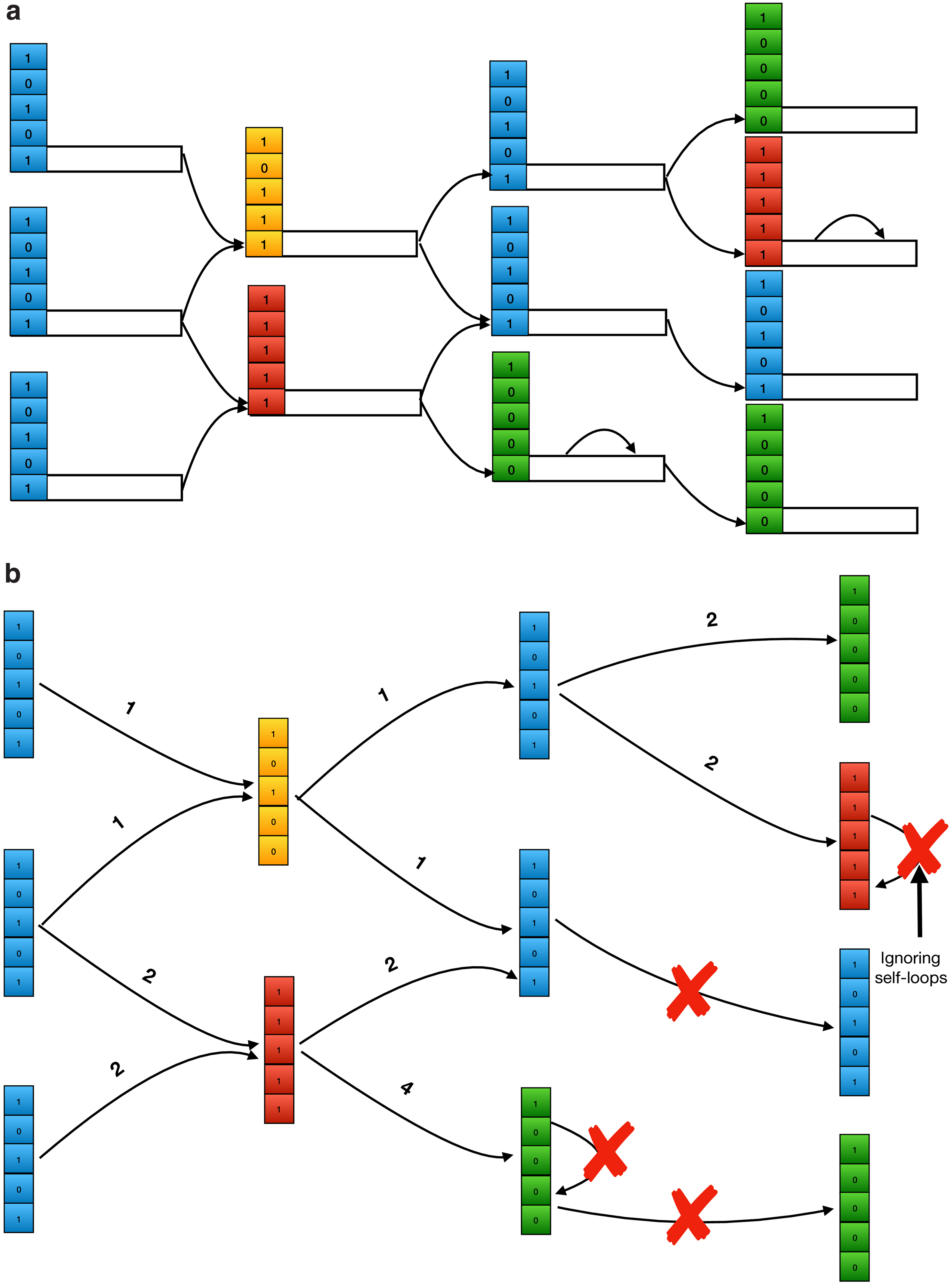
Encoding color classes by finding the MST of the color class graph, an undirected graph derived from cdbg. The order of the process is
We then compute a MST of the color class graph and root the tree at the special
We then store the MST as a table mapping each color class ID to the ID of its parent in the MST, along with a list of the differences between the color class and its parent. For convenience we can view the list of differences between color class c1 and color class c2 as a bit vector
Assuming we have  color classes,
- Parent vector: This vector contains slots, each of size  . The value stored in index i represents the parent color class ID of the color class with index i in the MST.
- Delta vector: This vector contains w slots, each of size
- Boundary bit vector: This vector contains w bits, where a set bit indicates the boundary between two delta sets within the delta vector. To find the starting position, within the delta vector, of the per-edge delta list for the MST edge with source ID i, we perform select(i) on the boundary vector. Select returns the position of the ith one in the boundary vector.
Query of the MST-based representation
Figure 2 shows how queries proceed using this encoding. We start with an empty accumulator bit vector and a color class ID i for which we want to compute the corresponding color class. We perform a select query for i and
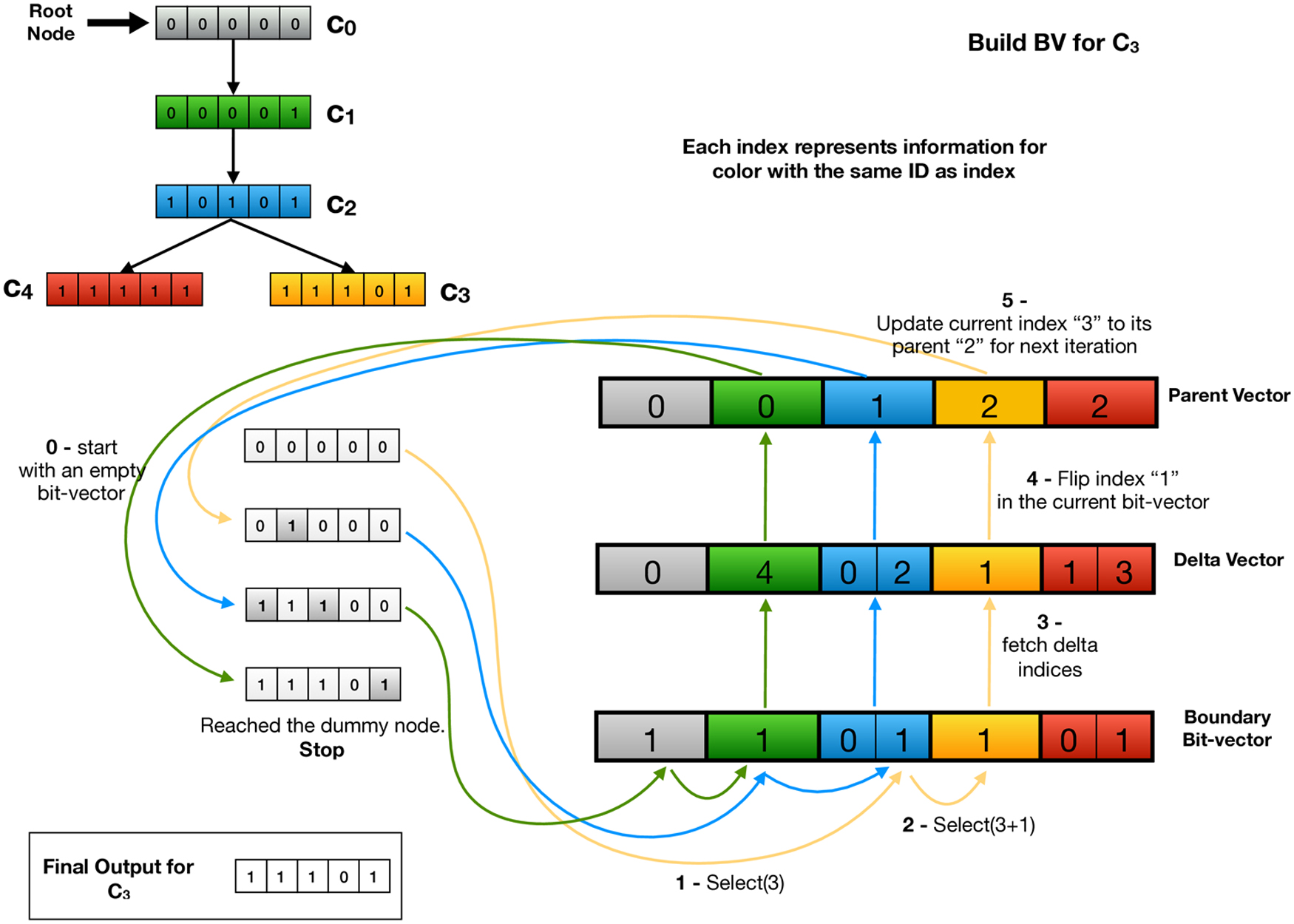
The conceptual MST (top-left); the data structure to store the color information in the format of an MST (right). This figure also illustrates the steps required to build one of the color vectors (C3) at the leaf of the tree. Note that the query process shown here does not depict the caching policy we apply in practice.
Once constructed, our MST-based color class representation is a drop-in replacement for the current color class representations used in several existing tools, including Mantis (Pandey et al. 2018) and Rainbowfish (Almodaresi et al. 2017). Their existing color class tables support a single operation—querying for a color class by its ID—and our MST-based representation supports exactly the same operation.
For this article, we integrated our MST-based representation into Mantis. The same space savings can be achieved in other tools, particularly Rainbowfish, which has a similar color-class encoding as Mantis.
Construction
We construct our MST-based color-class representation as follows. First, we run Mantis to build its default representation of the cdbg. We then build the color-class graph by walking the dbg and adding all the corresponding edges to the color-class graph. The edge set is typically much smaller than the dbg (because many dbg edges may map to the same edge in the color-class graph), so this can be done in RAM. Note that we do not compute the weights of the edges during this pass, because that would require having all of the large color-class bit vectors in memory to compute their Hamming distance.
In the second pass, we traverse the edge set and compute the weight of each edge. To minimize RAM usage during this phase, we sort the edges and iterate over them in a “blocked” manner. Specifically, Mantis stores the color class bit vectors on-disk sequentially by ID, grouped into blocks of roughly 6 GBs each. We sort the edges lexicographically by their source and destination block. We then load all pairs of blocks and compute the weights of all the edges between the two blocks currently in memory. At all times, we need only two blocks of color class vectors in memory. Given the weighted graph, we compute the MST and make one final pass to determine the relevant delta lists and encode our final MST structure.
Parallelization
We note that, after having constructed the Mantis representation, most phases of the MST construction algorithm are trivially parallelized. MST construction decomposes into three phases: (1) color-class graph construction, (2) MST computation, and (3) color-class representation generation. We parallelize graph construction and color-class representation generation. The MST computation itself is not parallelized.
We parallelized the determination of edges in the color-class graph by assigning each thread a range of the k-mer-to-color-class-ID map. Each thread explores the neighbors of the k-mers that appear in its assigned range, and any redundant edges are deduplicated when all threads are finished. Similarly, we parallelized the computation of edge weights and the extraction of the delta vectors that correspond to each edge in the MST. Given the list of edges sorted lexicographically by their end points (determined during the first phase), it is straightforward to partition the work for processing batches of edges across many threads. It is possible, of course, that the batches will display different workloads and that some threads will complete their assigned work before others. We have not yet made any attempt to optimize the parallel construction of the MST in this regard, although many such optimizations are likely possible.
Accelerating queries with caching
The encoded MST is not a balanced tree, so decoding a color bit vector might require walking a long path to the root, which negatively impacts the query time. Attempting to explicitly minimize the depth or diameter of the MST is, as discussed in Section 1, not generally approximable within a constant factor. However, considering the fact that the frequency distribution of the color classes is very skewed, some of the color classes are more popular or have more children and, therefore, are in the path of many more nodes. We take advantage of these data characteristics by caching the most recent queried color bit vectors. Every time we walk up the tree, if the color bit vector for a node is already in the cache, our query algorithm stops at that point and applies all the deltas to this bit vector instead of the zero bit vector of the root. This caching approach significantly improves the query time, resulting in the final query time required to decode a color class being marginally faster than direct RRR access.
The cache policy is designed with the tree structure of our color-class representation in mind. Specifically, we want to cache nodes near the leaves, but not so close to the leaves that we end up caching essentially the entire tree. In addition, we don't want to cache infrequently queried nodes. Thus we use the following caching policy: all queried nodes are cached. Furthermore, we cache interior nodes visited during a query as follows. If a query visits a node that has been visited by >10 other queries and is >10 hops away from the currently queried item, then we add that node to the cache. If a query visits more than one such node, we add the first one encountered.
In our experiments, we used a cache of 10,000 nodes and managed the cache using a FIFO policy.
Comparison with brute-force and approximate-nearest-neighbor-based approaches
Our MST-based color-class representation uses the dbg as a hint as to which color classes are likely to be similar. This leads to the natural question: how good are the hints provided by the dbg?
One could imagine alternatively constructing the MST on the complete color-class graph. This would yield the absolutely lowest-weight spanning tree on the color classes. Unfortunately, no MST algorithm runs in less than
Alternatively, we could try to use an approximate nearest-neighbor algorithm to find pairs of color classes with small Hamming distance. As an experiment, we implemented an approximate nearest neighbor algorithm that bucketed color classes by their projection into a smaller-dimensional subspace. Nearest-neighbor queries were computed by searching within the queried item's bucket. Results were disappointing. Even on small data sets, the average distance between the queried item and the returned neighbor was several times larger than the average distance found using the neighbors suggested by the dbg. Thus, we did not pursue this direction further.
Evaluation
In this section we evaluate our MST-based representation of the color information in the cdbg. All our experiments use Mantis with our integrated MST-based color-class representation.
Evaluation metrics: We evaluate our MST-based representation on the following parameters:
- Scalability. How does our MST-based color-class representation scale in terms of space with increasing number of input samples, and how does it compare to the existing representations of Mantis? - Construction time. How long does it take—in addition to the original construction time for building cdbg—to build our MST-based color-class representation? - Query performance. How long does it take to query the cdbg using our MST-based color-class representation?
Experimental procedure
System specifications
Mantis takes as input a collection of squeakr files (Pandey et al., 2017c). Squeakr is a k-mer counter that takes as input a collection of fastq files and produces as output a single file with a compact hash table mapping each k-mer to the number of times it occurs in the input files. As is standard in evaluations of large-scale sequence search indexes, we do not benchmark the time required to construct these filters.
The data input to the construction process was stored on four-disk mirrors (eight disks total). Each is a Seagate 7200 rpm 8 TB disk (ST8000VN0022). They were formatted using ZFS and exported using NFS over a 10 Gb link. We used different systems to run and evaluate time, memory, and disk requirements for the two steps of preprocessing and index building as were done by Pandey et al. (2018).
For index building and query benchmarks, we ran all the experiments on the same system used in Mantis (Pandey et al., 2018), an Intel(R) Xeon(R) CPU (E5-2699 v4 @2.20 GHz with 44 cores and 56 MB L3 cache) with 512 GB RAM and a 4 TB TOSHIBA MG03ACA4 ATA HDD running Ubuntu 16.10 (Linux kernel 4.8.0-59-generic). Constructing the main index was done using a single thread, and the MST construction was performed using 16 threads. Query benchmarks were also performed using a single thread.
Data to evaluate scalability and comparison to Mantis
We integrated and evaluated our MST-based color-class representation within Mantis, so we briefly review Mantis here. Mantis builds an index on a collection of unassembled raw sequencing data sets. Each data set is called a sample. The Mantis index enables fast queries of the form, “Which samples contain this k-mer,” and “Which samples are likely to contain this string of bases?” Mantis takes as input one squeakr file per sample (Pandey et al., 2017c). A squeakr file is a compact hash table mapping each k-mer to the number of times it occurs within that sample. Squeakr also has the ability to serialize a hash that simply represents the set of k-mers present at or above some user-provided threshold; we refer to these as filtered Squeakr files. Using the filtered Squeakr files vastly reduces the required intermediate storage space and also decreases the construction time required for Mantis considerably. For example, for the breast, blood, and brain data set (2586 samples), the unfiltered Squeakr files required: 2.5 TB of space, while the filtered files require only: 108 GB. To save intermediate storage space and speed index construction, we built our Mantis representation from these filtered Squeakr files.
Given the input files, Mantis constructs an index consisting of two files: a map from k-mer to color-class ID and a map from color-class ID to the bit vector encoding that color class. The first map is stored as a CQF, which is the same compact hash table used by Squeakr. The color-class map is an RRR-compressed bit vector.
Recall that our construction process is implemented as a postprocessing step on the standard Mantis color-class representation. For construction times, we report only this postprocessing step. This is because our MST-based color-class representation is a generic tool that can be applied to many cdbg representations other than Mantis, so we want to isolate the time spent on MST construction.
To test the scalability of our new color-class representation, we used a randomly selected set of
To eliminate spurious k-mers that occur with insignificant abundance within a sample, the squeakr files are filtered to remove low-abundance k-mers. We adopted the same cutoff policy originally proposed by Solomon and Kingsford (2016), by discarding k-mers that occur less than some threshold number of times. The thresholds are determined according to the size (in bytes) of the gzipped sample, and the thresholds are given in Table 1. We adopt a value of
Minimum Number of Times a k-Mer Must Appear in an Experiment to Be Counted as Abundantly Represented in That Experiment (Taken from the Sequence Bloom Tree Article)
Minimum Number of Times a k-Mer Must Appear in an Experiment to Be Counted as Abundantly Represented in That Experiment (Taken from the Sequence Bloom Tree Article)
Note, the k-mers with count of “cutoff” are included at each threshold.
Scalability of the new color-class representation
Figure 3a and Table 2 show how the size of our MST-based color-class representation scales as we increase the number of samples indexed by Mantis. For comparison, we also give the size of Mantis' RRR-compression-based color-class representation. Figure 3a also plots the size of the CQF that Mantis uses to map k-mers to color class IDs. We can draw several conclusions from these data:

Size of the MST-based color-class representation versus the RRR-based color-class representation.
Space Required for Ramen, Ramen, Rao and Minimum Spanning Tree-Based Color Class Encodings Over Different Numbers of Samples (Sizes in GB) and Time and Memory Required to Build Minimum Spanning Tree
Central columns break down the size of individual MST components.
BBB, Blood, Brain, and Breast; MST, Minimum Spanning Tree; RRR, Ramen, Ramen, Rao.
- The MST-based representation is an order-of-magnitude smaller than the RRR-based representation.
- The gap between the RRR-based representation and the MST-based representation grows as we increase the number of input samples. This suggests that the MST-based representation grows asymptotically slower than the RRR-based representation.
- The MST-based color-class representation is, for large numbers of samples, about 5
Table 2 also shows the scaling rate of all elements of the MST representation, in addition to the ratio of MST over the color bit vector. As expected, the list of deltas dominates the MST representation both in terms of total size and in terms of growth. Table 2 also shows the average edge weight of the edges in the MST. The edge weight grows approximately proportional to
To better understand the scaling of the different components of a cdbg representation, we plot the sizes of the RRR-based color-class representations and MST-based representations on a log–log scale in Figure 3b. Based on the data, the RRR-based representation appears to grow in size at a rate of roughly
Finally, the last two rows in Table 2 show the size of the RRR- and MST-based color-class representations for the human BBB and Escherichia coli data sets, respectively. BBB is the data set used in SBT and its subsequent tools (Solomon and Kingsford, 2017; Sun et al., 2017; Yu et al., 2018), as well as in Mantis (Pandey et al., 2018), and E. coli is the data set analyzed in the Rainbowfish article. This data set, which has been obtained from GenBank (O'Leary et al. 2016), consists of 5598 distinct E. coli strains. Since the strain assemblies are all from the same species, E. coli, each strain shares a large portion of its sequence with the others. We specifically chose this data set since Rainbowfish has already demonstrated a large improvement in size for it compared to Vari (Muggli et al., 2017).
As the table shows, our MST-based color-class representation is able to effectively compress genomic color data in addition to RNA-seq color data.
The “Build time” column in Table 2 shows the time required to build our MST-based color-class representation from Mantis' RRR-based representation. All builds used 16 threads. Table 3 shows how the MST construction time for a 1000 sample data set scales as a function of the number of build threads. The memory consumption is not affected by number of threads and remains fixed for all trials. The memory usage for both the main Mantis build and the MST construction steps is shown in Table 4. Since these phases are run independently, and since the MST phase follows the Mantis construction phase, the peak memory for the whole build pipeline is the maximum of the memory required for each of the two construction phases.
The Minimum Spanning Tree Construction Time for 1000 Experiments Using Different Number of Threads
The Minimum Spanning Tree Construction Time for 1000 Experiments Using Different Number of Threads
Memory stays the same across all the runs.
The Memory Required for Mantis Build and Minimum Spanning Tree Compression Phases on Human RNA-Seq Data
The overall memory required to construct the full index is the max of the two columns which, for these datasets, is always the MST memory.
Overall, the MST construction time is only a tiny fraction of the overall time required to build the Mantis index from raw fastq files. The vast bulk of the time is spent processing the fastq files to produce filtered squeakrs. This step was performed on a cluster of 150 machines over roughly 1 week. Thus MST construction represents <1% of the overall index build time. The memory required to build the MST is dependent on the size of the CQF and grows proportional to that. In fact, due to the multi-pass construction procedure, the peak MST construction memory is essentially the size of the CQF plus a relatively small (and adjustable) amount of working memory. For the run over
We evaluate query speed in the following manner. We select random subsets, of increasing size, of transcripts from the human transcriptome and query the Mantis index to determine the set of experiments containing each of these transcripts. Mantis answers transcript queries as follows. For each k-mer in the transcript, it computes the set of samples containing that k-mer. It then reports a sample as containing a transcript if the sample contains more than
Table 5 reports the query performance of both the RRR and MST-based Mantis indexes. Despite the vastly-reduced space occupied by the MST-based index and the fact that the color class decoding procedure is more involved, query in the MST-based index is slightly faster than querying in the RRR-based index. The average query time in both RRR-based and MST-based index is
Query Time and Resident Memory for Mantis Using the Minimum Spanning Tree-Based Representation for Color Information and the Original Mantis (Using Ramen, Ramen, Rao-Compressed Color Classes) Over 10,000 Experiments
Query Time and Resident Memory for Mantis Using the Minimum Spanning Tree-Based Representation for Color Information and the Original Mantis (Using Ramen, Ramen, Rao-Compressed Color Classes) Over 10,000 Experiments
The “query” column provides just the time taken to execute all queries (as would be required if the index was already loaded in e.g., a server-based search tool). Note that, in resident memory usage for the MST-based representation, the counting quotient filter always dominates the total required memory.
Once the index has been loaded into RAM, Mantis queries are much faster than the three SBT-based large-scale sequence search data structures, and our MST-based color-class representation doesn't change that.
We have introduced a novel exact representation of the color information associated with the cdbg. Our representation yields large improvements in terms of representation size compared to previous state-of-the-art approaches. While our MST-based representation is much smaller, it still provides rapid query and can, for example, return the query results for a transcript across an index of
Although it is not clear how much further the color information can be compressed while maintaining a lossless representation, this is an interesting theoretical question. It may be fruitful to approach this question from the perspective suggested by Yu et al. (2015), of evaluating the metric entropy, fractal dimension, and information-theoretic entropy of the space of color classes. Practically, however, we have observed that, at least in our current system, Mantis, for large-scale sequence search, the CQF, which is used to store the topology of the dbg and to associate color class labels with each k-mer, has become the new scalability bottleneck. In this study, it may be possible to reduce the space required by this component by making use of some of the same observations we relied upon to allow efficient color class neighbor search. For example, because many adjacent k-mers in the dbg share the same color class ID, it is likely possible to encode this label information sparsely across the dbg, taking advantage of the coherence between topologically nearby k-mers. Furthermore, to allow scalability to truly-massive data sets, it will likely be necessary to make the system hierarchical or even to adopt a more space-efficient (and domain-specific) representation of the underlying dbg. Nonetheless, because we have designed our color class representation as essentially orthogonal to the dbg representation, we anticipate that we can easily integrate this approach with improved representations of the dbg.
Mantis with the new MST-based color class encoding is written in C++17 and is available at https://github.com/splatlab/mantis
Footnotes
Author Disclosure Statement
The authors declare they have no competing financial interests.
Funding Information
This work was supported by the U.S. National Science Foundation grants BIO-1564917, CSR-1763680, CCF-1439084, CCF-1716252, CNS-1408695, National Institutes of Health grants R01HG009937, R01GM122935, and Gordon and Betty Moore Foundation's Data-Driven Discovery Initiative Grant GBMF4554. The experiments were conducted with equipment purchased through NSF CISE Research Infrastructure Grant Number 1405641. R.P. is a co-founder of Ocean Genomics.