




Abstract
There is little research to explore the relationship between Wnt ligands gene family and biochemical recurrence of prostate adenocarcinoma. The purpose of this study was to systematically evaluate the role of Wnt ligands gene family in biochemical recurrence in prostate adenocarcinoma. RNA-seq transcriptome data and clinicopathological data of 489 prostate adenocarcinoma tissues and 51 nontumor tissues were obtained from The Cancer Genome Atlas. We developed a risk score model with the least absolute shrinkage and selection operator Cox regression algorithm. We used the X-tile program to derive the best threshold for risk scores, dividing patients into high-, intermediate-, and low-risk groups. Gene set enrichment analysis (GSEA) was performed. Nomogram was constructed based on the risk score and clinical features. The risk score = (0.192 × expression level of Wnt9A) + (0.732 × expression level of Wnt8B) + (0.051 × expression level of Wnt7B) + (−0.320 × expression level of Wnt3A). The risk score was an independent prognostic factor, with a hazard ratio of 1.298 (95% confidence interval: 1.046–1.612; p = 0.018). GSEA revealed that the Kyoto Encyclopedia of Genes and Genomes pathway of the four selected genes was closely related to malignancy-related biological processes. Nomogram was constructed based on the risk score and clinical features. The C index was 0.719, and the calibration curve showed that the nomogram performed well. In general, we comprehensively evaluated the association between Wnt ligands gene family and biochemical recurrence of prostate cancer. We developed a risk score model based on messenger RNA expression levels of several selected Wnt ligand family genes (Wnt3A, Wnt7B, Wnt8B, and Wnt9A), which was significantly associated with biochemical recurrence of prostate cancer. Our results might be helpful for future molecular studies focusing on the biochemical recurrence of prostate cancer.
1. Introduction
Prostate cancer is the most common cancer and the second leading cause of cancer-related death in Western men (Shukla et al., 2015; Siegel et al., 2018). Researching genes that play a key role in the development of prostate cancer is critical for the identification of disease biomarkers that can be used for diagnosis, predictive prognosis, and even targeted drug development, such as abiraterone and enzalutamide, targeting androgen receptor activity through blocking androgen/the androgen steroid hormone receptor binding or androgen synthesis (Tran et al., 2009; Ryan et al., 2013). Prostate adenocarcinoma is the most common pathological type. The detailed underlying mechanisms for the development and progression of prostate cancer are considered complex, and although some research progress has been achieved, there is still a long way to go.
The Wnt ligands gene family consists of 19 cysteine-rich secretions (Wnt1, Wnt2, Wnt2B, Wnt3, Wnt3A, Wnt4, Wnt5A, Wnt5B, Wnt6, Wnt7A, Wnt7B, Wnt8A, Wnt8B, Wnt9A, Wnt9B, Wnt10A, Wnt10B, Wnt11, and Wnt16) that play a key role in tissue homeostasis and tumorigenesis (Dale, 1998; Kurayoshi et al., 2006; Klaus and Birchmeier, 2008; Yuzugullu et al., 2009; Gough, 2012; Yoshioka et al., 2012; Vouyovitch et al., 2016; Wang et al., 2016). Abnormal activation of Wnt signaling may be involved in the development of a variety of cancers, including breast cancer (Monteleone et al., 2019), gastric cancer (Peng et al., 2018), and melanoma (Ploper et al., 2015). Most of the previous studies were to investigate the relationship between Wnt ligand genes and advanced prostate cancer (Wang et al., 2008; Lee et al., 2014; Yokoyama et al., 2014). There is little research to explore the relationship between Wnt ligands gene family and biochemical recurrence of prostate adenocarcinoma. Biochemical recurrence is the first step in prostate cancer progression. Therefore, the purpose of this study was to systematically evaluate the role of Wnt ligands genes for biochemical recurrence in prostate adenocarcinoma.
2. Methods
2.1. Data sets
RNA-seq transcriptome data and clinicopathological data of 489 prostate adenocarcinoma tissues and 51 nontumor tissues were obtained from The Cancer Genome Atlas (TCGA, https://portal.gdc.cancer.gov). Clinicopathological data included biochemical recurrence status, biochemical recurrence-free survival time, age, Gleason score, pathologic T stage, pathologic N stage, clinical M stage, and residual tumor. Patients without information in tumor outcomes (biochemical recurrence or no recurrence) and other selected clinicopathological features were excluded.
2.2. Differential expression analysis about 19 Wnt ligands genes (Wnt1–Wnt16)
We performed differential expression analysis between prostate adenocarcinoma tissues and nontumor tissues on the Wnt ligands genes (Wnt1–Wnt16). The results are shown by heatmap and beeswarm plot, which are generated using R language pheatmap package and the beeswarm package, respectively.
2.3. Identifying Wnt ligands gene family for biochemical recurrence in prostate adenocarcinoma
First, we performed univariate Cox regression analysis to identify five genes related to biochemical recurrence-free survival in patients by considering the p-value <0.2 as significant. Then, we developed a risk score model with the least absolute shrinkage and selection operator (LASSO) Cox regression algorithm (Bovelstad et al., 2007; Sauerbrei et al., 2007), four genes and their coefficients were decided by the minimum criteria, and the optimal penalty parameter λ associated with the minimum 10-fold cross-validation within the data set was selected. The risk score was figured out using a linear combination of the expression level of four Wnt ligand genes weighted by the certain regression coefficient (β).
In light of the cutoff values determined by X-tile program, TCGA data sets were separated into low-, intermediate-, and high-risk groups. Kaplan–Meier survival curves were obtained for prostate cancer patients with high, intermediate, and low risk. To assess the predictive power of the risk score, we adopted receiver operating characteristic (ROC) curve analysis.
2.4. Building a nomogram
To verify whether the risk score was independent of other clinical variables in prostate cancer patients (including age, Gleason score, pathological T stage, pathological N stage, and residual tumor), univariate and multivariate Cox regression analyses were performed on the TCGA data set. According to results of multivariate Cox regression analysis, we constructed a nomogram with R package “rms” to assess the biochemical recurrence risk for prostate adenocarcinoma patients. The predictive performance was evaluated by C index and calibration curve.
2.5. Gene set enrichment analysis
To find potential biological functions in four selected Wnt ligand genes, gene set enrichment analyses (GSEA) were performed by GSEA v3.0 tool (Subramanian et al., 2005). GSEA was used by using the Molecular Signatures Database of Kyoto Encyclopedia of Genes and Genomes (KEGG) gene sets (c2.cp.kegg.v6.2.symbols). Gene sets with nominal p-value <0.05 and false discovery rate q-value <0.25 were considered as significant.
2.6. Statistical analyses
In light of the cutoff values determined by X-tile program (Camp et al., 2004), TCGA data sets were separated into low-, middle-, and high-risk groups. The Chi-squared test or Fisher's exact test was used to compare the clinicopathological features between the three risk groups. Univariate and multivariate Cox regression analyses were performed to determine whether the risk score was the independent prognostic value of various clinicopathological features. To evaluate the predictive power of the prognostic risk score, we adopted ROC curve analyses, the predictive performance of nomogram was evaluated by C index and calibration curve. The Kaplan–Meier method with two-sided log-rank test was used to compare biochemical recurrence-free survival in the three risk groups. All statistical analyses were performed using R v3.6 (https://www.r-project.org). All statistical tests were two-sided, and p-value <0.05 was considered statistically significant.
3. Results
3.1. Differential expression analysis of 19 Wnt ligands genes (Wnt1–Wnt16) in prostate adenocarcinoma
The flow chart of this study is shown in Figure 1. We downloaded gene expression data (489 prostate adenocarcinoma tissues and 51 nontumor tissues) and corresponding clinical data from TCGA, and performed differential expression analysis between tumor tissues and nontumor tissues on 19 Wnt ligands genes (Wnt1–Wnt16), the expression levels of Wnt7B, Wnt8B, and Wnt10B in prostate adenocarcinoma tissues were significantly higher than those in nontumor tissues, and we found that 13 genes (Wnt2, Wnt2B, Wnt3, Wnt3A, Wnt4, Wnt5A, Wnt5B, Wnt6, Wnt7A, Wnt9B, Wnt10A, Wnt11, and Wnt16) were significantly downregulated in tumor tissues compared with nontumor tissues (Fig. 2; Supplementary Fig. S1).
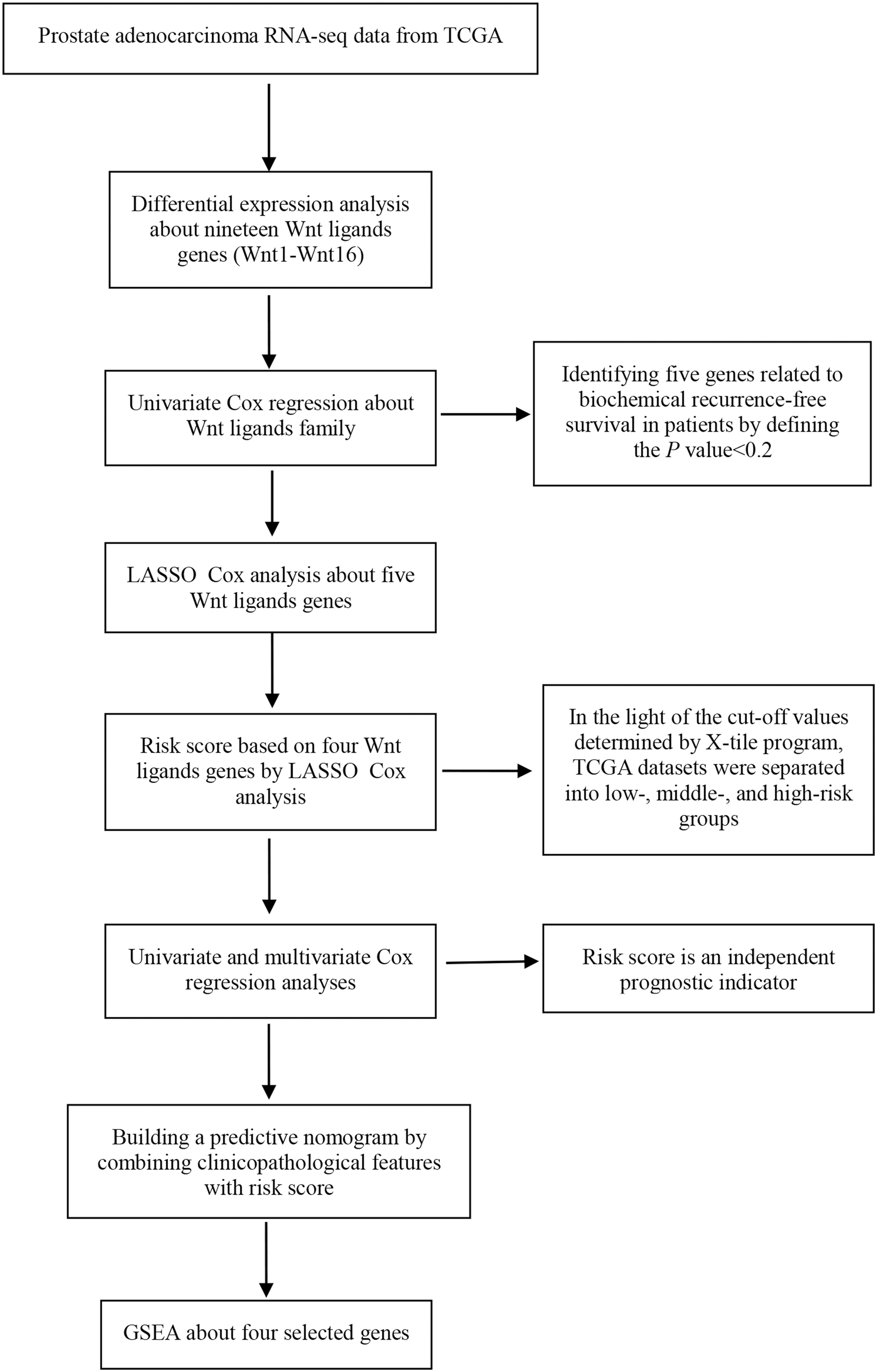
A flow chart of the study. GSEA, gene set enrichment analysis; LASSO, least absolute shrinkage and selection operator; TCGA, The Cancer Genome Atlas.

Heatmap for Wnt ligands gene family differential expression. *p < 0.05 and ***p < 0.0001.
3.2. Prognostic value of Wnt ligands genes, and the risk score model built using four selected Wnt ligands genes
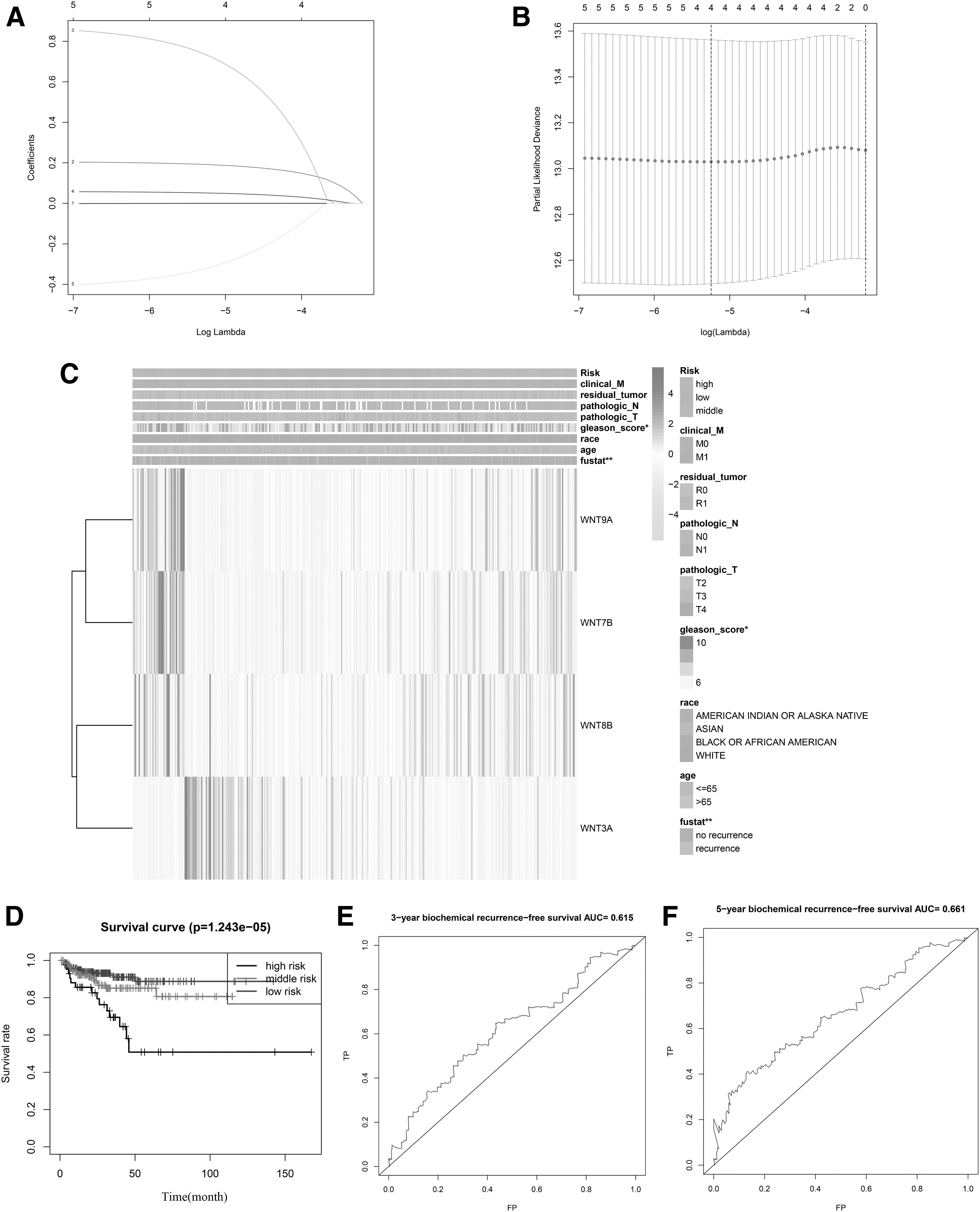
First, we performed a univariate Cox regression analysis of the expression levels of 19 Wnt ligands genes (Wnt1–Wnt16), the result is shown in Supplementary Table S1. We identified five genes (Wnt5B, Wnt9A, Wnt8B, Wnt7B, and Wnt3A) related to biochemical recurrence-free survival in patients by considering the p-value <0.2 as significant. To better predict the relationship between Wnt ligands genes and biochemical recurrence of prostate adenocarcinoma, we used LASSO Cox regression algorithm to analyze five prognosis-related genes (Fig. 3A, B). Finally, four genes were selected based on the minimum criteria to construct a prognostic risk score. The risk score was figured out using a linear combination of the expression level of four Wnt ligands genes weighted by the certain regression coefficient (β), the risk score = (0.192 × expression level of Wnt9A) + (0.732 × expression level of Wnt8B) + (0.051 × expression level of Wnt7B) + (−0.320 × expression level of Wnt3A). Positive coefficients are shown in Cox regression analysis, suggesting that these genes have high risk characteristics. We used the X-tile program to derive the best threshold for risk scores (Supplementary Fig. S2), dividing patients into high-, medium-, and low-risk groups. We observed significant difference in biochemical recurrence-free survival on the three groups (Fig. 3D, p < 0.0001), The ROC curve showed that the risk score can accurately predict the biochemical recurrence-free survival of patients with prostate cancer (Fig. 3E, F). The heatmap showed the expression levels of the four Wnt ligands genes in the three risk groups (Fig. 3C). We observed that the four-gene prognosis risk score was closely related to Gleason score of prostate adenocarcinoma (p < 0.05).
3.3. Building a nomogram based on the risk score and clinical covariates
We performed univariate and multivariate Cox regression analyses to confirm that the risk score is an independent risk factor (Fig. 4; Table 1). Then, nomogram predicting biochemical recurrence risk in prostate adenocarcinoma was constructed based on the risk score and clinical characteristics (Fig. 5A). The C index was 0.719. The calibration curve showed that the nomogram performed well (Fig. 5B, C). Both C index and the calibration curve suggested a good predictive performance.

Univariate

Univariate and Multivariate Cox Regression Analyses of the Characteristics and the Risk Score in Patients
CI, confidence interval; HR, hazard ratio.
3.4. Gene set enrichment analysis
To explore the potential role of the four selected genes in prostate adenocarcinoma, we conducted GSEA between low- and high-expression data sets. We chose the most meaningful enrichment signal pathways, and the results are shown in Table 2 and Figure 6. The results indicated that the high-expression genes were rich in malignant tumor-associated biological processes. P53 signaling pathway, vascular endothelial growth factor (VEGF) signaling pathway, prostate cancer pathway, and Wnt signaling pathway were differentially enriched in Wnt7B high-expression phenotype (Fig. 6A); mammalian target of rapamycin (MTOR) signaling pathway, Wnt signaling pathway, and prostate cancer pathway were differentially enriched in Wnt8B high-expression phenotype (Fig. 6B). And mitogen-activated protein kinase (MAPK) signaling pathway, NOTCH signaling pathway, Wnt signaling pathway, extracellular matrix (ECM)–receptor interaction, and transforming growth factor-β (TGF-β) signaling pathway were differentially enriched in Wnt9A high-expression phenotype (Fig. 6C).

Enrichment plots from GSEA, KEGG pathways associated with Wnt7B
Gene Sets Enriched in Increased Expression Phenotype
Gene sets with NOM p-value <0.05 and FDR q-value <0.25 are considered as significant.
ECM, extracellular matrix; FDR, false discovery rate; KEGG, Kyoto Encyclopedia of Genes and Genomes; MAPK, mitogen-activated protein kinase; MTOR, mammalian target of rapamycin; NES, normalized enrichment score; NOM, nominal; TGF, transforming growth factor; VEGF, vascular endothelial growth factor.
4. Discussion
The Wnt signaling pathway was divided into a canonical pathway that was dependent on β-catenin and a noncanonical Wnt signaling pathway that was independent of β-catenin (Angers and Moon, 2009; Miyamoto et al., 2015; Schneider and Logan, 2018). The Wnt signaling pathway is involved in a variety of important processes in cancer progression, including tumor initiation, tumor growth, cellular senescence, cell death, differentiation, and metastasis (Anastas and Moon, 2013). Previously, several reviews have reported the role of Wnt signaling in prostate cancer (Kypta and Waxman, 2012; Yokoyama et al., 2014; Schneider and Logan, 2018). However, there is a lack of comprehensive analysis on the relationship of Wnt ligand expression and clinicopathological features and biochemical recurrence of prostate cancer.
In this study, based on data obtained from TCGA, we comprehensively evaluated the association between Wnt ligands gene family and biochemical recurrence of prostate cancer based on data obtained from TCGA. We observed that the risk score based on messenger RNA (mRNA) expression levels of several specific Wnt ligand family genes (Wnt3A, Wnt7B, Wnt8B, and Wnt9A) was associated with biochemical recurrence of prostate cancer (Fig. 3D, p < 0.0001). In addition, we found that the risk scores based on the four selected genes were significantly correlated with Gleason score (p < 0.05). We also demonstrated that risk score was an independent prognostic factor. In addition, we constructed a nomogram to predict biochemical recurrence-free survival in patients with prostate adenocarcinoma. The C index and calibration curve indicated that the predictive performance of the nomogram was good. GSEA revealed the KEGG pathway of the four selected genes (Fig. 6), which were closely related to the development of malignant tumor.
Wnt3A ligand was a member of a canonical Wnt family (Pashirzad et al., 2019). Many studies have reported the significance of Wnt3A and the role of Wnt signaling in the pathogenesis of prostate cancer. Li et al. (2008) found that the frequent loss of stromal TGF-β type II receptor expression in human prostate cancer could relieve the paracrine suppression of Wnt3A expression. It was reported that Tmem64 was involved in the metastatic progression of prostate cancer cells by regulating Wnt3A secretion (Moon et al., 2019). According to previous studies, the expression of Wnt3A was associated with poor prognosis in many cancers, including hepatocellular carcinoma (Pan et al., 2016) and esophageal cancer (Oguma et al., 2018). Surprisingly, our study showed that the expression level of Wnt3A was negatively correlated with the biochemical recurrence of prostate cancer (LASSO regression coefficient = −0.320). This may be due to the biological heterogeneity of prostate adenocarcinoma at different stages, and further research is needed in the future to reveal the relationship between the expression level of Wnt3A and biochemical recurrence of prostate cancer. Previous study has shown that the expression of Wnt7B was essential for the growth of prostate cancer cells, and Wnt7B signaling pathway might be one of the key mechanisms of osteoblastic bone metastasis in advanced prostate cancer (Zheng et al., 2013). The specific mechanism of Wnt8B and Wnt9A in prostate cancer is not clear. Our study showed that the high-expression levels of Wnt8B and Wnt9A were closely related to the biochemical recurrence of prostate adenocarcinoma.
There are some limitations in this study. First, the population race in the TCGA database was mainly limited to whites and blacks. In addition, we have not externally verified the nomogram, so some bias might be inevitable. The specific mechanism of Wnt8B and Wnt9A in prostate cancer was not investigated in the previous literature. Therefore, future studies may focus on the molecular mechanisms underlying the potential interaction of Wnt8B and Wnt9A in prostate adenocarcinoma progression.
5. Conclusion
In general, we comprehensively evaluated the association between Wnt ligands family genes and biochemical recurrence of prostate cancer. We developed a risk score model based on mRNA expression levels of several selected Wnt ligand family genes (Wnt3A, Wnt7B, Wnt8B, and Wnt9A), which was significantly associated with biochemical recurrence of prostate cancer. Our results might be helpful for future molecular studies focusing on the biochemical recurrence of prostate cancer.
Footnotes
Statement of Ethics
Because the data set in this study was downloaded from TCGA, and data acquiring and application complied with the TCGA publication guidelines and data access policies, additional approval by an ethics committee and consent to participate were not needed.
Authors' Contributions
M.H. and J.X. carried out extraction of data, interpretation of the results, and wrote an initial article. X.W. and J.X. assisted with article editing. M.H. and Z.L. performed the data analyses. M.L. and J.W. provided feedback on the article and contributed to the study idea. All authors read and approved the final article.

Author Disclosure Statement
The authors declare they have no conflicting financial interests.
Funding Information
This study was supported by Beijing Natural Science Foundation (Grant No. 7194315) and Chinese Academy of Medical Sciences (CAMS) Innovation Fund for Medical Sciences (Grant No. 2018-I2M-1-002).
References
Supplementary Material
Please find the following supplemental material available below.
For Open Access articles published under a Creative Commons License, all supplemental material carries the same license as the article it is associated with.
For non-Open Access articles published, all supplemental material carries a non-exclusive license, and permission requests for re-use of supplemental material or any part of supplemental material shall be sent directly to the copyright owner as specified in the copyright notice associated with the article.
