




Abstract
The stochastic susceptible–infected–vaccinated (SIV) epidemic model includes a nonlinear term, making it difficult to obtain analytical solutions. Thus, numerical approximation schemes are an important tool for predicting the dynamics of infectious diseases and establishing optimal control strategies. However, the convergence rate of the existing numerical methods [e.g., Euler-Maruyama (EM) and truncated EM scheme] is only 1/2 order of the time step
INTRODUCTION
Medical research has shown that some diseases, particularly tuberculosis, hepatitis B, hand, foot, and mouth diseases, and COVID-19, do not produce permanent immunity, and so subjects can become reinfected after vaccination (Anderson et al., 1985; Kaufmann and Mcmichael, 2005; Keeling, 2003; Tildesley et al., 2006; Wei and Chen, 2014). Such diseases can be simulated by susceptible–infected–vaccinated (SIV) epidemic models (Arino et al., 2003; Safan and Rihan, 2014). As SIV epidemic models predict the dynamics of an epidemic, they enable doctors to provide better treatment (Deng and Liu, 2020) and have thus attracted considerable attention (Arino et al., 2003; Lin et al., 2014; Liu et al., 2018; Magpantay et al., 2014; Zhao and Jiang, 2015).
To date, there have been several studies on the deterministic SIV epidemic model (Arino et al., 2003; Magpantay et al., 2014). Considering that the spread of an epidemic is always affected by random noise, deterministic models cannot capture all the inherent fluctuations (Liu et al., 2018). Thus, stochastic SIV epidemic models incorporating white noise have been established. For example, Zhao and Jiang (2015) studied the ergodicity of a stochastic SIV epidemic model with vaccination, whereas Lin et al. (2014) proved the stationary distribution of a stochastic SIV epidemic model.
As well as being affected by temperature, humidity, climate, and other factors, epidemic models are also subject to telegraph noise, which may lead to the parameters of the system switching from one environmental state to another (Li et al., 2017; Mao and Yuan, 2006; Zhang et al., 2016). In most cases, the switching between environmental regimes is memoryless, and the waiting time for the next switching event follows an exponential distribution (Li et al., 2017). Many studies (Mao and Yuan, 2006; Li et al., 2017; Zhang et al., 2016) have shown that Markov switching can describe this phenomenon. For instance, Zhang et al. (2016) analyzed the following system:

Let
For model (1), considerable attention has focused on the long-time behavior; see Li et al. (2017) and Zhang et al. (2016) and the references therein. Note that, to better predict the number of infected individuals and design controls for infectious diseases, it is necessary to obtain exact solutions of model (1). As this model includes a nonlinear drift term, it is fairly difficult to obtain an exact solution. Therefore, the construction of accurate and efficient numerical methods for approximating models of this form is an urgent topic. As we know, the explicit Euler-Maruyama (EM) numerical method has a simple algebraic structure and is computationally inexpensive (Berres and Ruiz-Baier, 2011; Mao and Yuan, 2006).
For most stochastic differential equations, the EM scheme is a valuable tool (Lamba, 2007; Mao and Yuan, 2006; Yuan and Mao, 2004). However, the positivity of the numerical solution cannot be guaranteed using the classical EM method for model (1), which satisfies the local Lipschitz condition and has a complex structure. The convergence rate is half the order of the time step for most existing numerical methods (Lamba, 2007; Mao and Yuan, 2006). Therefore, the study of positive numerical solutions with high convergence rates for the stochastic SIV epidemic model with Markov switching remains incomplete.
The novel coronavirus epidemic outbreak has had a great impact on people's lives and on the global economy. The control of infectious diseases has aroused widespread concern among scholars, such as isolation, inoculation, treatment, and social distancing (Telenti et al., 2021; Worthmann et al., 2021). Therefore, studying the optimal control of model (1) is of great significance. Most previous studies have applied Pontryagin's maximum principle and dynamic programming to solve optimal control problems. For example, Buonomo et al. (2014) studied a stochastic SIV epidemic model with regimen switching in which the aim was to minimize the average costs, whereas another study investigated the near-optimal control of the SIV epidemic model with Markov switching (Kar and Batabyal, 2011).
The above references (Buonomo et al., 2014; Kar and Batabyal, 2011) investigated the optimal control of an epidemic model under an admissible set of convex solutions (Buonomo et al., 2014; Laarabi et al., 2011; Kar and Batabyal, 2011). In the real world, convexity is not always satisfied, and the optimal control may not be determined by Pontryagin's maximum principle and dynamic programming. To better control the number of infected individuals using model (1), it is crucial to establish optimal control theory and present more challenging analysis.
This article presents a logarithmic truncated EM (log-TEM), scheme combined with a log transform (Lamba, 2007) and truncated EM numerical methods (Mao and Yuan, 2006; Yang and Huang, 2021). Our key idea is to transform model (1) into another low-dimensional system using the Itô formula and log transformation. We can preserve the positivity of numerical solutions for model (1) by transforming back to the original space. Furthermore, we propose relaxed controls to study the existence of optimal control with nonconvex assumptions. The main innovations of our article are as follows:
The existing literature on stochastic SIV epidemic models primarily focuses on dynamic behavior; however, numerical solutions are rarely studied. The convergence accuracy of the positivity of numerical solutions to stochastic epidemic models (Berres and Ruiz-Baier, 2011; Li et al., 2017) is only 1/2 order of the time step. In this article, we present the log-TEM scheme, which provides approximate solutions that achieve order-1 of the time step and ensure the positivity of the numerical solution for model (1). For the study of near-optimal control theory of stochastic differential equations, existing literatures (Zong and Zhang, 2023; Zong et al., 2019) assume that the admissible control set U is convex. This article is based on a non-convex U, and a relaxed control strategy is provided for the stochastic SIV epidemic model with Markov switching. At the same time, a numerical approximation scheme, which is converging to the optimal control strategy, has been constructed. Our results can be considered as extensions of existing literatures on optimal control of the stochastic SIV epidemic model.
The remainder of this article is organized as follows. Some necessary preliminary knowledge and a novel SIV epidemic model are introduced in Section 2. The invariant measure of the numerical solution to our SIV epidemic model is given in Section 3, before the convergence of the log-TEM numerical method is proved in Section 4. In Section 5, the numerical approximation scheme for relaxed control by the Markov chain approximation method is established. Numerical examples are given to illustrate our theoretical results in Section 6. Finally, some concluding remarks are presented in Section 7.
PRELIMINARIES
We assume the Markov chain 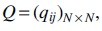 such that for a sufficiently small
where  (Mao and Yuan, 2006).
Based on the idea of the epidemic control policy, the SIV epidemic model that incorporates the treatment of the infected population as a control measure is extended. As in Anderson et al. (1985), Wei and Chen (2014), and Keeling (2003), we assume that the treatment control can containment of disease outbreaks. That is, the treatment control
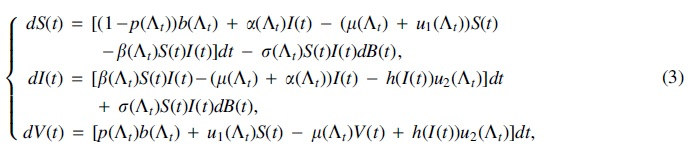
where
To proceed further, our work bases on the following assumption.
where c and K denote different positive constants.
and linear treatment function
From application and biological perspectives, the long-time behavior of an epidemic is one of its most important properties. A fundamental question in studying long-time behavior is whether an invariant measure exists. In this section, the existence and uniqueness of an invariant measure for model (3) is discussed. Similar to the study by Gray et al. (2012), one can define the basic reproduction number of the stochastic SIV epidemic model with Markov switching (3) as
the disease-free equilibrium E0 is globally stable (Beretta and Takeuchi, 1995)
Moreover, if
is Markovian and Feller continuous.
Define a set of probability measures
The proof of Theorem 2 is given in Section 8.1.

the distance
Give a stepsize  In general, the data of vaccinated and infected individuals are available directly from the Centers for Disease Control, whereas the data regarding susceptible individuals are difficult to be obtained. It is obvious that

then
where
or equivalently
By the Itô formula, one sees that
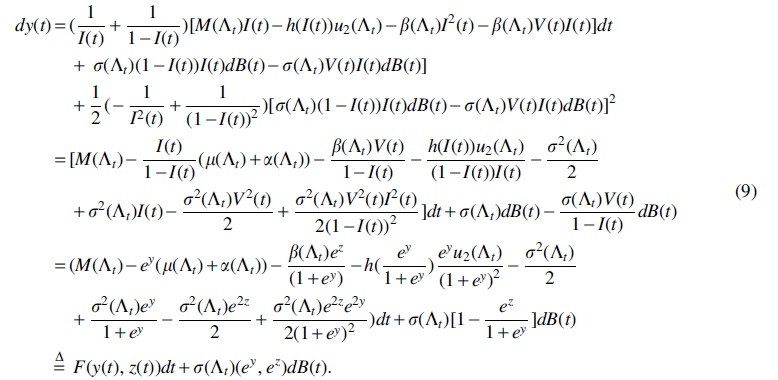
Applying the Itô formula, we get
with

where
gives a strictly positive approximation of the system (7).
To define appropriate numerical solutions, an explicit scheme for approximating the exact solution of the stochastic SIV epidemic model (3) is proposed. For any given
Then, we define a truncated EM scheme
where
where
Using the above proposition, we will obtain the existence and uniqueness of positive solutions to system (8). In particular, the positivity of the solution ensures the practical constraints of epidemic models.
Proof. First, picking
By similar method with Gray et al. (2012), we can proof the theorem.

where
and
Proof. For any

Let
Letting
For any

By similar method as above,  can be obtained.
The proof is completed.
where Cp is given in Equation (16).
Proof. Note that

Similarly, for any
Noticing that
Therefore,
The proof is completed.
This section derives the rate of convergence for the log-TEM explicit scheme. To prove the main results, two lemmas are first presented. For stochastic differential equations with Markov switching (Mao and Yuan, 2006), it is obvious that the EM scheme is an approximation of the model (9).

where
and
where C is a constant dependents on p.
Proof. Letting
and
the following inequalities can be derived
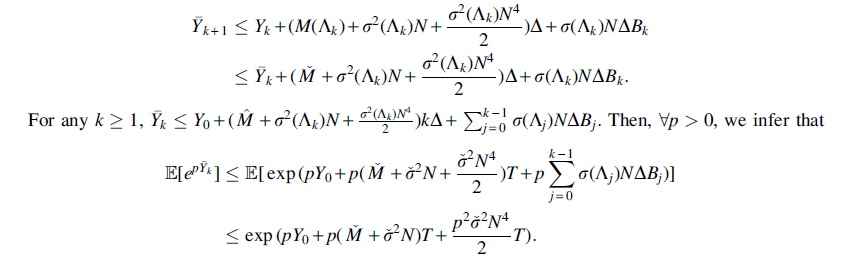
Using similar arguments developed above, it is easy to prove
The proof is completed.
Lemma 4 proves that the truncated EM scheme (13) is bounded. To investigate the rate of convergence of the log-TEM numerical solutions, the boundedness of scheme (13) is first proved.

where
Proof. For any integer

with
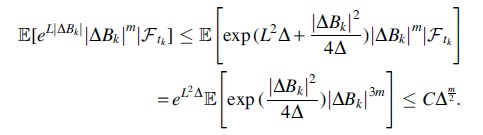
The proof is completed.
The following lemma proves the boundedness of the inverse moment of the truncated EM scheme (13).
where
The proof of Lemma 6 is given in Section 8.2.
Let
It is not difficult to get
where C is a positive constant. Moreover, by Lemma 5, we conclude that

Using similar method, let

and implies
where C is a positive constant independent of
To show that numerical scheme (13) accurately reproduces the dynamical behaviors of exact solutions, the rate of convergence of the numerical solutions needs to be studied.

Proof. Define
It follows Lemma 2, Equations (13) and (20), we yield that
It follows from Equations (22) and (23) that
where
By a similar analysis, we also have
Obviously,
Hence, the desired conclusion holds.
and
Proof. By the log-transformation, one has
By Theorem 4, for any
The proof is completed.
for any
Compared with previous studies (Mao and Yuan, 2006; Yuan and Mao, 2004), the convergence rate of the numerical method for solving the stochastic SIV epidemic model with Markov switching has been improved. Our results show that an order-1 convergence rate can be achieved using the log-TEM numerical method.
To give the process of relaxed control, let the process
where
A strategy
where
The cost function is as follows:
The practically meaning of the cost function is detailed in the study by Tran and Yin (2021). The Hamilton–Jacobi–Bellman (HJB) equation of the stochastic SIV epidemic model (3) is

for all
Since the convexity is not satisfied, the optimal control may not be determined by Pontryagin's maximum principle and dynamic programming. To overcome the non-convexity of the control set U, one has to develop the Markov chain approximation method to study relaxed controls. The definition of relaxed control is given as follows.
Given a relaxed control
Using the Markov chain approximation method, the controlled Markov chain in discrete time can be constructed to approximate the controlled switching diffusions. One of the advantages of this is that little regularity or prior information of the stochastic SIV epidemic system is needed.
Let
The sequence uh is said to be admissible if it satisfies the following conditions:
(a) uh is
(b) For any

(c)
Let

For

with
The discrete HJB equation for the stochastic SIV epidemic model (3)

for any
with
Constructing a continuous-time interpolation of the approximating chain. Define

The piecewise constant interpolation processes is denoted by
Define
Recall that

with
Based on the definition of relaxed control, Equation (31) can also be expressed as:
Note also that the value function defined in Equation (24) can be rewritten as
where
The goal of this section is to establish the convergence of the numerical algorithms for optimal control. First, a sequence for the continuous-time interpolation defined in Equations (28)–(29) is introduced. Second, the convergence of the value function is proved.
(i) The sequence
is tight. As a result,  has a weakly convergent subsequence with limit
Moreover,
(ii) For any
(iii)
(iv) The limit process satisfy
Proof. (i) By [(Song et al., 2006), lemma 3.4], we have
By Song et al. (2006), one infer that
(ii) Follows from (i) and Equation (30), (ii) is obtained.
(iii) By the definition of
where

where K is a positive constant and
where
and

where
Since
The proof is completed.
Consider the Markov chain with the transition probability in Equation (27). Using the relaxed control representation, its interpolation process can be represented by Equation (32). Following Song et al. (2006), let
To illustrate the theoretical results obtained in previous sections, a number of examples and simulations are now considered. Let the initial values
The coefficients in each state are presented in Table 1. According to the studies by Lin et al. (2014) and Zong and Zhang (2023), the parameters values are chosen as follows:
Value of the Coefficients
Value of the Coefficients
In this section, the existence of the unique ergodic invariant measure for the stochastic SIV epidemic model (3) with Markov switching is confirmed by several numerical simulations. Figure 1 shows the density kernels of solutions to (3) for the three groups
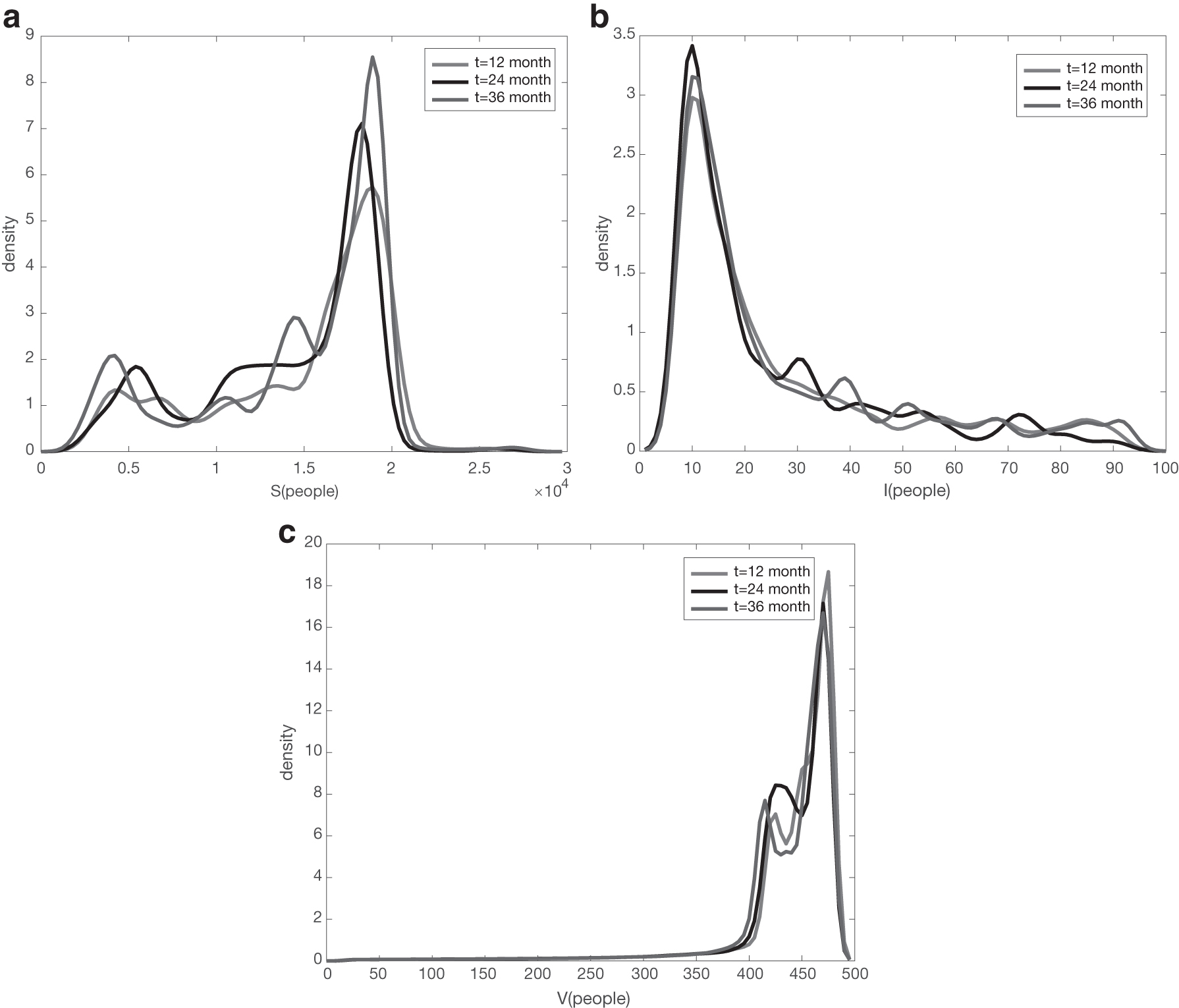
Density plots

Density plots
Figures 3 and 4 show that the sample paths of solutions to the stochastic SIV epidemic model with Markov switching are the same as those of the classical EM scheme from 0 to 50 months. Figures 5 and 6 show the sample paths of the solutions given by the log-TEM numerical method. To compare these with the simulation results given by the classical EM method, all parameters are listed in Table 1. We find that the positivity of the simulated numerical solution of model (3) can be achieved by the log-TEM method. From these figures, one can see that the EM method is not sufficient to ensure the positivity of the numerical solutions.

The path of classical EM solution of
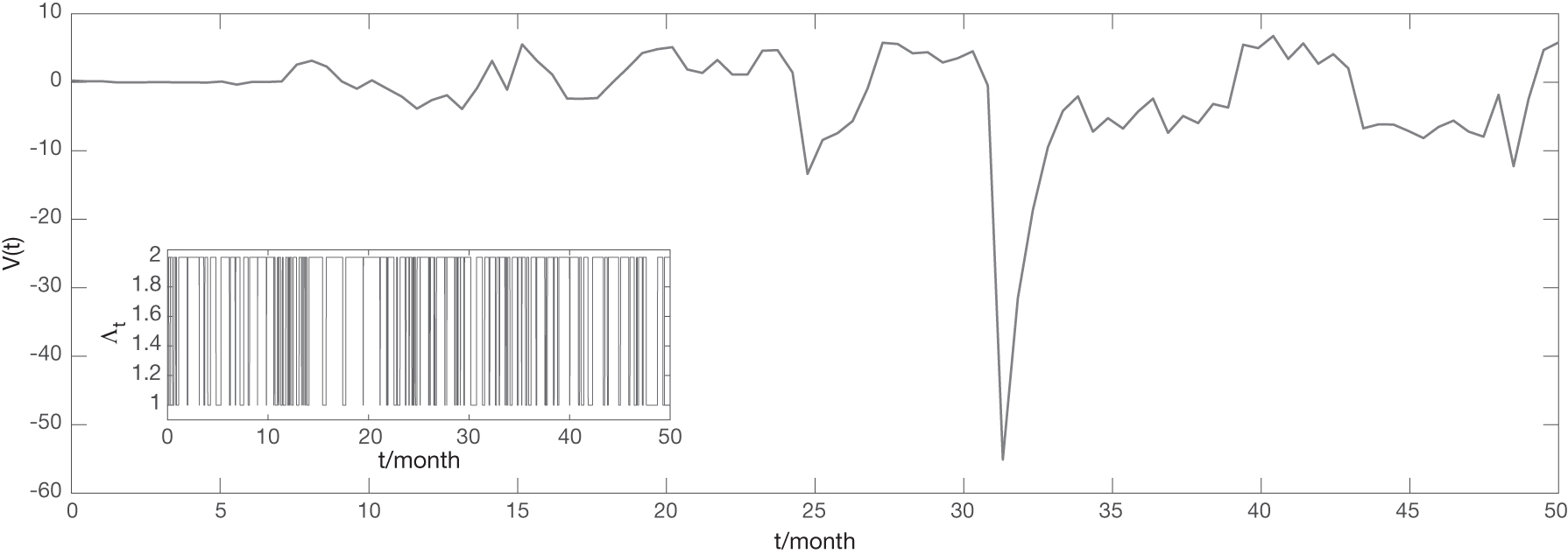
The path of classical EM solution of
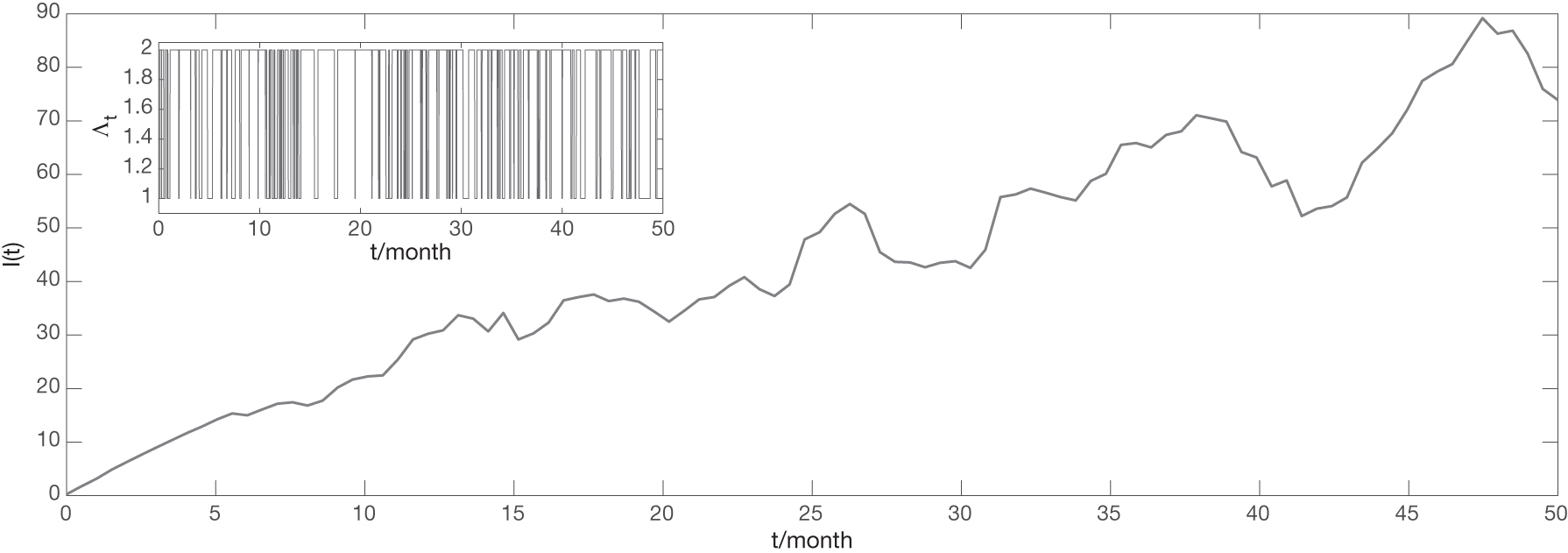
The path of log-TEM solution of
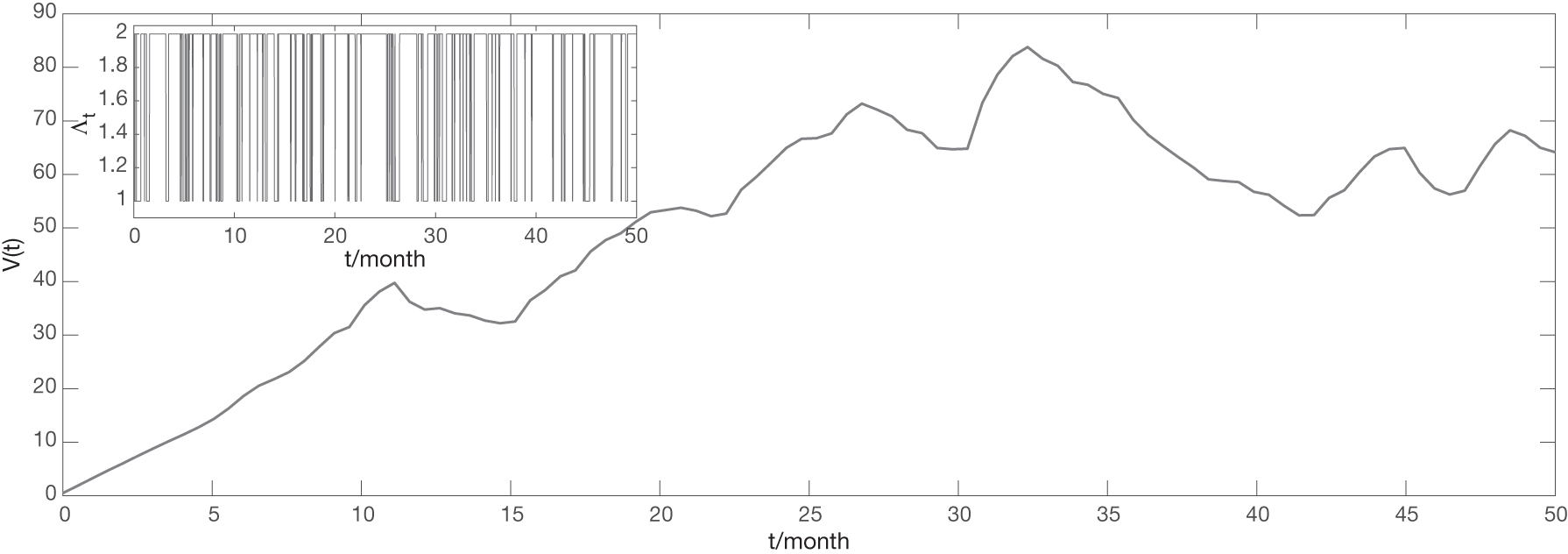
The path of log-TEM solution of
We regard the approximation with

Next, we plotting the log approximation error  with 500 independent trajectories. Figure 7a shows the error of the truncated logarithmic EM scheme for
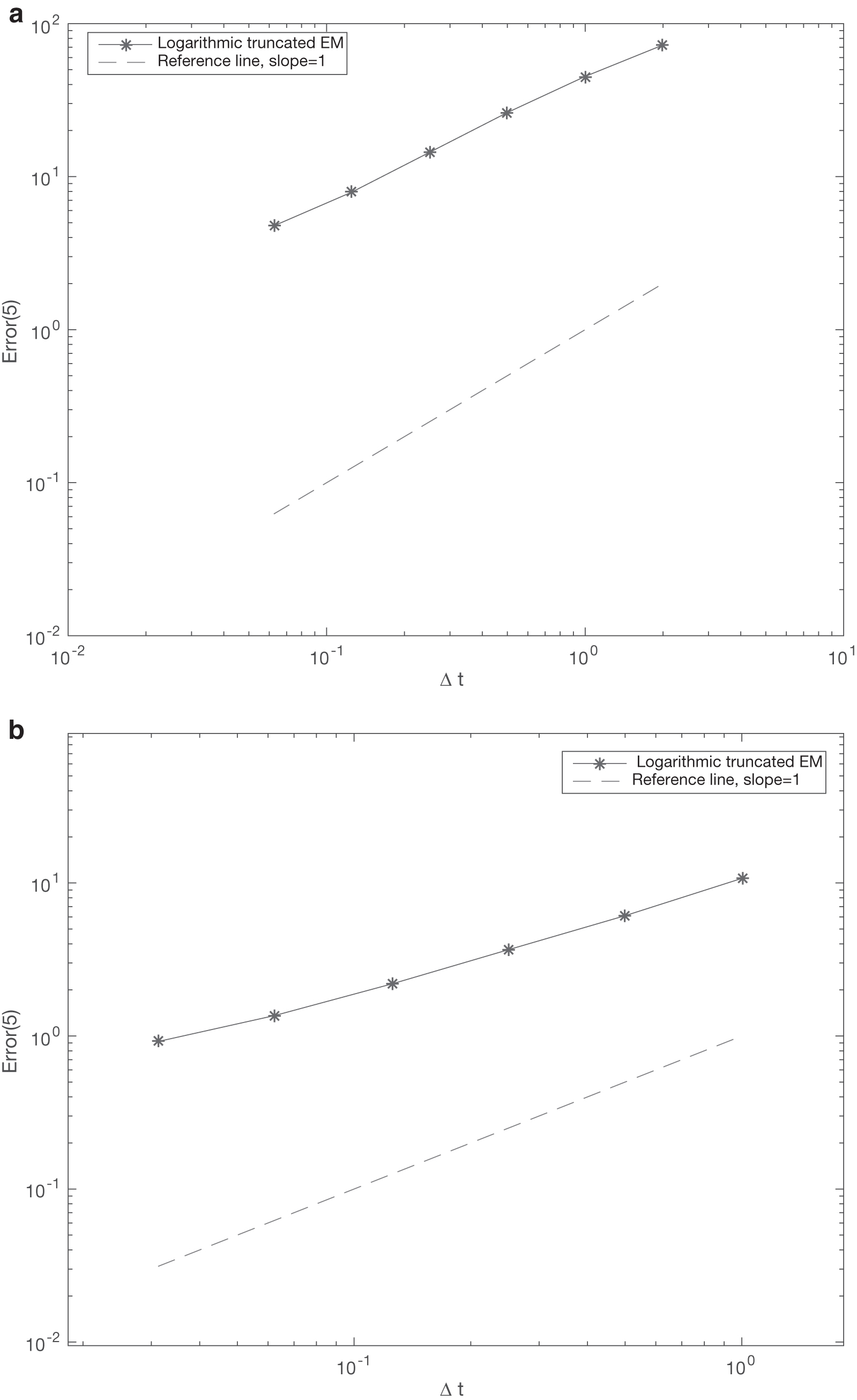
The solid-line trajectory depicts the approximation error of the exact solution and the log-TEM numerical solution of model (11) as the functions of stepsize

The approximation error  with 500 independent trajectories. Figure 7b shows the error of the truncated logarithmic EM scheme for
In this section, we assume that the discounting factor of objective function is
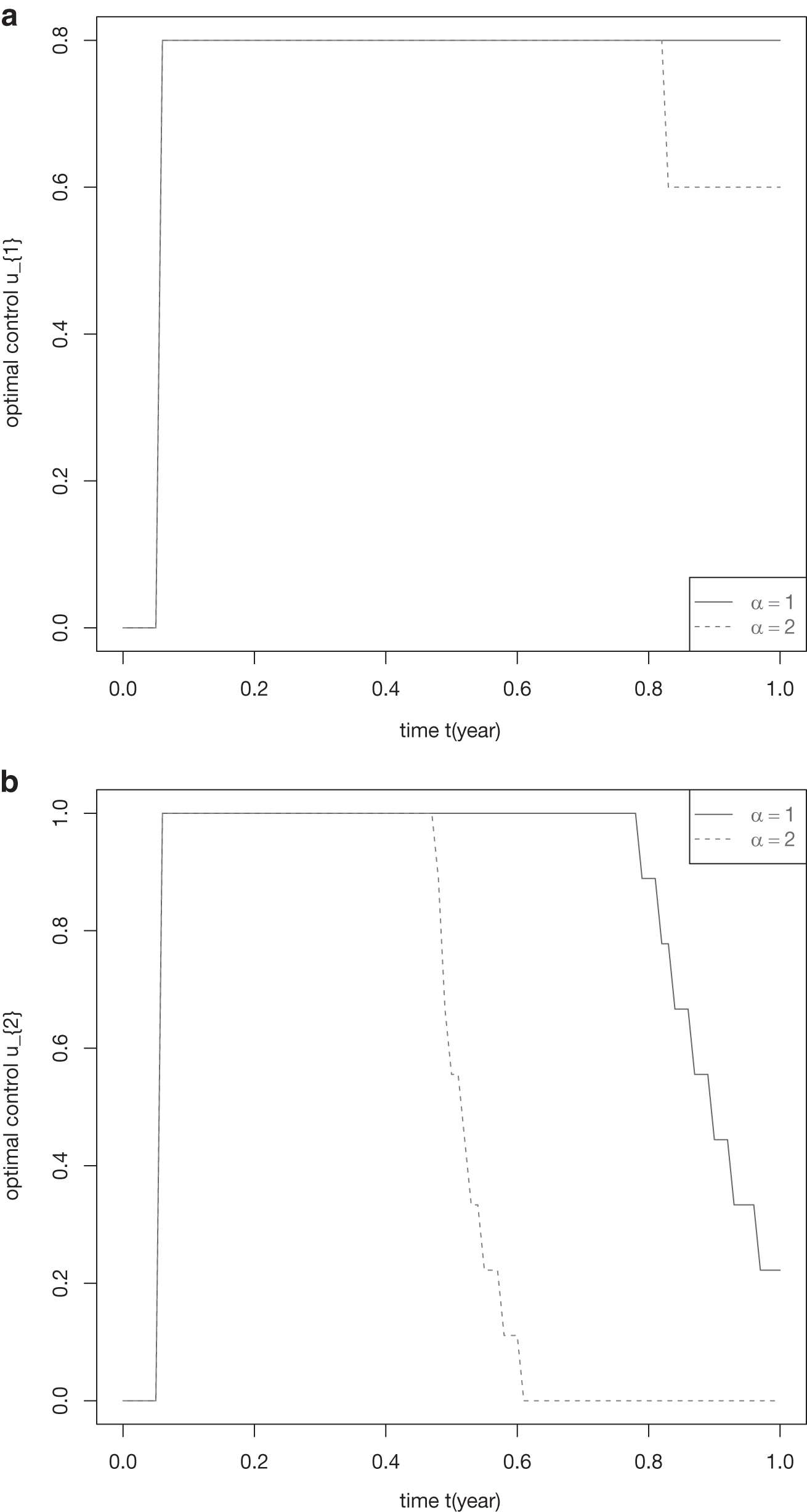
The trajectory depicts the optimal control u1 and u2 of model (11).
Algorithm
In this article, the positivity of numerical solutions for a stochastic SIV epidemic model with Markov switching has been considered. A new numerical method that preserves positivity has been established under certain conditions. The proposed log-TEM scheme provides numerical solutions that are guaranteed to be positive. The existence of an invariant measure for a stochastic SIV epidemic model with Markov switching has been studied. Additionally, relaxed controls for the stochastic SIV epidemic model were investigated using the Markov chain method to approximate the continuous-time dynamics. These conditions lead to meaningful numerical approximations. Based on model (3), we have obtained the following results:
(a) The log-TEM scheme guarantees positive numerical solutions with strong order-1 convergence.
(b) Compared with previous schemes (Kar and Batabyal, 2011; Li et al., 2017; Magpantay et al., 2014), the assumptions for control problems have been relaxed, and the convexity requirements for the state function and cost function have been removed.
Footnotes
ACKNOWLEDGMENTS
The authors would like to express the sincerest gratitude to all the anonymous reviewers for their comments and opinions on the article, which were of great help to the article.
AUTHORs' CONTRIBUTIONS
All authors agree that they have read and approved the article.
AUTHOR DISCLOSURE STATEMENT
The authors declare they have no conflicting financial interests.
FUNDING INFORMATION
This work is supported by the National Natural Science Foundation of China (Grant No. 12161068).