In this article, the qualitative properties of a stochastic dual virus parallel transmission model with immunity delay are analyzed. First, we use Lyapunov theory to study the existence and uniqueness of the global positive solution of the proposed model. Second, the threshold values of the persistence and extinction of two viruses were obtained. Finally, the numerical simulation verifies the theoretical results. The results show that the immunity delay and the intensity of noise have important effects on the two diseases spreading in parallel.
INTRODUCTION
In the process of human social development, infectious diseases are threatening human health, life safety, and economic security from beginning to end (Fan H et al., 2023; Majumder et al., 2021a; Zhang J et al., 2023). The mathematical models were used to describe the spread of disease as an important tool. Most models usually consider only one disease, but in real life, it is likely that two or three diseases exist simultaneously (Fudolig and Howard, 2020; Yaagoub and Allali, 2023; Zhao et al., 2020), such as the COVID-19 in 2019 (Liu and Jiang, 2023; Singh and Arquam, 2022; Wang et al., 2022b) and influenza A (Baba et al., 2018; Kumar et al., 2022), the HIV and hepatitis B. Although two infectious diseases are unrelated, an individual may be infected with both diseases. The scholars have studied the mathematical models in which two or more viruses spread in parallel (Massard et al., 2022; Shami and Lazebnik, 2022). Meskaf et al. (2022) studied an epidemic model of two strains with non-monotonic incidence and discussed the global stability of the model. Khan et al. (2022) discussed the existence and stability of two epidemic models of fractional order. A class of SIR epidemic models of two strains with cross-immunity was proposed in Amador et al. (2019), which discussed the extreme values behavior of the models. Meehan et al. (2018) built a multi-strain epidemic model to study the dynamical behavior of mutated pathogens. Wang et al. (2017) construct the mathematical models of single and multi-strain virus infection to discuss the dynamical mechanism of the virus. A two-strain epidemic model with general incidence rates was proposed by Khyar and Allali (2020), who analyzed the stability of the model. Otunuga (2022) proposed a multi-strain SVEAIR epidemic model to study the spread of infectious diseases in populations infected by disease mutations. In addition, many scholars analyzed the dynamical behavior of infectious disease models with competitive mechanisms and multi-strain infection on complex networks. Li et al. (2023) discussed the stability of two-strain infectious disease model in a complex network and obtained the threshold of coexistence of two strains. Paré et al. (2021) proposed a network multi-competing virus model and obtained sufficient necessary conditions for the existence of parallel equilibrium points for diseases. Sardanyés et al. (2022) analyzed the dynamical properties of the model which the two strain competition models of single and mixed plant infection was presented.
Infectious diseases are affected by many factors in the real transmission process, such as environmental changes, individual differences, human intervention, and so on. Some researchers considered the stochastic model of parallel propagation of two viruses under noise excitation (Chang and Liu, 2022; Hou et al., 2022; Yang et al., 2019). Din et al. (2023) proposed a stochastic viral model for co-infection of hepatitis B virus and COVID-19, who discussed the stochastic dynamical behavior of the disease. Rajasekar and Pitchaimani (2019) showed a stochastic SIRS epidemic model with two viruses and studied the effect of noise intensity on the extinction of each virus. A stochastic epidemic model with dual viruses and vertical transmission was made by Wang et al. (2022a), who analyzed the dynamical behavior of the model using Lyapunov function. Majumder et al. (2021b) studied a deterministic model of the phytoplankton–zooplankton interaction and compared its dynamics with two different stochastic models. Boukanjime et al. (2019) combined two different transmission mechanisms to discuss an infectious disease model with dual hypotheses, proving the extinction and persistence average of the disease in a stochastic system.
Although scholars have conducted above researches on deterministic and stochastic multi-viral transmission diseases, considering that the delay differential equation to describe the infectious disease model can more accurately describe the essence of the development of things (Fan et al., 2023; Zhu 2019). We separately consider that the immunity delay of two viruses is added into the stochastic double virus parallel transmission. The effects of immunity delay and noise on the extinction and persistence of the dual virus transmission model will be further discussed in this article.
This article consists of the following sections: A dual virus parallel transmission model with immunity delay of vaccination and stochastic disturbance is established in Section 2. In Section 3, the existence and uniqueness of global positive solutions for the model are proved. We obtain the threshold values of the persistence and extinction of two viruses in Section 4 and Section 5. In the last section, we verify the theoretical results by numerical simulation.
MODEL BUILDING
Considering the immunity delay of vaccination, based on the above conditions, we propose a stochastic dual virus parallel transmission model with immunity delay of vaccination and analyze the mechanism of disease transmission. The specific model can be expressed by the following system (1):
where S(t), , , , denote the sizes of susceptible(S), infective individuals with virus A(), infective individuals with virus B(), Immune individuals with virus A(), Immune individuals with virus B(), respectively. The parameter meanings in system (1) are as follows: A is the birth rate, β1 and β2 represents the transmission coefficients of viruses A and B, respectively. and are the patient recovery rate of virus A and virus B, respectively. and represent the vaccination rates for viruses A and B, respectively. μ is the death rate, τ1 and τ2 are the validity period of the vaccination. A susceptible person who is vaccinated at moments and will lose immunity at moments t and become susceptible again, since this part of the population still has mortality, the probability of being alive at t moment is , , respectively. All parameters are positive. The basic reproduction number can be obtained from system (1) as
which determine whether the two epidemic diseases occur or not.
The biological system will be affected by uncertain factors, which will affect biodynamic behavior (Lahrouz and Omari, 2013; Liu and Chen, 2015; Yu et al., 2009). Therefore, stochastic factors are considered in the modeling process. Due to the Immune individuals and has no effect on the dynamics of S(t), and , so the following model can be obtained:
where are independent standard Brownian motions, represents the intensities of . The variables in system (2) are constrained by the following initial conditions:
EXISTENCE AND UNIQUENESS OF GLOBAL POSITIVE SOLUTIONS
In order to study the dynamical behavior of the infectious disease model, we first need to consider whether the solution is a global positive solution and prove that there is a unique global positive solution.
Theorem 1.For any given initial value,and,for all,with, system (2) has a unique global solutionfor all t > 0 almost surely.
Proof: Since the coefficients of system (2) satisfy the local Lipschitz condition, then for any initial value , and , for all , with , there exists a unique local solution on , where and is the explosion time. In order to show that this solution is global, we need to show that is almost certainly true. Assume that is so large that are all satisfied. For each integer , define the stopping time as follows:
where . is increasing as . Assume that and a.s. We need to prove that a.s., then a.s. Otherwise, there exist the constants T > 0 and such that . Hence there exist the integers which take
Define a function as follows:
where a is a positive constant. We have the following inequality to get is non-negative According to formula, we get
where
let , then we can obtain
where , therefore we can get
Integrate both sides of the Eq. (6) from 0 to and then
Let , for and in view of Eq. (4), we get such that for each there is at least one of which is equal either k or . Then
There are
where is the indicative function of , let , then
This is a contradict for initial condition, so holds almost everywhere. Therefore, the theorem 1 is proved.
EXTINCTION OF DISEASE
In this section, we discuss the extinction of disease in system (2). First, we give the following lemma.
Lemma 1.(Ji et al., 2011) Letbe a real-valued continuous local martingale vanishing at t = 0. Thenand also
Lemma 2.(Xu and Li, 2018) Letbe the solution of system (2) with any initial value,and,for all,with, thenMoreover
Lemma 3.(Taki et al., 2022) Letbe the solution of system (2) with any given initial condition,and,for all,with, then
Theorem 2.Letbe the solution of system (2) with any initial value,and,for all,with. If,, thenthat is, the , index goes to 0, and the two diseases will become extinct with probability 1. Here
Proof: The second equation of system (2) can be obtained by using formula
then
Notice that
Integrate both sides of equation Eq. (10) from 0 to t to get the following formula
where
and
This is given by lemma 2 and Lemma 3
Bringing Eq. (11) into Eq. (9), the following formula is given:
Then follows from Lemma 1 that
and
If , we can get
where
Therefore we can get
Similarly
where
Therefore we can get
Remark 1.Theorem 3.1 shows that in the case of little white noise, ifand, the two viral infections will be extinct. By, it can be seen thatandare less than the basic regeneration number of the corresponding deterministic system. Thus, the conditions for virus extinction in system (2) are much weaker than those in the corresponding deterministic system.
PERSISTENCE
Definition 1.(C and X, 2018) System (2) is said to be persistent in the mean, if
Theorem 3.Letbe the solution of system (2) with initial value. Ifandare satisfied, then both diseasesandare persistent and meet the following conditionswhere
Proof: Definition .
then
According to Lemma 1, we have
So, we can get
The proof of Theorem 3 is thus completed.
Remark 2.According toTheorems 3.1 and 3.2, in the case of little noise,andare used as key thresholds to measure whether two virus are extinct. Ifand, it indicates that each patient has the ability to infect more than one person during their average illness, causing in the persistence of both viruses. Instead, it indicates that the two viruses may become extinct. At the same time, the change of noise intensity will also affect the persistence and extinction of the virus.
NUMERICAL SIMULATIONS
In this section, we use the method to conduct numerical simulations of the stochastic infectious disease model proposed in this article to support our theoretical results. In particular, the following discretization transformation equation is given:
where , are integers, the time-delay can be expressed by the step size as , . are independent random variables, subject to Gaussian distribution N(0, 1). represents the intensity of white noise. To ensure that the results of representative, this article adopts the method of multiple cycle simulation averaging. Specifically, 20 independent simulation cycles were performed for the sample path and the simulation results of these 20 cycles were averaged as the final estimate.
Based on Table 1, we perform numerical verification and obtain that
and the conditions in theorem 2 are satisfied. Therefore, through the conditions of theorem 2, it can be obtained that viruses and persist at the same time, which is shown in Figure 1. The curve trend in Figure 1 shows that with the increase of time, all the solution curves show a stable trend, that is, the susceptible, infective individuals with virus A, and infective individuals with virus B will reach the corresponding endemic fixed point of system (2) in a limited time, and the class will not change with the passage of time.
The trajectories of system (2) with , .
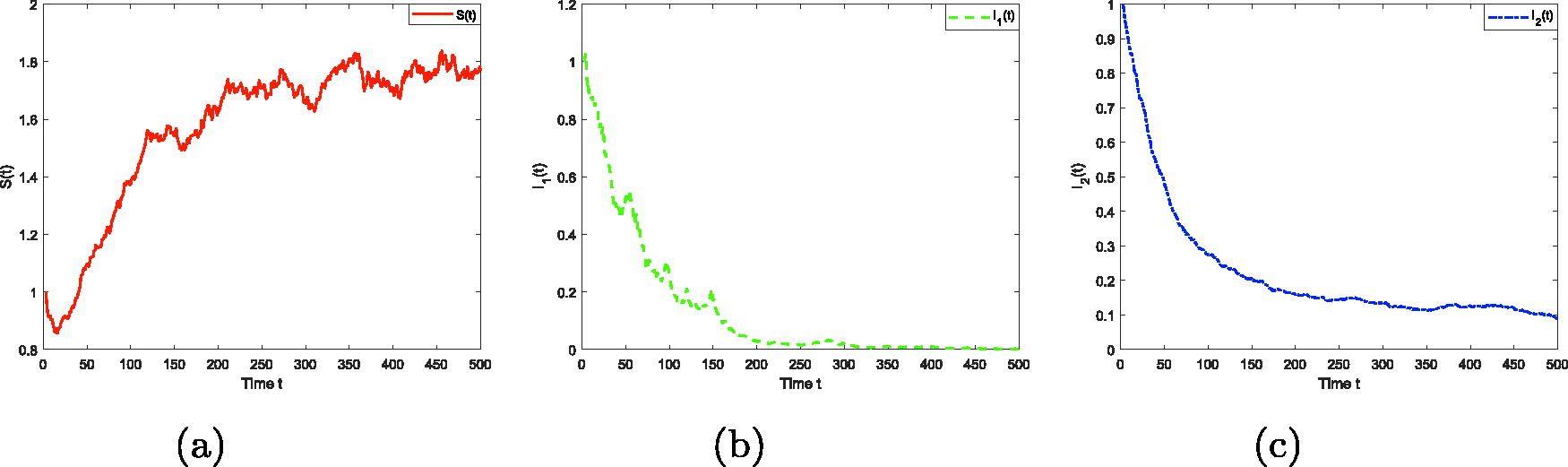
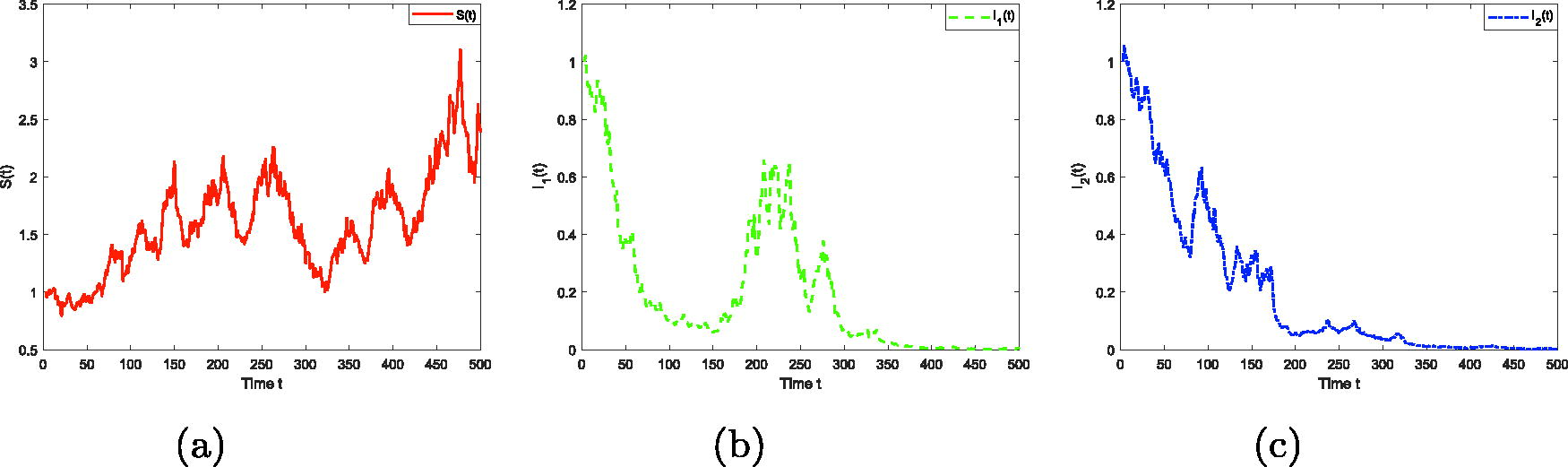
Now, we increase the stochastic disturbance of virus A, so that and keep the other parameters of Table 1 unchanged. Then we can get , . It can be seen from Figure 2(b) that virus A will tend to 0 with probability index 1, that is, virus A will be extinct and virus B will continue, so noise can promote the extinction of virus A.
The trajectories of system (2) with and .
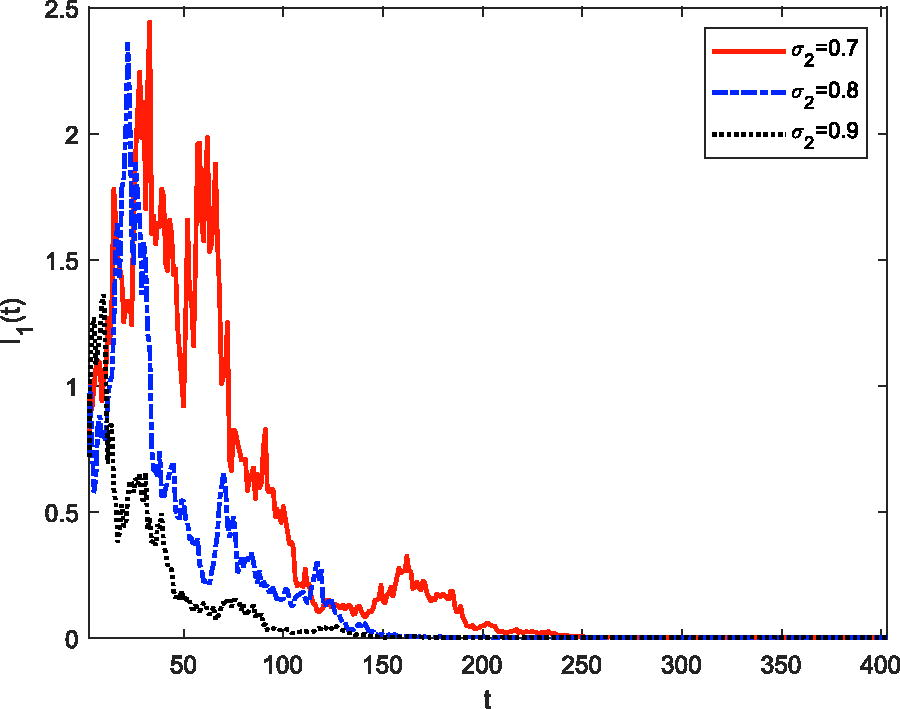
At the same time, we continue to increase the stochastic disturbance of virus A, setting the values of at 0.7, 0.8, and 0.9, respectively, and then paid attention to the influence of noise intensity on virus dynamics. The trend of virus extinction is shown in Figure 3. It can be clearly observed in Figure 3 that with the increase of , the extinction rate of virus A is faster.
The trajectories of system (2) with and .
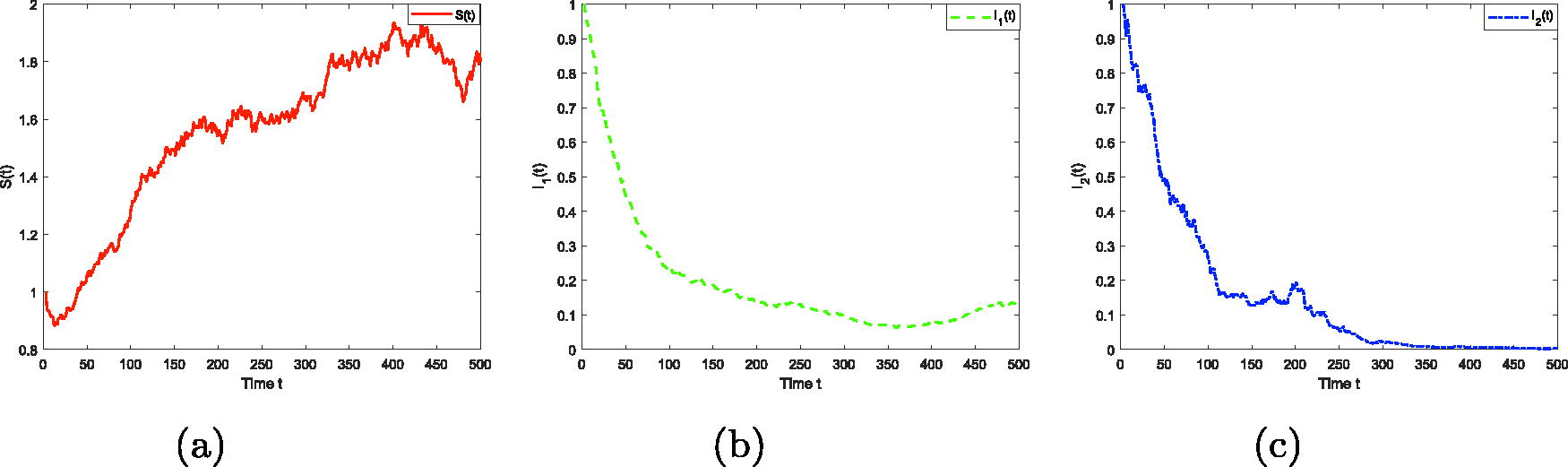
Then we increase the stochastic disturbance of virus B and set . The asymptotic state of the stochastic system is shown in Figure 4. From the curve trend of , It can be found that the curve behaves as a decreasing function, gradually approaching 0 over time. At this time, the numerical calculation results , which is the same as the theoretical result of theorem 2 about the extinction of the disease, that is, the virus B will tend to 0 with the probability 1 index and virus A will persist.
The trajectories of system (2) with and .
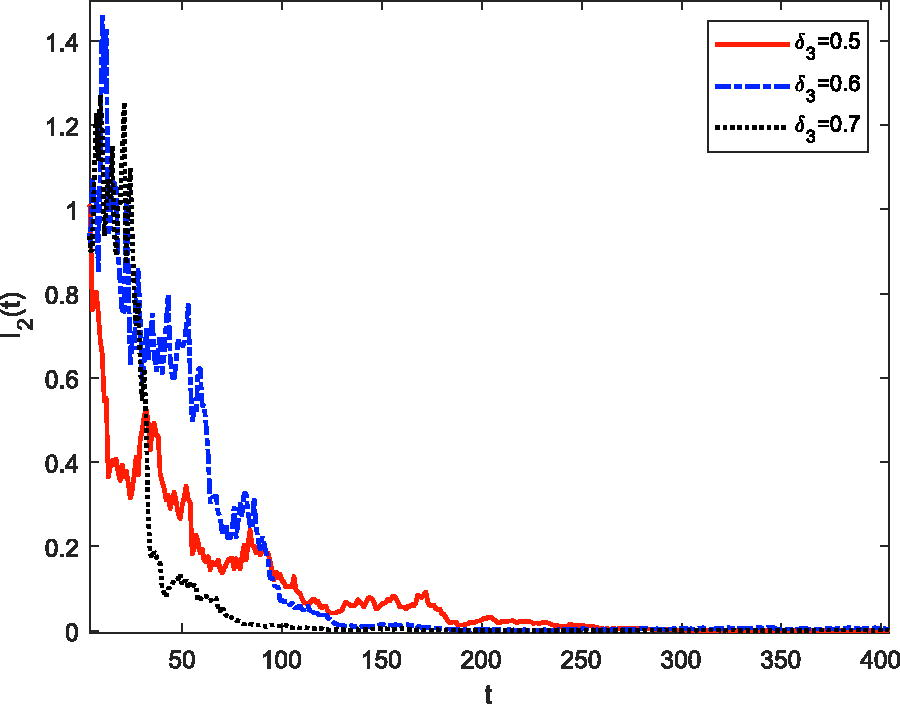
On this basis, we also investigate the stochastic disturbance effect of virus B, set are 0.5, 0.6, and 0.7, respectively. The extinction trend of virus B is shown in Figure 5. In Figure 5, it can be found that with the increase of , the extinction rate of virus B is faster. This finding suggests that stochastic perturbations have a significant effect on virus extinction.
The trajectories of system (2) with and .
Next, we increase stochastic perturbations of virus A and virus B. We set and keep the other parameters of Table 1 unchanged. When and are satisfied, the curve trend of the system is shown in Figure 6, where the curve trend gradually approaches 1 with probability 1, that is, both virus A and virus B tend to be extinct with the increase of time. Therefore, it can be seen from Figure 6 that improving the intensity of the noise is one of the important measures to effectively control the concurrent transmission of dual-virus diseases compared with Figure 1.
The trajectories of system (2) with , .
Finally, we study the effect of immunity delay of the vaccination on the extinction of dual-virus co-transmitted diseases. In Figure 7(a), we select parameters and in Figure 7 the delay parameters are chosen as . From the curve trend in Figure 7, it can be found that both viruses tend to be extinct with probability 1, that is, virus A and virus B tend to be extinct with the increase of immune delay, which is consistent with the result of theorem 2. In addition, with the increase of immunity delay of the vaccination, it can be found that the extinction rate of diseases in Figure 7(b) is higher than that in Figure 7(a), that is, increasing the immunity delay of vaccination is conducive to controlling the spread of diseases and accelerating the extinction of diseases.
The trajectories of system (2) with as (a), (b).
CONCLUSIONS
In this article, a stochastic dual virus parallel transmission model with immunity delay of vaccination is proposed. We added immunity delay of vaccination and noise intensity to the SIRS model to analyze the transmission mechanism of the two viruses. First, the existence and uniqueness of the positive solution of the model was proved using stochastic inequalities. Second, we established sufficient conditions for the extinction and persistence of dual diseases and obtained thresholds for the persistence and extinction of dual diseases spreading in parallel. Finally, through numerical simulation, it is found that the immunity delay of vaccination and the intensity of the noise have important effects on the persistence and extinction of the dual virus parallel transmission diseases.
Through the above theoretical and numerical analysis, we found that system (2) under different conditions, the two diseases may be extinct at the same time, only one virus may be extinct, and both viruses may persist. At the same time, when the system meets the extinction threshold of the disease, increasing the intensity of the noise and immunity delay of vaccination, respectively, will accelerate the extinction of the disease.
Footnotes
ACKNOWLEDGMENT
The authors would like to thank the editors and reviewers for their valuable suggestions on the logic and preciseness of this article and Postgraduate innovation project of North Minzu University (YCX24073).
The authors declare there is no conflict of interest.
FUNDING INFORMATION
This work was supported by the grants from the National Natural Science Foundation of China (No.12362005), Ningxia higher education first-class discipline construction funding project (NXYLXK2017B09), and Major Special project of North Minzu University (No.ZDZX201902).
References
1.
AmadorJ, ArmestoD, Gómez-CorralA, et al.Extreme values in sir epidemic models with two strains and cross-immunity. Math Biosci Eng, 2019; 16(4):1992–2022.
2.
BabaIA, KaymakamzadeB, HincalE, et al.Two-strain epidemic model with two vaccinations. Chaos, Solitons and Fractals, 2018; 106:342–348.
3.
BoukanjimeB, El FatiniM, LaaribiA, et al.Analysis of a deterministic and a stochastic epidemic model with two distinct epidemics hypothesis. Physica A, 2019; 534:122321.
4.
ChangY, LiuC. A stochastic multi-strain sir model with two-dose vaccination rate. Mathematics, 2022; 10(11):1804.
5.
DinA, AmineS, AllaliA. A stochastically perturbed co-infection epidemic model for covid-19 and hepatitis b virus. Nonlinear Dyn, 2023; 111(2):1921–1945.
6.
FanH, WangK, ZhuY, et al.Stability and asymptotic properties of the seqir epidemic model. Applied Mathematics Letters, 2023; 141:108604.
7.
FanL, QuanxinZ, ZhengWX, et al.Stability analysis of switched stochastic nonlinear systems with state-dependent delay. IEEE Transactions on Automatic Control, 2023.
8.
FudoligM, HowardR. The local stability of a modified multi-strain sir model for emerging viral strains. PLoS One, 2020; 15(12):e0243408.
9.
HouT, LanG, YuanS, et al.Threshold dynamics of a stochastic sihr epidemic model of covid-19 with general population-size dependent contact rate. Math Biosci Eng, 2022; 19(4):4217–4236.
10.
JiC, JiangD, ShiN, et al.Multigroup sir epidemic model with stochastic perturbation. Physica A: Statistical Mechanics and Its Applications, 2011; 390(10):1747–1762.
11.
KhanA, ShahK, AbdeljawadT, et al.Existence of results and computational analysis of a fractional order two strain epidemic model. Results in Physics, 2022; 39:105649.
12.
KhyarO, AllaliK. Global dynamics of a multi-strain seir epidemic model with general incidence rates: Application to covid-19 pandemic. Nonlinear Dyn, 2020; 102(1):489–509.
13.
KumarS, GhildayalN, YangM, et al.Social media effectiveness as a humanitarian response to mitigate influenza epidemic and covid-19 pandemic. Ann Oper Res, 2022; 319(1):823–851.
14.
LahrouzA, OmariL. Extinction and stationary distribution of a stochastic sirs epidemic model with non-linear incidence. Statistics and Probability Letters, 2013; 83(4):960–968.
15.
LiC-L, ChengC-Y, LiC-H, et al.Global dynamics of two-strain epidemic model with single-strain vaccination in complex networks. Nonlinear Anal Real World Appl, 2023; 69:103738.
16.
LiuQ, ChenQ. Analysis of the deterministic and stochastic sirs epidemic models with nonblinear incidence. Physica A: Statistical Mechanics and Its Applications, 2015; 428:140–153.
17.
LiuQ, JiangD. Stationary distribution and probability density for a stochastic seir-type model of coronavirus (covid-19) with asymptomatic carriers. Chaos Solitons Fractals, 2023; 169:113256.
18.
MajumderA, AdakD, BairagiN, et al.Phytoplankton-zooplankton interaction under environmental stochasticity: Survival, extinction and stability. Applied Mathematical Modelling, 2021b;89:1382–1404.
19.
MajumderA, AdakD, BairagiN, et al.Persistence and extinction of species in a disease-induced ecological system under environmental stochasticity. Phys Rev E, 2021a;103(3–1):32412.
20.
MassardM, EftimieR, PerassoA, et al.A multi-strain epidemic model for covid-19 with infected and asymptomatic cases: Application to french data. J Theor Biol, 2022; 545:111117.
21.
MeehanMT, CocksDG, TrauerJM, et al.Coupled, multi-strain epidemic models of mutating pathogens. Math Biosci, 2018; 296:82–92.
22.
MeskafA, KhyarO, DananeJ, et al.Global stability analysis of a two-strain epidemic model with non-monotone incidence rates. Chaos, Solitons and Fractals, 2022; 133:109647.
23.
OtunugaO. Analysis of multi-strain infection of vaccinated and recovered population through epidemic model: Application to covid-19. PLoS One, 2022; 17(7):e0271446.
24.
ParéPE, LiuJ, BeckCL, et al.Multi-competitive viruses over time-varying networks with mutations and human awareness. Automatica, 2021; 123:109330.
25.
RajasekarS, PitchaimaniM. Qualitative analysis of stochastically perturbed sirs epidemic model with two viruses. Chaos, Solitons and Fractals, 2019; 118:207–221.
26.
SardanyésJ, AlcaideC, GómezP, et al.Modelling temperature-dependent dynamics of single and mixed infections in a plant virus. Applied Mathematical Modelling, 2022; 102:694–705.
27.
ShamiL, LazebnikT. Economic aspects of the detection of new strains in a multi-strain epidemiologicalcmathematical model. Chaos, Solitons and Fractals, 2022; 165:112823.
28.
SinghA, ArquamM. Epidemiological modeling for covid-19 spread in india with the effect of testing. Physica A: Statistical Mechanics and Its Applications, 2022; 592:126774.
29.
TakiR, El FatiniM, El KhalifiM, et al.Understanding death risks of covid-19 under media awareness strategy: A stochastic approach. J Anal, 2022; 30(1):79–99.
30.
WangS, ZhangJ, XuF, et al.Dynamics of virus infection models with density-dependent diffusion. Computers and Mathematics with Applications, 2017; 74(10):2403–2422.
31.
WangX, HuangC, HaoY, et al.A stochastic mathematical model of two different infectious epidemic under vertical transmission. Math Biosci Eng, 2022a;19(3):2179–2192.
32.
WangL, ZhangQ, LiuJ. On the dynamical model for covid-19 with vaccination and time-delay effects: A model analysis supported by yangzhou epidemic in 2021. Appl Math Lett, 2022b;125:107783.
33.
XuC, LiX. The threshold of a stochastic delayed sirs epidemic model with temporary immunity and vaccination. Chaos, Solitons and Fractals, 2018; 111:227–234.
34.
YaagoubZ, AllaliK. Global stability of multi-strain seir epidemic model with vaccination strategy. MCA, 2023; 28(1):9.
35.
YangJ, XuR, LuoX. Dynamical analysis of an age-structured multi-group sivs epidemic model. Math Biosci Eng, 2019; 16(2):636–666.
36.
YuJ, JiangD, ShiN, et al.Global stability of two-group sir model with random perturbation. Journal of Mathematical Analysis and Applications, 2009; 360(1):235–244.
37.
ZhangJ, WangX, ChenS, et al.Study on the interaction between information dissemination and infectious disease dissemination under government prevention and management. Chaos, Solitons and Fractals, 2023; 173:113601.
38.
ZhaoL, WangZ-C, RuanS, et al.Dynamics of a time-periodic two-strain sis epidemic model with diffusion and latent period. Nonlinear Analysis: Real World Applications, 2020; 51:102966.
39.
ZhuQ. Stabilization of stochastic nonlinear delay systems with exogenous disturbances and the event-triggered feedback control. IEEE Trans Automat Contr, 2019; 64(9):3764–3771.