




Abstract
Plant-breeding technologies have expanded, accelerating breeding research beyond the confines of current regulations. The application of genome editing, such as CRISPR-Cas9, do not neatly fit into existing regulatory frameworks, creating uncertainty as to whether they can be regarded as conventionally developed varieties without further regulation. This research presents the current views of Canadian plant breeders based on a national survey of plant breeders. There is evidence that a review of existing regulations is required, as >60% anticipate the use of genome-editing technologies in the next few years. This paper reviews plant-breeding practices under the context of present plants with novel trait (PNT) regulations and where plant breeders place the use of CRISPR-Cas9 within the suite of available genome-editing options. This paper establishes when and why, or why not, breeders choose to introduce CRISPR-Cas9 into their research over other plant-breeding applications.
Introduction
Innovations in plant science involving the applications of genetic-engineering technologies were first publicly published and discussed in 1983 regarding gene insertions into tobacco, resulting in the first genetically modified (GM) crops.1–3 Research increased considerably, with crop field trials occurring within a few years, at which time discussions began on whether there was a need to revise crop regulatory systems. Since 1995, Canada has approved GM crops, using the science-based regulatory framework known as plants with novel traits (PNTs). 4 However, over time, the science and innovation of GM crops have advanced, and regulation has not been flexible enough to facilitate new plant-breeding technologies. While Canada has a 25-year track record of regulating plant-breeding advances, Canada has yet to exempt products of conventional breeding, let alone technologies moving from gene insertion to gene editing, producing products indistinguishable from conventional breeding. 5 Moreover, despite reviewing 130 products, all reaching the same positive conclusions with no safety issues identified to date, data requirements at times seem to be escalating rather than being reduced.
A 2019 Organisation for Economic Co-operation and Development (OECD) conference on genome editing provided a recommendation for regulators to review their escalating information requirements and to consider the introduction of multi-tiered assessment approaches to make their own in-house processes sustainable. 6 CRISPR-Cas9 is used to prompt the editing of a plant's genome by introducing RNA and Cas9 together, which induces targeted editing. 7 As a result, the use of a CRISPR-Cas9 system in crop editing has allowed advancements within plant-breeding science, offering precision and ease of editing and lowered costs, and yet regulation around CRISPR-Cas9-edited crops is uncertain. CRISPR systems are currently regulated under the PNT framework, while other countries have said that plant varieties edited by CRISPR will not be regulated as equivalent to GM varieties, providing the variety could have been produced using conventional (chemical or radiation mutagenesis) breeding methods and does not contain any foreign DNA.
Plant breeding is a small and closed network in Canada, and so to understand the current uses of genome editing better, a survey was sent to private and public breeders, as well as development consultants, public trait developers, researchers, and individuals involved in regulatory affairs across Canada. The objective of this survey was to understand the application of CRISPR-Cas9 better as a case study of genome editing in Canada. This paper reviews the current use of CRISPR-Cas9, presenting expert perceptions on the advantages and disadvantages from such an innovation within the current regulatory uncertainty. The paper is structured as follows: the context of the gene-editing regulation is discussed first, followed by the methodology, demographics, results, and summary of our surveyed sampled Canadian plant breeders.
Background
Canadian regulatory agencies determined PNTs would be a new plant classification, establishing a science-based framework to assess the potential risks of new genetic technologies in the late 1980s. The regulations that academic, government, and industry scientists agreed would form the core of Canada's risk-assessment process ensured the potential risks of the final product were assessed, not the process used to create the product. The result was that PNTs could be produced through chemical or radiation mutagenesis or genetic modification. Plants classified as PNTs are plants that do not have a history of production and safe consumption in Canada. 8 They may have been introduced from elsewhere or may have undergone genetic modification using genetic engineering, mutagenesis, somaclonal variation, or other forms of what in other countries are considered “traditional” breeding.
To date, the Canadian Food Inspection Agency (CFIA) has regulated all GM crop variety submissions as PNTs. While the novelty of PNTs is defined by CFIA and Health Canada regulations and policy directives, the definitions are unclear and subjective, open to interpretation. The original intent of the regulations was thought to be established in such a way that only GM plants with a clear hypothesis for risk would require evaluation, but in actuality, all GM products have triggered assessment on an event-by-event basis, steering away from a truly product-based approach. As breeders develop new varieties with enhanced trait expression or new traits, it is the job of each breeder to self-determine if the expression of the specific trait that is being bred for would result in the variety being novel. The CFIA encourages developers to initiate consultations if they are unsure about novelty, but there is no reconciliation process if opinions differ regarding novelty. If there is no history of trait changes regarding a specific trait, it could well be deemed a PNT, simply due to no previous modification of that trait existing. Canada has approved crop varieties developed by mutagenesis as PNTs, including Clearfield (imidazolinone) tolerant varieties of wheat and lentils.
Canada is unique in its approach to regulating novelty. The United States assesses the risk of new GM varieties using a coordinated framework whereby the United States Department of Agriculture (USDA) evaluates plants as potential pests of agriculture, the Food and Drug Agency evaluates potential food and feed risks, and the Environmental Protection Agency evaluates plants with pesticidal properties. The United States treats mutagenic varieties as conventional plant breeding, requiring no regulatory oversight. 9 The European Union (EU) treats mutagenic developed varieties as conventional plant breeding, regardless of the changes in gene expression. 10 However, the EU has adopted a precautionary process-based approach to the regulation of GM crop varieties. The EU has implemented a two-stage process, where the European Food Safety Authority (EFSA) conducts the scientific risk assessment and the mandate for commercial production approval resides with the European Commission's Standing Committee of the Food Chain. 11 The reality of this creates gridlock. The EU has approved one GM crop variety in the past 15 years, as EFSA is able to complete the science-based risk assessment, approving the variety safe, yet the political component never approves the variety for production. 12 Other GM crop-producing countries (Australia, Argentina, Brazil, and PR China) have variations of science-based risk assessment that are modeled on the risk-assessment protocol defined by the OECD. Canada is unique in that it did not exempt mutagenesis breeding technologies from PNT regulations as numerous other countries have done.
After 25 years of PNT regulations, there is a very clear delineation of research-technology application in Canada. Essentially, the private sector develops GM crop varieties that are regulated as PNTs, and the public sector develops varieties that will not be PNTs. 13 The rationale for this is strictly financial. Following the commercialization of GM crops, parts of the international commodity community indicated they would not be willing to import GM crops, initiating rigid and rigorous testing protocols. The result of this was that some of the commodity organizations demanded that all new varieties commercialized in Canada needed to have import approval for the key commodity export markets. This raised the cost of commercialization, forcing some commodity groups that had commercialized mutagenic PNTs to engage in extensive outreach and communication with key markets, explaining that PNT status was not equivalent to the variety being a genetically modified organism (GMO). 14 Over time, the result has been that public institutions began to ensure that new varieties were not PNTs, as this would create additional variety development costs. 13 To be able to develop PNT and non-PNT varieties simultaneously, a public institution would need duel phytotrons, greenhouses, laboratories, and land for field trials, which would be cost prohibitive. Presently, virtually all PNTs in Canada are developed by large multinational technology development firms involving canola, corn, soybeans, and wheat, while all other commodity varieties are developed at public institutions. Of the 123 PNT safety determinations, only one has been from a public institution: the 1998 decision on the University of Saskatchewan's herbicide tolerant flax. 13
Canada has received, assessed, and approved two varieties of canola, both herbicide-tolerant varieties developed through site-directed mutagenesis. 13 Canada's PNT system does not differentiate between any of the genome-editing technology applications. The Canadian agriculture industry has expressed concerns about genome-editing regulation, organizing a 2017 workshop involving CropLife Canada, the Canada Grains Council, and the Canadian Seed Trade Association. Canada's strong science-based regulatory system was acknowledged as being the cornerstone of successful risk assessments and commercialization. 15 The workshop recommended revisions to PNT novel food and novel feed oversight, whereby a tiered system would be implemented based on familiarity and leveraging the inherent flexibility of the current regulations as well as the scientific and regulatory experience gained over the past 30 years.
A tiered process with additional clarity as to what is novel, leveraging years of plant breeding experience and perfect safety record, is a solution that would ensure that genome-edited varieties would not be subject to the additional times and costs of PNT regulations. This would create a sustainable regulatory approach, keeping pace with technological innovations, and reduce unnecessary commercialization barriers. Public plant breeders are increasingly turning to genome-edited applications in the development of new varieties. Yet, additional regulatory approval costs coupled with international export market approvals threaten the public sector's ability to commercialize this research. 5
Looking at the other countries conducting CRISPR-Cas9 research leads to the question of which countries are regulating the crops that have included CRISPR-Cas9 systems. Canada, one of the early adopters of genome-editing technologies, has yet to modernize its current oversight, and therefore the introduction of CRISPR-Cas9 could cause a variety to be viewed as a PNT. The USDA has deemed a CRISPR-Cas9 camelina to be outside of the 1984 biotechnology regulation, and it can be freely commercially cultivated in the United States. 16 Several other plant products produced with CRISPR have be confirmed outside of USDA authority, including anti-browning mushrooms, drought- and salt-tolerant soybeans, and waxy corn. 17 In 2018, the European Court of Justice (ECJ) ruled that genome-edited crops, including those developed using CRISPR-Cas9, are subject to the 2001 GMO directive. 10 This limits access of new genome-edited food to the EU market due to the lengthy process for approval. In Australia, genome editing will not be regulated if new genetic material is not introduced to the subject for cultivation purposes, 18 suggesting that as long as the CRISPR-Cas9 does not use transgenic materials, the technology used for plants, animals, or human cell lines will not be restricted by regulation. In 2015, Argentina was the first nation to put forward new regulations for adopting new plant-breeding technologies due to non-trangenic products not falling within previous GMO legislation.19,20
With significant uptake in the application of genome editing, it was important to gauge Canadian plant-breeders' perspectives on regulation of this new plant-breeding technology. We expect genome editing to continue to play a vital role in the research of plant breeding, and further investments will be made in this area for the foreseeable future. According to the firm AheadIntel, the global market for CRISPR-Cas9 application is expected to grow by 20% annually from 2017 to 2025, reaching a global market value of U.S.$5.3 billion. 21 This research sought to understand better how plant breeders view Canada's PNT regulatory framework in the face of conventional breeding and genome-editing techniques, and whether PNT regulations act as a barrier to investment and innovation within Canada's agricultural industry.
Methodologies and Demographics
A survey was commissioned by CropLife Canada to survey Canadian plant breeders and private-firm regulatory affairs officers, gaining their views on the process of developing and regulating crop varieties. Funds were matched by the Plant Phenotyping and Imaging Research Centre project, a Canadian First Research Excellence Fund grant held by the Global Institute for Food Security at the University of Saskatchewan, to carry out the research. A total of 54 questions were uploaded onto the Survey Monkey platform for distribution. Over the course of April and May 2018, 430 potential respondents were emailed for participation. Potential respondents consisted of professionals from the Canadian plant-breeding sector, such as private and public breeders, consultants or staff of technology developer companies, public trait developers, and researchers. The names and emails for this survey were populated through the combination of a CropLife Canada database, personal connections, and general webpage searches of online plant breeders and regulatory affairs directories. This type of sampling is known as purposive sampling and is categorized as nonrandom or non-probability sampling. In a nonrandom sample, results and conclusions cannot be generalized to the entire population, as the type of sampling restricts the range of the inference. Another disadvantage of non-probability sampling is not being able to calculate confidence intervals and margins of error. Thus, because of the nonrandom sampling and the small sample size, only descriptive statistics were performed on the results. Therefore, the validity of our conclusions cannot be extended to the entire population.
Of the 430 contacted individuals, 114 submitted responses. However, 21 were incomplete or unassignable and therefore were not included in this analysis, resulting in 93 completed surveys. The survey response rate was 22%.
Respondents were predominantly male, accounting for 71%, with 18% female (Figure 1).
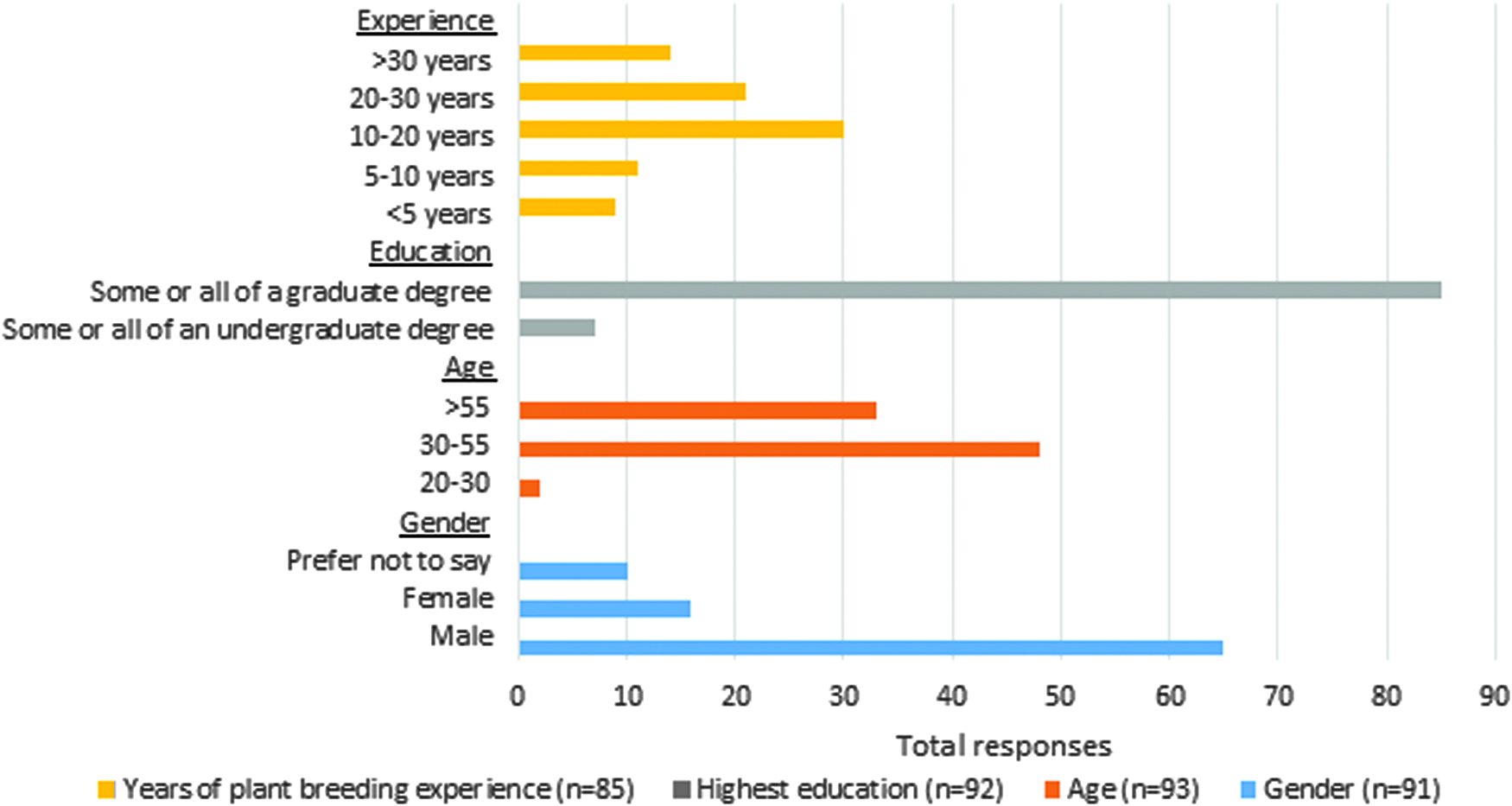
Survey response demographics.
The majority of the respondents (52%) were 30–55 years old, with only 2% younger than 30 years of age, while 37% were older than 55 years of age. Nearly all respondents (92%) identified as having completed some or all of a graduate degree.
With regard to accumulated experience in plant breeding, the answers indicate that most respondents had significant plant-breeding involvement: more than one third (35%) had 10–20 years of experience, 25% had between 20–30 years of experience, while 17% had more than 30 years of experience. Respondents with fewer than 5 years and between 5 and 10 years of experience accounted for 11% and 13%, respectively. The survey sample was characterized as a mature and highly educated population, mostly male, with substantial experience in plant breeding.
The 93 respondents are considered a fair representation of Canada's plant breeders as they represent a number of different crop kinds, shown in Supplemental Materials (Supplementary Figure S1), with a strong focus on the cash crops of cereals and oilseeds. The representation of plant breeders across various enterprises of employment within the public and private sector (Supplementary Table S1) also tends to match what we see across Canadian plant breeding programs, with a focus of commercialization in Canada and the United States (Supplementary Table S2).
Results
Before examining the acceptance of CRISPR-Cas9 based genome editing in breeding programs, respondents were asked which applications they currently employed (Table 1). Respondents could select all options from a defined list (Table 1) that applied and best described their current research programs and applications. By far the most employed application was classical breeding and predictive markers for selection (73%) and classical breeding using natural or artificial hybridization and selection based on phenotype (69%). Closely grouped were those indicating they employed one or more of the following techniques: genetic engineering (33%), genome editing (32%), speed breeding adjusting (29%), and classical breeding using induced mutation (29%).
Results indicated that in current research programs, private and public sectors utilize the same breeding applications but to differing degrees. In review of applications that can be implemented for CRISPR-Cas9, the public sector utilizes genetic engineering and genome editing in more research programs than the private sector does. Genetic engineering applications were used by 28% of the private respondents compared to 37% of the public sector. The use of genome editing was greater for the public sector. However, as a percentage of those surveyed, public and private use of genome editing was very comparable at 33% and 31%, respectively. Only 50/90 respondents identified as using either one or a combination of genetic engineering and genome editing.
The survey asked whether respondents intend to use CRISPR-Cas9 in plant-breeding research over the next 3 years. Breeding technologies are advancing at a rapid pace, resulting in certain applications such as zinc-finger nucleases being eclipsed by newer applications such as CRISPR-Cas9. 8 Therefore, asking beyond 3 years raises the level of uncertainty beyond acceptability. Of 88 respondents, 66% stated they anticipate using CRISPR-Cas9 versus 34% not planning to. Of those respondents, 32 from the public and 26 from the private sector anticipated using CRISPR-Cas9 in the near future. This suggests the private sector is more open to future CRISPR-Cas9 use (74%) compared to public breeders (60%).
Irrespective of whether they plan to use CRISPR-Cas9 in the future, all respondents were asked to indicate what advantages CRISPR-Cas9 has in comparison to existing technology applications. Respondents were presented with eight options and were asked to choose all they considered important (Table 2). CRISPR-Cas9 was viewed to have the advantages of precision editing without disruption to the remainder of the genome (90%), the confirmation of genes of interest (68%), cost reduction (61%), and the recent democratization (improved freedom to operate) of CRISPR-Cas9 (52%).
All respondents recognized CRISPR-Cas9 as an advantage of potential ease of regulation for commercialization. Yet, perceived advantages of CRISPR-Cas9 were not unified across private and public crop development sectors, for either adopters or non-adopters. The private sector, irrespective of whether planning to use CRISPR-Cas9, considers the experimental confirmation of genes of interest to be an advantage by 81% and 78%, respectively. However, public breeder agreement was not as supportive, with 69% of anticipated users and 48% of non-users. The public sector expressed greater agreement that CRISPR-Cas9 offers cost reductions, whereas only half of the private-sector breeders anticipating cost reduction as an advantage.
Quantifying the number of options considered as important and chosen by each category, the private industry not intending to use CRISPR-Cas9 and the public sector anticipating its use, agreed to the most advantages of CRISPR-Cas9, selecting 4.8 and 4.6 advantages, respectively. The least optimistic, the public sector not foreseeing the use of CRISPR-Cas9 in the near future, on average found CRISPR-Cas9 to offer only three advantages.
To understand the advantages of CRISPR-Cas9, those who identified advantages were asked to name the technology application they were comparing CRISPR-Cas9 to for every advantage chosen (Table 3). Sixty-five respondents named various applications and techniques that were further clustered into five categories: traditional breeding, GMO, transgenic, marker-assisted selection (MAS), or molecular marker-assisted selection (MMAS), and alternative genome editing.
Precision editing, easier regulatory commercialization pathway, experimental confirmation of gene(s) of interest, simplicity and efficiency, and cost reduction were identified as CRISPR-Cas9 advantages over transgenic and traditional breeding techniques (Table 3). Respondents comparing CRISPR-Cas9 to GMO plant-breeding techniques identified easier commercialization and precision-editing advantages. When comparing CRISPR-Cas9 to MAS and MMAS, more responses indicated precision editing, simplicity, and efficiency.
Under further sector analysis (Fig. 2), 65 respondents across the private and public sectors felt similarly about the precision-editing advantages CRISPR-Cas9 has over transgenic and conventional breeding technologies. These two sectors typically agreed on the ease of regulatory path of CRISPR-Cas9 over transgenics and GMOs. The public also has a stronger agreement of the advantages of experimental confirmation of a gene of interest over conventional breeding and transgenics and sees it as an opportunity.

CRISPR-Cas9 advantages compared to other divisions of technology application by sector.
Subsequently, respondents were asked to indicate what technology applications do not have an advantage over CRISPR-Cas9. Respondents were shown a table containing 12 choices. Only 14 respondents answered this question, and therefore the options without responses were removed (Table 4). With so few respondents, it was not possible to draw conclusions from this question regarding the difference between private and public sectors. However, the results indicated that for those not anticipating CRISPR-Cas9's use, technology applications found to hold a disadvantage to CRISPR-Cas9 were GMO and transgenic technologies. Typically, respondents felt the disadvantages with these other technologies were in regards to public or market acceptance issues, and regulation time and clarity.
Conclusion
Clearly, public and private plant breeders in Canada recognize benefits from the actual or anticipated use of CRISPR-Cas9 genome editing. Precision-breeding capabilities stand out as benefits, allowing plant breeders an increasingly greater ability to target and control the intended mutations. By far, the most significant benefit recognized by 90% of all respondents is that of potentially reduced regulatory oversight of CRISPR-derived varieties, mostly in comparison to GM breeding technologies. Presently, public breeders have had very limited capacity to apply GM breeding techniques within their programs due to the additional time and cost required to receive regulatory approval. For the successful application of genome editing, adoption within the public sector must be as accessible and as cost-effective as it is for the private sector. Presently in Canada, the private sector is the predominant sector applying GM breeding technologies. Should the use of CRISPR-Cas9 in genome editing follow the path of GM technology, its application will have to be viewed as a failure.
It is important to keep in mind that CRISPR-Cas9 genome editing will not provide a be-all and end-all solution for the future of plant breeding. Its use will be assessed and applied as required, differing from case to case. Ideally, the decision to introduce CRISPR-Cas9 into plant breeding of a specific crop will be driven by scientific rationale. However, given the political opposition to genome-editing technologies in some parts of the world, most notably the EU, decisions on whether to utilize CRISPR-Cas9-edited crops may be based more on the political circumstances than scientific ones, as was demonstrated by the 2018 ECJ ruling.
Footnotes
Author Disclosure Statement
No competing financial interests.
Funding Information
This survey of this research was funded jointly by CropLife Canada and matching funds from the P2IRC project through the University of Saskatchewan. The P2IRC project is funded from the Canada First Research Excellence Fund (CFREF).

References
Supplementary Material
Please find the following supplemental material available below.
For Open Access articles published under a Creative Commons License, all supplemental material carries the same license as the article it is associated with.
For non-Open Access articles published, all supplemental material carries a non-exclusive license, and permission requests for re-use of supplemental material or any part of supplemental material shall be sent directly to the copyright owner as specified in the copyright notice associated with the article.
