




Abstract
Over the past 8 years, the widespread adoption of CRISPR-based technologies has fueled the global genome editing revolution. This platform is based on Cas molecular machines such as Cas9, Cas12, Cas13, as well as other CRISPR effector proteins that are able to alter the genome, transcriptome, and epigenome of virtually any species. Technological improvements have rendered these tools more efficient and precise, and enabled functional diversification and specialization, as recently illustrated by the rise of base editing and the quickly growing demand for prime editing constructs. Here, we discuss the continued adoption of CRISPR tools and constructs distributed by the nonprofit organization Addgene, highlight the trends in the global demand for the CRISPR toolbox, and consider the widespread attitude changes around open sharing that are having a transformative effect on speeding up science.
Introduction
The advent of CRISPR-based technologies has accelerated and democratized genome editing over the past eight years. 1 Initially fueled by the use of Cas9 single-guide RNA technology for genome editing in mammalian cells, the so-called CRISPR toolbox has expanded considerably to include more Cas nucleases such as Cas12, Cas13 and other Cas effectors. This in turn has led to a diversification of the genome, transcriptome, and epigenome editing applications across the tree of life for agriculture, biotechnological, and medical applications. 1
As genome editing tools become optimized and polished with regard to specificity and efficiency, molecular engineers are combining Cas effectors with functional domains of interest to diversify the biochemical potential and functional spectrum of these molecular machines, via tethering, fusions, and chimeras. 1 The accessibility and dissemination of CRISPR tools via repositories such as Addgene, a nonprofit organization, have allowed broad access to the best tools by organizations around the world.2,3
The rise of base and prime editing
The speed at which new editing tools are being adopted by the CRISPR community is perhaps best illustrated by requests for state-of-the-art tools for base editing and prime editing, technologies largely developed in the lab of David Liu at the Broad Institute (Cambridge, MA). 1
The novel prime editing CRISPR constructs were requested more than 850 times by scientists around the world in the first 2 weeks after Andrew Anzalone, Liu, and colleagues published their first article on the prime editing system. 4 While scientists conceived new experiments they could run—with fewer PAM sequence constraints and improved homology directed repair efficiency, amongst other potential gene editing benefits —those of us at Addgene were stunned. In only 2 days, the core prime editing plasmids hit “blue flame” status, a badge of honor bestowed upon plasmids once they have been requested more than 100 times.
This marked a new record, unprecedented in our 15 years of managing a plasmid repository that now contains almost 90,000 plasmids. As our lab strained to prepare bacterial stabs of these plasmids to keep up with demand and our customer support team learned all it could to answer questions from scientists eager to use this new technology, we could only marvel at the larger structural changes in science that have been building inexorably to bring us to this point.
In 2004 when Addgene was launched, scientists were still sharing research reagents via the slow and unreliable method of “available upon request.” 3 Scientists learned about new plasmid tools in publications, emailed the author to request the plasmid, corresponded with authors and lab managers, and crossed their fingers in hope that they would eventually receive the requested plasmid a few weeks later. As many scientists will recall, even with the best of intentions, this process was often slow and error-prone – wrong plasmids sent, scant sequence data available. Not infrequently, these requests were simply forgotten or overlooked in the bustle of a busy lab.
Addgene developed as a means to improve the efficiency and quality of plasmid sharing, to increase access to these reagents to all scientists worldwide, and to provide logistical support to this process so that research scientists could focus on moving science forward. Similar work was carried out by Jackson Labs, the Arabidopsis Biological Resource Center, the American Type Culture Collection, the Drosophila Genomics Resource Center, and other research tool repositories. Science was changing; scientists embraced sharing their tools more widely via repositories to ensure technology could be readily accessed and that science could get done quickly by all.
The expanding CRISPR toolbox
By 2012, as the first CRISPR genome editing tools were being developed and published, open reagent sharing was taking off. As we discussed previously in The CRISPR Journal, this early adoption of the open sharing mindset helped prime CRISPR technology to be used so quickly and widely. 2 Beyond sharing this new technology with each other, scientists also shared resources to optimize use of these plasmids in the form of forums for asking questions, 5 sharing best practices and protocols, 6 Twitter threads on the newly published papers, and workshops dedicated to teaching the basics to new users.7,8
As scientists learned to share and use these new tools with one another, they also innovated and further refined the technology. New CRISPR tools were developed that moved from cutting DNA to nicking it (e.g., from Cas9 to nCas9), followed by derivatives for transcriptional regulation and epigenome modulation (from Cas9 to dCas9 fused to an activator, repressor, or epigenetic modifier). A growing number of CRISPR-guide RNA pooled libraries were adopted for genome-wide screening. Besides Cas9, scientists harnessed the power of diverse CRISPR nucleases and effectors, such as Cas12, Cas13, and Cascade-Cas3. 1 Indeed, 2016 brought the development of CRISPR base editors for more precise editing without DNA double-stranded breaks, as well as CRISPR technology specific to RNA targeting and editing. In 2019, we saw the emergence of prime editors, as well as new CRISPR tools developed and applied to address the COVID-19 pandemic. 9
Over the past 8 years, scientists from 640 depositing labs designed and deposited almost 11,000 CRISPR-related plasmids, which have been distributed more than 190,000 times to some 4200 organizations worldwide (Fig. 1). Since we last reported data on CRISPR plasmid deposits and distribution in 2018, 2 more countries have emerged as sources of new CRISPR plasmids and destinations for CRISPR reagent shipments. Labs from five new countries have now deposited CRISPR tools, bringing the total number of depositing countries to 30. Similarly, Addgene has shipped CRISPR plasmids to 13 additional countries, bringing the total to 88 documented countries where CRISPR research is being done.
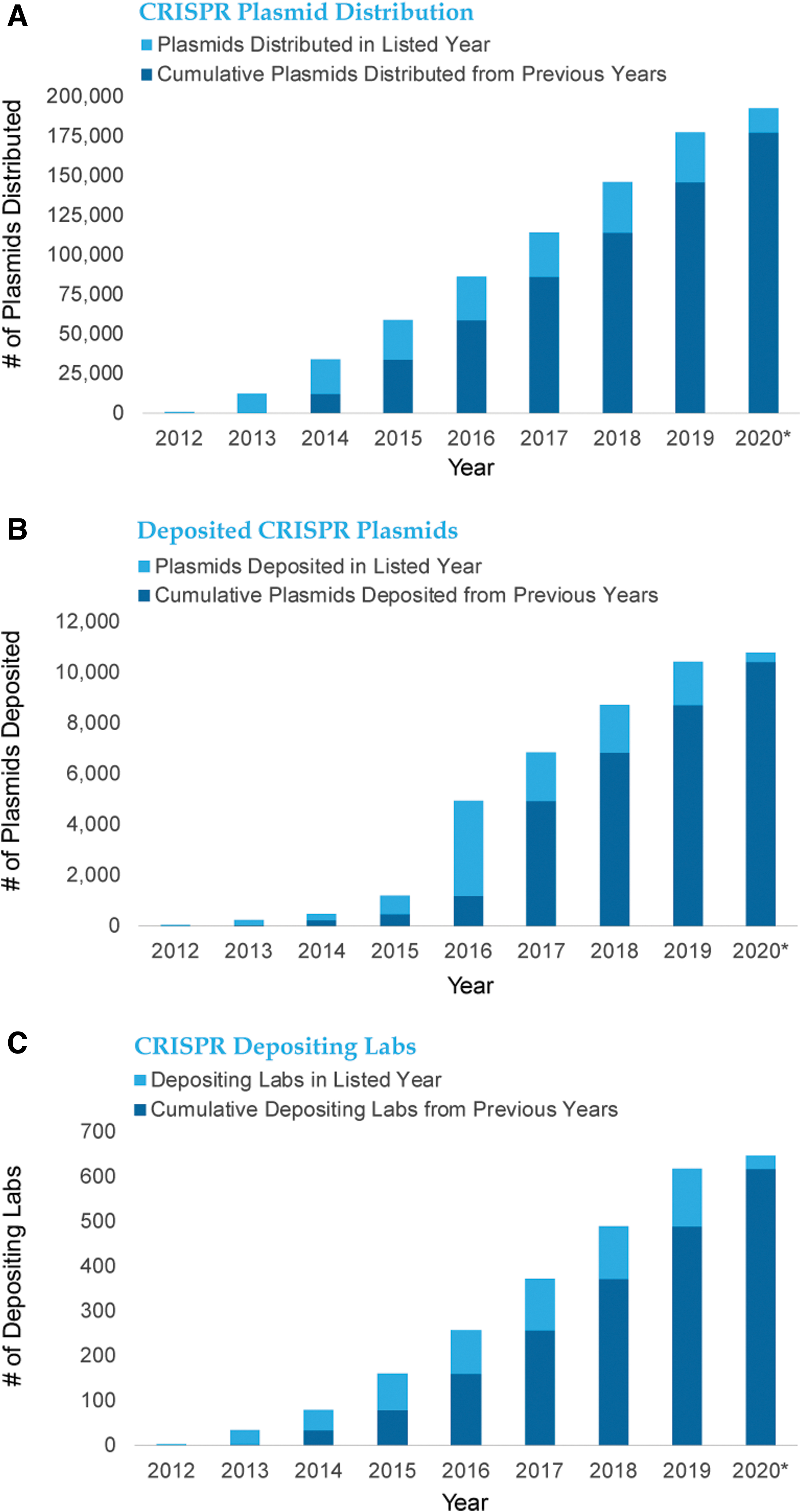
Continued rise in use of CRISPR plasmid technologies from their initial deposit in September 2012 through July 2020.
Furthermore, by looking at request data from Addgene, we can see how CRISPR nuclease plasmids for different applications have been adopted over time (Fig. 2). The Cas9, Cas12, and other nuclease variants that generate double-strand DNA breaks, have consistently been the most widely requested tools, together averaging nearly 750 plasmid requests per month. The sustained use of these nucleases is a testament to the versatility and ease that they afford the user community. The publication of numerous high-fidelity Cas9 variants in January 2016, such as eSpCas9(1.1) 10 and SpCas9-HF1, 11 resulted in a boost in distribution of Cas nucleases.
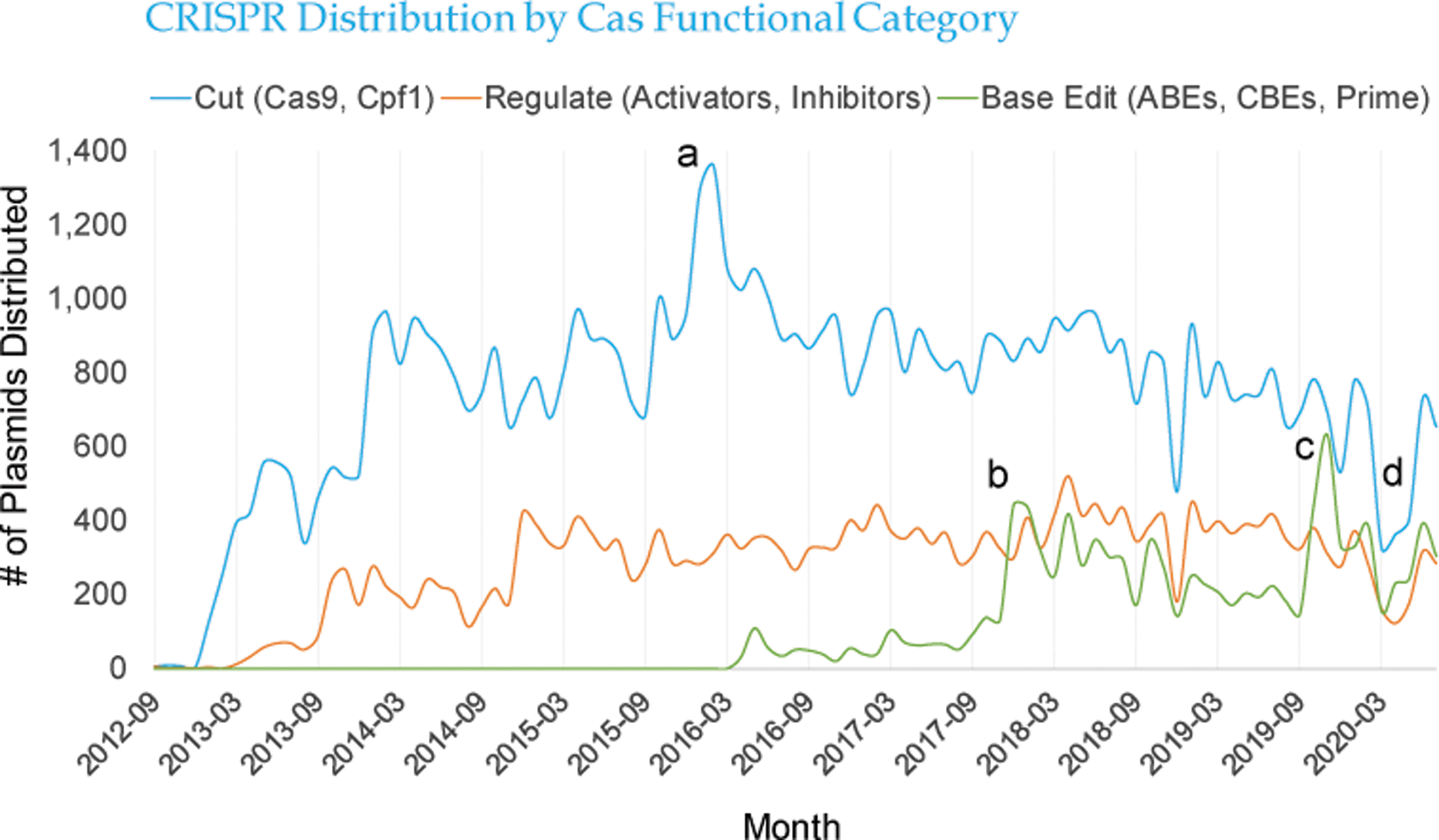
Distribution by Addgene of CRISPR plasmids by Cas functional category: Cut (Cas9, Cpf1) shown in blue; regulation (includes activators, repressors, and epigenetic modifiers) in orange; and base editing (includes base editors, prime editors, and RNA editors) in green. The graph does not include plasmids containing a targeting gRNA. Letters denote the release of
The popularity of nuclease variants that are used to regulate gene transcription has remained steady, possibly due to the large variety of activators and repressors that can be fused to them. Base editors have rapidly grown in popularity and show a few notable peaks in distribution, such as ABE7s 12 and Cas13b 13 in November 2017 and the prime editors 1 in October 2019.
We should also note the dramatic drop in requests of all CRISPR plasmids from March through May of 2020, due to the widespread closure of research labs due to the COVID-19 pandemic.
Any discussion of the expanding CRISPR toolbox must also address the use of CRISPR pooled libraries—thousands of plasmids for expressing multiple guide RNAs for various target genes—used in large-scale genetic screening experiments. There are currently 160 CRISPR pooled libraries in the Addgene repository. Although these libraries are a powerful tool, their use requires access to costly technology such as next generation sequencing to accurately evaluate the results of a screening experiment. Surprisingly, despite reliance on more complex protocols and equipment, Addgene's data shows that more than 1000 requests have been made for these libraries each year since they were first made available in 2014 (Fig. 3).
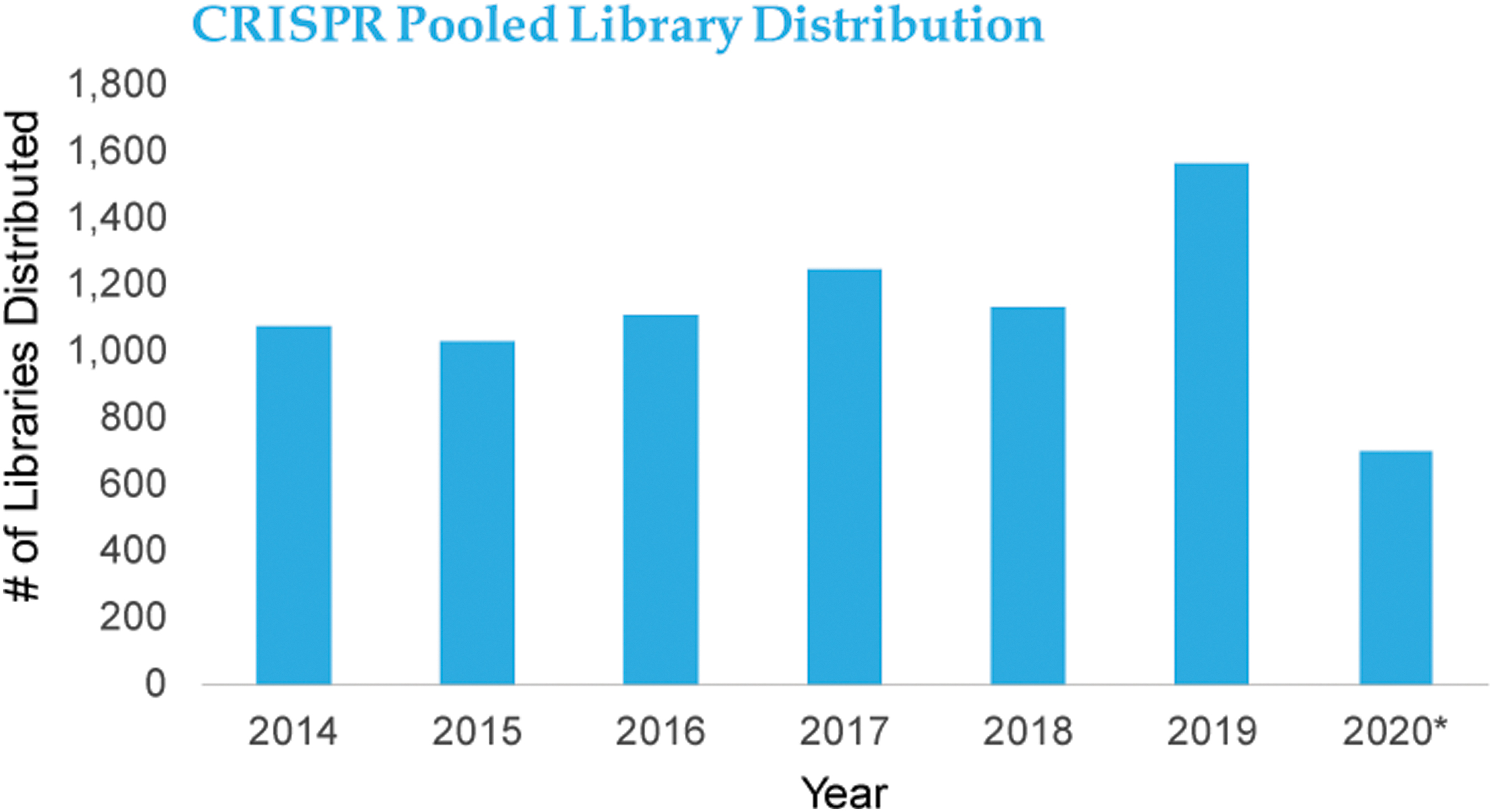
Distribution of CRISPR pooled libraries annually from 2014 to 2020 from Addgene. (*Graph reflects repository data through July 31, 2020.)
Changing mindsets with a sharing community
As with any exciting fast-moving area of molecular biology, there is an element of friendly competition in the genome editing field and some lingering intellectual property disputes. But scientists are commendably sharing their most powerful tools. What changes in the scientific ecosystem have facilitated this trend of rapid growth and adoption of new tools?
We have observed a change in the attitude of scientists, who recognize the value in sharing their reagents openly as a way to advance the field, while also enhancing the visibility of their own work and stimulating new opportunities for collaborations. Indeed, collaborations are fueling the genome editing field, transcending the incentives of some individuals therein. 14
Additionally, organizations and institutions have challenged the mindsets that previously hampered this type of sharing. For example, bioRxiv, FigShare, and other preprint and data servers are enabling and even incentivizing scientists to quickly share publications and data and to start gathering feedback from their peers before the official closed peer review process begins. The Center for Open Science has been championing open and reproducible science initiatives (such as the Open Science Framework), and the Allen Institute has created a wealth of open data resources (such as the Allen Brain Map and the Allen Cell Explorer). Addgene has made it easy for scientists to deposit plasmids prepublication: They can share these plasmids immediately or with the release of a preprint, or they can choose to release the plasmids synchronously with a publication or on a specific public presentation date.
These mindset and institutional changes have had a transformative impact on speeding up science in the 21st century, especially when it comes to CRISPR technologies. Prime editors were set for quick adoption thanks to a number of factors—scientists interested in widely sharing their newest tools, institutions having processes that make depositing with a repository easy, a repository able to store and QC plasmids prior to publication, and quick dissemination of the new techniques via publication and presentations at high-profile conferences.
Moreover, new tools keep coming. For example, in March 2020 an enhanced series of adenine base editors, ABE8, became available. 15 Like many CRISPR tools, these evolved from previously developed base editing systems, but unlike many others, these tools were deposited and shared by a biotech company, Beam Therapeutics. The sharing mindset has not only permeated academic research communities but also industry research circles. Just as we have seen with this example of the swift rise of base editor usage, reagent sharing and open science platforms in general are taking off at an ever-increasing speed, which will in turn speed up basic science research, medical diagnostic developments, and disease therapeutics.
Conclusions
Since 2012, the CRISPR toolbox expanded dramatically, offering a variety of new options to scientists around the world, from Cas nucleases to base editors and pooled libraries for genetic screens. The data from Addgene's repository shows that a diverse global scientific community continues to adopt the original Cas tools, as shown by continued demand for Cas9 and Cas12 nucleases and continued requests to ship to new countries. We can also see the rapid adoption of new CRISPR tools as scientists request the newest base editors, use them in original research, and enhance them to develop even more polished next-generation tools.
These trends in CRISPR use and adoption have been facilitated by the shift in mindset of the community from competition to collaboration and the broad push for open sharing of valuable and enabling tools. The enthusiasm for collaborative and open-resource sharing is refreshing for scientific equality and technical access. This is especially gratifying during a time when we are witnessing the critical importance of expeditious science to understand new infectious diseases and to develop better diagnostics and therapeutics in response to a global health crisis.
Footnotes
Acknowledgments
The authors acknowledge support from Addgene and access to shipment and deposit data. We thank Jason Niehaus and Shagun Bhardwaj for data acquisition.
Author Disclosure Statement
CML and BP are employees of Addgene. RB is a shareholder of DuPont, Caribou Biosciences, Intellia Therapeutics, Locus Biosciences, Inari Ag, and TreeCo.
Funding Information
No funding was received for this article.