




Abstract
Since its Nobel Prize-winning breakthrough in 2012, CRISPR-Cas-based gene-editing system has emerged as one of the most promising biotechnologies in decades. In this article, we present an objective and comprehensive evaluation of CRISPR-based gene-editing technologies, including base editing and prime editing, based on the bibliometric analysis of 22,902 published records. We also assessed the status of CRISPR gene-editing technologies in academia from 2010 to 2020 globally, with respect to countries, institutions, and researchers, and used text clustering methods to assess technical trends and research hotspots. Our results indicate, not surprisingly, that this is a thriving and prominent area of research. By comparing the relevance and growth of CRISPR gene-editing technologies in China with other countries by several metrics, we show that the Chinese scientific community attaches considerable importance to the field of plant genome engineering, with more scholars from agricultural sectors than other sectors.
Introduction
The clustered regularly interspaced short palindromic repeats associated (CRISPR-Cas) system is a microbial immune system that bacteria and archaea use to prevent infection by foreign nucleic acids, such as viral genomes and plasmids. 1 The CRISPR-Cas system has revolutionized basic science and translational medicine by significantly improving the ability to manipulate, detect, image, and annotate specific DNA and RNA sequences in living cells of different species. 2 Systems employing the direct homologs of Cas9, Cas12, Cascade, and Cas13 have extended the range of target selection, binding, and RNA editing. Their biological mechanisms have been reviewed extensively.3–5 CRISPR-Cas has emerged as a powerful and versatile tool for medical research, clinical disease detection and therapies, detection of viral RNA (such as Ebola virus and severe acute respiratory syndrome coronavirus 2 [SARS-CoV-2]), breeding of genome-edited crops, livestock, insects, and genetic models, and the study of food microbes. Furthermore, the CRISPR toolbox has the potential for restoring ecosystems and biodiversity.6–10
Academic research has made great progress since the introduction of CRISPR as a gene-editing tool in 2012.11,12 Several CRISPR patent surveys have been conducted, although there is still a lack of a comprehensive evaluation of the literature.13,14 In this article, we present a compilation of the current status, research hotspots, and global trends of CRISPR technology development for the past 10 years from a bibliometric perspective, highlighting specific trends and topics with regard to the Chinese scientific community.
Materials and Methods
We obtained peer-viewed articles related to CRISPR from SciVal, a research management and analysis platform (Elsevier). Our search strategy was based on the following query equation: CRISPR OR “clustered regularly interspaced short palindromic repeats” OR “base editor” OR “base editing” OR “prime editing” OR [(Cas9 OR Cas10 OR Cas11 OR Cas12 OR Cpf1 OR Cas13 OR Cas14 OR CasX OR gRNA OR sgRNA) AND (“gene-editing” OR “genome engineering” OR “genome editing” OR “genome editor” or “genome binding”)].
SciVal uses a stemming algorithm that reduces words to their root form, so the singular, plural, and possessive forms of most keywords in the query equation are included. We performed a cleanup to remove irrelevant data, such as literature on computer science generated from “base editor.” The search extended to articles with a publication date up to March 24, 2021. We retrieved a total of 22,902 articles, including 15,729 articles from 2010 to 2019 and 5479 articles in 2020. Based on the same records, we analyzed the status of academic performance, including the distribution of countries, institutions, and scholars. Technical trends and research hotspots are revealed by text clustering.
Bibliometric software such as Citespace and VOSviewer have certain shortcomings; they rely heavily on direct citations without normalizing citation counts or journal impact, which is a prerequisite for citation analysis.15–17 Despite the time-lag associated with certain metrics, SciVal addresses the aforementioned issues and achieves accurate domain-wise big data analysis.18–21 By combining several indicators, such as scholarly output, Field-Weighted Citation Impact (FWCI), citations, top percentiles of publications, topic growth, and prominence percentile, we provide an objective evaluation of research focused on CRISPR technology.
Results and Discussion
Status of CRISPR academic performance
The overall performance of CRISPR research from 2010 to 2020 is shown in Tables 1 and 2. We break the analysis into four parts: (1) authors and scholarly outputs, (2) citations and FWCI/Field-Weighted Views Impact (FWVI), (3) Patent-Citations, and (4) the top percentiles of publications.
CRISPR, clustered regularly interspaced short palindromic repeats; FWCI, Field-Weighted Citation Impact; FWVI, Field-Weighted Views Impact.
The year 2012 gave birth to two landmark studies—one led by Jennifer Doudna and Emmanuelle Charpentier, the other by Virginijus Siksnys—showing that Cas9 is an endonuclease that uses RuvC and HNH motifs to generate double splicing in target DNA, which can be recoded using single guide RNAs (sgRNAs) that mimic dual-tracrRNA: crRNA complexes.11,12 These discoveries laid the foundation for the CRISPR gene-editing technology. Since then, the global academic output and the number of authors have grown sharply in the ensuing years.
In 2012, the number of authors worldwide associated with CRISPR was 603, and the scholarly output was only 137 articles. By 2020, the number of authors worldwide had increased to 35,173, and the scholarly output grew to a staggering 5479 articles.
Not surprisingly, there has been a sharp rise in CRISPR research in China. In 2012, the number of Chinese researchers was only 28, with a scholarly output of 6 articles. Since then, Chinese scholars have taken a keen interest in CRISPR technology, with the number of authors growing to 11806 producing 1622 articles.
Citation is used to indicate the impact or quality of research output. Citations in CRISPR gained a qualitative change in 2013, with an increase from 16,213 in 2012 to 71,590 in 2013. The number of annual citations has exceeded 70,000 in subsequent years. However, citations are subjected to field and temporal differences and need to be normalized. FWCI is an article-level field-normalized metric for the benchmarking of comparative research impact. 22 It represents the number of times a publication in a given field is cited compared with the average number of citations for all other similar publications in Scopus, taking into account differences in research behavior across disciplines.
An average FWCI of 2.33 for the CRISPR field from 2010 to 2019 is 133% higher than the world average of 1.0. The CRISPR field became an academic hotspot in 2013 with an FWCI of 8.43, followed by a FWCI of 4.77 and 3.54 in 2014 and 2015, respectively. However, the FWCI of research studies funded by the U.K. Engineering and Physical Sciences Research Council from 2010 to 2015 ranged between 1.6 and 2.1, which includes physics and astronomy, materials science, chemistry, computer science, mathematics, chemical engineering, and energy. 23
FWVI is a usage impact metric that indicates the number of views received by an entity's publications compared with the world average, offering earlier academic readership status. 24 The FWVI averaged 1.46, whereas the number of annual views has grown from 8745 in 2012 to more than 90,000 since 2017.
2013 was the first year of active CRISPR academic activity in China. Although only 27 articles were published in 2013, the FWCI reached 14.44, followed by a FWCI of 4.72 and 3.91 in 2014 and 2015, respectively.
Patent citations have long been used for empirical analysis in economics to indicate direct knowledge transmission and the value of innovation. 25 There is a close link between the quality of science and the value of inventions, 26 which can be quantified by economic impact metrics such as Patent-Citations per Scholarly Output.
Patent-Citations per Scholarly Output are the average Patent-Citations received per 1000 scholarly outputs published by an entity. This metric helps us to understand the amount of research produced that is used to create patents. The index was very high, with values of 26,163, 23,117, 20,891, 42,660, and 13,662 from 2010 to 2014, respectively. It has decreased in recent years, indicating a time-lag in the citation and patents' preference to cite earlier literature. The indicator of Patent-Citations per Scholarly Output in China was higher in 2011 and 2013, at 92,856 and 74,482, respectively; however, the reported values were lower than the world average in other years. There are three possible reasons for this: (1) patents prefer to cite important literature published in the early years, (2) literature citation is not taken too seriously in activities related to patents in China, and (3) the absence of a close link between scientific research and patent activities in China.
The top percentiles of publications are used to benchmark contributions of the most influential highly cited research fields. It is useful to benchmark the contributions of publications and distinguish their performance. Global CRISPR research has shown outstanding research excellence in that publication in the top 1%, 5%, 10%, and 25% of the most cited articles are 4.8%, 15.4%, 25.2%, and 47.6%, respectively. Publication by Chinese researchers did not appear in the top 1% of most cited articles until 2013, indicating the early difficulties encountered by Chinese scientists in catching up with their global counterparts. Since then, Chinese researchers have steadily caught up, with publications in top citation percentiles almost in line with the world average.
The geographical distribution of CRISPR research in 2015–2020 is shown in Table 3. The United States is in first place with a scholarly output of 8431. China comes second with a scholarly output of 5057, followed by Germany, the United Kingdom, and Japan in third. Canada, France, South Korea, the Netherlands, and Australia follow behind. From the FWCI index, the United States, most European countries, Canada, and Israel all rank above 2.0, indicating strong research capabilities. In contrast, Asian and South American countries fall below 2.0, which indicates a gap in the development of science and technology in regions outside the developed countries of the United States and Europe.
IC, International Collaboration (%); CP10, Output in Top 10% Citation Percentiles (%); JP10, Publications in Top 10% Journal Percentiles by CiteScore Percentile (%).
We observed that 28.9% of publications from 2015 to 2020 were international collaborations, and 37.0% were national collaborations. As the United States is the largest research contributor, most of the research in the United States constitutes national collaborations. At the same time, the United Kingdom, France, Germany, Canada, the Netherlands, and Australia have a higher degree of international collaboration as they rely heavily on cooperation with the United States.
China, Japan, South Korea, and India rank lower in international collaboration. For China, 35.7% (1805) of its publications from 2015 to 2020 were international collaborations, of which 1250 were collaborations with U.S. institutions, followed by the United Kingdom (133), Australia (96), and Germany (87). Another significant indicator is the rate of academic–corporate collaboration, which is only 1.5% for China, whereas the world average is 3.9%, and the rate for the United States is 5.4%.
International and academic–industry collaborations significantly promote CRISPR research, as indicated by higher-quality metrics such as citations per publication and FWCI of international cooperative publications and academic–corporate collaboration publications compared with other publications. Other indicators, such as Output in Top 10% Citation Percentiles (%) and Publications in Top 10% Journal Percentiles by CiteScore Percentile (%), exhibit a similar pattern.
Global distribution of research institutions
The scholarly output ranking of research institutions during 2015–2020 is shown in Table 4. Among the top 100 institutions by scholarly output, 40 are from the United States, 22 from China, 7 from France, and 6 from the United Kingdom. The top 20 research institutions are from the United States, China, and France. Harvard University ranks first, with an academic output of 903 and an FWCI of 4.85; the Chinese Academy of Sciences ranks second with an academic output of 912 and an FWCI of 2.78. These two institutions' scholarly output is exceptionally high, and the gap between the institutions after them is notable.
CAAS, Chinese Academy of Agricultural Sciences; CNRS, Centre national de la recherche scientifique; NSERM, Institut national de la santé et de la recherche médicale; MIT, Massachusetts Institute of Technology; UCAS, University of Chinese Academy of Sciences; UCSF, University of California at San Fran.
The five institutions from China exhibit lower indicator values in quality metrics, indicating that Chinese research institutions generally lag the United States in terms of research quality and prestige, although they trail only the United States in terms of scholarly output. French institutions are at approximately the same level as China on all indicators, except for a higher level of international cooperation.
Global distribution of scholars in CRISPR gene editing
The distribution of researchers, although more complicated, can be sorted according to scholarly output, citation count, or FWCI. Researchers in the CRISPR field are prolific; for example, the investigator ranked 500th still has nine research articles. In terms of citation counts among the top 500 authors ranked by scholarly output, 190 researchers have been cited more than 1000 times. For the FWCI, 55 researchers are greater than 10, most from the United States; 127 scholars score between 5 and 10, 201 scholars between 2 and 5, and 88 scholars between 1 and 2.
In terms of researchers' location, 207 scholars are from the United States, 119 from China, 38 from Japan, 30 from Germany, 16 from the United Kingdom, 15 from France, 10 from the Netherlands, and 8 from South Korea. Overall, U.S.-based researchers have more significant academic influence, followed by European and Korean scholars. Chinese scholars generally have relatively low FWCI and cited scores.
Table 5 lists scholars in the field of CRISPR gene editing according to their scholarly output between 2010 and 2020. In first place are Jennifer Doudna and Emmanuelle Charpentier, who shared the 2020 Nobel Prize in Chemistry for their discovery of the CRISPR-Cas9 genetic scissors. Rodolphe Barrangou began studying the role of CRISPR-Cas role in prokaryotic immunity in 2005 and with Philippe Horvath and colleagues demonstrated CRISPR's immune function. Feng Zhang was one of the first researchers to apply CRISPR to eukaryotic cells. Jin-Soo Kim is among the first to adapt CRISPR for genome editing in various cells. Kim was a highly cited scientist in the biology and biochemistry categories of Clarivate Analytics in 2018 and 2019, respectively. Eugene V. Koonin is an expert in evolutionary biology and computational biology. George Church independently demonstrated in 2013 that CRISPR works in eukaryotic cells. David Liu developed cytosine base editors and adenine base editors for editing single nucleotides; his laboratory also developed prime editing in 2019, which allows the exchange of single DNA bases and simultaneous deletion and insertion.27–29 The frontiers of precision genome editing continues to advance, for example, the improved efficiency of prime editing in plants. 30
CAS, Chinese Academy of Sciences; HHMI, Howard Hughes Medical Institute.
We note that Chinese scholars, such as Xingxu Huang, Liangxue Lai, Caixia Gao, Yongping Huang, and Qunxin She, have high scholarly outputs. In addition, they have published numerous articles in the past few years. These index values are relatively low, but as mentioned earlier, they are above the world average. With many researchers from agricultural universities, such as the Chinese Academy of Agricultural Sciences, Northwest Agriculture and Forestry University, South China Agricultural University, and Huazhong Agricultural University, Chinese investigators focus more on CRISPR's agricultural application. In general, China still trails the United States regarding the number of high-level scholars and their academic influence.
As shown in Table 6, the top 10 most cited articles are from four teams: Feng Zhang, Emmanuelle Charpentier/Jennifer Doudna, George Church, and Rodolphe Barrangou. In 2013, studies led by the groups of Prashant Mali and Stanley Qi extended CRISPR technology to RNA-guided editing and RNA-guided DNA recognition platforms.
CRISPR-Cas9, CRISPR associated 9.
CRISPR gene editing in technical fields
The global (excluding China) technical fields featuring CRISPR academic output from 2015 to 2020 are shown in Figure 1A. Basic research and applications of CRISPR accounted for most publications. Biochemistry, genetics, and molecular biology accounted for 39.8% of all publications, medicine 16.7%, immunology and microbiology 10.8%, agricultural and biological sciences 9.3%, pharmacology, toxicology, and pharmacy 3.1%, and neuroscience 3.5%.
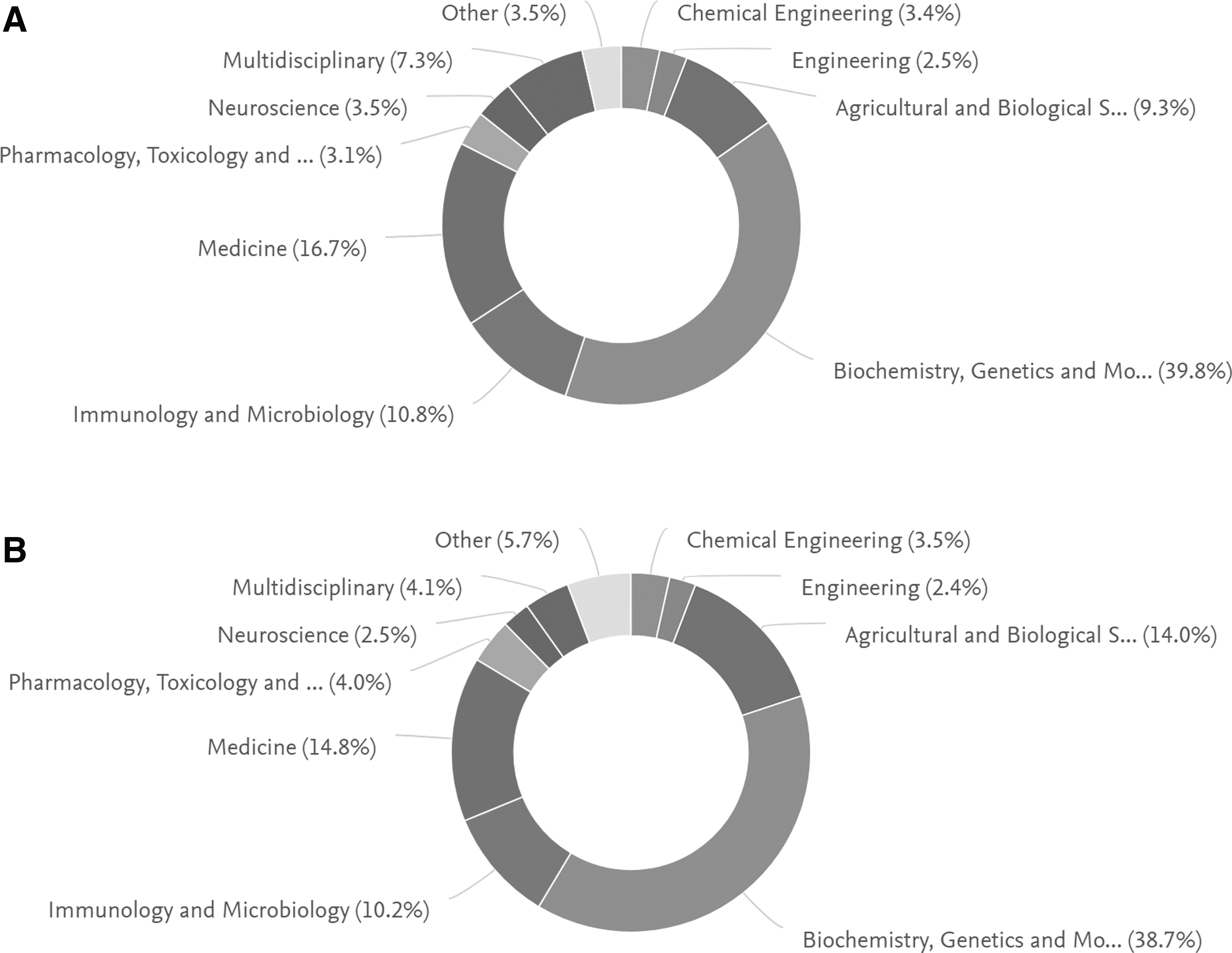
Global versus China technical areas of scholarly output.
As shown in Figure 1B, Chinese scholars attach more importance to agricultural and biological sciences (14%), whereas there is lesser significance attached to the fields of biochemistry, genetics, and molecular biology (38.7%), medicine (14.8%), and immunology and microbiology (10.2%).
CRISPR research hotspots and leading topics
Essential concepts in the field of CRISPR can be identified by text mining. The increased usage of key phrases reflects the evolution of academic research hotspots. As shown in Supplementary Table S1, certain keywords are more significant for China, including Long Noncoding RNA, RNA Editing, plant genome, and Liver Cell Carcinoma. Unique keywords for China include Bombyx mori, Soybean, Tomato, Arabidopsis, Suid Herpesvirus 1, Ribonucleoprotein, Male Fertility, Corynebacterium glutamicum, Haploidy, Colorectal Neoplasm, and Pollen.
The improvement of CRISPR gene-editing technology is an important research area. Existing studies aim to reduce the off-target effect by turning off nuclease activity and enhancing target gene recognition specificity. Safe and effective delivery is one of the most significant challenges in the CRISPR system's clinical application. Recombinant adeno-associated virus (rAAV) is an important viral vector, with a high potential for host immune response. Many advanced AAV/rAAV vectors have been developed, and their applications broadened through strategies such as improved viral vector capsids. Novel viral vectors have been developed, such as retrovirus-based particles or lentiviral capsule-based bionic particles. Nonviral vectors, such as polyethylenimine, poly(lactic-co-glycolic acid) (PLGA) nanoparticles, bionic mineralized ribonucleoprotein (RNP) nanoparticles, and engineered lipid nanoparticles, may overcome the disadvantages associated with viral vectors.
CRISPR technology has great potential for clinical disease treatment research, including hematological diseases such as sickle-cell disease (SCD) and β-thalassemia, retinal diseases, Duchenne muscular dystrophy, cystic fibrosis, liver disease, non-small cell lung cancer, acute lymphoblastic leukemia, and refractory cancers. In 2020, the first CRISPR-edited T cell therapy for patients with refractory non-small cell lung cancer was delivered. 31 It can be used for high-throughput screening of genetic factors related to cellular processes, the discovery of cancer drug target genes and antiviral targets, and antiviral therapy for HIV-1 and SARS-Cov-2. The potential of stem cell therapy is greatly enhanced by the CRISPR-Cas system. CRISPR-Cas9-edited human hematopoietic stem cells or human pluripotent stem cells, can treat various genetic defects such as SCD, β-thalassemia, and primary immune deficiency. It has been applied to plant and livestock breeding, yield improvement, quality, disease and herbicide resistance, directed evolution to accelerate domestication, and enhanced microbial traits, which are of great economic importance in the food industry.
A topic is the dynamic collection of documents with a common focused intellectual interest. Topics and Topic Prominence reveal the latest research trends and performance, including funding, active talent, and leading research fields. Topics with the most momentum during 2015–2020, as listed in Supplementary Tables S2 and S3, were selected using the following criteria: academic output >15, FWCI >2, prominence percentile >99%, and 26 topics were obtained. These topics represent the cutting edge of CRISPR research, most of which are improvements to the CRISPR technology itself and, to a lesser extent, applied research. Growth rate values were not available for some topics, as they did not exist in the starting year of 2015. See Supplementary Tables S2 and S3 for a list of global topics (excluding China) versus China.
Conclusion
CRISPR is a revolutionary technology that has developed remarkably in recent years; it has become the focus of global academic communities in the life sciences and medicine, advancing research in myriad ways. This study uses bibliometrics to analyze academic research in CRISPR technology, presenting an overview of the trends and landscape of this booming field of research for the past decade. The geographical distribution of authors, institutions, and research output reveal interesting trends in CRISPR research, alongside characteristics in international collaboration and academic-industry collaborations. Our study highlights the global versus China CRISPR academic performance status, revealing that the Chinese scientific community attaches more significance to plant genome engineering.
For researchers, it is important to select research priorities for technological breakthroughs. Our analysis should help researchers identify current trends as well as future directions of CRISPR research, potentially helping them plan their research and identify researchers for collaboration and academic exchange. Our findings will also be useful for allocating research funds and policymaking. However, our study has certain limitations; we did not compare our results with other quantitative bibliometric studies. Furthermore, the CRISPR field metrics have not been adequately compared with other research fields.
We have witnessed a surge in the number of Chinese scholars entering the field of CRISPR research. Although the overall academic output in CRISPR research is high, China still lags the rest of the world regarding research quality and productivity. If Chinese researchers can conduct targeted research and strengthen international collaboration, it should help to develop this novel technology. At present, many countries such as the United States and China are conducting CRISPR-based clinical trials; however, its practical application is still limited. We expect that this revolutionary technology will continue to attract more scientists in the future as it will play a significant role in medicine and the life sciences.
Footnotes
Authors' Contributions
W.Z. and D.C. conceived and coordinated the study. W.Z., Y.Y., and Y.Z. collected the data. W.Z. and Y.Z. performed the analyses and drafted the article. Y.Y. and D.C. reviewed and revised the article. D.C. supervised research. All authors contributed to results interpretation, reviewed, and approved the final article.
Acknowledgments
We thank the reviewers and editors for their help and comments. We also thank Zhejiang Soft Science Programs for supporting this study.
Author Disclosure Statement
The authors declare no conflict of interest. No support, financial or otherwise, has been received from any organization that may have an interest in the submitted study, and there are no other relationships or activities that could appear to have influenced the submitted study.
Funding Information
This study was generously supported by Zhejiang Soft Science Programs (grant no. 2019C35070).

References
Supplementary Material
Please find the following supplemental material available below.
For Open Access articles published under a Creative Commons License, all supplemental material carries the same license as the article it is associated with.
For non-Open Access articles published, all supplemental material carries a non-exclusive license, and permission requests for re-use of supplemental material or any part of supplemental material shall be sent directly to the copyright owner as specified in the copyright notice associated with the article.
