In 2011, after 4 years in Jennifer Doudna's lab at UC Berkeley, Martin Jínek was starting to look for faculty positions back in Europe. He decided to embark on one last project involving CRISPR. That project, in collaboration with Emmanuelle Charpentier's group, turned into a pivotal paper in 2012, launching the CRISPR-Cas9 revolution. A short time later, Jínek launched his own independent lab at the University of Zurich.
In this interview, Jínek talks to The CRISPR Journal's executive editor, Kevin Davies, about his journey to Berkeley, giving details of the key insights and experiments in the Doudna lab and his current research interests. (This interview has been lightly edited for length and clarity.)
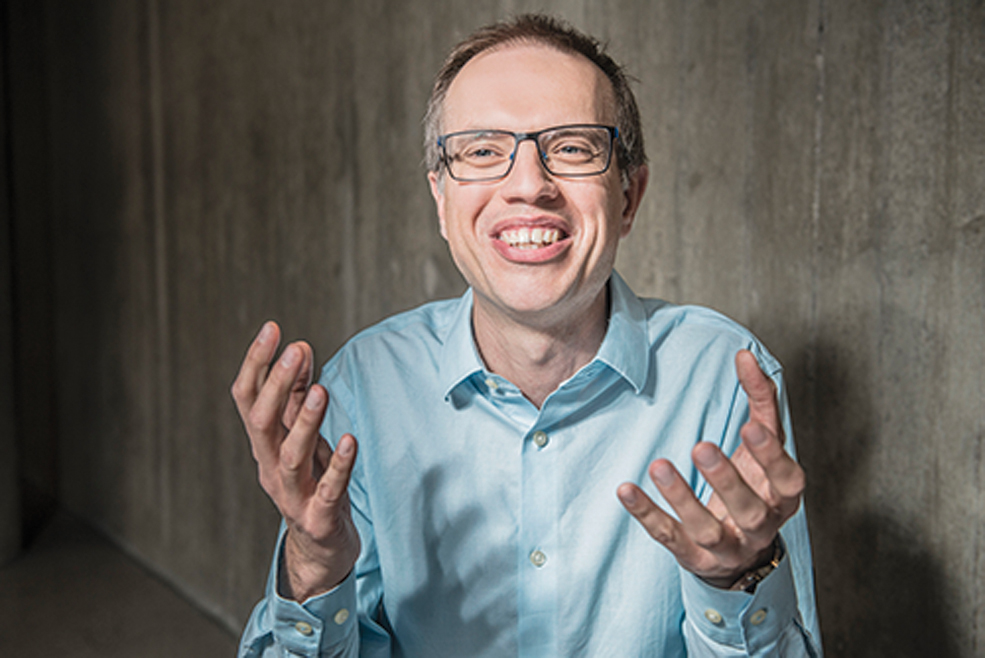
Martin Jínek
(Credit: Michael Tomes)
Davies: Martin, you were born in Třinec in the Czech Republic. Do you consider yourself a proud Moravian?
Jínek: That's my hometown, but strictly speaking it's in the Czech part of Silesia. The bigger part of Silesia is now in Poland and used to be part of the German Empire. There's a smaller part on the Czech side of the border.
Davies: When you were growing up, you must have visited the birthplace of genetics, Gregor Mendel's monastery in Brno, only 2 hours away?
Jínek: I didn't go to Brno until I was in high school. I knew about Mendel of course, but I only visited the monastery and museum later when my brother was a university student there. Two years ago, when I was invited to give a lecture at a summer school at CEITEC, I was taken on an extended tour and could see much more than the regular visitors can, which was really great!
Davies: You were educated in part in the United Kingdom?
Jínek: Yes, I moved there for the last 2 years of high school. I had an opportunity to go there as part of a scholarship program for, I guess, talented kids from Eastern Europe. I went to the Oratory School, a boarding school near Reading.
I did my 4-year undergraduate degree at Cambridge University and trained as a straight-up organic chemist. Then I did my PhD in structural biology in Germany. I always had an inclination toward biology and knew that I wanted to do further academic training in the life sciences. Half of my family are medical doctors—I thought about becoming one myself before I went to university. But I was always more interested in the fundamentals.
Davies: Why did you want to work with Jennifer Doudna for your postdoctoral research?
Jínek: Through my experience in undergrad and PhD, I had a passion for RNA. It's such a versatile molecule—it can do catalysis, it can fold into 3D structures. At the same time, it's a carrier of information. It's an all-rounder in the world of biomolecules! That always fascinated me.
When my PhD was finishing, I was looking at labs where I could focus on biochemistry and structural biology of RNA. At the time (mid-2000s), the exciting topic wasn't CRISPR, it was RNA interference. Jennifer's lab had a fantastic reputation and had just published the structure of Dicer, the processing nuclease for the guide RNAs. I was very happy that I was offered to join for a postdoc.
I arrived just before the Barrangou et al. paper came out in March 2007.1 I remember we had a journal club in the Doudna group, organized by the postdocs. Everybody was quite excited about it. We were all convinced that CRISPR was going to be an RNA-guided mechanism like RNA interference—there was going to be some kind of connection.
About 2 weeks later, Blake Wiedenheft showed up for his postdoc interview, and presented the idea of working on CRISPR. We were all primed for that by the journal club—Jennifer included. She was very receptive to this idea; she'd met Jill Banfield by this point. Blake joined in May 2007 and brought CRISPR to the Doudna lab.
I continued to work on non-CRISPR projects for almost 3 years. But I always stayed in touch with CRISPR. Blake came from a biochemistry/microbiology background. He was very interested in structural biology, and wanted to learn how to solve crystal structures proteins. I helped him early on with one of those structures, Cas1.2 This was my initial exposure to CRISPR, collaborating first with Blake and then with Rachel Haurwitz, now CEO of Caribou Biosciences.
Davies: There was an interesting episode when Jennifer briefly joined Genentech. How did that affect you?
Jínek: That happened in late 2008, early 2009. I went through that period. Jennifer was at Genentech for about 2 months. The lab was supposed to move into the company, but I wasn't very keen on going to industry. As I had my own fellowship, and the situation with visas wasn't so clear, we started making alternative plans. I was going to continue working on my projects but formally relocate to the lab of Jennifer's husband, Jamie Cate, and stay behind in Berkeley. The move was called off a month before it was supposed to happen. Some people in the lab had left by then; they were going to leave anyway. In the aftermath, there was a period of about a year when there were no new arrivals because Jennifer stopped hiring during that time. For me, nothing really changed. Okay, it's not happening, let's move on.
Davies: You spent more than 5 years in the Doudna lab. Why did you stay so long?!
Jínek: It was a combination of factors. Jennifer's lab was a great environment to do the kind of science I was interested in, and I could get fellowships to fund myself for the first 4 years. But it also took me some time to look for and find a faculty position. Plus, I enjoyed helping other people in the lab with X-ray crystallography and contributing to their projects. I think that Jennifer saw that and was generous to keep me for the last 2 years when I didn't have my own funding.
Davies: How did the now famous collaboration with Emmanuelle Charpentier's group come about?
Jínek: In late 2010, early 2011, I'd built up my CV with a few publications and was thinking what to do next. I wanted to start applying for academic jobs, but I knew this was going to take a while. I wanted to do one last project before leaving Berkeley.
By that point, I was so fascinated by CRISPR that I wanted my own project. Not just helping other people in the lab, but something I could work on full time. I was looking at Blake, Rachel, Sam Sternberg—projects that they were developing. One thing that was clearly missing was the type II CRISPR-Cas systems. Nobody was working actively on that at the time. The lab had tried at some point earlier, but it never really went anywhere. I thought I'd give it another shot.
This happened around the same time when Jennifer was in Puerto Rico at the American Society of Microbiology ASM conference, met Emmanuelle, and agreed to collaborate. She came back, we had a meeting, I wanted to do it, and she was looking for someone to do it.
Davies: The story goes you would have regular Skype sessions with Emmanuelle's student, Krzysztof Chylinski?
Jínek: The story goes that we had a Polish connection—remember that I grew up near the Polish border, watched Polish TV as a kid, so I could speak the language. But we would still mostly communicate in English because it's easier for discussing science. Krzysztof had started his PhD when Emmanuelle was a group leader at the Max Perutz Laboratories at the University of Vienna. But since she didn't have a tenured position, she moved her lab to the University of Umea in Sweden. Krzysztof stayed behind in Vienna. He wasn't too keen on freezing in Sweden!
Davies: Was there a formal division of responsibilities between you and Krzysztof?
Jínek: No, it was more organic. One of the primary motives behind the collaboration was that Emmanuelle's lab had previously done a lot of genetic and RNA sequencing studies on the Streptococcus type II CRISPR-Cas system. This led up to their 2011 Nature paper identifying the tracrRNA.3 To go beyond that, they knew they had to do some biochemistry, but were not really set up to do it themselves. This was when Emmanuelle reached out to Jennifer. Our first goal was to purify enough Cas9 to do both biochemical studies and work toward a crystal structure.
The initial motivation from my side wasn't really genome editing in the early days. My interest in this was mechanistic—how the hell does this work? It's a molecular system that uses guide RNAs, but most likely targets DNA. There are clear parallels with RNA interference, but it's not RNA that's being targeted, it's DNA. In evolutionary terms, there's very little the two pathways have in common. So, the mechanism would have to be quite different, which made it very interesting. We knew this could lead to some very exciting science down the line.
Davies: Did you know at the time you were working on a simpler CRISPR-Cas system?
Jínek: If you just count the number of genes, yes—much simpler. From the genetics, it was clear that it was just Cas9 plus the guide RNAs that were necessary for the interference mechanism. The Cas9 protein was most likely acting as an RNA-guided DNA cutter, doing everything it needed to.
Davies: Was there a Eureka moment?
Jínek: We went through several rounds. I first managed with a summer student, Michael Hauer, to purify the Streptococcus pyogenes Cas9 protein. We'd got constructs from Emmanuelle's lab—plasmids with these genes—but everything from our side was done by recombinant expression in Escherichia coli.
We made the protein and then started experiments. With the Charpentier lab, we went through two to three cycles of unsuccessful experiments—initially, we naively thought just the crRNA was going to be sufficient for the guidance mechanism. Then came the breakthrough when Krzysztof realized we needed both the crRNA and tracrRNA.
Davies: Did you see much of the Charpentier group during this period?
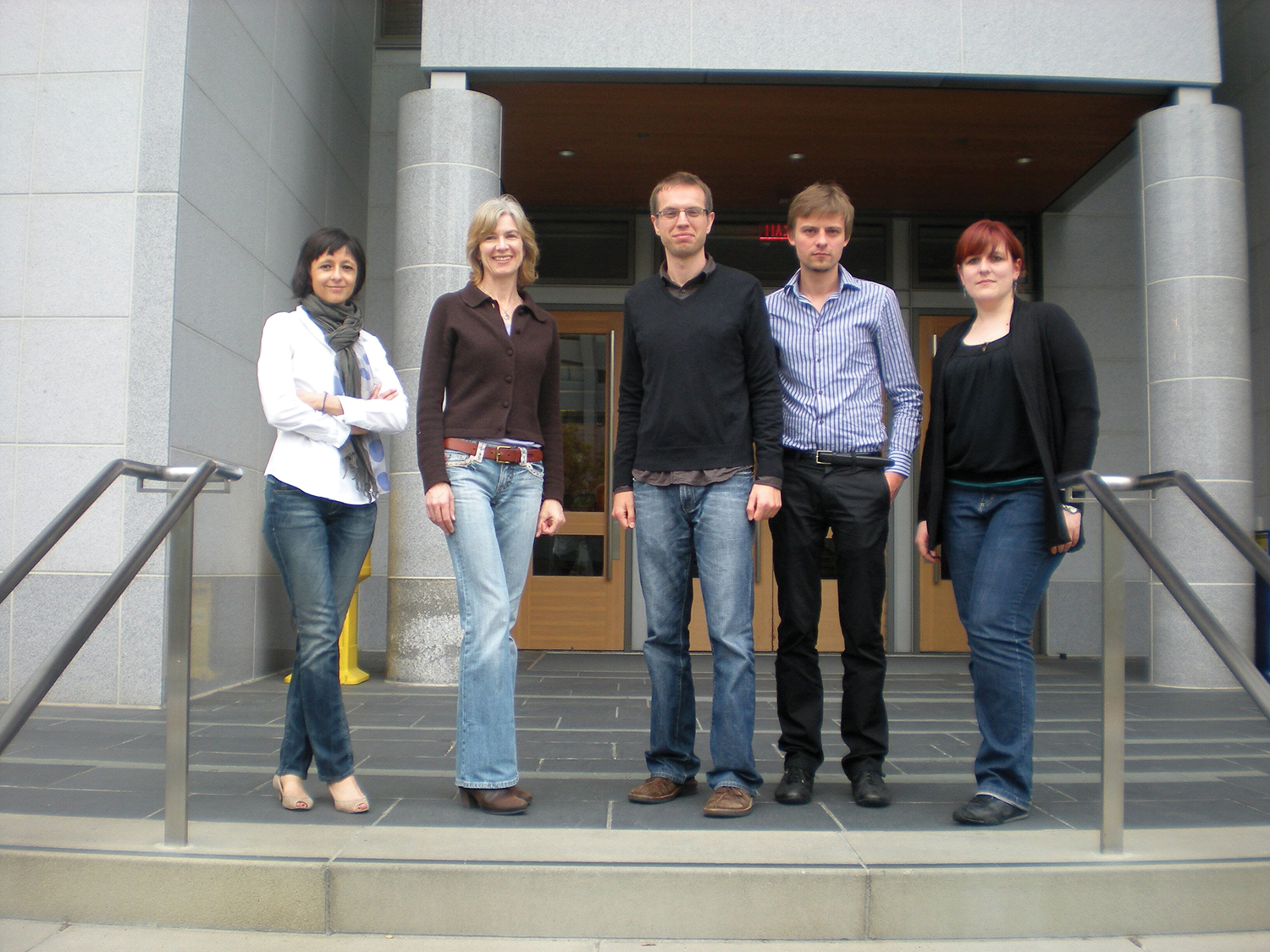
Jínek: We had one personal meeting with Emmanuelle and Krzysztof at the 2011 CRISPR meeting in Berkeley—this was when we formalized the collaborative partnership (Fig. 1). Throughout the collaboration, we regularly kept in touch, but the second time we met in person was only at the next CRISPR meeting in 2012. But all this time, I communicated with Krzysztof by Skype and email, and we were coordinating our experiments and sending samples and reagents back and forth across the Atlantic.
Building the team: The Doudna-Charpentier collaboration is sealed on the steps of Stanley Hall, University of California, Berkeley, in 2012. From left-to-right: Charpentier, Doudna, Jínek, Chylinski, Ines Fonfara.
Davies: How did the idea of the single-guide RNA come about?
Jínek: This was a follow-up idea from a series of experiments I had done to find the essential features of the guide RNAs. As biochemists, we would ask how we can test what's really needed for the DNA cutting reaction. Can we take the reductionist approach and break it down to some minimal components? I'd gone through experiments modifying various parts of the crRNA and the tracrRNA. We saw that you could truncate the crRNA from the 3′ end down to a certain length, and likewise truncate the 5′ end of the tracrRNA. You had to maintain some degree of base pairing between the two. But that base-paired region was a lot shorter than what was initially predicted based on the complementarity of their sequences.
We then came up with the idea that if they're part of a duplex, then presumably the 3′ and the 5′ ends must not be too distant from each other. Then you can stitch them together with a loop.
This was the kind of thinking one had to do in the field of structural biology of RNA to get RNAs to crystallize because sometimes adding or removing a base pair from the end of a duplex or joining ends together can have profound effects on how these molecules behave in solution so that they can make crystals. With this thinking, it was still a leap, but we were primed to have these ideas.
Davies: Did it work straight away?
Jínek: It worked almost straight away. This was also at the time when we were already thinking that Cas9 could be a tool for genome editing. One of the questions was if we put the system into a eukaryotic cell, how do we get the RNAs to be processed properly? Fusing the crRNA and the tracrRNA together would potentially bypass the need for a dedicated processing mechanism that the bacteria had but that eukaryotic cells might not necessarily have functioning in the same way. This became one of the ideas behind using CRISPR-Cas9 as a tool.
At one point, we had a brainstorming session with Jennifer, another Eureka moment. We looked at all the experiments where we were deleting parts of the RNAs, adding things, and so on, and then designed chimeric RNAs that at least in our minds had the best chance of working. Then, it took another 3 weeks to make those RNAs. These were too long to be made by chemical synthesis, so I had to prepare them by in vitro transcription. We had to make them in-house. If they could have been a bit shorter, we could have just ordered them from a company.
Davies: When you say “We had a brainstorming session…”?
Jínek: Initially just Jennifer and me, but Krzysztof and Emmanuelle were brought on board very shortly after that.
When we knew that Cas9 was able to cut DNA, the idea of using it as a gene editing tool came to us all quite quickly. At the time, there was a lot happening in the literature about TALENs and genome editing. But what really cemented it in the end was this idea that we could have a simple way of expressing these single-guide RNAs in cells. At that point, to deploy the system would not be all that different from the way that you can do RNAi in mammalian cells, where you can express the guide RNA by transfecting cells with a plasmid with an RNA polymerase III promoter. To start the work of repurposing the CRISPR-Cas9 system for editing, we could rely on some of the ideas that had been established for other systems.
Davies: What was the reaction when you first presented the story in your first lab meeting? What about after the paper was published?
Jínek: Things happened very quickly. We had group meetings where everyone took turns to present, but Jennifer's lab was quite big. At the time, we were 20–25 people. On average, you'd give maybe one or two presentations in a year. So, I only gave group meeting once during that period. But the great thing about the Doudna lab was that there were lots of smart people around. I could always rely on getting critical feedback from the other lab members, and not just during lab meetings. We'd discuss ideas and project directions all the time.
Davies: When you submitted the Science paper, were you aware of any competition?
Jínek: There certainly was a sense of urgency. We had suspicions about the Šikšnys lab or Rodolphe's lab, as both had published on type II CRISPR-Cas systems previously. I didn't know that Šikšnys's paper had been rejected by Cell. Before our paper came out in June 2012,4 we presented the work at the 2012 CRISPR meeting. This caused quite a lot of excitement—we had back-to-back presentations with the Šikšnys lab, which also showed Cas9 was an RNA-guided, DNA-cutting enzyme.5 It didn't take long for everyone to jump on board with the idea that the CRISPR field was going to move from a somewhat obscure aspect of molecular microbiology to genome editing and biotech.
Davies: Did the Charpentier collaboration just peter out?
Jínek: It was again an organic thing, and there were several factors. The collaboration was punctuated by my job interviews in Europe, and when I had an offer to start my own lab in Switzerland, I started preparing for the move. Charpentier was looking to move from Umea to Germany, and Krzysztof started writing up his PhD thesis. We all had other motives!
We were overtaken by the speed things started to develop. We didn't decide to end the collaboration; I think that we all enjoyed it tremendously. We made a really good team. There was a lot of back and forth with ideas. But suddenly, the thing became almost too big for us. There was so much to do, and we only had a limited bandwidth. The Charpentier lab continued to focus on microbiology, while my goal was to solve the crystal structures of Cas9. I only managed to finish that in Zurich. In the meantime, Jennifer started collaborations with several labs to apply genome editing to various model organisms, and I was involved in the early stages of those.
Davies: Did you worry about whether CRISPR-Cas9 could work in human cells, given the differences between prokaryotic DNA and eukaryotic chromatin?
Jínek: There was a lot of optimism from my side that it would work in human cells. After all, ZFNs and TALENS showed it was possible to cut DNA within eukaryotic chromatin. The FokI nuclease part of ZFNs and TALENs—that's a prokaryotic enzyme. A priori, there was nothing in my mind that would preclude CRISPR-Cas9 from working in mammalian cells, but we still had to demonstrate it.
The ZFN and TALEN people had already shown us how to go about it. Take a protein and get it to work in the eukaryotic cell nucleus. The idea that you'd have to put a nuclear localization signal, codon optimize the constructs, this was all out there. This was why, in early 2013, it wasn't just Church and Zhang in Science, there were other papers published very shortly after, ours included6—all converged on the same set of parameters for how to put this to work. There were some slight differences, but the recipe turned out more or less the same.
Davies: You ended your 2019 TED talk back in your hometown talking about human embryos. Do you talk with Jennifer about that? Do you think there is a path forward or is the genie out of the bottle?
Jínek: I agree with the consensus position that it's too early to think about germline genome editing for any purpose. Personally, I could imagine it being used in the few instances where there's a clear medical need, but this would apply only to very few cases: a tiny minority of parents who, due to some combination of genetic defects, would not ever be able to have healthy children.
As for using germline editing for human enhancement, I don't think that we should be going down that path. You could argue it's easy for me to say this, now that I'm in Switzerland, where there's a constitutional ban on germline editing and very strong consensus in society against it. Switzerland has direct democracy. So, to change something like this, you'd have to change the mind of the entire electorate. I agree with Jennifer that we'll have to try to build upon the current consensus, and I think that there should be an internationally agreed regulatory framework. But there'll always be outliers—renegades who might want to go against it.
Davies: What is your major focus in your new lab in Zurich, and what are you most excited about?
Jínek: We still enjoy working on Cas9 and Cas12. It's not like I've given up on those. I like the fact that I've been able collaborate with people who continue to develop CRISPR technologies, even though I wouldn't consider myself a technology developer. A case in point is our recent collaboration with Caribou Biosciences on the off-target activity of Cas9.
We have also been really fascinated by type III CRISPR-Cas systems that use signaling molecules to make connections with other pathways. We have been in competition with the Šikšnys lab again, as fate would have it. I'm also very excited by the work that Rotem Sorek is doing on non-CRISPR genome defense pathways and by Sam Sternberg's work on CRISPR-associated transposons. There's still so much to be discovered!
References
1.
BarrangouR, FremauxC, DeveauH, et al.CRISPR provides acquired resistance against viruses in prokaryotes. Science, 2007; 315:1709–1712. DOI: 10.1126/science.1138140.
2.
WiedenheftB, ZhouK, JinekM, et al.Structural basis for DNase activity of a conserved protein implicated in CRISPR-mediated genome defense. Structure, 2009; 17:904–912. DOI: 10.1016/j.str.2009.03.019.
3.
DeltchevaE, ChylinskiK, SharmaCM, et al.CRISPR RNA maturation by trans-encoded small RNA and host factor RNase III. Nature, 2011; 471:602–607. DOI: 10.1038/nature09886.
4.
JínekM, ChylinskiK, FonfaraI, et al.A programmable dual-RNA-guided DNA endonuclease in adaptive bacterial immunity. Science, 2012; 337:816–821. DOI: 10.1126/science.1225829.
5.
GasiunasG, BarrangouR, HorvathP, et al.Cas9–crRNA ribonucleoprotein complex mediates specific DNA cleavage for adaptive immunity in bacteria. Proc Natl Acad Sci U S A, 2012; 109:E2579–E2586. DOI: 10.1073/pnas.1208507109.
6.
JínekM, EastA, ChengA, et al.RNA-programmed genome editing in human cells. eLife, 2013; 2:e00471. DOI: 10.7554/eLife.00471.