




Abstract

Güneş Taylor

As academic scientists, we are expected to communicate scientific findings, and our interpretations of these findings, to our lab mates, peers, and students. We give lab meetings, speak at conferences, write grants, and (hopefully) publish papers. Yet, in my experience, talking to the public about my research or science news in general is at best viewed as a quirky hobby, more often as a waste of precious time.
The importance of clear communication became apparent to me during my PhD, when the first reports of genome editing using CRISPR-Cas9 sparked a windfall of papers (which does not appear to have abated much!). As a student, the language of scientific reports significantly impacted my ability to keep up with such a dynamic field. Furthermore, CRISPR-based genome editing captured the imagination of those outside academic science, leading to many people asking scientists like myself to explain how this new technology actually works.
Understanding and employing CRISPR has benefited my own research—I'm currently a postdoc with Robin Lovell-Badge at the Crick Institute in London—but finding ways to share that hard-earned knowledge with others has had some unanticipated benefits. Thus, I believe that extending the de facto audience of scientific findings to include the general public directly benefits both scientist and society.
Of course, much has been written about the benefits of public engagement for society. In a world increasingly seeped in Big Data and where politicians in the United Kingdom and the United States claim (debatably) to be “led by the science” during pandemics, scientific literacy is clearly an advantage. While a scientific grounding is primarily gained through formal schooling, the media and personal encounters with scientists are major sources of continued information for the public, helping increase scientific literacy and curiosity.
An improved appreciation of the intrinsic uncertainties, iterative progress, and lengthy duration of the scientific process should encourage the public to question the emphatic certainties presented in click-bait headlines. This is paramount if we are all to be led by science; the ability to integrate scientific findings into one's life and daily regimen should be a normal expectation, not a privilege.
London Calling
I was born a political refugee to Turkish parents in Germany and, for various reasons, moved each year between the ages of 4 and 15. Despite this unconventional background, I've had a relatively conventional career trajectory, at least thus far! After leaving home at 15, I did my undergraduate master's degree in human genetics. During my PhD at the University of Oxford, I studied the tissue-specific regulation of a chromatin remodeler in the neural crest, with implications for a clinical condition called CHARGE syndrome.
Since joining the Crick, I've been investigating the role of key transcription factors in primary gonadal sex determination (the process by which ovaries and testes differentiate from a bipotential embryonic structure). The common thread between these two projects is the use of CRISPR-Cas9 to answer questions modeled in a classic developmental biology system, the chicken embryo. Like many others, I'm excited at the promise of CRISPR for the future of basic research and potential translations into human health.
Throughout my PhD and postdoctoral position, I have leveraged my unusual upbringing and experiences of living in disparate areas of the United Kingdom to engage diverse and particularly underprivileged members of the public in my research questions, and especially CRISPR genome editing. Nowadays, I sit on panels at debates, festivals, and science-specific outreach events, often discussing genome editing and its implications (Fig. 1). But my first foray into public engagement occurred as an undergraduate. Dressed as a giant strawberry, I showed children how to extract the DNA from strawberries using washing-up liquid and sieves (Fig. 2). (My conclusion: children are more likely to listen to a giant strawberry than an adult!)
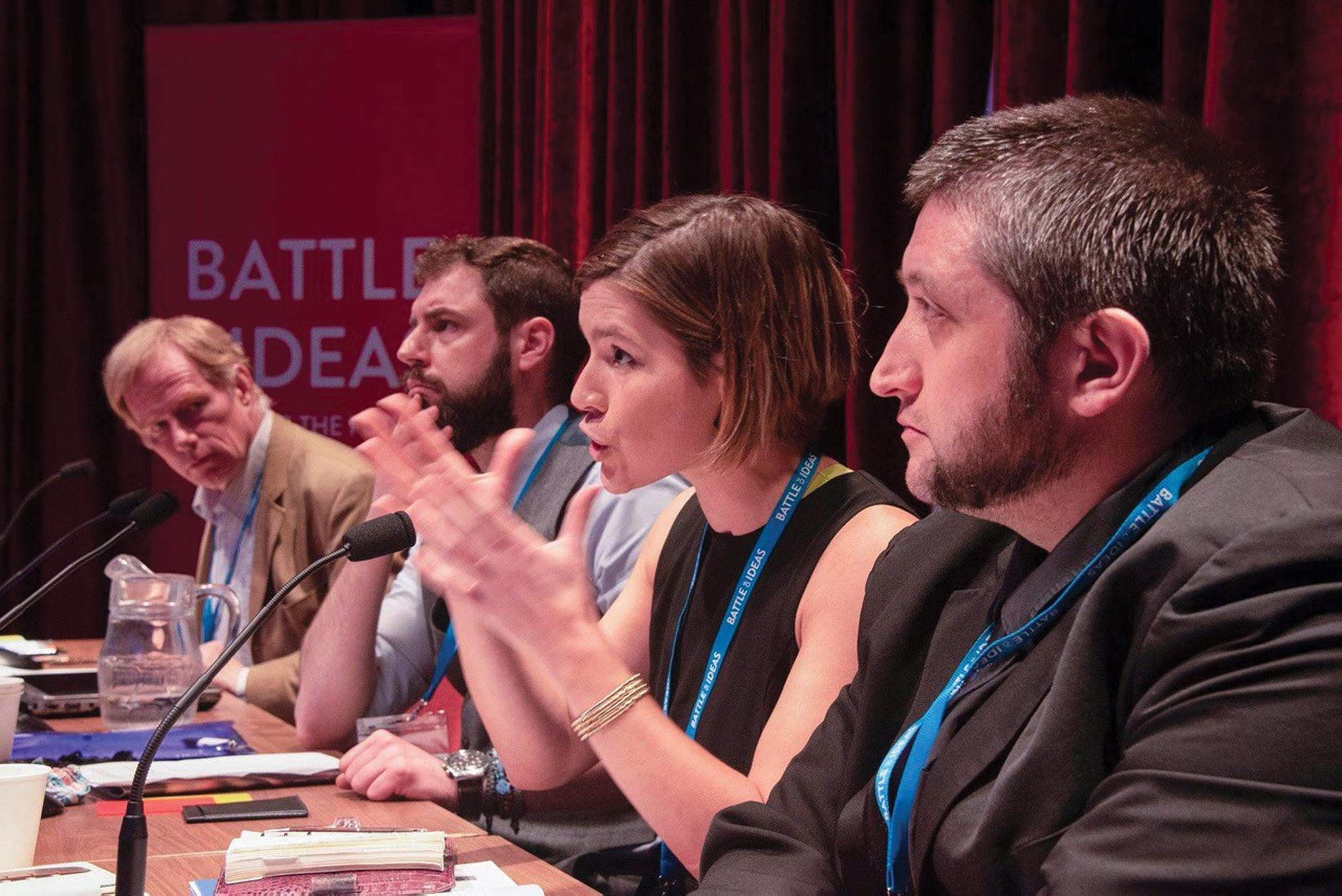
The author speaking during a public debate.
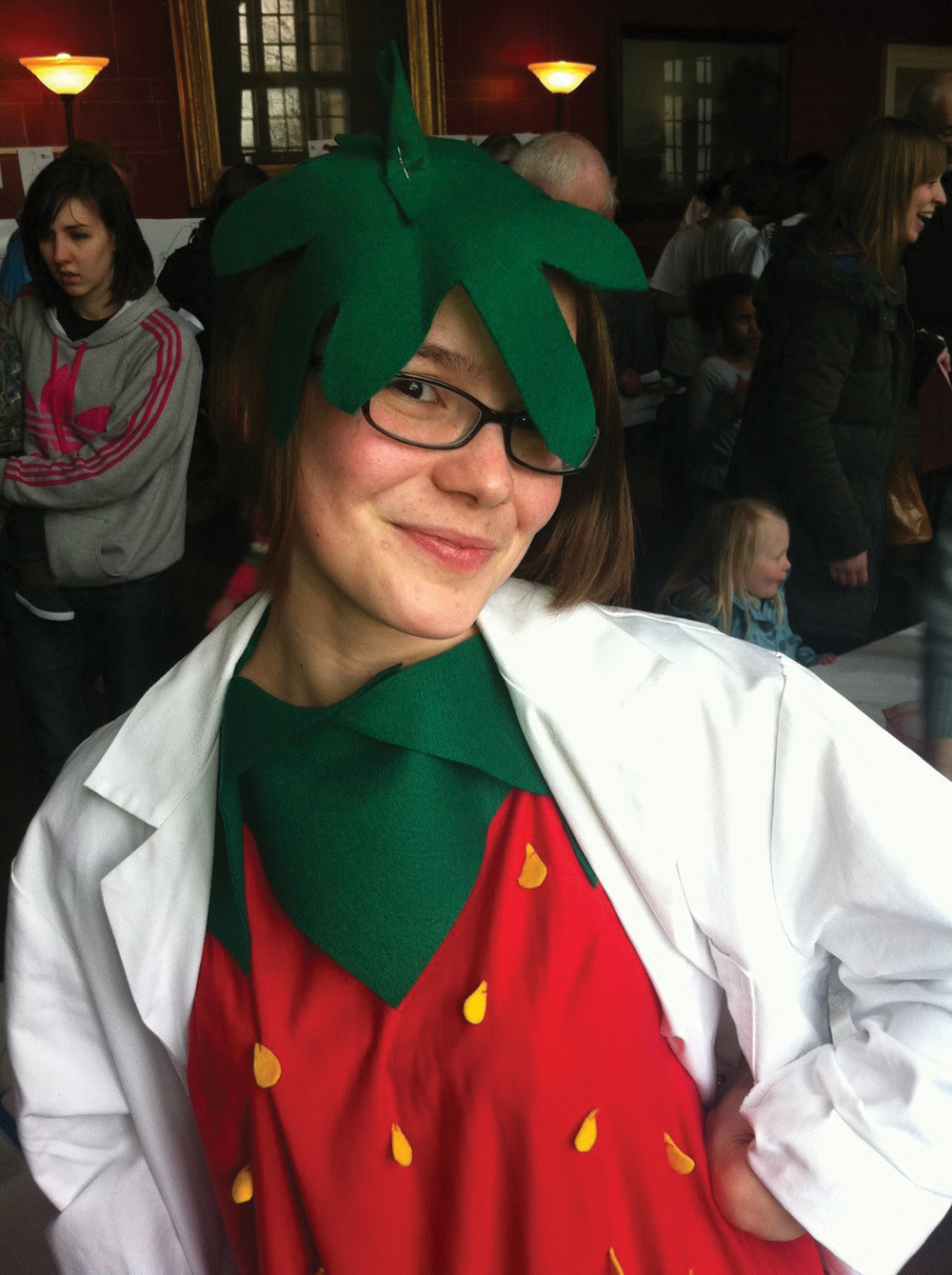
The author embracing her role teaching school children on the joys of DNA extraction.
From this perspective, I see public engagement serving two main functions for the individual scientist: it simultaneously demands the development of strong communication skills and builds confidence.
The act of explaining your work to the public is beneficial to you as a scientist, as you will have to step back from the nitty-gritty of your experiments and current frustrations, and paint a simple picture. Much as the abstract of a paper contextualizes a novel finding, public engagement requires you to be explicit about the context within which your research is placed and its wider ramifications. Public engagement entails verbally distilling your research goal in real time—a skill that is eminently useful within academia and also outside it.
Regular practice will improve your ability to explain your research project swiftly and succinctly to laypeople, hopefully prompting further questions and conversation. This improved verbal efficiency will feed into your work, from talking to students to constructing narratives within a paper. Improved communication skills may even help those prospective grant reviewers from adjacent fields, or members of ethical boards, to appreciate the potential significance of your work!
Public engagement also improves your self-confidence, as members of the public effectively act as in-person reviewers of your communication skills. This has career benefits: there are far more graduate students and postdocs than there are tenured positions available in academia. The moments of successfully explaining any scientific concept to a colleague, friend, or complete stranger are immensely gratifying. Furthermore, the prevalence of imposter syndrome among academics at all stages of their career is widely accepted. Building confidence is a shield to the inevitable stresses of life as a research student or trainee.
Getting the Word Out
Genome editing technologies such as CRISPR have attracted immense public interest in recent years. CRISPR captures the imagination by its unparalleled potential applications and the now imminent ethical quandaries these potentials pose. Many cultural reference points exist on the subject of genome modification of humans in particular. Through books, films, and TV series, most people have encountered the nature versus nurture debate and the work of scientists to modify the code of life. Even Sideshow Bob in The Simpsons TV series has dabbled in a little (self) genetic modification!
In recent years, at least in the United Kingdom, there has been increased public interest surrounding science, museum events, and research institutes and new science-meets-design/art venues. Conversations within these spaces serve to overcome public apprehension about engaging with scientists. From explaining developmental biology to 5-year-olds to debates on the future of humanity in a post-CRISPR world, I find that engaging with the public brings important diversity and new perspectives into the academic bubble. Especially as publicly funded scientists, it is our communal responsibility to provide comprehensible outputs for their investment in our work.
Finally, it is worth remembering that many people are intimidated by scientists. How many times has the declaration of a scientific profession been the end of the conversation in a social gathering? Establishing common ground between scientist and non-scientist closes the imagined gap between us, and is usually the best place to start. It is seeing us scientists as humans too that improves the receptiveness of non-scientists, thereby changing the course of the conversation.
Fellow scientists, when you can't see the proverbial wood for the trees in your work, step back and tell a non-scientist about it!