




Abstract


When Editing with CRISPR, Single-Cell Proteomics Has Provided Key Insights Into the Functional & Epigenetic Downstream Impacts
IsoPlexis is not only the first company to achieve highly multiplexed functional proteomic analysis, it's also the first to provide deep functional multi-omics or full functional proteomics: extracellular, intracellular and metabolomics at the single-cell and population resolutions. This is done using very small sample sizes and is automated on just one system, the IsoLight. IsoPlexis has worked with numerous cancer centers, biopharmas, academic medical centers, etc. to provide researchers with the functional data they need to take their therapy from pre-clinical development all the way to clinically approved products.
IsoPlexis' single-cell proteomics has uncovered a range of unique biological insights that are illuminating the underlying drivers of complex diseases. IsoPlexis provides an automated suite of life sciences products that are powering the future of advanced medicines to fight these diseases. IsoPlexis' unique omics reveals critical cellular differences through single-cell functional proteomics allowing researchers to uniquely predict response and accelerate development of novel personalized therapies. IsoPlexis has already proven that its system works well with CRISPR-edited therapies as can be seen in several publications.1,2
Confirming Function from Gene Edits with IsoPlexis' Superhero & Supervillain Cells
Detecting Superhero & Supervillain Cell Subsets with Unique Function Using IsoPlexis' Single-Cell Proteomics
IsoPlexis can detect the unique subsets of cells that are driving patient outcomes such as inflammation, anti-tumor response, toxicity, and more. As revealed in the various correlative and published data sets, highly polyfunctional cells are the cells with “superpowers.” These cells can act as “superheroes” or “supervillains,” depending on the types of cells as well as the cytokines and chemokines driving their high polyfunctionality.
Cells with superpowers were revealed by IsoPlexis' single-cell proteomics in a variety of studies and correlated with:
Superheroes:
Functionally potent CRISPR-edited NK cells in leukemia Functionally persistent NK cells in solid tumor Functionally durable trimeric CAR-T cells in myeloma
Supervillains:
Functionally suppressive monocytes in follicular lymphoma
Functionally resistant glioblastoma cells
Functionally inflammatory myeloid progenitor cells in myelofibrosis
Cell therapy workflow using gene-editing techniques like CRISPR and IsoPlexis' platform.
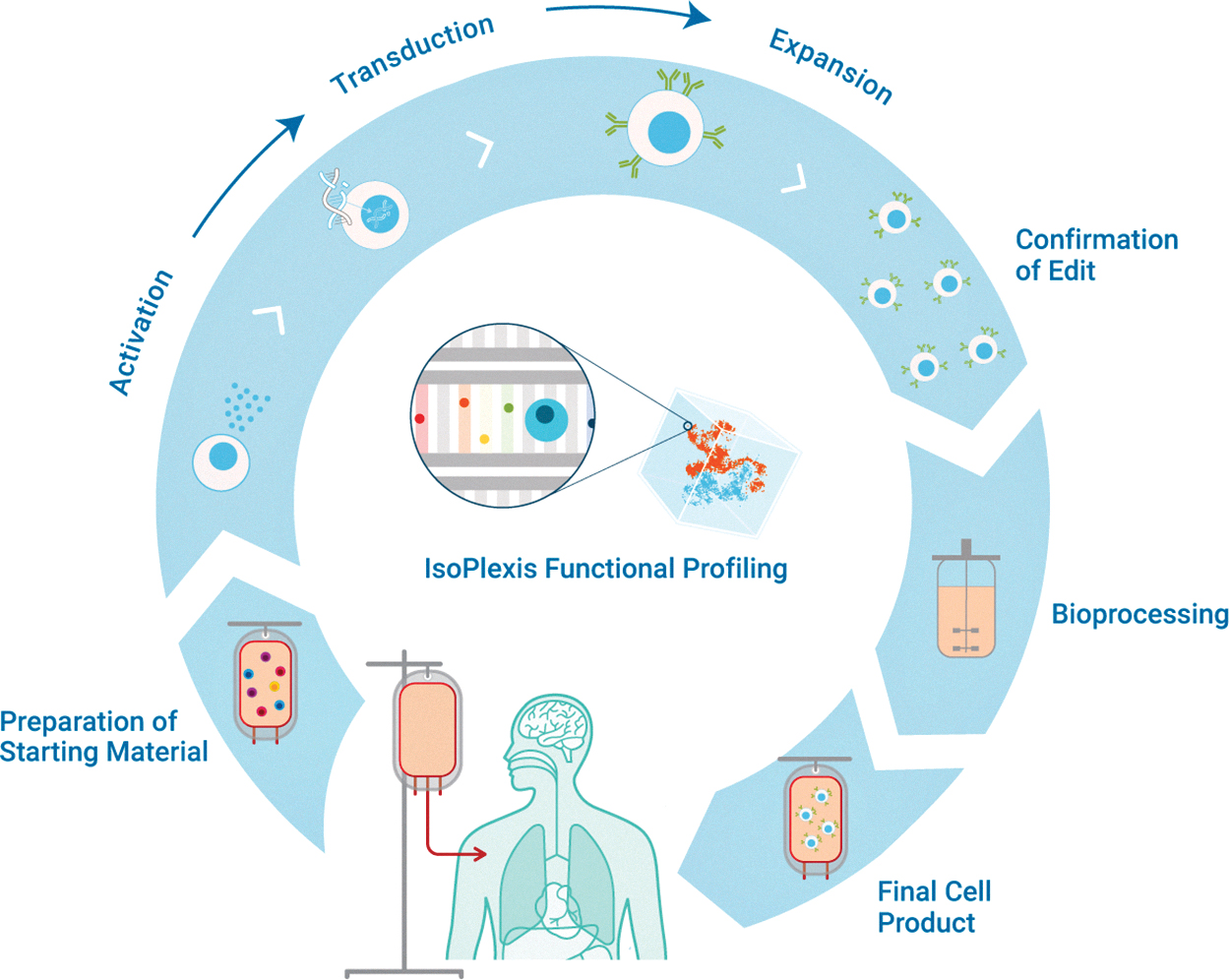
Targeting the right cell types, IsoPlexis' unique super cells and avoiding the villains, is critical to speeding development of durable breakthrough medicine.

Identifying Functional Drivers to Provide Researchers the Edge They Need to Accelerate Complex Therapies
IsoPlexis' technology detects the highly polyfunctional cell subsets, typically missed in bulk, that correlate to in vivo outcome in cellular and regenerative medicine. Functional characterization of gene-edited cells needs to be implemented in order to accelerate therapeutic efficacy and improve patient outcomes, such as potency, durability, and the reduction of immune related adverse events. One major challenge facing the therapeutic development of engineered immune cells is that legacy technologies only provide estimates of cellular function that do not correlate well to in vivo responses. The IsoLight platform can confirm if the gene edits made through technologies such as CRISPR result in improved function. Researchers have used IsoPlexis' single-cell proteomics to analyze CRISPR-edited NK cells that were modified by knocking out the CISH gene, which researchers believed inhibited NK cell-mediated tumor resistance. IsoPlexis' platform revealed the improved function of these iPSC-derived CRISPR-edited NK cells, demonstrating their potential therapeutic ability.1,2
Functional Proteomics: IsoPlexis Fills the Gap that Other Technologies Miss
Researchers have utilized IsoPlexis' platform to analyze gene-edited and engineered cells. Previously, researchers were only able to confirm that the gene edits (e.g., CRISPR-editing) were present, however, they did not have a way to identify if those edits resulted in the intended function. IsoPlexis' single-cell functional proteomics is overcoming this challenge by directly measuring true function from individual cells.
IsoPlexis‗ suite of proteomic products.

The traditional technologies that researchers utilize for optimization of CRISPR-edited therapies are not effective in providing the necessary functional data to verify the potency and durability of these therapies. Methods such as single-cell transcriptomics can measure RNA, but RNA has a relatively weak correlation to secreted protein, making it more difficult to ascertain the true function of a cell therapy product. IsoPlexis' single-cell proteomics and ultra-small volume omic products are revealing a direct view into functional biology to power researchers' most important work.
IsoPlexis' single-cell IsoCode technology meets an unmet functional need for the first time by measuring a range of over 30 cytokines at the single cell level. The IsoPlexis technology has been published in over 80 publications within infectious disease, cancer immunology, and other immune-mediated diseases. The highly multiplexed functional proteomics covers the range of immune cell functions from monocytes, NK cells, and T cells including anti-tumor, stimulatory, chemotactic, inflammatory, and regulatory cytokines, all critical to patient outcome. The IsoLight system utilizes reduced sample input, targeting 500-1500 cells, an additional advantage over the existing single-cell technologies for the analysis of low quantity patient samples.
Optimizing Bioprocessing for Allogeneic Cell Therapies with IsoPlexis' Platform
In CAR-T therapy, clinicians obtain T cell source material directly from a patient (autologous), or from a donor (allogeneic), modify the cells, and then re-introduce them to the patient. Working with autologous cells can be complicated by insufficient source material quality or quantity and expanding the cells to the requisite number takes time that the patient may not have. Allogeneic cells can be prepared in advance and mass-produced, but they can be rejected by the patient, and in the worst case, begin attacking the patient's own cells. IsoPlexis' technology has been used by leading pharmas and top research institutions to functionally characterize these engineered cell products. Recent published research found improved patient outcomes where unique polyfunctional T cells were identified with IsoPlexis' technology.

Researchers have used IsoPlexis' single-cell proteomics in an integrated workflow with an automated cell manufacturing platform for precision analytics and the optimization of CAR-T cell products. Comparing two different bioprocessing procedures to discover the method that created consistently more robust polyfunctional response, IsoPlexis' single-cell proteomics identified the method which created more highly polyfunctional CAR-T cell products that met the product release criteria. 3
Improving Patient Outcomes with Single-Cell Functional Proteomics
The IsoPlexis platform can help predict which patients will respond to the engineered therapy before infusion using anti-tumor biomarkers by identifying highly polyfunctional cell subsets. Not only have these anti-tumor biomarkers been correlative and helped accelerate pre-clinical development, such as in treating antigen-escape in multiple myeloma 4 and solid tumor liver cancer, this data has also been predictive within patients by predicting patient response from pre-infusion CAR-T products.
Grant Writing & Assistance
IsoPlexis has helped its customers in writing grants to receive funding for using the IsoLight platform in their research and development. The IsoLight system provides a solution for the single cell and accelerated population level functional proteomics required to overcome the challenges with this type of research, such as cellular immune monitoring for protective response and cellular prediction and cytokine level monitoring for toxicities related to cytokine storm.
By functionally defining each cell type involved in the immune response, researchers can better understand the functional mechanisms for the development of patient biomarkers, vaccines, and novel therapies for cancer, infectious diseases, and more.
What researchers need is a system that can perform:
Multiplexed proteomic detection of 20+ cytokine markers simultaneously, to provide early predictive metrics of these inflammatory cytokines
In an automated, all-in-one system, for universal ease-of-use
Which can handle a smaller amount of sample if large blood draws are not possible
With the IsoCode and CodePlex solutions, IsoPlexis' platform is the only one that can perform such deeply multiplexed cytokine analysis. Because both types of solutions run on the fully automated IsoLight system, it's also the only platform that can enable technicians to get highly multiplexed data with no expertise and no interaction with their samples. The IsoLight is also able to handle a wider range of clinical sample sizes and a vast number of cell types, with results returned within the same day to deliver real-time analysis.
Reach out to IsoPlexis at info@isoplexis.com for grant assistance or to speak to a cellular proteomics expert about your research needs.