




Abstract

A New Study from Rotem Sorek and Colleagues Reveals a Biological Role for Bacterial Retrons 35 Years in the Making
Retrons are DNA sequences found in bacteria that code for a specialized reverse transcriptase and a unique chimeric single-stranded DNA/RNA molecule. They were first discovered in Myxococcus xanthus back in 1984 as short DNA sequences present at high abundance in the bacterial cell. 1 While several dozen retrons have been experimentally validated in the past 35 years and hundreds more identified bioinformatically, 2 their biological functions remained mysterious.
Numerous hypotheses have been put forward, from retrons simply being selfish genetic elements 3 to retrons playing roles in coping with starvation 4 and enabling intestinal colonization by enteric pathogens. 5 Now an exciting new preprint from Rotem Sorek's group at the Weizmann Institute (Rehovot, Israel) reveals that bacterial retrons function as defense systems that confer resistance to a broad range of phages. 6
Inspired by previous work showing that reverse transcriptase genes were involved in bacterial defense and phage counter-defense mechanisms, Millman and colleagues searched for reverse transcriptase genes of unknown function located near known anti-phage defenses like restriction enzymes. They identified a reverse transcriptase gene that was always found next to a gene with a predicted ATPase domain, cloned the two genes, and expressed them in an Escherichia coli strain that naturally lacks the system.
Phage challenge revealed that this system conferred resistance to a diverse set of E. coli phages. The authors noticed that this newly discovered anti-phage system contained a conserved intergenic region between the reverse transcriptase and ATPase genes. This suggested that it might contain a noncoding RNA like retrons do, and isolation of single-stranded DNA from cells expressing this system revealed a single-stranded DNA species of the expected size. These results confirmed that this newly discovered anti-phage defense system encodes a retron and provided an answer to the 35-year-old mystery of why bacteria encode these systems.
This new anti-phage defense system, called Eco8, consists of three components that are essential for its anti-phage activity: the reverse transcriptase and noncoding RNA (the active retron) and an accessory gene with an ATPase domain. Other previously studied retrons were found to be associated with accessory genes that encode DNA-binding, HNH endonuclease, ribosyltransferase, and transmembrane domains.
Further testing of systems encoding these diverse accessory genes revealed that they also function as retron systems that endow bacteria with phage resistance. Remarkably, retrons that encode genes with similar effector domains provided defense against different phages, suggesting that the reverse transcriptase and/or the single-stranded DNA/RNA molecule of the retron controls the specificity. Precisely how they recognize specific phages and the mechanism through which the signal is transmitted to the effector protein remains unknown.
Homologues of retron reverse transcriptases are found in more than 4400 bacterial genomes, with almost half of these genes associated with defense islands. This suggests that retrons form a widespread class of bacterial defense systems that should provide a formidable barrier to phage survival. However, similar to other bacterial defense systems such as CRISPR-Cas and restriction enzymes, phages evolve to circumvent retron activity. E. coli phages λ and T7 were shown to bypass the activity of one of the anti-phage retron systems (Ec48) through mutations in genes gam and 5.9 respectively. The finding that these phage mutants escaped retron-mediated killing suggested that retrons sense the activity of these proteins and trigger the anti-phage response.
Intriguingly, both Gam and 5.9 are phage-encoded counterdefenses that bind to and inactivate the RecBCD complex, 7 allowing phages carrying these genes to survive and replicate in their bacterial host. The RecBCD complex is known to participate in anti-phage activities through multiple mechanisms, including destroying the linear double-stranded DNA phage genome as it enters the cell, 7 assisting in the acquisition of new CRISPR spacers, 8 and promoting the formation of guide DNAs for bacterial argonaute proteins. 9 It appears that the Ec48 retron defense system characterized in this study acts as a guardian of the RecBCD complex, with the phage inhibitors triggering the retron system and causing cell suicide through an abortive infection mechanism (Fig. 1).
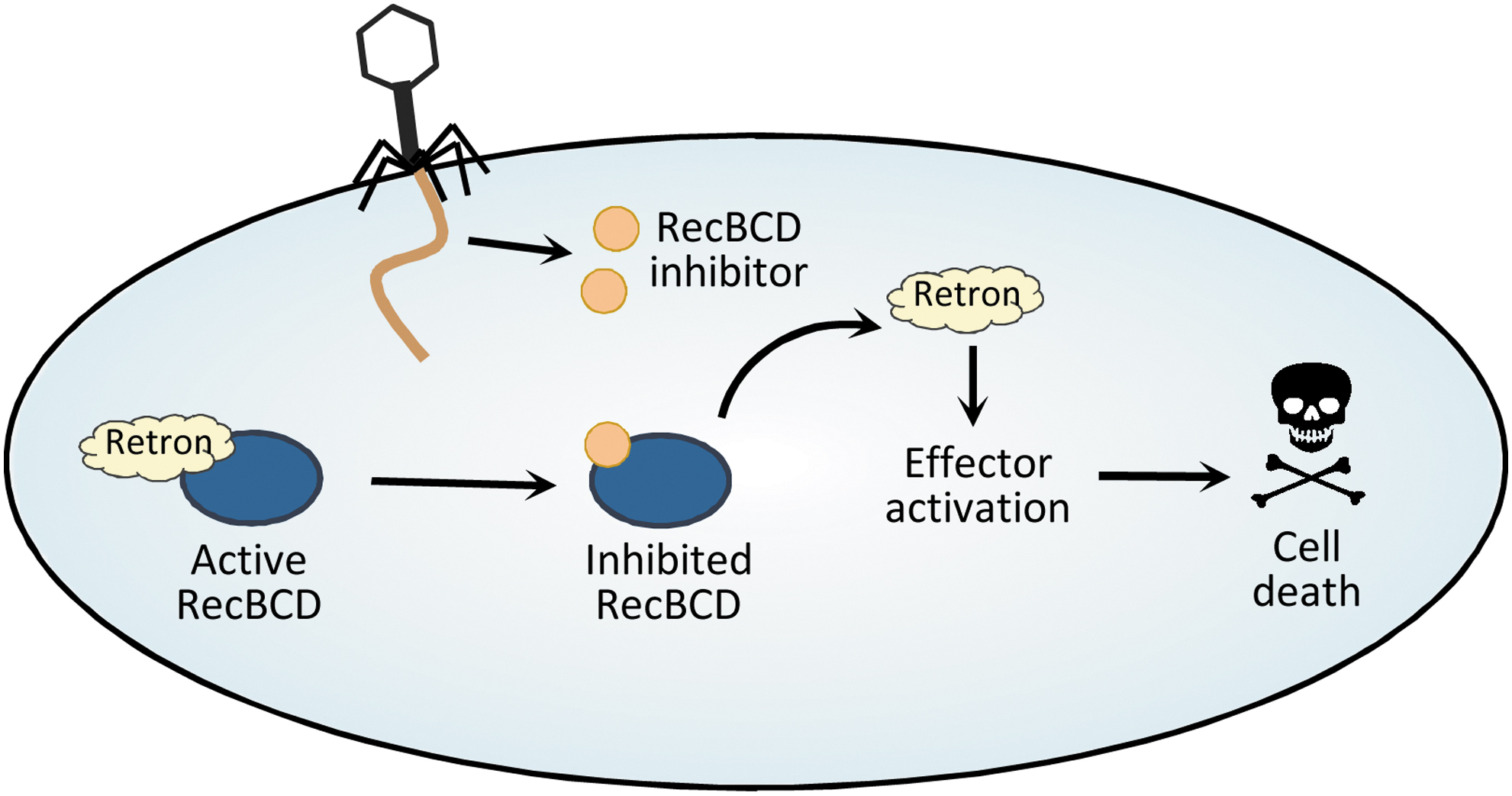
A retron-based defense against phage infection. Following phage infection, the activity of phage-encoded inhibitors of RecBCD triggers a retron that acts as the “guardian” of this complex. This in turn activates an effector protein that kills the cell before the phage can complete its replication cycle, thereby stopping the phage infection from spreading through the bacterial community.
While it is unclear exactly how this anti-phage defense is triggered, it may involve the retron RNA and the reverse transcriptase sensing or directly monitoring the activity of RecB. Regardless, the monitoring of RecBCD, a central hub of anti-phage immunity in E. coli, provides bacteria with a broad defense because different phages inhibit RecBCD in different ways.7,10 Instead of detecting unique individual phage inhibitors, the retron monitors the integrity of the RecBCD-mediated immunity system as a whole. It also provides the bacteria with a multitiered defense, for if the phage mutates to escape retron targeting, it then becomes more susceptible to the RecBCD-mediated anti-phage responses.
Not all retron defense systems act through the RecBCD complex. Thus, there must be alternative signals or other important complexes that are monitored to mitigate phage infection. The Gam and 5.9 proteins are analogous in function to other phage counterdefenses such as anti-restriction 11 and anti-CRISPR proteins. 12 One might speculate that these phage proteins, known to be expressed very early in the infection process, could also serve as targets for retron-mediated phage defense.
The guard theory of immunology, first described in plants, proposes that the immune system can sense the consequences of infection instead of directly sensing a component of the microbial invader. It does this by monitoring key cellular process that are common targets for pathogens, such as cytoskeletal dynamics in plants and the inflammasome in mammalian cells. 13 Thus, the discovery that retron Ec48 acts as a guardian of RecBCD provides yet another common link among the principles that govern immune systems from bacteria to plants and animals.