




Abstract
The U.S. Patent Trial and Appeal Board (PTAB), in an interference proceeding decided in February 2022, concluded that researchers at the Broad Institute (Cambridge, MA) were the first to “conceive” of using single-guide RNA CRISPR-Cas9 genome editing in eukaryotic cells in 2012. The PTAB reached this verdict even though competing researchers at the University of California, Berkeley, among other institutions, could document the idea 7 months earlier. Understanding the basis for the PTAB's decision turns on patent law's particular “conception” requirement. In this study, I explain that requirement, detail the PTAB's interference decision, and discuss the decision's practical effects on CRISPR technology and routine science.
Introduction
By many accounts, using CRISPR as a genome editing tool was first invented now a decade ago, in 2012. But legal disputes surrounding some of the foundational patents to CRISPR continue to drag on. A core issue in several of these cases is who was the first to “conceive”—a particular term of art in patent law—genome editing using a CRISPR-Cas9 system in eukaryotic cells.
On February 28, 2022, the U.S. Patent Trial and Appeal Board (PTAB) released a monumental decision on that issue in an interference proceeding—a type of administrative procedure at the U.S. Patent and Trademark Office (USPTO)—to determine who, among competing inventors, was legally the first to invent a patented technology. 1 For the first time, the USPTO declared that Feng Zhang of the Broad Institute (Cambridge, Mass.) was the first to both “conceive” and “reduce to practice” the canonical single-guide RNA (sgRNA) CRISPR-Cas9 genome editing system in eukaryotic cells (Fig. 1).

Feng Zhang. (Photo: Justin Knight, McGovern Institute.)
This occurred mere weeks before the laboratories run by 2020 Nobel Prize winners Jennifer Doudna (University of California, Berkeley) and Emmanuelle Charpentier (at the time working at Umeå University in Sweden, but affiliated with the University of Vienna), who had agreed to collaborate in early 2011 (Fig. 2). The PTAB ruled in favor of the Broad Institute even though Doudna's laboratory documented—in painstaking detail and in a laboratory notebook dated, signed, and witnessed by Berkeley researchers on March 1, 2012 (Fig. 3)—a sgRNA CRISPR-Cas9 system a whole 7 months earlier than Zhang.
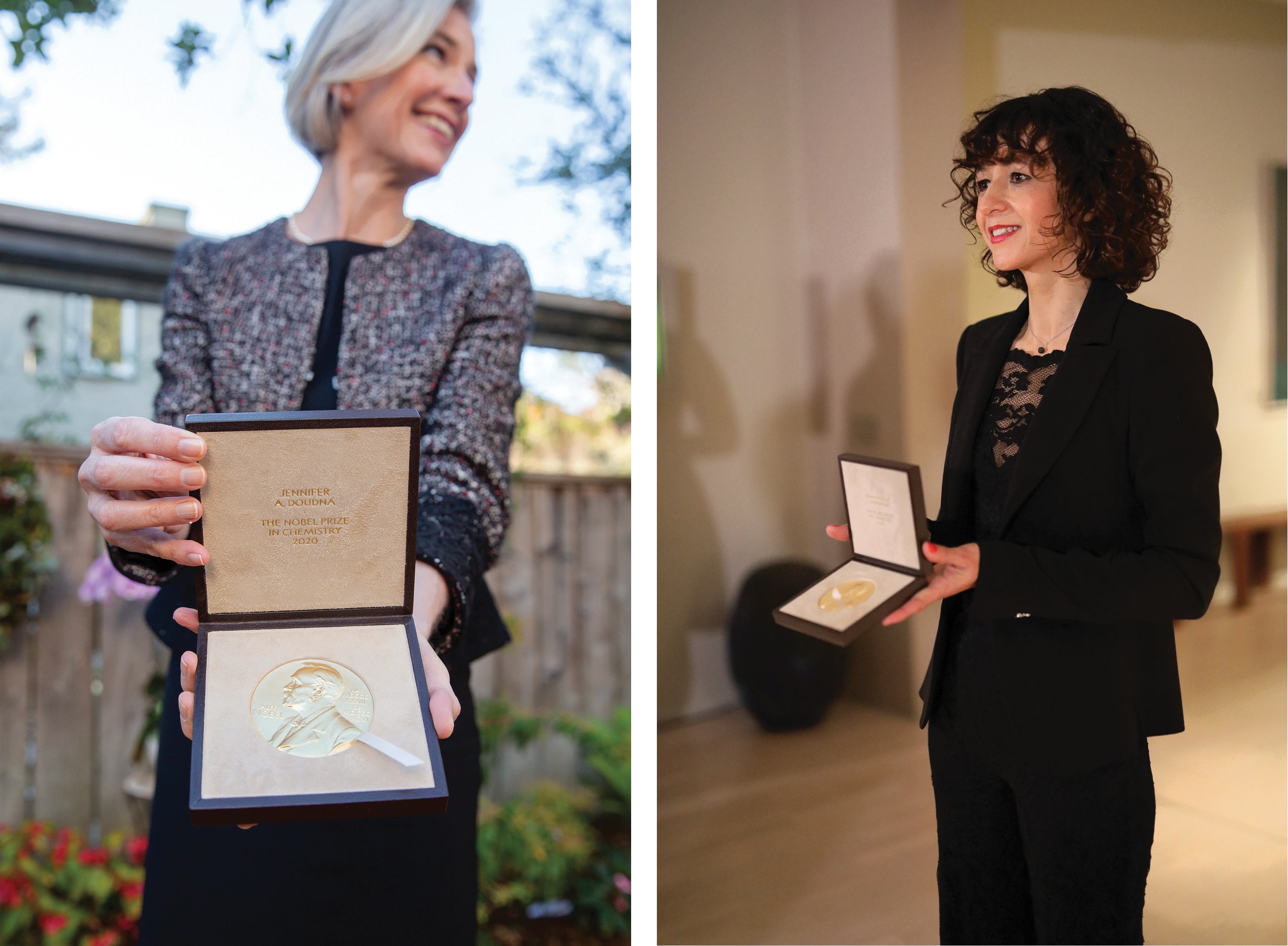
Nobel dreams do come true, but history shows there is a difference between invention and conception. The figure shows the winners of the 2020 Nobel Prize for chemistry: Left, Jennifer Doudna receiving her Nobel Prize medal at her home in Berkeley, California (© Nobel Prize Outreach, photo: Brittany Hosea-Small). Right, Emmanuelle Charpentier at the Swedish ambassador's residence in Berlin. (© Nobel Prize Outreach, photo: Bernhard Ludewig.)
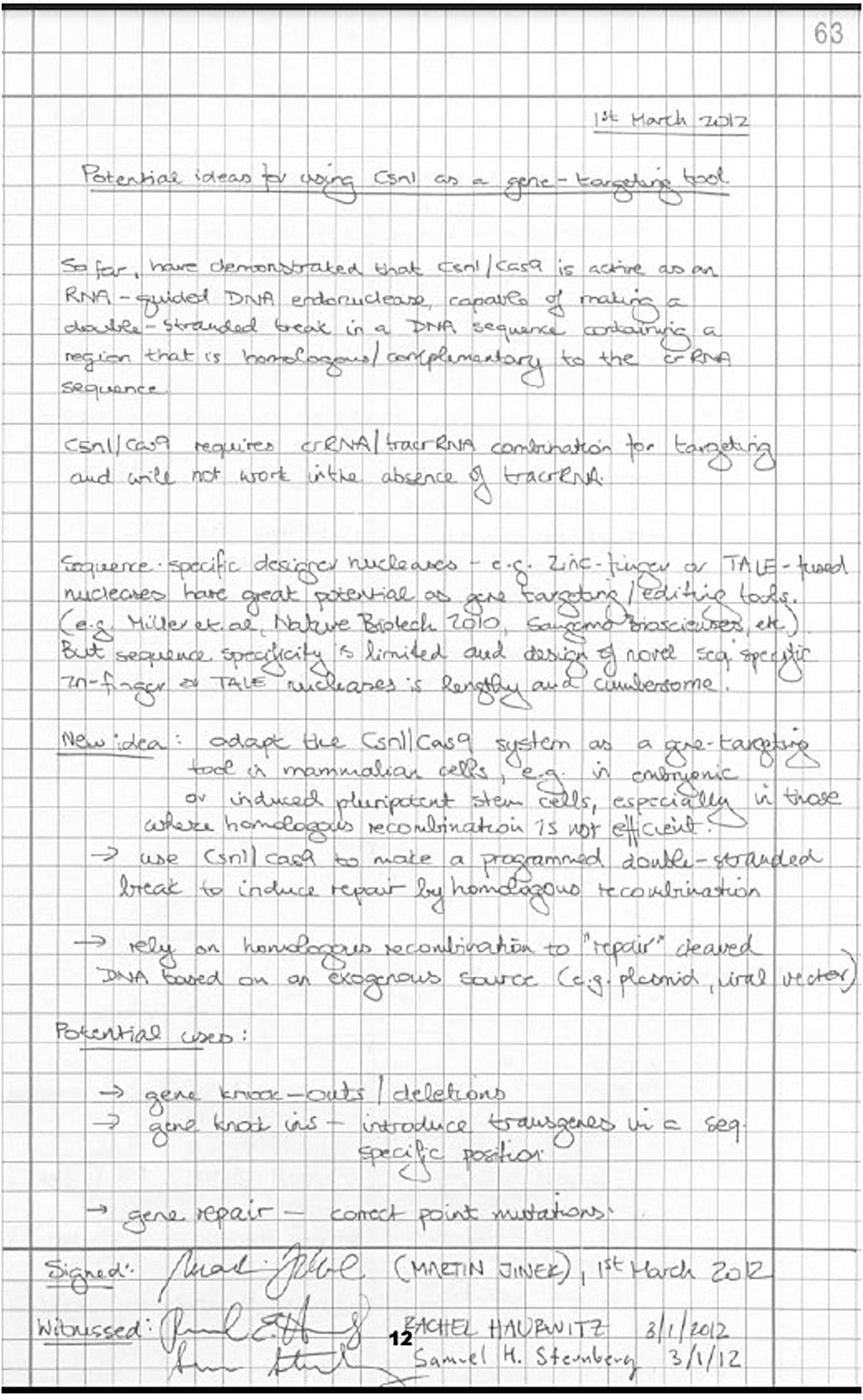
Signed, dated, and witnessed. A page from Martin Jínek's laboratory notebook with notes from March 2012, as published in the PTAB Interference decision (February 2022). PTAB, Patent Trial and Appeal Board.
Understanding how the PTAB came to the decision it did highlights patent law's peculiar concept of invention, including its relationship with conceiving an idea and experimental failures in getting that idea to work. And it suggests that patent law's standards are out of step with recent advances in molecular biology. The decision is practically important, too, because it is likely to greatly affect several companies currently working on the first CRISPR-based human in vivo therapies, such as Intellia Therapeutics and CRISPR Therapeutics, which do not, as of this writing, have patent licenses from the Broad Institute.
Over the past 4 years, I have provided something of a running commentary on the long-running CRISPR patent drama for this journal.2,3 In this perspective, I aim to explain the recent interference decision, its practical effects for commercial CRISPR research, and what all this says about the intersection of science and patent law.
The CRISPR Interference Decision
The first interference
Understanding the PTAB's February 28, 2022, decision is, in part, an exercise in history. The decision was—surprisingly perhaps—not the first decision at the USPTO concerning CRISPR. The dispute pits Zhang and the Broad Institute on one side and Doudna, Charpentier, and their related institutions on the other (often referred to as “CVC”*). The February 28 decision was the third major decision arising from the larger dispute between the Broad Institute and CVC across two interferences.
In the previous interference proceeding—concluded in 2017—the PTAB determined that eukaryotic applications for CRISPR-Cas9 were separately patentable over and above more general applications for sgRNA CRISPR-Cas9 (e.g., in vitro uses or work done in prokaryotic cells). As a consequence, the Broad Institute's patents did not “interfere” with CVC's then-still-pending patent applications. 4
This earlier interference—perhaps a fruitless exercise to quench a fire before it turned into a conflagration—did not resolve the broader question of who invented the technology in eukaryotic systems first. And so, after the surprise amendments of some of CVC's patent applications to cover eukaryotic uses, the PTAB declared a second interference between CVC and the Broad Institute. On September 10, 2020, the PTAB issued its second major decision in the dispute, concluding that the Broad's and CVC's patent claims indeed overlapped, thereby setting the stage for the PTAB to finally resolve the issue of priority for the U.S. patent system. 5
The second interference and priority decision
The priority decision on February 28, 2022, was tasked with determining who—between Zhang and the CVC scientists—was the first to “conceive” of eukaryotic sgRNA CRISPR-Cas9 and subsequently “reduce it to practice.” In patent law, the standard for conception is a particular one, requiring the putative inventor to have a “definite and permanent” idea of all of the elements of the invention in their mind. This generally means the inventor must have “a specific, settled idea, a particular solution to the problem at hand, not just a general goal or research plan.” 1 Routine confirmatory testing is fine—but true trial-and-error experiments are not.
In such cases, experimental failure is seen as “[undermining] the specificity of the inventor's idea”—putting it in “constant flux”—such that it is not “definite and permanent.” 1 Furthermore, an inventor's reasonable expectation of success, here, is not enough—especially where the inventor is, in fact, beset by experimental failures over the course of reduction to practice. Given that, there are numerous cases collapsing the period between when an inventor “conceives” an invention and when it is “reduced to practice.” To put it simply, sometimes an inventor did not conceive of an invention until they got it to actually work. This standard highlights the difference in patent law between an idea and an invention.
Against this backdrop, CVC argued that it conceived of sgRNA CRISPR-Cas9 in eukaryotic cells on March 1, 2012, based on descriptions it provided in laboratory notebooks. These descriptions of sgRNA CRISPR-Cas9 in Martin Jínek's laboratory notebook—reproduced in full in the interference decision—are an astonishingly early, accurate, and prescient description of the technology the world has come to know (Fig. 3). In these pages, Jínek, during his closing months as a postdoctoral fellow in Doudna's laboratory, 6 describes (and draws beautiful diagrams of) CRISPR-Cas9 as a “gene-targeting tool,” requiring only Cas9 and a crRNA–tracrRNA “hybrid”—the sgRNA system first used in Doudna's laboratory.
It also notes—in a moment of unwitting candor—that the researchers still needed to conduct a “next set of experiments,” including a “test [of] whether the strategy can be used… in mammalian cells.” 1 Nonetheless, these pages seem to represent the first documented example of anyone recognizing the minimal components for the sgRNA CRISPR-Cas9 system, and its potential power as a genome editing tool. A few months later, Doudna and Charpentier published their landmark report in Science, in June 2012. 7
Interestingly—and perhaps presaging the interference—Jínek's laboratory notebook pages were also dated, signed by Jínek, and witnessed by Rachel Haurwitz and Samuel H. Sternberg, then two of Doudna's laboratory members (Fig. 3). This practice of contemporaneously dating, signing, and witnessing laboratory notebook pages was pioneered by Bell Laboratories in the mid-20th century, specifically in the event that any of the laboratories' inventions were subject to a patent interference proceeding. 8 Such evidence—using witnesses' signatures as “independent corroboration”—could potentially be used to defeat rivals by demonstrating an earlier date of conception.
But this documentation, according to the PTAB, was not enough—it was not a legal act of “conception” under the patent statute. The detail in Jínek's laboratory notebook did not specify the tools now used in eukaryotic applications of CRISPR—including codon optimization and the use of nuclear localization sequences for endogenous expression—suggesting that a conception of eukaryotic applications was not yet “definite and permanent.”
To the contrary, the experiments in eukaryotic cells as proposed in Jínek's laboratory notebook turned out, for the CVC group, to be troublesome—a departure from the sort of routine confirmatory experimentation nonetheless allowed to maintain an earlier conception date. Those included a series of failed experiments in zebrafish and mammalian cells, described in dozens of pages of detail in the PTAB opinion, and lasting from at least March 2012 through October of that same year. Alongside those experiments, the PTAB recounted statements by CVC researchers, including Doudna, but also Jínek, and their collaborator, Florian Raible, at the University of Vienna, that the experiments were “not giving anything conclusive,” “might be unspecific,” and had “problems.” 1
These, interpreted by the PTAB, constituted a “preponderance of the evidence [that] demonstrates that they did not have a definite and permanent idea of how to achieve that result,” that is, eukaryotic applications, as of the date of the Jínek's laboratory notebook. 1 Moreover, in the weeks and months after the Jínek et al. publication, researchers speculated whether the technology would, in fact, work in eukaryotic cells. In an essay published in Nature Biotechnology in September 2012 on the Doudna–Charpentier study, Rodolphe Barrangou wondered, “Only the future will tell whether this programmable molecular scalpel can outcompete ZFN and TALEN DNA scissors for precise genomic surgery.” 9
At the Broad Institute, Zhang, by contrast, began to conduct CRISPR experiments in earnest in July 2012, after apparently learning of the utility of sgRNA systems weeks earlier from his collaborator Luciano Marraffini at The Rockefeller University (who, in turn, learned it from CVC's inventors). These experiments included designing a plasmid coding a “chimeric RNA” and Cas9 for transfection in mouse cells. After conducting a series of experiments with the plasmid to knock out mTH (a gene involved in neuronal development)—experiments that Zhang described to colleagues as “promising”—Zhang submitted, on October 5, 2012, an article to Science, describing a successful implementation of CRISPR in eukaryotic cells.
This article—the now classic article with Le Cong as first author 10 —was, according to the PTAB, the first “actual reduction to practice” of sgRNA CRISPR-Cas9 in eukaryotic cells. The submission was followed, weeks later, by an article detailing a similarly successful effort from George Church's laboratory. 11 (Both were published simultaneously in Science in January 2013.)
Taken as a whole, the PTAB's interpretation of these experiments meant that CVC could not demonstrate either a date of conception or a reduction to practice any earlier than October 31, 2012—almost 4 weeks after Zhang and his coauthors submitted their article to Science. In a field where the PTAB had collapsed conception and reduction to practice, the Broad beat CVC to the mark.
Other issues
Beyond this issue of priority, the PTAB also rejected a number of additional arguments from CVC regarding how Zhang's experiments came about. CVC had asserted, for example, that Zhang had “derived” the invention from Marraffini—essentially, patent law's version of plagiarism. But to successfully demonstrate derivation, CVC would have needed to show that it or someone else communicated a “complete conception” of the invention to Zhang—something the PTAB concluded did not occur before Zhang's article to Science, on which Marraffini was a coauthor. 12
Marraffini's contribution to the Broad inventors' success—whatever it may have been—was not enough to demonstrate derivation. The PTAB also glossed over CVC's assertion that the Broad's patents were invalid because they listed different sets of inventors from Broad's related patent applications in Europe.
CVC also argued that because Zhang's success in getting sgRNA CRISPR-Cas9 to work in eukaryotic cells used only “routine techniques,” they were not inventive. 1 But the PTAB rejected this suggestion, too, noting that it was “not persuaded that the determination of technical features necessary to achieve success is irrelevant,” but evidence, again, of who was the first to have a “definite and permanent idea of a system in eukaryotic cells” 1 —Zhang.
Lastly, the PTAB passed on CVC's contentious arguments that Zhang submitted “false declarations” during the prosecution of some of Broad's patents. Those allegations centered on alleged differences regarding when, exactly, Zhang first became aware of sgRNA CRISPR systems and statements he made regarding the timing of their use in the Broad patents. But these, like other arguments advanced by CVC, were “not directly related to the issue of priority for the subject matter” of the current proceeding 1 ; they did not advance an understanding of who was the first to conceive and reduce to practice sgRNA CRISPR-Cas9 in eukaryotic cells.
What Comes Next, and Some Practical Effects
What are we to make of the impact of this complex, contentious, and contorted legal proceeding? The immediate upshot of the decision—assuming it stands on appeal—is that at least 14 of CVC's patent applications will be subsequently rejected by the USPTO. These patent applications constitute >100 pending claims directed to sgRNA CRISPR-Cas9 in eukaryotic systems, all of which will presumably now be canceled. The Broad Institute's patents—13 in this second interference, not including another separate patent application—will, by contrast, emerge from the PTAB's decision unscathed.
The PTAB affirmatively declined to invalidate any of the Broad's claims, which, when taken together, cover a wide range of uses and methods of sgRNA CRISPR-Cas9 genome editing in eukaryotes. It is hard to look at this decision as anything other than a major victory for the Broad Institute.
There is, of course, the possibility of an appeal; CVC has the right to appeal the decision to the U.S. Court of Appeals for the Federal Circuit, the appellate court that oversees virtually all patent disputes in the United States. But CVC has not had luck at the Federal Circuit, losing there on the first interference decision back in 2018. 13 And it seems likely to lose there again. The Federal Circuit's standard for reviewing decisions from patent interferences is to defer to any of the PTAB's factual findings if they were based on “substantial evidence,” even while it decides issues of law anew.
This is generally a very high bar to overcome, as noted in the Federal Circuit's 2018 decision: “We do not reweigh the evidence. It is not our role to ask whether substantial evidence supports fact-findings not made by the Board, but instead whether such evidence supports the findings that were in fact made.” 6
For this interference, the substantial evidence standards means that the Federal Circuit will review only whether the PTAB's findings of fact about CVC's and the Broad's experiments were “supported” by “substantial evidence”—the least one could say about the PTAB's review of thousands of pages of documents on experimental evidence and embodied in an 80-plus page decision recounting those experiments. To be clear, there are potentially larger issues about whether the PTAB invoked the correct understanding of the conception–reduction-to-practice divide, something the court will review de novo.
But the Federal Circuit has largely been consistent on that issue for decades, and it is not clear whether it has the appetite to upend it. And yet, there is also the possibility that Federal Circuit will reverse the PTAB as some form of “rough justice,” making amends to the CVC scientists who, it seems, did everything they could to stake out a claim to priority. But such a decision would not be based on any appellate legal standard.
Assuming the interference decision is affirmed, CVC still does have at least one U.S. patent covering sgRNA CRISPR-Cas9 for use in any system, prokaryote or eukaryote alike. This is U.S. Patent No. 10,266,850 (or '850)—the patent that surprisingly resulted from the first interference. 3 But the PTAB's decision in this second interference casts a shadow over that patent on two grounds: the doctrines of enablement and written description. The doctrine of enablement typically requires that a patent enables a person of ordinary skill in the art to “make and use” the “full scope” of the patent at the time it was first filed.
For CVC's '850 Patent, this means it must have enabled researchers to do sgRNA CRISPR-Cas9 work in eukaryotic cells as of May 25, 2012—months before anyone had any success in the area, including the CVC researchers themselves. The written description doctrine, by comparison, requires that a patent specifically disclose a “representative number of embodiments” of the claims. And although the'850 Patent mentions eukaryotic applications, it does not appear to disclose them with enough specificity to demonstrate CVC scientists' “possession” of invention—especially when read in the light of PTAB's second interference decision. The'850 Patent is, as of this writing, currently valid and unchallenged by anyone, but may now be on shaky ground.
This may spell trouble for some of the surrogate companies developing CRISPR-Cas9 therapeutics, namely, Intellia Therapeutics (cofounded by Doudna) and CRISPR Therapeutics (cofounded by Charpentier). 14 Neither company has reported receiving licenses from the Broad Institute and, given the tenor of the interference, there is good reason to think they have not. This means, though, that both companies are going to need to get a license from the Broad Institute or its surrogate, Editas Medicine, before commercially launching any FDA-approved product in the United States.
Neither Intellia nor CRISPR Therapeutics will likely want to cloud their groundbreaking therapies with patent uncertainty, a truly unfortunate way of announcing to the world genome editing's therapeutic potential. The companies could also simply—and finally—settle the patent dispute, perhaps even establishing a collaborative commercial research endeavor at some “neutral” location—a CRISPR Institute, perhaps. But there is no evidence such a deal is forthcoming.
Even then, it would not necessarily be the end of the story. There are, believe it or not, yet other interferences regarding CRISPR technologies currently pending before the PTAB. These include another set of interferences among Sigma-Aldrich, ToolGen, the Broad Institute, and CVC. How those will play out is entirely unclear at the moment. But patent litigation surrounding priority on CRISPR-Cas9 continues, even while CRISPR technology has—as The CRISPR Journal's chief editor notes—dramatically eclipsed the original claims. 15 The second interference decision, while monumental in CRISPR's history, is but a moment in time.
Furthermore, these interference proceedings are only significant for U.S. patent rights—they do not affect analogous proceedings being conducted throughout Europe and elsewhere. In Europe, for example, CVC decidedly has the upper hand after its patents survived challenges from the Broad Institute and others, and while the Broad's European patents have largely been canceled. 16 Whether, how, and to what extent the fractured global landscape for CRISPR-Cas9 patent rights will affect any settlement between the parties are unclear.
Patents, Normal Science, and the Future of CRISPR
Beyond these practical concerns, the CRISPR patent interference may tell a few stories about the role of patents in shaping normal science. But, like antiquated fables, whatever morals such stories strive to impart may be less instructive in a more modern era. For one, the second CRISPR interference may be seen as highlighting—perhaps in stark relief—the significance of priority in scientific research. More than simply bragging rights or the fear that currently drafted articles will be rejected as being “scooped” deeming priority for the second interference has enormous practical—and financial—consequences.
Jínek's signed, dated, and witnessed laboratory notebooks (as well as some of Zhang's e-mails) suggest the principal researchers were at least vaguely aware as much. But this is not, in any way, unique to patents or the CRISPR patents' named inventors. The engine of much science (and scientists) is an omnipresent drive to be the “first” to elucidate nature's discoveries, be they the molecular structure of DNA or abstract mathematical proofs. 17 Patents may add to or shape that drive, but they do not create it.
In addition, patent law itself has since dramatically changed its own notion of priority. Being “first” for patent law's purposes no longer means the first to conceive of an invention and reduce it to practice, but simply the first to file one's invention with the Patent Office. The very basis for the second interference and its contentiousness—Who really was the first to conduct a successful experiment?—is, going forward, mostly moot. In addition, with the rise of electronic laboratory notebooks—unless dates could be verified—one would be unlikely to see such clear uncontestable evidence of the generation of an idea, like that documented by Jínek in March 2012. Were the dispute to have been decided under the new rules, today, it is likely that both CVC and the Broad Institute would have been awarded their patents with much less fanfare—and, perhaps, better opportunities for settlement.
Some, too, may read the interference decision as a lesson about how the patent system is broken, given Doudna and Charpentier's 2020 Nobel Prize (Fig 2). But the USPTO works under different standards and constraints from the Nobel Prize Committee, the latter of which tends to focus on priority in groundbreaking and theoretical work, even if not up to the Patent Office's strict definition of conception. Indeed, history is replete with instances where the Nobel Prizes were not awarded to the same researchers with valuable patents, in areas including recombinant DNA, magnetic resonance imaging, and human embryonic stem cells.
If anything—and perhaps counterintuitively—the PTAB's second interference decision cements that Doudna and Charpentier were deserving of the 2020 Nobel Prize for Chemistry, as evidence documented in the interference showed their laboratories were the first to truly appreciate a minimal sgRNA genome editing system. This does not mean that patent priority is broken—only that the patent system values “definite and permanent” ideas more than path-breaking ideas.
Finally, some may read the PTAB interference decision—and patents, in general—as a mark of sin upon academic science, a stain that cannot be washed away so much as absolved with a vow of poverty. 18 Not so. As the pages of this journal detail, scientific research on CRISPR proceeds apace, with academic researchers using the technology for increasingly interesting and powerful ends. Some of those are likely to be economically valuable and may be subject to patent applications. But others—like CRISPR screens—are widely replicable tools, put in service for other researchers to advance science themselves. 19 This suggests, perhaps gingerly, that the CRISPR patents, including this interference decision, do not seem to have somehow poisoned the technology's soul.
Patents or not, the revolutionary nature of CRISPR and its flexibilities mean that new ideas for using CRISPR will continue to arise from open and collaborative efforts, just as they did in March 2012. It is a lesson, instead, that good ideas borrow from each other and that no conception is perfectly immaculate.
Footnotes
Author Disclosure Statement
No competing financial interests exist.
Funding Information
No funding was received for this article.