




Abstract
Periodontal disease (PD) is an immune-inflammatory disease affecting the supporting structures of the teeth, which results in progressive destruction of the hard and soft tissues surrounding teeth, ultimately resulting in tooth loss. The primary etiological factor for this disease is the presence of pathogenic microorganisms. Pathogenic bacteria face antagonistic conditions and foreign DNA components during the infection stage and depend on defense mechanisms such as clustered regularly interspaced short palindromic repeats (CRISPR)-Cas to counter them. Virulence genes regulated by the CRISPR-Cas system are often expressed by bacteria as part of the stress response to the presence of stress conditions and foreign elements. There is ever-growing evidence regarding the role of CRISPR-Cas in virulence of periodontal pathogens. The same CRISPR-Cas system may also be targeted to reduce bacterial virulence and it may also be utilized to develop diagnostic and therapeutic strategies for prevention and control of PD progression. This review article describes the CRISPR-Cas systems in the periodontal dysbiotic microbial communities, their role in the virulence of periodontal pathogens, and their potential role in understanding the pathogenesis of periodontitis and treatment of PD.
Introduction
Periodontitis, as an inflammatory noncommunicable disease with a multifactorial etiology, is an extremely prevalent condition. 1 Chapple stated “Periodontitis is the most common chronic inflammatory disease seen in humans, affecting nearly half of adults in the United Kingdom and 60% of those over 65 years. It is a major public health problem, causing tooth loss, disability, masticatory dysfunction, and poor nutritional status. Periodontitis also compromises speech, reduces quality of life, and is an escalating burden to the health care economy.” 2
An estimated 54 billion USD/year is the global cost of lost efficiency due to severe periodontitis.3,4 In 2018, periodontal disease (PD) caused an estimated loss of $154.06B and €158.64B in the United States and Europe, respectively. 5
PD is primarily caused by colonization of various pathogenic microorganisms and the host response plays an equally important role in development of the disease. The progression of PD is divided into initial, early, advanced, and established stages and changes in the microbiota, cells of immunity, and vascularity are some of the most noticeable changes as the disease progresses. 6 The roles of microorganisms, their virulence factors, and polymicrobial communities in the etiology of periodontitis have been extensively researched. 7
Following colonization of periodontal tissues by microorganisms, Toll-like receptors and pathogen recognition receptors facilitate formation of functional complexes that respond to pathogen-associated molecular patterns and this acts as a mechanism that initiates a cascade of events, including production of cytokines 8 and matrix metalloproteinases, 9 activation of complement components, and production of acute-phase reactants and neuropeptides.10,11 Establishment of periodontal pathogens in the periodontal tissue results in overactivation of the immune response characterized by excessive infiltration of immune cells and stimulation of osteoclastic activity. 7
The invading microorganisms possess several mechanisms such as the virulence factors, leukotoxin and cytolethal distending toxin, for evasion of host defense responses. 12 Clustered regularly interspaced short palindromic repeats (CRISPR) array and CRISPR(cas)-associated genes form one of the adaptive defense mechanisms of bacteria as well as other single-celled organisms. 13 These are capable of neutralizing the invading genetic elements in a sequence-specific manner 14 as the Cas9 enzymes can identify and split CRISPR-complementary DNA structures in a specific sequence. 15 This mechanism, in turn, enables CRISPR-Cas to manipulate the genome and accurately edit genes. 16
There are multiple applications for this technology in the health care field. For example, CRISPR-Cas may be utilized for deleting antimicrobial resistance genes from bacteria 17 and causative organisms or to identify and control faulty genes involved in different diseases. 15
The CRISPR-Cas locus usually has cas genes that form an operon in addition to a CRISPR array, which has a series of 25–35-bp-long sequence-specific repeats. Each CRISPR array has a leader sequence, that is, a DNA sequence containing large quantities of adenine and thymine, located before the first repeat. 13 The CRISPR array has adjoining inserts of ∼26–72 bp in length known as spacers acquired from extrachromosomal elements and these are key constituents of adaptive immunity. 13
The invading mobile genetic elements contribute to the new spacers that are incorporated into the existing CRISPR array through the activity of cas proteins. 18 The history of CRISPR-Cas-mediated interactions can be traced through identification of the spacer sequence.
The identification of four cas genes further led to the discovery of additional 93 cas genes clustered in ∼45 diverse gene families. Two classes of CRISPR-Cas along with six types and several subtypes have been identified 13 : the class 1 system comprises types I, III, and IV, while class 2 comprises types II, V, and VI. 19 Of the six types, the three most important types of CRISPR-Cas systems are types I, II, and III. 20
The CRISPR-Cas system can be ordered into four modules: the adaptation module with the proteins, Cas1 and Cas2, which encode the enzyme involved in insertion of the spacer, Cas4 nucleases, and reverse transcriptases; the expression-processing component that functions to process pre-crRNA; the interference module or effector module that processes the primary CRISPR transcripts (crRNA) and also takes part in the destruction of foreign nucleic acids; and the signal transduction or ancillary module with CRISPR-linked genes that may be involved in signal transduction pathways for type III systems. 21 These CRISPR-Cas systems have a role in understanding varied aspects of several disease processes, including PD pathogenesis and treatment.
Various pathogens, immunological factors, and genetic factors interact to generate the perfect condition leading to periodontal tissue destruction, and several treatment modalities have been proposed for management of PD. Conventional surgical and nonsurgical therapies have been the gold standard for treatment of PD.
In the last decade, researchers have focused on several targeted approaches that emphasize specific components in the immune-inflammatory pathway of PD pathogenesis. Newer therapeutic strategies that could facilitate regeneration of lost periodontal structures are also being extensively investigated.
Complement therapeutics, chemically modified RNA therapeutics, host modulation therapies, including the use of resolvins and lipoxins, gene therapy using viral and nonviral vectors, whole oral microbiome transplantation; bacterial predation, and use of phytonutrients and neutraceuticals are few of the newer developments in the therapeutic front.22–24
A vaccine that targets periodontal pathogens has been developed, which (if successful in human clinical trials) will prevent the development of chronic periodontitis.25,26 Understanding PD pathogenesis from different standpoints can pave the way for innovative diagnostic and treatment modalities.
CRISPR systems offer one such perspective as they can be mapped to different aspects of pathogenesis, diagnosis, and treatment of PD. CRISPR-Cas9 may be used to assess the molecular and cellular pathways in PD pathogenesis. CRISPRa, CRISPRi, and Cas13 are CRISPR systems that facilitate alterations in the manifestation of genes implicated in progression of periodontitis, and it has been observed that the periodontal biofilm may be inhibited by Cas3. 15
Several articles have dealt with the role of CRISPR systems in precision oral health care, including periodontal care. In this article, an attempt has been made to understand the CRISPR-Cas systems in relation to specific periodontal pathogens and their role in the pathways of PD progression and therapeutic strategies.
CRISPR-Cas in the Periodontal Pathogens of the Red Complex
Deterioration in periodontal health (PH) is often marked by a shift in the oral microbial ecology, with resultant dysbiosis and multiple factors causing an upregulation of virulence-associated functional systems. 27 The primary dysbiotic microbial communities include red complex pathogens—Porphyromonas gingivalis, Treponema denticola, and Tannerella forsythia. 27 Prevotella intermedia and Aggregatibacter actinomycetemcomitans 27 are two of the other major pathogens implicated in periodontal tissue destruction.
Pathogenic bacteria face antagonistic conditions and foreign DNA components during the infection stage and depend on defense mechanisms such as CRISPR-Cas to counter them. 13 Virulence genes that are regulated by the CRISPR-Cas system are often expressed by bacteria as part of the stress response to the presence of stress conditions and foreign elements. 13
There is increasing evidence regarding the role of CRISPR-Cas in virulence of periodontal pathogens. The following section describes the CRISPR-Cas systems in primary dysbiotic microbial communities and their role in the virulence of periodontal pathogens.
Porphyromonas gingivalis
Chen and Olsen 28 and Watanabe et al. 29 have identified 2 diverse classes with 4 types of Cas systems in 19 P. gingivalis genomes and 6 CRISPR-Cas systems in 13 P. gingivalis strains based on unique genetic signatures. 30 In the Porphyromonas gingivalis W83 strain, four CRISPR areas have been noted, and researchers have hypothesized that the CRISPR-Cas system may have a part in verification and selection of DNA molecules that enter bacterial cells, especially in the biofilm environment. 31 Three P. gingivalis genomes have been noted to possess cas genes, which enable targeting of foreign DNA and RNA. 28
The P. gingivalis cas3 gene expression has been observed to be 17 times more in the clinical disease site. It was demonstrated by the same authors that cas3 deletion does not affect P. gingivalis growth rates, 32 but it does control certain facets of P. gingivalis metabolism when the bacterium grows inside the host cell. 32 As a response to Δcas3 (deletion of the Cas3 gene) mutant invasion in THP-1 cells, there was an increase in the expression of genes for elements such as adenosine triphosphatase and nonheme iron protein, which has the oxidative stress protection function in anaerobic bacteria, gingipain-sensitive ligand A protein, and immunoreactive 46-kDa antigen.
The cas3 mutant was observed to have the ability to alter gene expression in relation to the genes associated with cytoskeleton organization and cell death and it also led to a minimal elevation in the levels of interleukin (IL)-1 β, IL-6, and IL-10 compared with the cells infected with the wild-type strain. Moreover, it was seen in the Galleria mellonella killing assay that cas3 deletion causes a surge in virulence of Porphyromonas gingivalis ATCC 33277. 32 However, fimbrial genes, containing fimA, were found to be depressed in the mutant strain, 32 and since the fimbriae are critical for bacterial adhesion, this concept may be studied for utilization as a potential therapeutic strategy.
Cytoskeleton metabolism, which is a part of the defense against infection, is also altered with P. gingivalis infection, with the reestablishment of the cytoskeleton organization delayed in cells infected with the cas3 mutant group. 32 Findings from the literature reveal that CRISPR-Cas systems escape the host immune reaction through efficient remodeling of bacterial virulence.
Treponema denticola
Seshadri et al. have demonstrated that T. denticola has genomic regions that signify laterally assimilated DNA and include a 36-bp CRISPR and four contiguously positioned CRISPR-associated cas genes. A sequence of 30 bp, which is nonrepetitive, was seen to have spread between the direct repeats (DRs). 33 Lateral DNA transfer resulting in the acquisition of genomic regions, including CRISPR-Cas, is hypothesized as critical for survival of T. denticola in the periodontal biofilm. 34
In the article by Endo et al., they classified the CRISPR-Cas locus in T. denticola as a type II-A CRISPR-Cas system. 35 In the same study, the authors identified 6/7 spacers with nucleotide resemblance to the putative genes in the genome of T. denticola. Of the six spacers, four were situated in the ATCC 35404 genome and targeted genes in the ATCC 35405 genome.
The other two of the six spacers were situated in ATCC 35405 and exhibited the phenomenon known as self-targeting as they were directed against the genes on the same chromosome and had a lone single-nucleotide polymorphism existing in the protospacer regions. The self-targeting spacers may influence the regulation of gene expression or be fatal to the strain possessing such spacers and thus influence the genome-scale evolution of the species. 35
Tannerella forsythia
The type I-B CRISPR-Cas locus with six cas genes was found in three T. forsythia strains and the type II CRISPR-Cas system was seen in the KS16 strain, while another five strains had the type II CRISPR-Cas system in addition to the type I-B CRISPR-Cas locus. The TR1 strain had a type I-B and a CRISPR-Cas locus, which is uncategorized. A 3.5-kbp insertion area flanked by csm4 and csm5 genes in T. forsythia is called the phage-like structure and this was seen in five strains (3313, 2444, 1224, 2442, and TR1).
Endo et al. identified 55/106 nonredundant spacers in T. forsythia. Twenty-two of these spacers had nucleotide similarity to T. forsythia's genome. Sixteen spacers in T. forsythia had similarities to genomes of P. gingivalis, while 3 spacers had nucleotide similarities to genomes of T. denticola. It may be hypothesized that the CRISPR-Cas system of T. forsythia might be capable of targeting genomes of the species of the red complex. 35
T. forsythia may competitively interact with P. gingivalis and T. denticola. P. gingivalis is capable of delivering its DNA to the other species intracellularly, thereby establishing itself in the niche. The methyltransferase gene of P. gingivalis is attacked by T. forsythia through delivery of the spacer along with the associated Cas proteins into P. gingivalis cells, which will then obstruct P. gingivalis persistence in the niche.
As T. forsythia also has spacers with nucleotide similarity to T. denitcola, it is postulated that the CRISPR-Cas system in T. forsythia might have a blockage or lethal action against the other red complex organisms. 35
CRISPR-Cas Systems in Additional Putative Periodontal Pathogens—Brief Note
Prevotella
P. dentalis, P. denticola, P. intermedia, P. fusca, and P. enoeca have CRISPR-Cas systems in their genomes. P. dentalis was found to have the type I-C CRISPR-Cas system, while the type III-D CRISPR-Cas system is found in P. denticola and P. intermedia has a type II-C CRISPR-Cas system. 36
CRISPR-Cas provides immunity against viruses and its presence in Prevotella may facilitate its survival against viruses in the oral cavity and this factor may be investigated further to assess the therapeutic potential. 36
Aggregatibacter actinomycetemcomitans
Bacterial competence systems facilitate the incorporation of new genes into their genome, and it has been theorized that during evolution, bacterial populations that are naturally competent give rise to noncompetent brethren. A. actinomycetemcomitans is a member of Pasteurellaceae, and the genomes in noncompetent strains of A. actinomycetemcomitans are of smaller size compared with competent strains. 37 CRISPR-Cas adaptive immune system loss in A. actinomycetemcomitans is directly correlated with its loss of competence, which results in noncompetent strains.
However, noncompetent strains conserve one CRISPR system and it has a few spacers. The noncompetent strains are capable of adapting to environmental changes through phage- and plasmid-mediated horizontal gene transfer, unlike the competent strains that can utilize the CRISPR-Cas systems for the same. 37 Moreover, CRISPRs confer higher susceptibility to genetic parasites of competent bacteria and this fact is reinforced by identification of extracellular DNA in bacterial biofilms that retain parasitic DNA from neighboring cells. 37
The potential use of this knowledge in periodontal therapy has to be explored further.
CRISPR-Cas—Understanding Dysbiosis in the CRISPR Way
CRISPRs of bacterial groups in PH and PD differed, in that more short DRs were found in PD, while PH had 33 more spacers than PD. 38 PH possesses stable microbial CRISPRs having a variety of spacers, which are capable of defending against invasion from bacteriophages. 38
It may be hypothesized that the microbiome in PH can resist the attack from phages compared with the microbiome in PD. It was observed that in PD, the oral microbial flora was susceptible to bacteriophages having unique spacers seen in PH and this resulted in an unstable bacterial community with resultant dysbiosis, leading to periodontal destruction. 38
PH microbial samples demonstrated similar composition of DRs and spacers, thereby demonstrating stable microbial CRISPRs capable of defending against invading phages and thereby preserving the dynamic equilibrium of the oral microbial community. Since there are more spacers in PH and because these spacers represent bacterial resistance to invasion by specific phages, the microbiota in PH is protected against these phages and resists oral microbial imbalance.15,38
Role of CRISPR-Cas in Identification of the Pathways of PD Pathogenesis
Knockout models prepared by removing genes using CRISPR-Cas may be utilized to study the effects of the specific gene on the pathogenesis of periodontitis. CRISPR-Cas9 has been used to knock out the PTPN2 gene and this increased the upregulation of JAK1 and STAT3, which are involved in periodontal inflammation. 39 Another study demonstrated the protective role of intracellular SOD2 in inflammation, utilizing CRISPR-Cas9-mediated knockout models. 40
The insulin-like growth factor 2 mRNA-binding protein 1 knockout model created using a CRISPR-Cas9 system demonstrated a reduction in lipopolysaccharide-induced nuclear factor kappa B activation, which reduced the inflammatory response 41 normally seen in PD. Similarly, NLRC4 knockout models 42 and Fas, CD11a, and CD18 knockout in T lymphocytes 43 have been used to study the pathogenesis of periodontitis. The IL-8 gene and its role in the pathogenesis of PD have been studied using single-guide RNA (sgRNA) vectors generated through the use of CRISPR-Cas9, which have been utilized to create HEK293 cells with the IL-8 haplotype. 15
Understanding the pathogenesis will be a valuable tool for developing therapeutics for patients who have PD. 15 CRISPR-mediated gene manipulation for identifying pathways of PD pathogenesis and therapeutic options has been summarized in Figure 1.
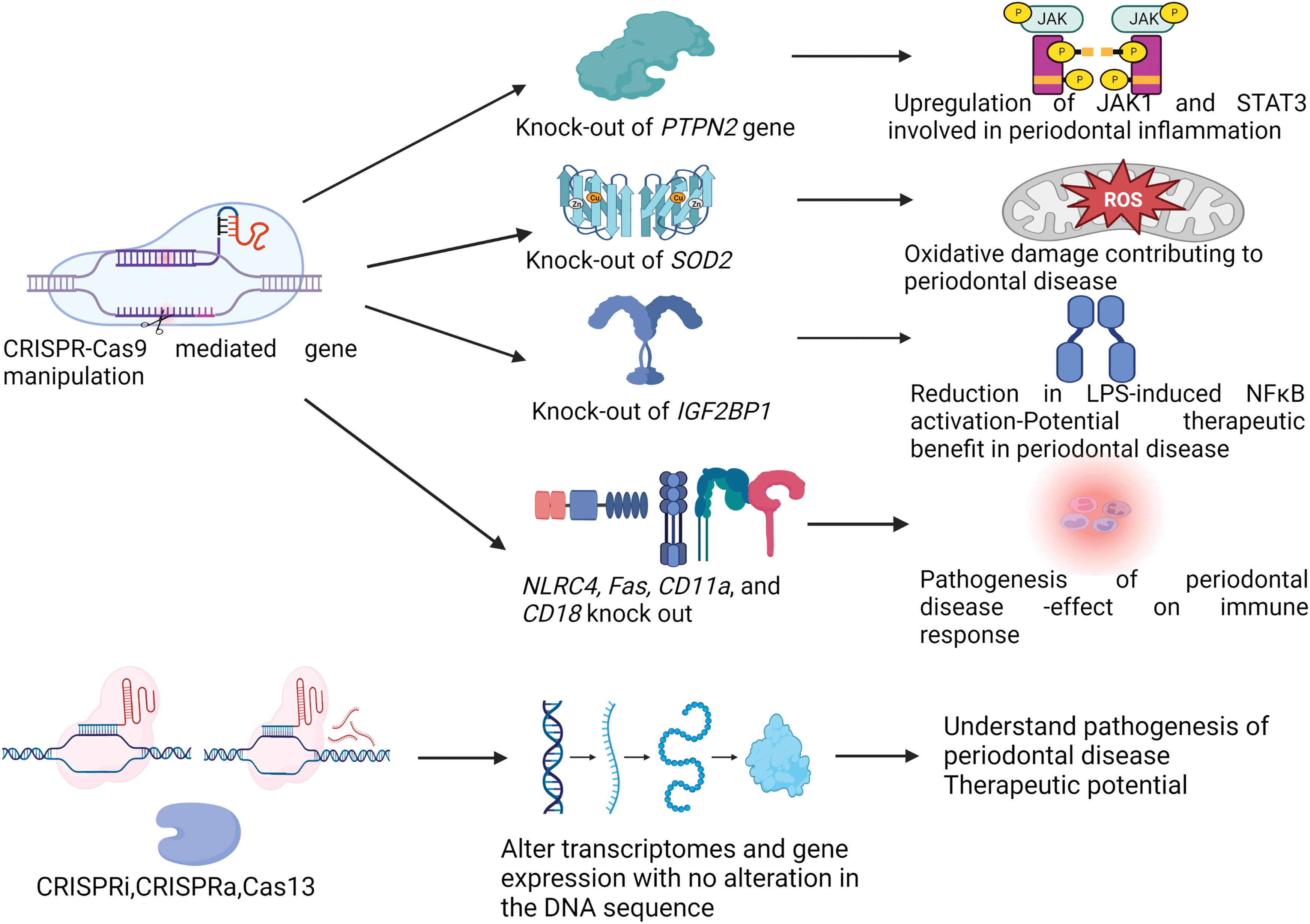
CRISPR-mediated gene manipulation for identifying pathways of periodontal disease pathogenesis and therapeutic options. Created with BioRender.com. CRISPR, clustered regularly interspaced short palindromic repeats; LPS, lipopolysaccharide; NFκB, nuclear factor kappa B; ROS, reactive oxygen species. Color images are available online.
Therapeutic Aspects of CRISPR-Cas in PD
CRISPR may be utilized to modify genomes, facilitating an alteration in disease prognosis or susceptibility. However, using CRISPR-Cas9 for creating a knockout model may result in a permanent change of the genome structure, 44 which may have undesirable outcomes in the clinical scenario. RNA-guided platforms for regulation of gene expression in a sequence-specific manner have been devised to overcome the disadvantages associated with the CRISPR-Cas-mediated gene knockout. 45
These are CRISPRa, CRISPRi, and Cas13, which can alter transcriptomes and gene expression, with no alteration in the DNA sequence. 46 CRISPRi, a transcription repressor, results in gene transcriptional repression or knockdown. 46 CRISPRa is a transcription activator that upregulates target gene expression. 45
Cas13, a Cas enzyme, can be used to knock down or modify the transcriptome.47,48 Using this technology, it is possible to bring about inducible temporary changes that are mutable and may be applied in the treatment of periodontitis, where modification of immune cells to improve PD prognosis is desired without genetic alteration-induced chronic immunosuppression.
CRISPR-Cas systems may also have an application in regenerative periodontal therapy. Mesenchymal stem cells (MSCs) or dental pulp stem cells may be engineered to have self-renewal and multilineage differentiation abilities, which will help in periodontal tissue engineering and regeneration.15,49
CRISPR-Cas9-engineered MSCs may have altered expression of various genes and have effects on CXCL2, CXCR4 with increase in neovascularization, neoangiogenesis, and regenerative efficacy 50 ; bone morphogenetic protein-4 gene, which facilitates osteoblastic differentiation 51 ; IKB kinase β 52 and soluble receptor for AGEs 53 with a resultant decrease in the inflammatory response. CRISPR-Cas9-mediated genetic manipulation in MSCs for tissue regeneration is shown in Figure 2.

CRISPR-Cas9-mediated gene manipulation in MSCs for tissue regeneration. 49 Created with BioRender.com. MSCs, mesenchymal stem cells. Color images are available online.
The antibiofilm activity of CRISPR-Cas systems may offer significant benefits in control and prevention of PD. The glucosyltransferase genes of Streptococcus mutans may be altered using CRISPR arrays, which will help in reducing biofilm formation by inhibiting extracellular polysaccharide formation. 54
Gong et al. have shown that deletion of the gtfB (or gtfBgtfC) gene with the use of the endogenous CRISPR-Cas9 system in Streptococcus mutans UA159 resulted in reduction of exopolysaccharide and biofilms. 55 CRISPR-Cas3 may be used to deliver antimicrobials using genetically modified bacteriophages, thereby disrupting the biofilm. 56 The Cas3 gene in S. mutans controls biofilm formation and by deleting this gene, it is possible to reduce biofilm formation. 57
The pathogenic biofilm may also be replaced with health-promoting bacterial strains that have genetically engineered CRISPR-Cas systems resistant to bacteriophages. 15 The CRISPR machinery of bacteria may be targeted to inhibit pathogenic microorganisms. For example, the P. gingivalis CRISPR-Cas9 system acts as a defense against rival pathogens by providing immunity against transposons.
Targeting this CRISPR system may prove to be of therapeutic value as it may help inhibit the keystone pathogen in periodontitis. 28 CRISPR-Cas in P. gingivalis and other putative periodontal pathogens with potential therapeutic effects in periodontics are shown in Table 1.
CRISPR, clustered regularly interspaced short palindromic repeats; IL, interleukin.
Delivering CRISPR-Cas systems into the host cell in a predictable manner is a factor to be considered when dealing with the therapeutic potential of the system. Liposome as a delivery vector 58 or lipid nanoparticle-facilitated transport of Cas9 messenger RNA 59 along with adeno-associated viruses encoding sgRNA can be considered for implementing CRISPR-Cas9 treatments.
CRISPR-Cas in Periodontics—Conclusions and Applications
CRISPR-Cas3 and CRISPR-Cas9 constructs can be targeted at virulence genes, which will aid in attacking pathogens or affecting the antimicrobial resistance genes, which in turn will help in reducing drug resistance. 13 CRISPR-Cas13a-based nucleocapsids that are antibacterial and capable of recognizing and killing resistant pathogens have been developed. The systems may serve to identify bacterial resistance genes and also act as therapeutic agents against bacterial infections. 60
CRISPR-Cas systems have been found to play a subtle, yet significant, role in PD progression. The following are the potential uses of CRISPR-Cas systems in management of PD:
These systems may be utilized to study the pathogenesis of PD by creating genetic knockout/knockdown models. They may also inhibit the progression of PD through modification of the transcriptome and gene expression of certain genes. These systems may also serve as a vulnerable link that may be exploited while designing therapeutic strategies to combat PD as these provide the perfect targets to weaken the defense mechanisms of pathogenic organisms.
Footnotes
Authors' Contributions
M.N.K. was involved in conceptualization, reviewing, and editing. L.P. was involved in conceptualization, writing—original draft preparation, reviewing, and editing. R.P. and A.R. were involved in reviewing and editing.
Ethical Approval
This article does not contain any studies with human participants or animals performed by any of the authors.
Informed Consent
Informed consent is not applicable for this article as it is a literature review.
Author Disclosure Statement
Authors declare that they have no conflicts of interest.
Funding Information
This work has not received any funding.