




Abstract

My personal CRISPR story begins in 2016. While I was a graduate student at the University of Sao Paulo in Brazil, word spread among my friends of several exciting high-resolution methods such as whole-genome sequencing, quorum sensing, and machine learning. During a graduate course on “Advanced topics in Food Microbiology,” the lecturer, Uelinton Manoel Pinto, listed a number of scientific topics for student seminar presentations. Prof. Pinto invited us to choose the themes for our presentations, only to be met with absolute silence in the classroom. He said, “Ok, since you didn't choose, I'll distribute the themes to each of you!” He wrote on the board several topics for presentation, one of which was “CRISPR.”
At that time, my career was focused on basic aspects of bacteriology and molecular biology applied to the study of antimicrobial resistance of Salmonella enterica. I confess I had never heard of CRISPR. I started praying that I would not be chosen for this topic, as I did not have much time to study such a complex subject. To my dismay, Prof. Pinto said, “I suggest CRISPR for you Daniel, is that ok?” No problem, I replied. Later on, he briefly explained CRISPR to me and mentioned a landmark article from 2007, “CRISPR provides acquired resistance against viruses in prokaryotes,” with lead author Rodolphe Barrangou. 1
With time running short, I dedicated myself to studying that article and preparing the slides for my presentation. I was soon hooked: passionate about science and astute enough to know that the focus of science changes quickly, I quickly decided to somehow use CRISPR in my thesis. In short, I became obsessed with it!
But there is a bit more to this story. A year later, I was a visiting scholar at the Department of Population Health and Pathobiology at North Carolina State University, working with Dr. Paula Fedorka-Cray (Fig. 1). With CRISPR in mind, I realized that I was at the same institution as the “CRISPR guy.” I thought about reaching out to Dr. Barrangou and proposing a short collaboration.
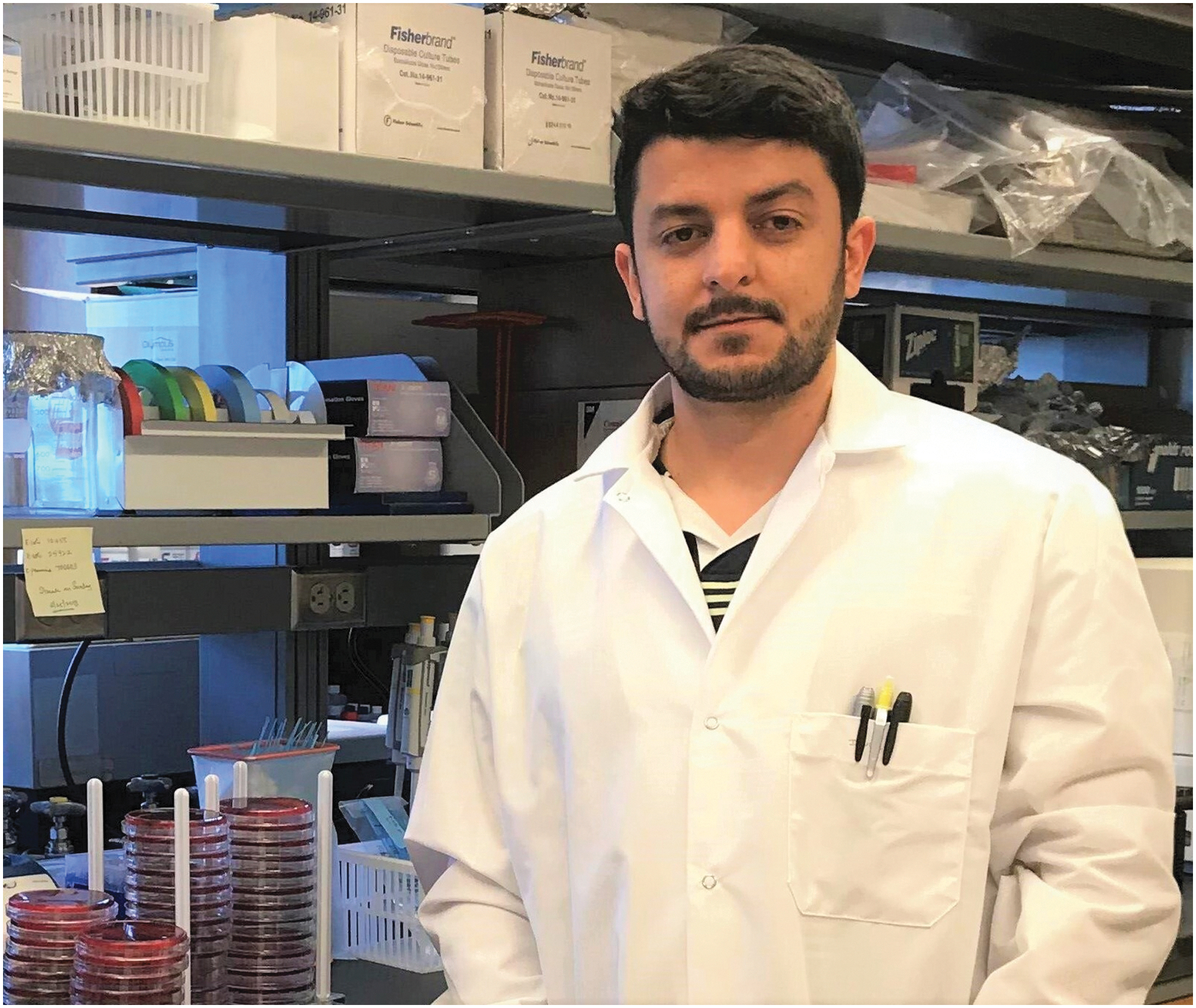
The author in Paula Fedorka-Cray's laboratory at NC State as a visiting scholar in 2017.
After Dr. Barrangou gave a lecture at the College of Veterinary Medicine on campus, I had the opportunity to introduce myself. I explained my ideas and asked whether we could use the CRISPR toolkit to study a collection of Salmonella enterica strains. He approved of my idea and suggested that we use a new tool developed in his laboratory called CRISPRviz. 2 This was great news! “Wow, this is very inspiring and I look forward to seeing this being done,” I replied.
A few weeks later, with 300 bacterial whole-genome sequences in my pocket, I went to his laboratory to set up the analyses. By this time, I had read up on a series of groundbreaking CRISPR articles and become familiar with many of the pioneers in the field, including Jennifer Doudna and Emmanuelle Charpentier. This meeting convinced me that the world will definitely change in the next few decades because of this technology.
Assisted by Barrangou's former PhD student, Matthew Nethery, we obtained the results from the CRISPR analyses. It is interesting to understand how adaptive immunity in bacteria is driven by a range of diversified CRISPR-Cas systems and how bacteria defend themselves against bacteriophages, the most abundant biological entity on the planet.
Indeed, our results so far have generated a couple of interesting research articles, with the collaboration extending beyond S. enterica strains to include the analysis of 23 Escherichia coli strains. Interestingly, the results of our E. coli experiments differ from those observed in S. enterica, as the strains present highly diverse spacer compositions. We first demonstrated that the spacer content is strongly correlated with serovar and multilocus sequence types for all strains, independently confirming the observed phylogenetic patterns, and highlighting the value of CRISPR-based genotyping for rare antibiotic-resistant S. enterica serovars isolated from food and related sources. 3
Our CRISPR genotyping analysis also revealed that the spacer content is highly conserved overall but distributed into 13 distinct groups (Fig. 2). Our findings underscore the potential role of Salmonella Heidelberg as a key pathogen, disseminated from farm to fork in Brazil, and reinforce the importance of CRISPR-based genotyping for salmonellae. 4 I am thrilled to help publish these articles and contribute to the scientific community.

Reconstructed phylogeny based on the core genome, distribution of spacers composition, CRISPR loci, and CRISPR profiles among Salmonella Heidelberg strains. The location of where each strain was isolated is labeled on its respective branch. Color strips depict the year (Y) and source (S) of isolation, respectively. Brazilian states: PR, Paraná; SC, Santa Catarina; SP, São Paulo; MG, Minas Gerais; DF, Distrito Federal; MS, Mato Grosso do Sul.
Back in Brazil
These findings have inspired me to take the next steps in my career. CRISPR technology is still relatively unexplored in Brazil and deserves to be widely used to generate the desired impact on public health and society. Since 2012, the broad range of applications of CRISPR technology has been widely recognized. However, in Brazil, the implementation of this technology has been gradually taking place, particularly in states such as Sao Paulo and Minas Gerais, in comparison with the other 25 states.
The state of Sao Paulo houses the largest research-funding agency, which supports research focused on applying CRISPR for diagnosis and therapy. The slow diffusion of this technology in Brazil can be attributed to the high costs involved and the need for skilled labor. In most cases, researchers acquire this knowledge after studying abroad. Encouragingly, several research institutions have now adopted this technology for a wide range of studies including editing of bovine embryos, in vitro production of porcine embryos, mitochondria research, stem cell studies, cancer research, and plant genetics, among others. This reflects the growing acceptance and utilization of CRISPR technology in diverse fields of research within Brazil.
To align with these changes and stay at the forefront of research, it is essential to continuously generate new project ideas. Developing innovative hypotheses that address gaps in current knowledge and have the potential to advance the field is a crucial first step. Conducting high-quality research involves designing rigorous experimental protocols, utilizing and ensuring data accuracy and reliability.
Obtaining funding is a vital aspect of research advancement. Researchers must prepare well-crafted grant proposals. Demonstrating the potential impact and feasibility of the project can greatly enhance the chances of obtaining funding from various sources, such as government agencies, foundations, or private sponsors. By combining groundbreaking hypotheses, quality research, and successful funding acquisition, researchers can advance their field of study.
I am fortunate to have met many prominent scientists who have kindly shared their knowledge, offered valuable input, and inspired me to continue working in scientific research. After graduating, I became a postdoctoral fellow at Sao Paulo State University, working on the detection and isolation of foodborne pathogens such as Salmonella, as well as antimicrobial resistance, virulence, mutagenesis, infectious diseases, whole-genome sequencing, CRISPR, and One Health.
I am submitting a new project as a young researcher entitled “[CRISPR]-based genotyping of Salmonella enterica serovars isolated from food and related sources” to the Sao Paulo Research Foundation. This project aims to characterize different S. enterica serovars isolated from food and related sources to enhance our understanding of the genetic diversity, epidemiology, and potential virulence factors associated with these serovars. I hope this project will contribute to the development of effective strategies for Salmonella surveillance, outbreak investigation, and control measures.