




Abstract
We were interested to read the article by Redel et al.
1
in the June 2024 issue of The CRISPR Journal, which “…illustrate[s] a pipeline to comprehensively identify off-targeting events on a global scale in the genome of three different gene-edited pig models.” The authors tackle an important consideration in the development of genome-edited animals: the identification of off-target alterations. We appreciate their goal of providing a guideline “to comprehensively identify off-targeting events.” However, we have three areas of concern regarding the design of the proposed pipeline. We want developers and researchers to be cognizant of some limitations and flaws we identified in this study due to the potential for incomplete identification of alterations in the assessed genome-edited animals.
Our first concern is that the authors’ use of the online version of the in silico tool Cas-OFFinder
2
for identifying regions to screen for off-targets may have resulted in an underrepresentation of off-target edits. Due to the low number of Cas-OFFinder sites identified in the study, we suspected the authors used a truncated list of sites. The online version of Cas-OFFinder warns that results are truncated after 1,000 sites per target sequence per mismatch as opposed to the offline version, which provides full results. We repeated the analysis using both versions of Cas-OFFinder
3
and confirmed that the values in the authors’ Table 2 represent the truncated list from the online version. In total, there are 5.05 million sites identified by the offline version of Cas-OFFinder that were erroneously omitted from the authors’ analysis (Fig. 1A), with site truncation not occurring until >4 differences (Fig. 1B-C). Of the 10 confirmed off-target events identified by the pipeline (authors’ Table 3), half were in Cas-OFFinder predicted sites with >4 differences. This suggests additional off-target edits may have occurred in predicted sites not assessed due to the truncated site list produced by the pipeline. The authors’ pipeline may not be reliable for detecting mosaic off-targets, which have been reported to occur at levels below 5% in edited swine embryos.5,6 The authors employ GATK’s germline variant tool (HaplotypeCaller), which GATK warns is not appropriate for somatic (e.g., mosaic) variants and instead recommends their Mutect2 tool.
7
Given that HaplotypeCaller can miss a third of variants with ≥15% allele frequency, it is likely the authors’ pipeline would miss low-level mosaicism in edited embryos.
8
The detection of even low-level mosaicism is important for a complete evaluation of off-target editing, as any alteration in a germ cell can be passed onto offspring. The authors’ pipeline provides an incomplete assessment of off-target editing because it only assesses short insertions and deletions (indels). The pipeline does not evaluate substitutions and structural variants. While, as the authors note, long-read sequencing is better at detecting structural variants, these variants could be identified from the short-read sequencing data generated by the authors.
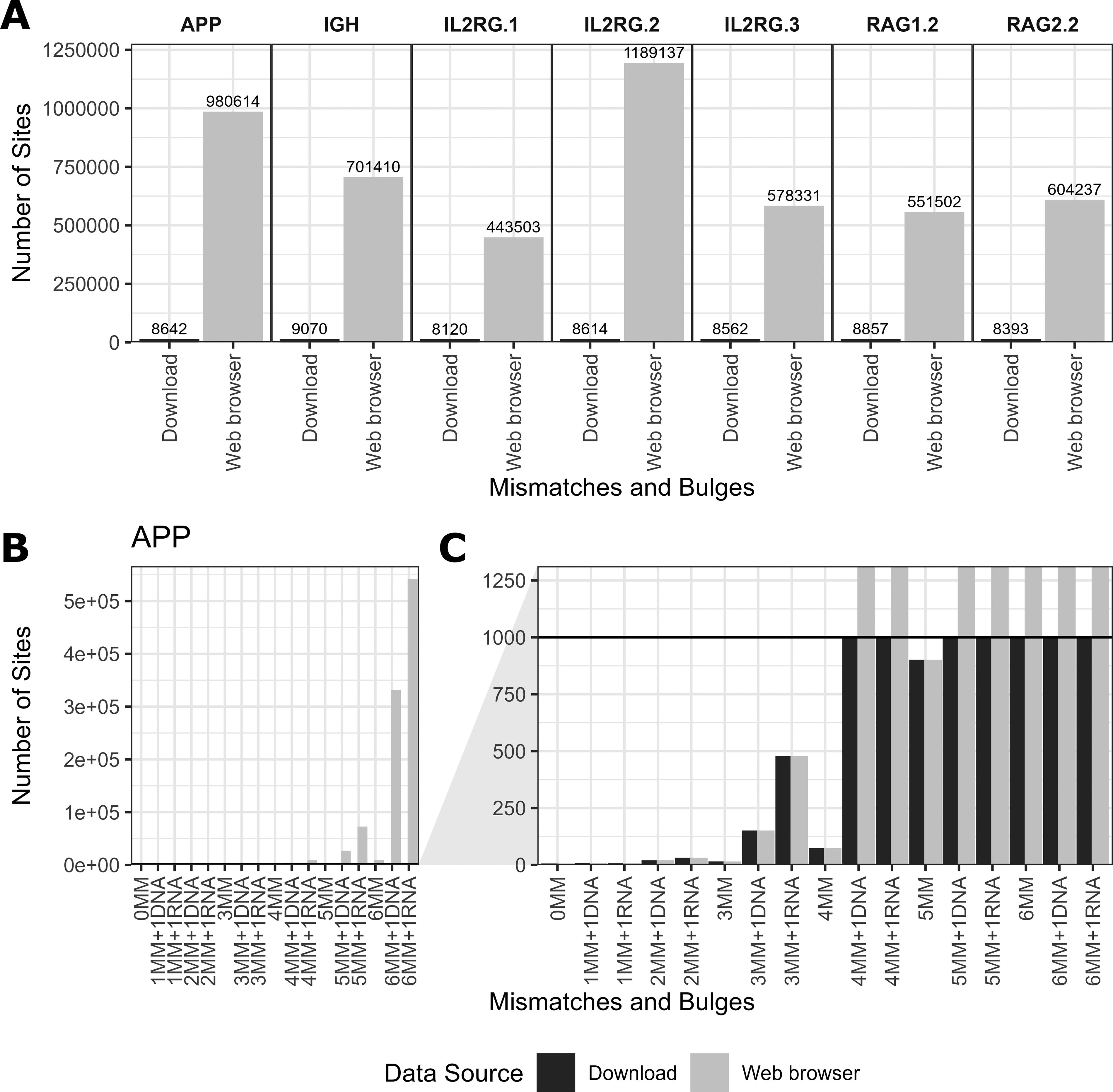
Truncation of site list downloaded from the online version of Cas-OFFinder.
We applaud Redel et al. for taking on this important work. We recommend that their pipeline is further tested and refined before it can serve as a guideline to comprehensively detect off-targeting events in pigs. The pipeline is not a truly global identification of off-targeting events but rather prioritizes particular sites based on variant type and location. Despite the limitations, this is a laudable goal that we want to support further. As a first step, we have added Cas-OFFinder to precisionFDA, an FDA cloud computing platform we make available to support developers of animal biotechnology products. We encourage developers to access this tool and the others on the site (https://precision.fda.gov).
Footnotes
Authors’ Contributions
A.L.C. and A.L.N.: Identified the concerns and wrote the original draft. A.L.M. and L.B.: Provided context and edited the article. All authors reviewed and approved the final article.
Author Disclosure Statement
No competing financial interests exist.
Funding Information
No funding was received for this article.