




Abstract
Abstract
Current business leaders continue to adopt e-learning technology despite concerns regarding its value. Positing that the effectiveness of e-training depends on how its environment is managed, we argue that a learner-centric approach is necessary in order to achieve workplace training goals. We subsequently develop a theoretical model that is aimed at identifying the key components of learner-centered e-training environments, which serve the function of providing a benchmarked approach for evaluating e-training success. The model was empirically tested using data from an Internet survey of retail industry employees and partial least squares techniques were used for analysis. Based on the findings, this study clarifies what is needed for successful e-training in terms of instructional design, system design, and organizational support.
Introduction
Consistent with this perspective, researchers are becoming more interested in factors that result in desirable outcomes of e-training, rather than the types of e-training technologies.6–7 They hypothesize that the success of e-training depends primarily on how well its environment is designed to achieve the ultimate goals of workplace training. However, few studies to date have explored the key components of successful e-training environments within the confines of a theoretical framework that provides a documented and benchmarked approach for evaluating e-training success. Thus, this study aims to understand the characteristics of an ideal workplace e-training environment. We examined learning theories and the philosophy of learner-centered education to develop a conceptual framework. The results of an empirical test are presented along with a discussion of theoretical and practical implications.
Theoretical Framework
The philosophy of learner-centered education takes the perspective of combining a focus on individual learners with a focus on the learning environment. 8 A focus on individual learners implies a consideration of their backgrounds, knowledge levels, capacities, and learning needs. 8 A focus on the learning environment entails providing the best available combination of knowledge, delivery methods, and teaching practices that most effectively promote the motivation, learning, and achievement of all learners. 8
Two central learning theories taken from the field of education, objectivism and constructivism, provide differing views of how people learn as well as the nature of knowledge. 9 These two philosophical foundations also employ different goals and practices when applied to technology and e-training. From the objectivist perspective, teachers adopt e-training systems as a means of overcoming challenges that range from high learner-to-instructor ratios to insufficient time to interact with learners. 9 Objectivism-based e-training has been criticized due to its teacher-centric learning environment and lack of learner motivation. On the other hand, when the constructivist perspective is adopted, e-training environments become learner-centric because technology is used to support learners rather than direct them. 9 In this case, the role of learner motivation in the knowledge construction process is more emphasized. Our literature review on the philosophy of learner-centered education provides insights for clarifying what is needed for successful workplace e-training. A summary review of each primary component follows.
Support from organizational facilitators
The success of e-training requires cultural rather than the common technological changes that are often seen in most organizations. 10 In order to create a new learning culture, it is essential to support learners with appropriate internal regulations, which stem from the top management of the organization. 11 For example, reservation of too little time for e-training has been a major concern of employees, while top managers have the authority to mandate longer training hours. In tandem with support from top management, there is a need for support from e-coaches. An e-coach is a dedicated individual who supports learners consistently during the knowledge development process and guides learners to their next phase of learning activities. 12 There is a view that most e-training programs have not achieved the expected outcomes because the influence of a good e-coach has been largely neglected. 13 The results of a survey of national CPA firms also confirmed that good e-mentoring relationships lead learners to perceive a higher quality of training content and experience personal knowledge development. 14
Quality of instructional design
Instructional design is the systematic process of accurately designing training program contents to meet learning objectives. Like excellent building architecture that reflects the users, functional purpose, and environment, well-designed instruction should fit the context of specified learners. 15 To provide such learner-centric contents, it is necessary to analyze learner job tasks, work-related knowledge levels, and the specific skills that are needed to fulfill job specifications. Ultimately, training contents should be designed to fill the gap between the learner's current knowledge level and the specific learning goals, thereby leading to effective job knowledge construction. It is important to note here that a one-size-fits-all approach, which is common in e-training, is not the goal; rather, more customized training contents and activities for each employee are needed. For example, Stan's Stores, a national retailer, has provided e-training programs that are matched with different job functions based on the analyses of employee job accountability and learning objectives. 16 This approach not only provides a simple structure from the learner's perspective, but also minimizes the time required for the learner to build skills enhancing the sales productivity of the firm.
Easy-to-use e-training system
Besides the long distance between learners and instructors, an additional challenge for successful e-training is the requirement that learners have the ability to use computer-based technology to develop their knowledge skill set. The complexity of an information system influences user acceptance of the system in that users tend to have stronger intentions to adopt an information system that is perceived as easy-to-use. 17 Learners with insufficient abilities and confidence in using computers seem reluctant to take up e-training courses. For example, many U.S. airline companies have been concerned about the widely varying degrees of e-training adoption among employees, which are due to their heterogeneous characteristics including computer skills. 18 Less educated people or people with insufficient computer skills appear to benefit less from company e-training program offerings. On the other hand, if an e-training system is easy to use, learning activities are more likely to be facilitated due to increased confidence in using the technology. 19 In addition, an easy-to-use system is seen as more functional since good usability enables learners to more fully utilize its main functions, ultimately enhancing work efficiency. 19
Expected outcomes of learner-centered e-training
It is frequently noted that e-training increases accessibility to learning contents for distributed learners, thus it saves substantial travel costs allocated for training.2,3 Such benefits, however, overshadow the original ultimate goals of developing learner-centered e-training environments. It is also inappropriate to judge the success of e-training merely on the number of its users. Based on our review of the extant literature, we propose three aspects ultimate goals of workplace e-training.
Efficient knowledge development
Knowledge management is a series of actions that aim to increase the value of intellectual assets within an organization. E-training systems are known to effectively contribute to knowledge management, enabling learners to acquire new knowledge, share it with others, and store it for future use. 20 For example, to overcome the challenges of capturing the knowledge of experts who are nearing retirement, the National Aeronautics and Space Administration has adopted e-training and conducted task and learning analyses before gathering incumbent knowledge from experts. 21 Subject-matter experts were used to identify appropriate e-training topics and validate their accurate treatment for young aerospace workers. 21 Webster 22 adds that learner-centric customized approaches can increase the effectiveness of learning, thereby reducing the time needed for learners to become proficient by as much as 60%.
Improved work performance
In general, e-training systems enable consistent internal communication between employees, which leads to better customer responsiveness. 23 E-training also allows organizations to become more responsive to an ever-changing dynamic business environment by rapidly equipping employees with updated knowledge. 23 At Lucent Technology, for example, e-training successfully delivered up-to-date knowledge to employees right after its separation from AT&T in 1996. 24 E-training seems to be more essential, in particular, for customer support areas that involve intensive knowledge such as sales and call-center environments.
Increased job satisfaction
According to Motivator Hygiene Theory, 25 the factors that affect employees' job satisfaction are different from those that cause dissatisfaction. Assuring hygiene issues such as good salary and interpersonal relationships is critical for relieving employees' job dissatisfaction, but is not sufficient to improve job satisfaction above neutral. Instead, motivators such as advancement and achievement make employees more satisfied in the workplace. 25 On-the-job learning experiences are also intrinsic motivators that contribute to employee personal career development. As an example of an empirical study, a survey of employees in small American commercial banks showed that good workplace learning experiences resulted in job satisfaction. 7
Conceptual Framework of This Study
The current study defines the key characteristics of learner-centered e-training environments in terms of instructional design, system design, and organizational support. Efficient knowledge development, improved work performance, and increased job satisfaction are proposed as the expected outcomes of creating a learner-centered e-training environment. We hypothesize that the customization of training contents relevant to individual learners' characteristics, which measures the quality of instructional design, will directly influence the proposed outcomes. When an e-training system is easy to use, perceived quality of instructional design will be maximized. As more organizational supports are perceived, learners will evaluate the quality of instructional design more favorably. The facilitators include top management and e-coaches. Causal relationships between the components of learner-centered e-training environments were proposed based on previous studies. These hypotheses are represented in Figure 1.

Conceptual framework of learner-centered e-training environments.
Methods
To validate the proposed research model, an empirical survey was conducted with employees in the retail industry where job training has been a major concern for top managers. The survey invitation letters were posted on two retail worker forum websites (
Results
Among the respondents, 54% were male. About 38% were younger than 30 years while the others were evenly distributed across the various age groups. The departments that the participants worked in at the time of the survey were customer service (17.5%), sales (36.5%), and management (30.2%). Nearly half the respondents were nonsupervisory employees. The length of work experience with the current employer was varied: less than 2 years (44.4%), between 3 and 6 years inclusive (28.6%), and 7 or more years (26.9%). Without exception, all items were highly loaded on their respective constructs (≥0.8) and each construct showed a satisfactory Cronbach's alpha value as well as Average Variance Extracted (AVE).
The partial least squares result from the data analyses is graphically shown in Figure 2. All inner relations were significant at the 0.05 level. Specifically, the positive relationship between Quality of Instructional Design and Outcomes was quite strong (β = 0.797), supporting the importance of the individual customization of e-training contents. As organizational support increased, learners perceived higher quality of instructional design (β = 0.348). When the e-training system was perceived as being easier to use, learners also evaluated the quality of e-training contents more positively (β = 0.316). When the direct influence of Perceived Ease-of-Use on Outcomes was posited, the relationship was not significant. This result indicates that Quality of Instructional Design is an important mediator of the relationship between those two constructs. This finding also implies that the return on investment for the usability of e-training systems may be minimal absent the design of learner-centric contents. Of the two organizational facilitators, e-coaches (w = 0.685) played a more important role than top management with regard to achieving the e-training outcomes. The creation of learner-centered e-training environments appeared to confer benefits upon retail businesses in terms of efficient knowledge development (w = 0.427) and improved work performance (w = 0.566), but did not necessarily increase employee job satisfaction. As shown in Figure 2, the weight of Job Satisfaction (w = 0.006) was not significant. Analysis revealed an R2 value of 0.310 for Perceived Quality of Instructional Design and 0.625 for Outcomes, indicating relatively good predictability of the presented model.
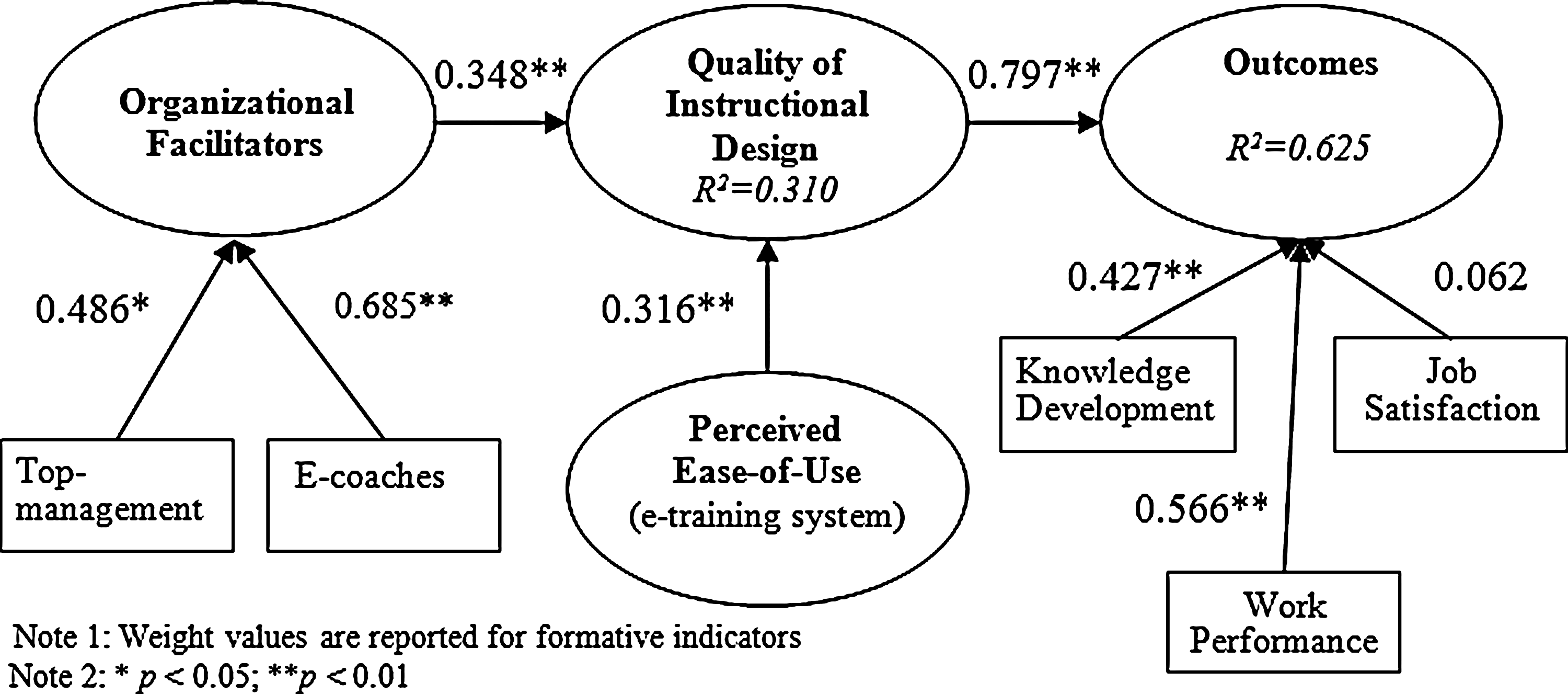
Result of partial least squares analysis with a bootstrap sampling procedure.
Discussion
Why do businesses invest resources for the development of e-training? Is it merely to save money by delivering standardized learning materials to a large number of employees with fewer instructors? No one doubts that firms train employees to make them apply the learned knowledge to specific job tasks. E-training or any workplace training should serve the purpose of improving both employees' personal and job knowledge skill sets thereby making them better citizens overall. To this end, this study tried to understand what constitutes the best environment for workplace e-training. Supporting the philosophy of learner-centered education, we suggest that e-training contents be designed to be relevant to individuals' knowledge levels, job functions, and learning goals. Learner-centered instructional design will enable the delivery of what the learner needs, thus maximizing the learners' work performance and knowledge development. In addition, a well-organized learner-analysis process enables e-training programs to be performance-based lifelong learning programs wherein the e-training system records the current knowledge and skill levels, job specifications, and learning gaps of employees and improves upon these noted gaps. The effectiveness of e-learning depends on the extent to which well-designed training programs are delivered in a manner that facilitates learners' motivation. As a way to increase learner motivation, this study calls for consistent guidance by e-coaches as well as support from top management. In the unique context of the current study, e-coaches seem to be a more influential facilitator than top management. As in any computer-mediated communication, as supported by the findings of this study, usability of e-training system is a critical issue for user adoption.
This study found that the creation of learner-centered e-training environments helps employees develop new knowledge better and also improve their work performance. In comparison, employee job satisfaction did not appear to be influenced by e-training experiences. The insignificant influence of high-quality e-training experiences on job satisfaction can be explained in the following two ways. First, the relationship between workplace training and job satisfaction, which has often been examined in previous studies, 28 might be significant only when vital needs of employees are fulfilled, as explained by the Hygiene Motivator Theory. 25 A survey of sales managers also resulted that workplace training failed to increase overall job satisfaction when hygiene factors, including salary and job design, were still their main concerns. 29 Second, a positive relationship between training experiences and job satisfaction might be apparent in a traditional training environment rather than in a technology-mediated one. In the same vein, Schmidt 30 showed that employees' satisfaction with e-training experiences varied by individual preference for technology-mediated environments over traditional classroom instructions. Nevertheless, our conclusion at this point is somewhat limited since few studies have so far examined e-training as a contributor to job satisfaction.
The limitations in this study suggest directions for future research. First of all, even though the statistical methodology was sound, this study validated the proposed model with a relatively small sample size. Furthermore, the respondents of an online survey and/or the members of online forums might have more favorable attitudes toward using technology for training, which increases the likelihood of biased results. We expect future studies to use more representative samples in order to generalize research findings to the larger target population. Second, the constructs in this study were measured based on employees' subjective perceptions rather than objective metrics (e.g., counting the number of positive user feedbacks as an indicator of work performance in the customer service area). While perceptions by real users are often considered more important than observations by a third party, the incorporation of objective measures may be more desirable. Lastly, additional research using qualitative techniques or group comparison analyses based on various demographic characteristics will also enrich our understanding of e-learners, ultimately helping firms to create better learning environments.
Footnotes
Acknowledgments
The authors would like to acknowledge the retail workers who participated in the survey and a Purdue University Research Foundation Grant that made this study possible.
Author Disclosure Statement
No competing financial interests exist.