




Abstract
Abstract
We investigate how national cultural distance, defined as the extent to which the shared values and norms in one country differ from those in another, affect the number of Web site visits. Based on a sample of 2,654 U.S. households visiting Web sites in 38 countries over 25 different Web site categories, we find that cultural distance has a negative and significant effect on the number of taste-related foreign Web site visits. In the case of Web sites containing sexually explicit material, we obtain a significantly positive effect of cultural distance. Our findings suggest that cultural distance can be both a source of attraction and a source of repulsion in explaining the number of Web site visits depending on the nature of the Web site.
Introduction
In this work, we further explore the impact of cultural differences on online behavior. Specifically, we investigate how national cultural distance, defined as the extent to which the shared values and norms in one country differ from those in another,2,8 affect the number of Web site visits by U.S. households. Similar to what has been found for the amount of foreign investment by firms,9–12 we may expect that the number of Web site visits by U.S. households decreases with the cultural distance to the country hosting the Web site. People may be more reluctant to visit Web sites located in culturally more distant countries because they feel less “connected” to the shared values and norms in these countries. This may especially hold true for Web sites that are taste-related, such as gambling or gaming Web sites. 13
Following Hu and Bartneck 3 and Jackson et al., 6 we use Hofstede's culture framework. Hofstede defines culture as the collective programming of the mind that distinguishes the members of one group from those of another. 2 Comparative empirical work in cross-cultural psychology and international business is dominated by Hofstede's seminal work entitled Culture's Consequences. Hofstede analyzed survey data obtained from almost 100,000 IBM employees in 40 countries and identified four dimensions along which national cultures differ: power distance, uncertainty avoidance, individualism, and masculinity. Hofstede assigned each country a score on each cultural dimension that varied between about 0 and 100. Throughout the years, these scores have become available for an increasing number of countries. Hofstede's dimensions have been used to explain a wide variety of phenomena,14,15 and the validity of the culture dimensions has been confirmed by many studies.16,17
We calculate the cultural distance between the United States and the country hosting the focal Web site through the index developed by Kogut and Singh.
12
This index has often been used in the research field of international business and is based on differences in countries' scores on Hofstede's
2
culture dimensions. These differences are corrected for differences in the variance of each dimension and then arithmetically averaged. Algebraically,
where CDj is the cultural distance between country j and the United States, Iij is country j's score on the ith cultural dimension, IiUS is the score of the United States on this dimension, and Vi is the variance of the score of the dimension. A higher cultural distance score implies that shared values and norms of a country's citizens differ more from those of U.S. citizens. Countries with low cultural distance scores are, for example, Australia and the United Kingdom, and countries with a high score are, for example, Malaysia and Portugal. It is this cultural distance measure that we relate to the number of foreign Web site visits of a sample of 2,654 American households.
Analysis and Results
Sample
To test the impact of cultural distance on the number of Web site visits, we use data of 2,654 American households of which each Web site visit in the period December 27, 1999, to March 31, 2000, is tracked. The data are collected on the basis of information provided by Plurimus Corporation. Web site visits are identified on the basis of individual clickstream data, meaning that both the Web address and the exact time of each Web site visit are included in this database. Plurimus identified 25 Web site categories, listed in Table 1. It clearly shows the popularity of Web sites containing sexually explicit material (SEM), 18 which are ranked second after general search portals like Yahoo! and Google. This aggregate ranking of these categories is in line with what has been found in other studies.19–21
Based on the country suffixes of the Web address (e.g., .dk, .nl, .uk), we identified the country hosting the Web site visited. For extensions like .org or .com, the host country was identified on the basis of the location of the headquarters of the owner of the Web site. In total, we have Web site data for 46 countries, but this number is reduced to 38 because the Hofstede data were unavailable for several countries. The 25 categories consist of both taste-related and non–taste-related Web sites. In our analysis, we pay particular attention to the taste-related Web site categories of games, gambling, music, and SEM, because we expect these to be particularly value laden. 13
Variable definition
Our dependent variable is the aggregate number of visits by U.S. households to Web sites hosted by a specific country. We aggregate the individual household data to the country level for several reasons. First, and most important, our cultural distance data are at the country level. Second, analyzing more than 2 million Web site visits nested in 25 categories in 38 countries is statistically too complex to yield clear results. Third, an individual-level analysis requires independent variables at the individual level to control for individual-level characteristics such as a person's age and gender, and these data are unavailable for privacy reasons. Hence, we use aggregate country-category-level data, resulting in a final sample of 950 observations (25 Web site categories for 38 countries). As explained earlier, our independent variable of interest is the cultural distance between the United States and the country hosting the Web site, measured through Kogut and Singh's index. We include the following control variables: (a) a country's gross domestic product (GDP) to control for the size of the host country, (b) its GDP per capita to control for its level of economic development, (c) the number of Internet hosts in the country to control for level of technology and availability of Internet portals, (d) a dummy coded 1 if the official language of the country is English, and (e) a country's geographic distance from the United States. A similar list of control variables was used by Blum and Goldfarb 13 in their aggregate analysis of Web site visits. We apply a left-censored Tobit model using category-based weights.
Results
Table 2 presents our regression results.
Note: Following Blum and Goldfarb, taste-based Web site categories are games, gambling, music, and SEM. Model 5 excludes SEM from the taste category and includes a separate SEM dummy.
p < 0.01, *p < 0.05, ***p < 0.10; censored normal regression (Tobit).
Model 1 includes only our controls and contains 1,150 (46 countries × 25 categories) observations. We add cultural distance in model 2. We find that cultural distance has a nonsignificant impact on the number of Web site visits. However, tastes and preference structures are strongly related to one's home culture. Hence, we would expect a stronger negative effect of cultural distance on the number of visits to Web sites that contain taste-related elements.22,23 Following Blum and Goldfarb, we classified games, gambling, music, and SEM Web sites as taste based. Using the full sample, we test the effect of taste-based categories by including an interaction effect of the taste category dummy and cultural distance. The results are shown in model 3. We find a significant and negative main effect for cultural distance (though at p < 0.10) and a significantly positive effect of the taste-based dummy. The latter finding reflects the relative popularity of taste-related Web sites. Interestingly, we find a strong positive effect of the interaction between cultural distance and the taste dummy. Jointly, the coefficient of cultural distance (−0.464) and that of the interaction term (0.953) indicate that the total impact of cultural distance on the number of taste-related Web site visits is actually positive (−0.464 + 0.953 = 0.489).
The special position of SEM Web sites
Given the inclusion of the SEM category in the taste-related category, the popularity of SEM Web sites (as shown in Table 1), and that of all the taste-based categories, one's preferences will probably be most clearly reflected in one's online behavior regarding sites containing SEM, we decided to examine this special Web site category in more detail. The intimate nature of browsing SEM Web sites is expected to make the number of visits to this Web site category closely related to one's preferences.22,24 Therefore, it is important to test if the opposing main and interaction effects of cultural distance in model 3 are caused by this specific category.
To test if SEM sites are a special category, we include a separate SEM dummy, and an interaction variable between cultural distance and this SEM dummy. The results are shown in model 4. The main effect of cultural distance is negative and significant (at p < 0.10), and the interaction effect of cultural distance and the SEM dummy is highly significant and positive (p < 0.01). The overall effect of cultural distance on visits to SEM Web sites is positive (−0.513 + 1.419 = +0.906).
As a final test of the specific relation between cultural distance and taste-related Web sites categories, we simultaneously include the SEM interaction effect and the taste-related interaction effect. In order to test the effects separately, our dummy reflecting taste-related Web sites now logically excludes the SEM category and refers to music, gambling, and games. The results in model 5 in Table 2 indicate that the interaction effect of taste-based Web sites (excluding SEM) is significantly negative, whereas the interaction effect of cultural distance and the SEM dummy is significantly positive. Hence, the positive interaction effect reported in model 3 is caused by the inclusion of SEM Web sites in the taste-based category in this model. Similar analyses for the other taste-based categories (music, gambling, and games) yield insignificant interaction effects, confirming the special position of SEM as a taste-based category (results not shown but available upon request).
Additional tests
We test the robustness of our main findings by including additional control variables and reducing the sample size by excluding those countries in which more than 50% of the Web site visits were visits of SEM Web sites. The results of these additional analyses are shown in Table 3.
Countries classified as SEM hubs are Austria, Brazil, Holland, Hungary, Korea, Luxemburg, Mexico, Norway, Panama, Thailand, and Turkey. Taste-based Web site categories are games, gambling, music, and SEM. Model 5 excludes SEM as a taste category and contains a separate SEM dummy.
p < 0.01, *p < 0.05, ***p < 0.10; censored normal regression (Tobit).
To check if the impact of cultural distance is driven by immigrants in the United States browsing “home-country” Web sites (e.g., Dutch-Americans visiting Dutch Web sites), we control for the number of immigrants in each country and rerun our models 2, 3, 4, and 5. Our conclusions regarding the cultural distance variable do not change. The main effect of cultural distance remains negative, and the interaction effect with taste-based categories remains significantly negative except for the taste-based category of SEM Web sites for which we continue to find a positive and significant relation with cultural distance. A similar conclusion holds when including a control variable measuring the number of Americans who travel to a specific host country or including a dummy that takes the value 1 if the host country uses the Latin alphabet.
Our final robustness check examines whether the results for cultural distance and SEM sites are driven by a number of countries that may serve as SEM hubs on the Internet. People may choose to visit culturally distant countries, but we cannot rule out that our finding is driven by supply-related factors; if only a specific number of countries offer sites containing SEM, the cultural distance effect is not so much the result of a demand-driven love for variety but caused by the limited availability of SEM sites in countries that happen to be culturally distant. Excluding the countries in which SEM Web site visits make up more than 50% of the total number of Web site visits, we obtain results highly similar to our main results reported in Table 2.
Conclusion
These results provide a complex picture of the role of cultural distance in explaining the number of foreign Web site visits. First of all, cultural distance has different effects depending on the nature of the Web site. We find that cultural distance has a negative and significant effect on the number of taste-related foreign Web site visits. In the case of Web sites containing SEM, we obtain a significantly positive effect of cultural distance. For the other Web site categories, we obtain negative relationships with cultural distance, but this relationship is not always robust to alternative model specifications. These findings imply that the relation between cultural distance and Web site visits is actually more complex than just a simple negative association that may be expected a priori. Based on the estimated coefficients of model 5 in Table 2, we summarized our main findings graphically in Figure 1.
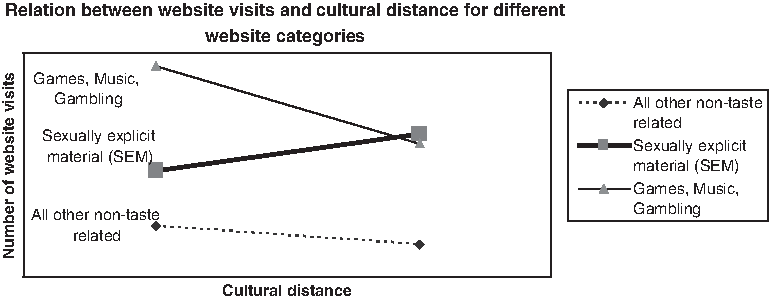
The relation between cultural distance and Web site visits for different Web site categories. Note: The slopes of the curves are based on the regression coefficients of model 5 in Table 3.
Our findings also indicate that different types of distance (geographic and cultural) need not be related to the number of foreign Web site visits in a similar fashion but may have opposing effects. Depending on one's preferences, cultural distance can have both a negative and a positive effect on the number of taste-related Web site visits. People may also like certain products because of the larger cultural distance. More specifically, the positive impact of cultural distance on SEM sites may be interpreted along this line, meaning that for this specific taste-based category, the love for variety outweighs the more traditional negative cultural distance argument. Data limitations do not allow us to delve further into the role of cultural distance as a source of attraction for Web sites containing SEM and as a source of repulsion for other taste-related categories. Future individual-level research on this topic might therefore be warranted.
Footnotes
Disclosure Statement
No competing financial interests exist.