




Abstract
Abstract
This article explores the effect of gender and contextual features on emotional reactions, identification toward game characters, and game enjoyment. Two aspects of contextual features are specifically examined: the moral justification of game characters and violence. An experiment was conducted by allowing participants to play either a morally justified character of a non-violent game, a morally justified character of a violent game, or a morally unjustified character of a violent game. The results show that participants felt less guilty and identified with the characters more when playing the morally justified characters of the non-violent game. Furthermore, males and females demonstrate different patterns of enjoyment to different contextual features of video games. The implications of these findings and directions for future research are discussed.
Introduction
Another contextual factor that might influence the entertainment processes of game play is the attributes of the game characters. Although there is little empirical evidence, some have proposed that whether player-controlled characters are portrayed as morally justified or not may have an effect on players' game experiences. 7 An in-depth interview with the game players revealed that some players found it important to play morally justified characters in order to enjoy playing the game. 8 A character may be considered as morally justified or having justified motivations when the character achieves the goal of saving lives, helping others, and keeping the world safe. On the other hand, a character may be considered as morally unjustified when the character fights or initiates violent interactions out of self-interest or personal gain. In fact, video games often portray game protagonists as heroes who fight to protect lives or to save the world. Study findings have shown that about 70% to 90% of video games portray justified violent interactions initiated by player-controlled characters. 9 While playing video games, players could vicariously imagine themselves as being a superhero in the virtual world, and enjoy the heightened arousal and thrill of saving the world through fighting evil forces or villains.
Many video games include vivid portrayals of serious intentional harm and explicit injuries or gore with various weapons, which are committed by player-controlled characters. With the interactive nature of video games, players are able to control when and how to perform violent actions as if they were shooting at the enemies or fighting with the opponents themselves in the virtual world. Those brutally violent behaviors, however, may violate the players' moral standard and lead to a sense of guilt. According to Bandura's notion of social cognitive theory, 10 individuals develop moral standards to guide their own thoughts and behaviors through self-regulatory processes. The inconsistency between moral standards and behaviors, such as performing brutal violent acts, may cause the feeling of guilt or negative affective states. In playing video games, players' violent virtual behaviors and the thought of enjoying those behaviors may lead to a sense of self-censure and guilt. The self-regulatory process, however, may be disengaged through several mechanisms, such as moral justification.11,12 Although recognizing that harming others is wrong, a person who fights for a justified reason, such as protecting life, may seem to be acceptable. As Klimmt et al. 8 suggest, players adopt this strategy to manage concerns arising from committing various violent actions in the games in order to enjoy the game.
However, some players may find it entertaining to play a “bad person” in the game world. Players may enjoy being an assassin who kills any assigned target, as in Hitman, or they may like to play as mercenaries who fight for personal gain and money in Mercenaries. When playing villains, players may enjoy the sensational arousal of being able to do things that are considered inappropriate in the real world. Players who enjoy playing villains with unjustified motivations to commit crimes may require a higher ability to disengage from their moral sanctions. Bandura 12 suggests that males are more capable of deactivating the self-regulation process of those immoral behaviors or thoughts. From this reason, male players may enjoy violent video games with characters who perform unjustified tasks more than female players do.
This study suggests that players' emotional reactions and enjoyment of game playing might vary depending on the level of violence and whether the game characters are portrayed as justified or not. In addition, males and females might react differently toward different contextual features of video games. To examine the players' enjoyment and responses toward different contextual features, this study observes players' game enjoyment and reactions in three conditions: playing a morally unjustified character in a violent game (i.e., the violent/unjustified condition), playing a morally justified character in a violent game (i.e., the violent/justified condition), and playing a non-violent game (i.e., the non-violent condition).
It is proposed that performing violent behaviors in violent games will violate moral standards that cause guilt and a decrease in game enjoyment. Among those who play violent games, moral justification could provide a disengagement mechanism so that violent acts conducted by morally justified characters seem more acceptable than those conducted by morally unjustified ones. In addition, males and females are proposed to have different reactions on the effect of contextual features on game experiences.
Another important concept that has often been discussed in previous media-entertainment research is “identification.” Previous television-entertainment research suggests that when viewers identify with media characters, they often share the perspective and the feeling of the characters. Little research has examined identification with game characters; however, it is reasonable to assume that players identify with game characters, as viewers do with media characters. With the interactive nature of video games, it might be relatively easy for players to identify with the game's characters when they control every movement of the character and are required to achieve the goals of the character.
Previous studies have suggested that factors such as the gender and valence (i.e., good or bad) of media characters may impact how viewers identify with them. 13 More specifically, viewers identify with same-sex characters more so than with opposite-sex characters. With most player-controlled characters being male, and with relatively few female characters available in the market, 14 it may be assumed that identification with male characters will generally be higher for male players than for female players.
In addition, media-entertainment research on also indicated that viewers identify with heroes more so than with villains. 15 It is proposed that when playing video games, players may identify more with those characters who are heroes or morally justified than those who are morally unjustified.
Lastly, research questions are proposed on the associations among dependent variables (i.e., enjoyment, identification, and guilt). More specifically, do players who feel less guilty also identify with a character more and enjoy the game more? In addition, are there gender differences in the relationships among those variables?
Methods
Participants
A total of 104 college students were recruited from a large university in Taiwan. The average age of the participants was 21.1 years (SD = 2.00). Participants were randomly assigned to one of three conditions: the violent/unjustified condition (n = 36), the violent/justified condition (n = 36), and the non-violent/justified condition (n = 32). In each condition, half of the participants were male and half were female.
Material
To make the results more generalizable, more than one video game was adopted for each condition. 16 For the violent/justified condition, 25 To Life (police officer) and True Crime were selected. Video games used for the violent/unjustified condition were 25 To Life (gangster) and Saint's Row. For the non-violent/justified condition, TopSpin3 and Beautiful Katamari Tamashi were selected. Only male characters were assigned in the study because most video games in the market include only male protagonists who are player-controllable.
25 To Life is a third-person shooting game. The advantage of this game is that players are able to play as a police officer or as a gangster. Two versions of the game were adopted in the violent/justified condition and the violent/unjustified condition, allowing participants to play either the police officer or the gangster respectively. In the violent/justified condition, the player-controlled character was shown wearing a police uniform. Participants were informed that the character they would be playing was a police officer named “Niko,” whose task was to stop gangsters from successfully trading drugs and to protect the life of his partner. In the violent/unjustified condition, participants were informed that the character they would be playing was a gangster named “Niko,” whose task was to trade drugs and escape from the police.
True Crime and Saint's Row are action games that involve intense violence. The characters in these games are able to use various weapons and initiate violent interactions. The main protagonist of True Crime is an undercover cop, so this game was adopted in the violent/justified condition. The participants were informed that the character they would be playing was an undercover cop named “Niko,” whose task was to stop gangsters from trading drugs. Saint's Row involves stories among different groups of gangsters, so it was selected for the violent/unjustified condition. Participants assigned to play this game were informed that the character they would be playing was a gangster named “Niko,” whose task was to escape from prison and fight with the police officers. All four violent games were controlled at similar levels for comparability. Other than the different roles and task manipulations, the characters in the four video games perform similar violent behaviors (i.e., shooting at opponents).
TopSpin3 is a tennis game that allows game players to play in a match with professional tennis players. Participants were informed that the character was a professional tennis player named “Niko,” whose task was to win the world tennis cup. Beautiful Katamari Tamashi is a third-person puzzle action game. The participants were informed that they would be playing the role of “Prince Niko,” whose task was to roll up a ball to collect objects until the ball is big enough to save the world.
Procedure
Upon arrival, the participants were led to the experimental room and given an instruction sheet with the name, role, and task of the character they would be playing.
The participants then answered two questions regarding the role and the task of the character on the instruction sheet to ensure that they had read and understood the instructions correctly. Participants were given 20 minutes to play the game. After playing the game, the participants filled out questionnaires about enjoyment, identification with the game's character, justification of the character's task, and the feeling of guilt during the game.
Measurement
Enjoyment was measured by asking participants whether the game they played was enjoyable or not enjoyable, likeable or unlikable, entertaining or unentertaining on a 7-point semantic differential scale.
Identification was assessed by adopting four items from Schneider et al.: 17 “I felt the character that I play in the game was interesting,” “I identified with the character I was playing in this game,” “I was interested in my character's goals in this game,” and “I liked the character I was playing in this game” (1 = strongly disagree, 7 = strongly agree).
Participants were also asked the degree to which they felt guilty while playing the game (1 = does not describe how I felt at all, 5 = accurately describes how I felt), and whether they felt that the character's task was justified (1 = strongly disagree, 7 = strongly agree).
Results
For each type of video game (i.e., violent/unjustified, violent/justified, and nonviolent), the two different games were examined for whether they produced different responses for enjoyment, identification, and the feeling of guilt in order to ensure comparability. The results showed that there was no significant difference in enjoyment, identification, and the feeling of guilt between the video games in each condition (F < 1, p > 0.5). Thus the data for the two games in each of the conditions were combined for the following analyses.
An analysis of variance (ANOVA) was performed to examine whether the participants perceived different levels of justification of the characters' tasks across the three conditions. The results showed that controlling for gender, the perceived justifications of the characters' tasks of the three conditions were significantly different, F(2, 98) = 59.915, p < 0.001. Tukey post-hoc comparisons of the three groups indicate that the violent/unjustified condition obtained significantly lower scores on the perceived justification of the characters' tasks (M = 2.222) than the violent/justified condition, M = 4.306, 95% CI (−2.788, −1.379), p < 0.001, and the non-violent condition did, M = 5.500, 95% CI (−4.003, −2.552), p < 0.001.
Next, ANOVA analyses were conducted to test the hypotheses. The contextual features of the games and gender were the between-subject factors, and the feeling of guilt, enjoyment, and identification were entered as the dependent variables respectively in each analysis. Descriptive analyses of the dependent variables by gender and conditions are presented in Table 1.
H1a and H1b examined the effects of gender and the contextual features on the feeling of guilt. As Figure 1 shows, the results for H1 indicated that there was no significant interaction effect, F(2, 95) = 0.704, p = 0.497, η2 = 0.015. The main effect of gender was not significant either, F(1, 95) = 1.898, p > 0.05, η2 = 0.02. However, there was a significant main effect of the contextual features of the games on the sense of guilt, F(2, 95) = 6.308, p < 0.01, η2 = 0.117. Participants felt less guilty when playing the morally justified characters in the non-violent games (M = 1.160) than playing the police officers in the violent games (M = 1.794), t(98) = 2.489, p < 0.05, and the gangsters in the violent games (M = 2.028), t(98) = 3.454, p < 0.01.
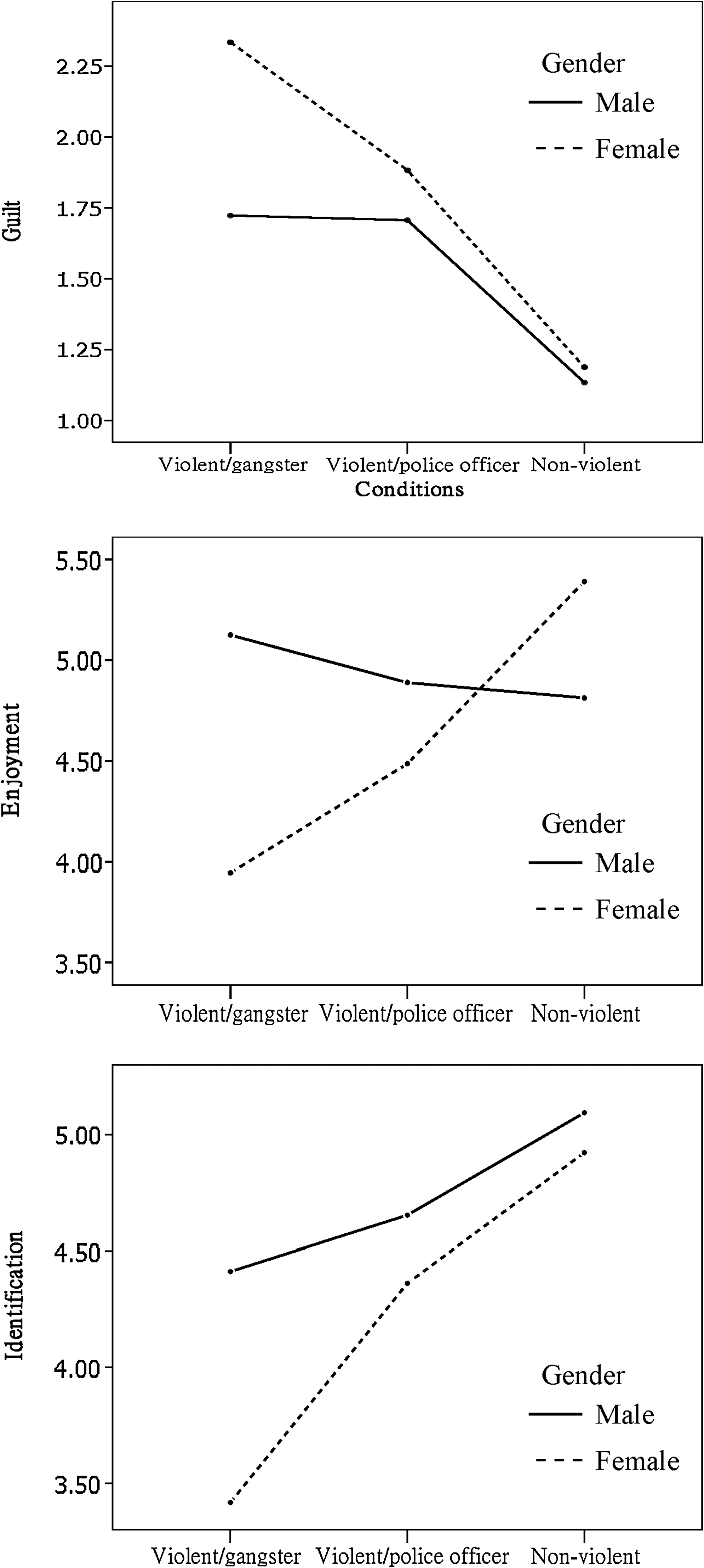
Interaction effects of gender and conditions on guilt, enjoyment, and identification.
H2a and H2b examined the effects of gender and the contextual features of the games on enjoyment. There was a significant interaction effect between the contextual features and gender on enjoyment, F(2, 98) = 6.410, p < 0.01,η2 = 0.116. Females enjoyed playing justified characters in the non-violent games (M = 5.391) more so than justified characters in the violent games (M = 4.486), t(49) = −2.420, p < 0.05, and they also enjoyed playing the non-violent games more than playing gangsters in the violent games (M = 3.944), t(49) = −3.869, p < 0.001. Males, on the other hand, enjoyed games of the three types at similar levels, F(2, 49) = 0.534, p > 0.05. Sidak-corrected comparisons indicate that, in the violent/unjustified condition, males (M = 5.125) obtained significantly higher enjoyment levels than females did (M = 3.944), 95% CI (0.512, 1.850), p < 0.001.
H3a and H3b proposed that male participants identify with the game characters more so than females, and that the participants identified more with the justified characters. The results revealed a significant main effect of gender, F(1, 97) = 6.095, p < 0.05, η2 = 0.059, and also a significant main effect of contextual factors, F(2, 97) = 10.090, p < 0.001, η2 = 0.172. The males identified with the male game characters (M = 4.719) more than the females did (M = 4.233). Sidak-corrected comparisons indicate that, in the violent/unjustified condition, males (M = 4.412) obtained significantly higher enjoyment than females did (M = 3.417), 95% CI (0.325, 1.665), p < 0.001. In addition, those who played in the non-violent games (M = 5.008) identified with the characters more so than those who played police officers in the violent games (M = 4.507), t(100) = −0.200, p < 0.05. There were also significant differences in the levels of identification between those who played the violent/unjustified games (M = 3.914) and the violent/justified games, t(100) = −2.480, p < 0.05, and between those who played the violent/unjustified games and those who played the non-violent games, t(100) = −4.394, p < 0.001.
The research questions asked about the associations among enjoyment, guilt, and identification, and whether the relationships differ by gender. The results showed that, for males, the correlations between guilt and enjoyment, r = −0.192, p > 0.05, and the correlations between guilt and identification, r = −0.132, p > 0.05, were not significant. There was a significant moderate correlation between enjoyment and identification, r = 0.512, p < 0.001. For females, there was a significant negative association between guilt and enjoyment, r = −0.331, p < 0.001, and between guilt and identification, r = −0.328, p < 0.001. There was also a significant correlation between identification and enjoyment for females, r = 0.800, p < 0.001. Female players who felt guilty while playing the games obtained less enjoyment and identified less with the game characters.
Discussion
This study provides evidence that contextual factors of video games, such as the justification depiction of game characters and the levels of violence, may influence the players' entertainment experiences. In this study, players who committed violent actions in the virtual world felt guiltier than players who played the non-violent games.
The results showed that video games did not attract males alone. Female participants found video games appealing as much as male participants did, but for specific kinds of content. Females preferred playing non-violent games, and they did not seem to enjoy being a villain in the virtual world. It is harder for females to identify with the villains, and they feel less enjoyment when conducting unjustified violent acts in the video games. As for male participants, they seemed to enjoy the games no matter what contextual features the games had. In contrast to female participants, males were able to identify with gangsters, and obtained enjoyment from committing unjustified violent behaviors during the game. Future research should examine whether identification with violent and morally unjustified characters may lead to imitation of those behaviors in real life, as social learning theory proposes. 18 This study also shows higher identification with the male characters among the male participants. Wright et al. 19 have provided an explanation for this phenomenon in that the reason why female players fail to identify with game characters is that the main protagonists in most video games are portrayed as powerful males who exert violence, which are not the characteristics that promote identification for females.
This study provides evidence that, as in the real world, people monitor their own moral conduct in the virtual world. The performance of violent and brutal behaviors in the virtual world caused guilt to the players in the real world. For female participants, their game enjoyment suffers due to their moral concerns of committing virtual violence, which is consistent with the findings of Klimmt et al. 8 On the other hand, the male participants are more able to cope with the moral concerns of conducting violent acts or being villains in the virtual world. One explanation is that males might have better moral disengagement abilities, as Bandura has suggested. 12 It is also likely that males are more desensitized with respect to the violent games' content than females are, because historically they are found to have longer exposure to media content with violent attributes. 20
Footnotes
Acknowledgment
This study was supported in part by a research grant from the National Science Council, Taiwan.
Disclosure Statement
No competing financial interests exist.