




Abstract
Abstract
This study examines the factors influencing consumer intention to watch online video ads, by applying the theory of reasoned action. The attitude toward watching online video ads, the subjective norm, and prior frequency of watching online video ads positively influence the intention to watch online video ads. Further, beliefs held about entertainment and information outcomes from watching online video ads and subjective norm influence attitude toward watching these ads.
Introduction
Literature Review
Determinants of intention to watch OVAs
The TRA is a most useful theoretical framework for predicting a particular behavior.5,6 According to the TRA, the most important determinant of a behavior is an individual's intention to perform the behavior. 6 Further, the first determinant of behavioral intention is the attitude toward performing a behavior, which refers to “the individual's positive or negative evaluation of performing the behavior”. 5 (p6) Previous studies have shown that there is significant influence of the attitude toward a behavior on the intention to perform that behavior.7–9 In the context of OVAs, therefore, a more favorable attitude toward watching OVAs is expected to lead to a stronger intention to watch these ads. Thus:
According to the TRA, the second determinant of behavioral intention is subjective norm, which refers to “the person's perception that most people who are important to him think he should or should not perform the behavior in question”. 6 (p302) Previous studies have found that the stronger the subjective norm is, the stronger the behavioral intention will be.10,11 Similarly, consumer perceived social pressure to watch OVAs will have a positive effect on consumer intention to watch those ads. Thus:
Although the original TRA assumes that there are independent influences of the attitude toward a behavior and the subjective norm on intention, respectively, some researchers suggest that the interdependencies between the two main determinants of behavioral intention should be examined to improve the overall explanatory power of the model.11–13 Consistent with previous studies, 13 subjective norm with respect to watching OVAs can be predicted to positively influence consumer attitudes toward watching those ads. Thus:
Although not included in the original TRA, it was found that adding a past behavior as a co-determinant of behavioral intention to the original model strengthened the explanatory power of the model.14,15 Therefore, in the context of OVAs, it is expected that the more frequently consumers watched OVAs in the past, the greater will be their intention to watch the ads. Thus:
Determinants of attitude toward a behavior
The TRA assumes that the attitude toward a behavior is determined by behavioral beliefs, which refer to a “person's beliefs that the behavior leads to certain outcomes and his evaluations of these outcomes”. 5 (p8) Although the original TRA assumes a unidimensional belief, researchers have decomposed beliefs to avoid underestimating the complicated relationship between beliefs and determinants of intention.8,9,13,16
Given that OVAs are a new form of advertising on the Internet and motivations reflect certain expected outcomes for a particular behavior, 17 a review of the literature on the motivations for watching advertising as well as for using the Internet is helpful in identifying the expected outcomes from viewing OVAs. In the context of advertising viewing, O'Donohoe 18 identifies several motivations for watching advertising, including marketing uses, enjoyment, and social interaction. Similarly, Pollay and Mittal 19 found that consumers use advertising for product information, social role guidance, and hedonic experiences. Additionally, in the context of Internet usage, a number of researchers have identified the specific gratifications that consumers expect to gain from using the Internet, including information,20–22 entertainment,21–23 social interaction,20,22,23 relaxation-escape, 23 passing time,21,23 interactive control, 20 and shopping. 24
Among the expected outcomes for using advertising and for using the Internet, the outcomes most relevant to the context of watching OVAs include entertainment, information, relaxation, escape, passing time, social interaction, and control. We predict that consumers will expect these same outcomes from watching OVAs. As consumers further believe that watching OVAs will produce these outcomes and judge those outcomes to be good outcomes, it is expected that consumers will develop a more positive attitude toward viewing OVAs. Thus:
Methodology
Participants
An online survey was conducted. Overall, 514 undergraduate students at a large Midwestern university completed this survey in return for extra credit in their courses. Responses from 22 of the participants were removed because of many missing responses. Thus, responses from 492 participants were used for the subsequent analysis. Ages of the participants ranged from 18 to 29 (M=20.45, SD=1.50). Female participants (67.7 percent) outnumbered male participants. College students were deemed to be appropriate for this study. Prior research reported that about 89 percent of Internet users aged 18–29 watched online videos on video-sharing sites in 2009. 25
Measurement
Intention to watch OVAs and subjective norm were measured, using three items, respectively. Each item was assessed on a scale ranging from “strongly disagree (1)” to “strongly agree (7).” Attitude toward watching OVAs was measured using five items on a 7-point scale. The items used to measure each of these variables were taken from previous studies,5,26 and modified for this study. Additionally, to measure prior viewing of OVAs, participants were asked to indicate how often they had watched OVAs in the past 3 months, on a scale ranging from “never (1)” to “quite often (7).”
With respect to behavioral beliefs, to gain better insight into what consumers expect from watching OVAs, three focus groups were conducted. A total of 19 undergraduate students (different students from the survey participants) each participated in one of three focus groups in a campus focus group room. These focus groups identified several expected outcomes from watching the OVAs: Entertainment, relaxation, escape, passing time, social interaction, and control. The review of previous studies and the findings in the focus groups, taken together, identified seven expected outcomes from watching OVAs, that is, entertainment, information, relaxation, escape, passing time, social interaction, and control. The strength of each belief and the evaluation of its corresponding outcome were measured using items borrowed from previous studies,20,23,a after being modified for this study. 5 The strength of each behavioral belief was assessed on a scale ranging from “extremely unlikely” (1) to “extremely likely” (7). Its corresponding evaluation was measured on a scale ranging from “extremely bad” (1) to “extremely good” (7). To compute the sum of the behavioral beliefs, the strength of each belief was multiplied by its corresponding evaluation, and the resulting scores were then summed for each outcome. 5 See Appendix A for the items used in this study.
Results
Measurement model
Confirmatory factor analysis was conducted, using AMOS 7.0, to confirm the measurement model. Two indicators of the social interaction belief and two of the entertainment belief were removed due to cross loading. All of three indicators of the control belief were also removed due to a low level of composite reliability. The overall fit for the modified measurement model was acceptable (Table 1). 27 All indicators were loaded on the same constructs found in the previous literature. Composite reliabilities and average variances extracted for each of the constructs indicated convergent validity (Table 2).12,28 Further, the square root of the average variance extracted for each construct was higher than the correlations involving the construct (Table 3), confirming discriminant validity.12,29
χ2(398)=1090.287, p<0.001; χ2/df=2.739; RMSEA=0.060; NFI=0.916; CFI=0.944; SRMR=0.041.
CFI, comparative fit index; NFI, normed fit index; RMSEA, root-mean-squared error of approximation; SRMR, standardized root mean of the residual.
The numbers in the diagonal row arc square roots of the average variance extracted.
ENT, entertainment; INF, information; REL, relaxation; ESC, escape; PT, passing time; SI, social interaction; ATT, attitude toward watching online video ads; SN, subjective norm; INT, intention to watch online video ads.
Hypotheses testing
To test the hypotheses, a path analysis was conducted, using AMOS 7.0. The control belief was not included in the analysis due to the low reliability, and thus H5g was not tested. To improve the overall fit of the hypothesized model, a path from the entertainment belief to intention to watch OVAs was added to the hypothesized model, after reviewing modification indices. The overall fit for the modified model was good (see Fig. 1). 27
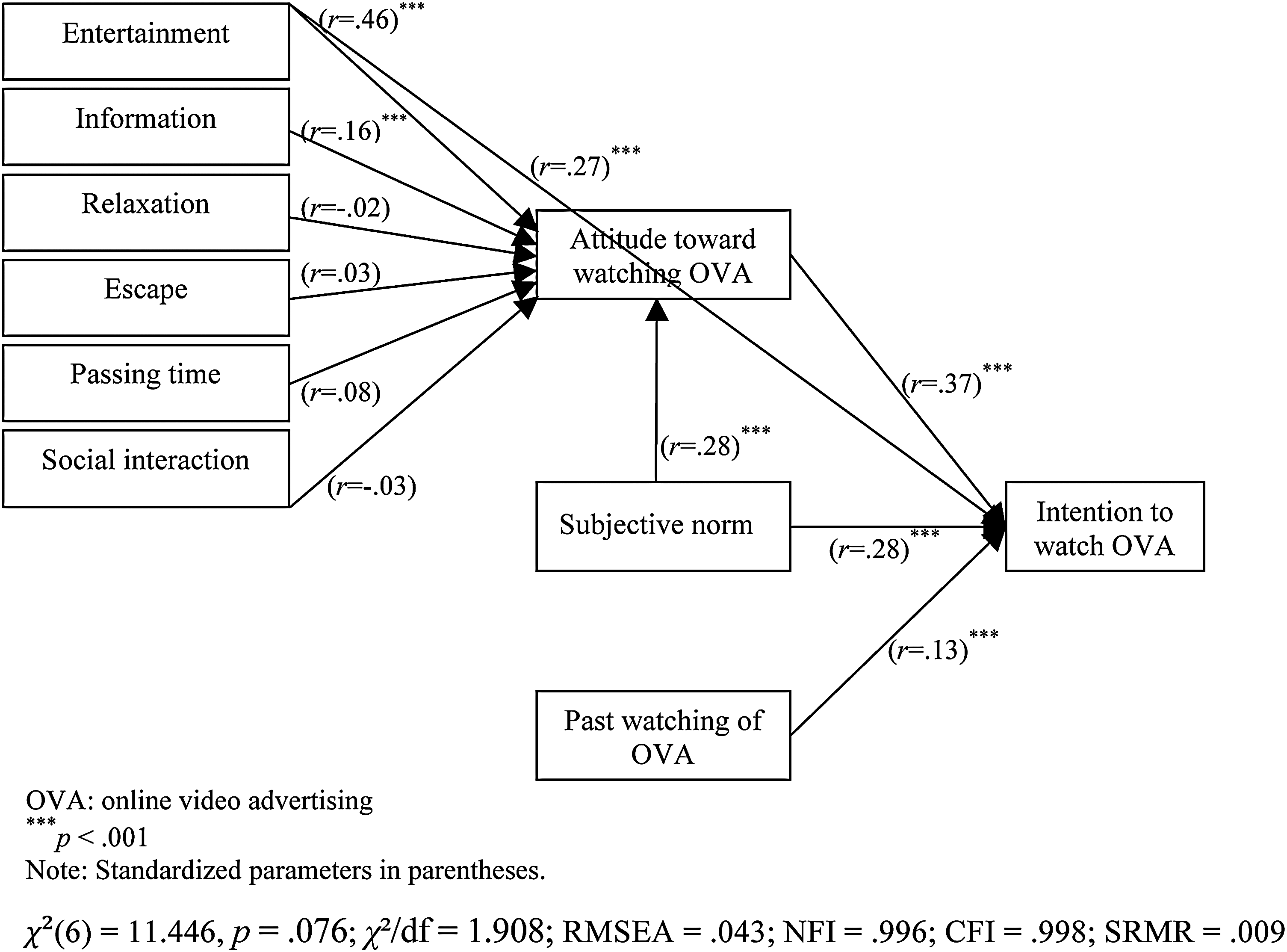
Hypotheses Testing and Modified Model.
As shown in Figure 1, attitude toward watching OVAs, subjective norm, and prior viewing of OVAs all had a significant positive relationship to the intention to watch OVAs. Additionally, subjective norm showed a positive impact on attitude toward watching OVAs. Hence, H1–H4 were all supported. Further, entertainment and information both had a positive impact on attitude toward watching OVAs. However, other behavioral beliefs all showed no significant relationship to attitude. Thus, H5a and H5b were both supported, whereas H5c–f were not. Finally, there was a positive impact of entertainment on intention to watch OVAs.
Discussion and Conclusions
Our findings demonstrate that the TRA is a robust theory that can help researchers predict the factors that influence consumer intention to watch a subset of advertising—online video ads—which requires consumers' active participation. Specifically, this research found that the more positive the participant attitudes toward watching OVAs were and the more that participants perceived there was social pressure to watch those ads, the greater was their intention to watch these ads. Additionally, subjective norm was found to influence attitudes toward watching OVAs positively. Advertisers may consider partnering with video sharing Web sites and social network sites, so consumers can see whether their friends have viewed OVAs. Such a feature will lead consumers to form favorable attitudes toward watching OVAs and subsequently motivate them to watch those ads. This study also found that the intention to watch OVAs is also influenced by the habitual 10 watching of consumers.
Building upon the motivations for viewing advertising and for using the Internet, as identified in previous studies, this study identified six outcomes that consumers expect from watching OVAs: Entertainment, information, relaxation, escape, passing time, and social interaction. Understanding these types of outcomes gives useful insights to advertisers for how they can best satisfy consumers' specific needs for viewing OVAs. Specifically, this study found that the more that participants believed that watching OVAs would entertain them and the more they judged that outcome to be a good outcome, the more positive were their attitudes toward watching OVAs. Additionally, this behavioral belief about entertainment positively influenced consumer intention to watch OVAs directly. This study suggests that OVAs should be very entertaining to enhance consumer attitudes toward watching OVAs the most and increase their intention to watch these ads. Additionally, given that the belief about information outcome also positively influenced consumer attitudes toward watching OVAs, entertaining OVAs should provide useful information at the same time.
Unexpectedly, however, other behavioral beliefs for watching OVAs did not predict their attitudes toward watching the ads. These nonsignificant findings might have occurred because participants' beliefs about these outcomes were not strong enough to influence their attitudes toward watching OVAs. These findings are consistent with the findings of previous studies demonstrating that some motivations for using the Internet such as passing time and relaxation did not predict Internet affinity and satisfaction.21,23
Limitations and Future Research
Although the list of expected outcomes from watching OVAs that were identified in this study is comprehensive, it is not exhaustive. Additionally, this study examined the factors identified in the TRA. Future research should identify a more comprehensive list of expected outcomes for watching OVAs and examine other factors that may further predict consumer intention to watch OVAs.
Endnote
aSeveral items used in these studies were not included in this study because some of these items do not reflect consequences in general and other items do not reflect a specific outcome that they are supposed to represent.