




Abstract
Abstract
Brain responses, particularly within the orbitofrontal and cingulate cortices, to Internet video-game cues in college students are similar to those observed in patients with substance dependence in response to the substance-related cues. In this study, we report changes in brain activity between baseline and following 6 weeks of Internet video-game play. We hypothesized that subjects with high levels of self-reported craving for Internet video-game play would be associated with increased activity in the prefrontal cortex, particularly the orbitofrontal and anterior cingulate cortex. Twenty-one healthy university students were recruited. At baseline and after a 6-week period of Internet video-game play, brain activity during presentation of video-game cues was assessed using 3T blood oxygen level dependent functional magnetic resonance imaging. Craving for Internet video-game play was assessed by self-report on a 7-point visual analogue scale following cue presentation. During a standardized 6-week video-game play period, brain activity in the anterior cingulate and orbitofrontal cortex of the excessive Internet game-playing group (EIGP) increased in response to Internet video-game cues. In contrast, activity observed in the general player group (GP) was not changed or decreased. In addition, the change of craving for Internet video games was positively correlated with the change in activity of the anterior cingulate in all subjects. These changes in frontal-lobe activity with extended video-game play may be similar to those observed during the early stages of addiction.
Introduction
The activity of the prefrontal cortex during cue stimulation
Changes in brain activity in patients with substance dependence during substance cue presentation
There are a number of studies in which increased craving and brain activity have been observed in response to drug cues after a small dose of a drug.7–11 After drinking a small amount of alcohol, patients with alcohol dependence showed increased brain activity in the nucleus accumbens, anterior cingulate, and orbitofrontal cortex, which was correlated with subjective craving for alcohol. 10 Park et al. 11 also reported that after taking 5 cc alcohol, patients with alcohol dependence showed brain activation in similar regions, including the middle frontal, medial frontal, and cingulate gyrus in response to alcohol cues. Breiter et al. 7 observed an increase in craving and brain activity in the nucleus accumbens, parahippocampal gyrus, and lateral prefrontal cortex in patients with cocaine dependence after cocaine infusion (0.6 mg/kg) compared to saline infusion. Moreover, a positron emission tomographic study noted increased glucose metabolism in the dorsolateral prefrontal cortex and the medial temporal lobe in response to cocaine cues. 8
Cue-induced brain-activity changes in Internet video-game players over time
In a recent study of cue-induced brain activity in patients with online game addiction, Ko et al. 12 suggested that the brain areas that responded to game stimuli in patients with Internet game addiction would be similar to those responding to the substance cue-induced craving in patients with substance dependence. Particularly, the patient group showed increased activity in the dorsolateral prefrontal cortex, orbitofrontal cortex, anterior cingulate, nucleus accumbens, and caudate nucleus in contrast to the control group. 12 Our previous functional magnetic resonance imaging (fMRI) study 13 also reported that craving for Internet video-game playing was positively correlated with the beta values of the left inferior frontal gyrus, left parahippocampal gyrus, and right thalamus in response to game cues in healthy volunteers. Moreover, compared to the general players, those with excessive Internet video-game play (EIGP) showed significantly greater activity in the right medial frontal lobe, right and left frontal pre-central gyrus, right parietal post-central gyrus, right parahippocampal gyrus, and left parietal precuneus gyrus. 13 However, to date there are few cohort studies showing the effects of playing Internet video games on brain activity over time.
Hypothesis
Most studies of patients with substance addiction suggest that brain activity will increase in response to substance cues following substance administration.7–11 In this cohort study of Internet game playing, we hypothesized that during cue presentation, excessive Internet game playing would increase craving and brain activity, particularly in the prefrontal cortex. In addition, we expected that subjects with a high craving for Internet video-game play would be associated with increased activity in the prefrontal cortex.
Method
Subjects
Through advertisement in Chung Ang University and Chung Ang University Medical Center, 22 university students were recruited. Of these 22, one student was excluded due to claustrophobia on MRI scanning, leaving a final sample of 21 students (14 male, 7 female, mean age = 24.1± 2.6 years, minimum age = 20, maximum age = 30) with a history of education years (15.4 ± 1.0 years), computer use (3.6 ± 1.6 hours/day, minimum 1 hour, maximum 7 hours), and mean Young's Internet Addiction Scale score (YIAS, 38.6 ± 8.3) during the past 6 months. Of these 21 subjects, 15 subjects drank alcohol (social-drinking frequency, 3.1 ± 2.1/month) and four subjects were smokers (3.25 ± 0.5 pack years; Table 1). All subjects were screened with the Structured Clinical Interview for DSM-IV and the Beck Depression Inventory (BDI; 14 mean score = 6.5 ± 3.6). There were no gender differences in terms of age, usual computer-use time, YIAS score, and BDI score. Exclusion criteria were: (1) a history or current episode of Axis I psychiatric disease, (2) substance-abuse history (except for alcohol and tobacco), (3) neurological or medical disorders, and (4) IQ < 80 assessed with the Korean Wechsler Adult Intelligence Scale (K-WAIS). All students were classified into two groups: an excessive Internet game-playing group (EIGP, playing for more than 2,520 minutes, 60 minutes/day × 42 days) and a general player group (GP, playing for less than 2,520 minutes). There was no significant differences in the age, education years, computer using time, YIAS, alcohol drinking, and smoking pack years between the two groups. The Chung Ang University Hospital Institutional Review Board approved the research protocol of this study. Written informed consent was provided by all participants.
GP: subjects who played Lost SAGA for fewer than 2,520 minutes; EIGP: subjects who played Lost SAGA for more than 2,520 minutes; Eyr: educational years; Alc: alcohol drinking frequency during past 30 days, where n = no alcohol drinking/smokers; Smk: smoking, pack years; UCUt: usual computer using time/day; b/6BDI: baseline/6 weeks Beck Depression Inventory scores; b/6YIAS: baseline/6weeks Young's Internet Addiction Scale score; PGT: playing game time (minutes) during 6 weeks; b/6Cr: baseline/6 weeks craving for playing Lost SAGA at baseline.
Study procedure
Video-game play and functional magnetic resonance imaging scanning
At the first visit, after a brief training session on how to play the Internet video game, craving for playing the Internet video game and brain activity during the presentation of video-game-play cues in volunteers participating in the study were assessed. Brain activity was assessed using 3T blood oxygen level dependent (BOLD) fMRI. Craving for playing the Internet video game and the severity of Internet addiction were assessed by self-report on a 7-point visual analogue scale (VAS) and Young's Internet Addiction Scale (YIAS) respectively. This video game, Lost SAGA, is an online action game, which is played online with multiple other players at the same time. The game is styled after a fight in a fantasy world, using 100 characters such as the grim reaper, dark shaman, Taekwon master, and Viking with character movement and magical weapons. Each player is assigned to one of 100 characters with the mission to eliminate members of the opposing alliance. Because it was newly developed and launched in March 2009, students in the current research played Lost SAGA for the first time during this study. A registration, username, and password for playing Lost SAGA were given to the students. The students were asked to play the game for 1 hour per day for 6 weeks. With the permission of the subjects, the game company, IO-entertainment Co., Ltd (iO, South Korea), monitored the playing time, score, and game stage during the 6-week period. At the end of this period, brain activity during game-play cue presentation was again assessed with fMRI recordings, and craving for playing the Internet video game was assessed with self-reports on a 7-point VAS (ranging from 1 = “not at all” to 7 = “extreme”). At each fMRI scan visit (baseline and the end of research period), students received a $30 payment, as well as reimbursement for their transportation expenses.
Assessment of brain activity and craving for Internet video-game play
All MR imaging was performed on a Philips Achieva 3.0 Tesla TX MRI scanner (Philips, Eindhoven, The Netherlands). The silent video was a single 450-second videotape consisting of five continuous 90-second segments. Three 30-second stimuli (sub-segments) consisting of a white cross in a black background (B), a neutral control (N, humanoid robot animation scenes), and the video-game cue (C, playing Lost SAGA) were included in these 90-second segments. The five segments were ordered accordingly: B-N-C, B-C-N, C-B-N, N-B-C, and C-N-B. This tape was presented by means of IFIS-SATM (MRI Device Corporation, Waukesha, WI) during a single fMRI scanning session. For the fMRI session, 180 echo planar images (EPI) were recorded at 3-second intervals with the following parameters: 33 transverse slices, 4.0-mm thickness, voxel size of 1.8 × 1.8 × 4.0 mm, TE = 30 msec, TR = 3000 ms, flip angle = 90°, in-plane resolution = 128 × 128 pixels, field of view (FOV) = 230 × 230 mm. For anatomical imaging, 3D T1-weighted magnetization-prepared rapid gradient echo (MPRAGE) data were collected with the following parameters: TR = 2000 ms, TE = 4.00 ms, FOV = 256 × 256 mm, 340 slices, 0.9 × 0.9 × 1.0 mm voxel size, flip angle = 30°. Using a 7-point VAS, each student's level of craving for Lost SAGATM was also checked after scanning.
Functional magnetic resonance imaging data analysis
fMRI data sets were analyzed using the Brain Voyager software package (BVQX 1.9, Brain Innovation, Maastricht, The Netherlands). The fMRI time series for each subject was co-registered to the anatomical 3D data set using the multi-scale algorithm provided by BVQX. Individual sets of structural images were spatially normalized to standard Talairach space. An identical nonlinear transformation was subsequently applied to the T2*-weighted fMRI time series data. Following preprocessing steps for slice scan time correction and 3D motion correction, the functional data were spatially smoothed using Gaussian kernel with an FWHM of 6 mm and temporally smoothed using Gaussian kernel of 4 s using algorithms provided by BVQX.
Statistical analysis
The general linear model (GLM) and random effects analysis (RFX) were applied to analyze the fMRI signal time-courses on a voxel-by-voxel basis and to generate individual and group statistical parametric maps of brain activation. For all analyses, we regarded the associations as significant when the False Discovery Rate (FDR) was less than or equal to 0.05 in 40 adjacent voxels. First, using an F test to examine the interaction between within-factor variables (video game cue vs. neutral stimuli) and between-factor variables (EIGP vs. GP) at the baseline, we found two clusters. A second-level analysis using repeated-measures analysis of variance (ANOVA) with two dependent factors (cluster activity at the baseline and 6 weeks later) and two independent factors (GP vs. EIGP) was used to show the difference in the change of brain activity between GP and EIGP. Spearman correlations were used to show the relationship between the change of mean β value in clusters and craving at the baseline.
Results
Clusters in the interaction between stimuli and subject factors at baseline
When subjects viewed segments of the Internet game Lost SAGA for the first time, the mean craving for Internet video-game segments in all 21 subjects was 2.7 ± 0.9 (minimum 1, maximum 5). There was no significant difference in terms of craving for Lost SAGA between the GP group (2.47 ± 0.83) and the EIGP group (3.16 ± 0.98; z = 1.59, p = 0.11; Table 1). There was no significant difference in BDI scores at the baseline between the EIGP group (6.7 ± 3.1) and the GP group (6.5 ± 3.9; z = 0.67, p = 0.51). There was also no significant change in BDI score from the baseline to 6 weeks in all subjects (z = 0.25, p = 0.8).
Using an F test to examine the interaction between within-factor variables (video-game cue vs. neutral stimuli) and between-factor variables (EIGP vs. GP), two clusters of activities were identified (FDR < 0.05, p < 0.0005). Cluster 1 (CL1): Talairach x, y, z; −8, 25, −3, anterior cingulate, Brodmann area 24; Cluster 2 (CL2): −21, 53, 8, superior frontal gyrus, Brodmann area 10 (Figure 1).
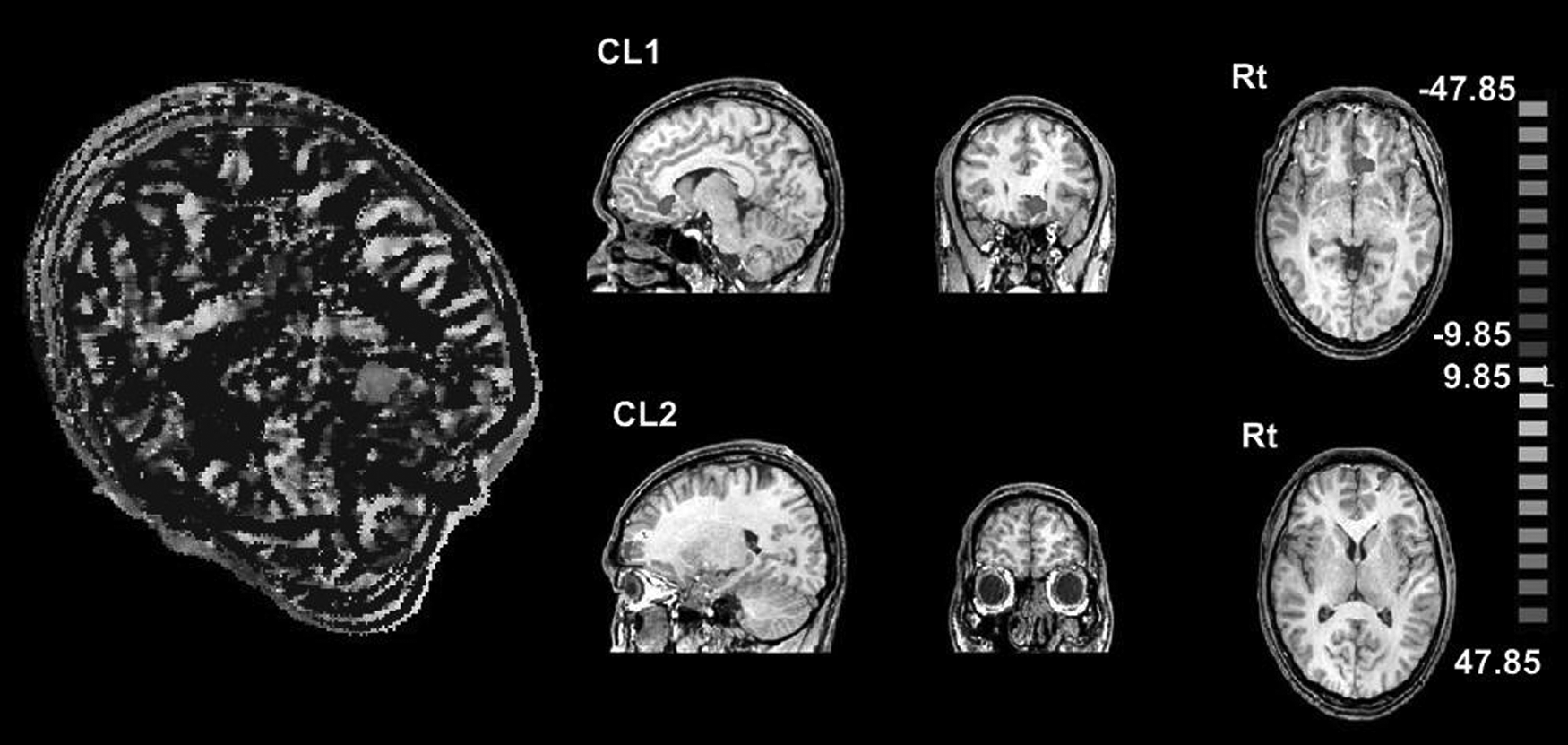
Clusters in the interaction between stimuli and subject factors at the baseline. F test, interaction A × B: within-factor (video game cue vs. neutral stimuli) × between-factor (EIGP vs. GP), FDR < 0.05, p < 0.0005408; Cluster 1 (CL1): Talairach x, y, z; −8, 25, −3, anterior cingulate, Brodmann area 24; Cluster 2 (CL2): −21, 53, 8, superior frontal gyrus, Brodmann area 10.
The change of mean beta value in cluster 1 and cluster 2 following 6 weeks of game play
During the 6-week game-play period, the mean total time of playing Lost SAGA in 21 subjects was 1155 ± 1597 minutes. The EIGP and GP groups played the Internet video game for 3594 ± 386 minutes and 180 ± 150 minutes respectively. After 6 weeks, the mean craving for the Internet video game in 19 subjects was increased (3.5 ± 1.5, minimum 1, maximum 7, z = 2.21, p = 0.03). There was a significant difference in craving for Lost SAGA between the GP group (2.93 ± 1.27) and the EIGP group (4.83 ± 1.33; z = 2.50, p = 0.01).
Between the EIGP and GP groups, the changes of mean β value during 6 weeks in CL1 and CL2 were different in responding to Internet video-game stimuli: CL1: F(1, 19) = 4.98, p = 0.037; CL2: F(1, 19) = 5.03, p = 0.033. In CL1, the mean β value of the EIGP group was increased (z = 2.04, p = 0.04), while the mean β value of the GP group was not changed (z = 0.04, p = 0.91). However, in CL2, the mean β value of the EIGP group was increased (z = 2.02, p = 0.04), while the mean β value of the GP group was decreased (z = 2.58, p < 0.01; Figure 2).
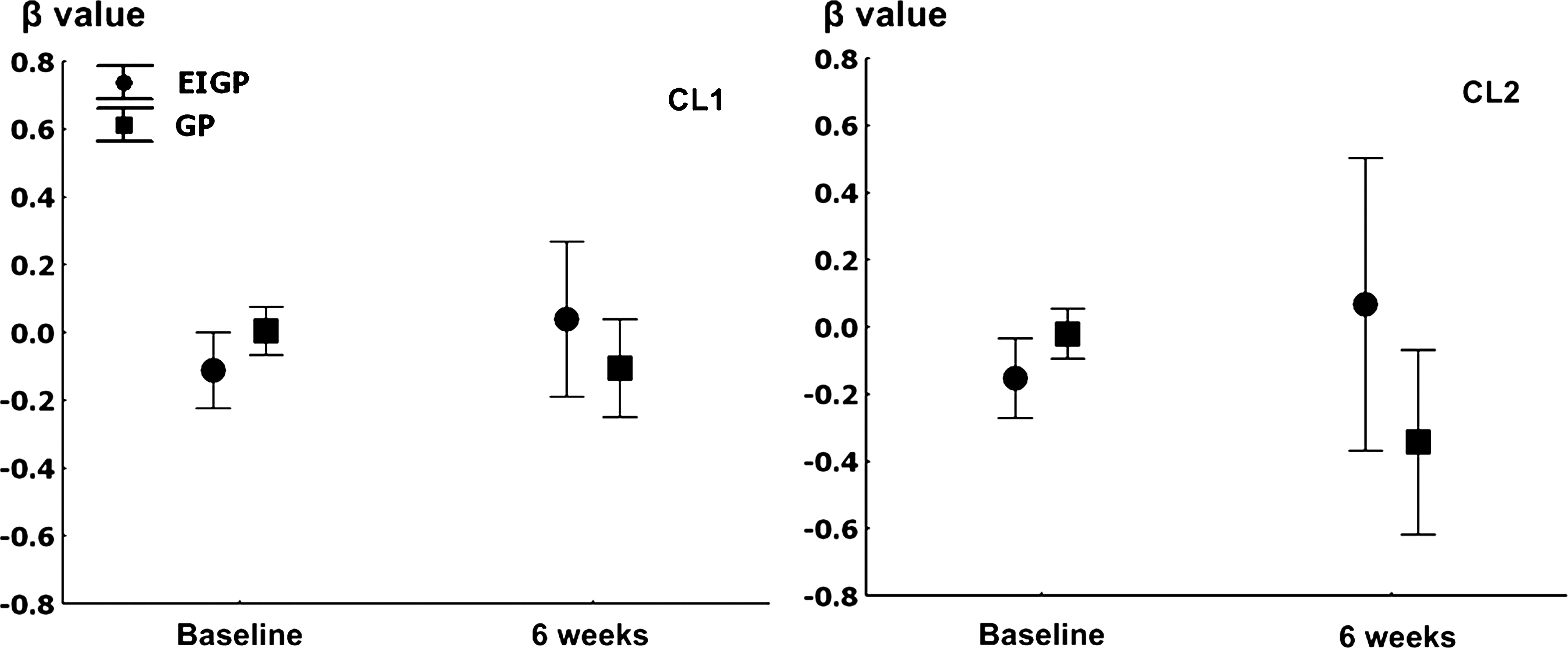
The change of mean β value in Cluster 1 and Cluster 2 following 6 weeks of play. Repeated-measures ANOVA, A: Cluster 1 (CL1): Talairach x, y, z; −8, 25, −3, anterior cingulate, Brodmann area 24, F(1, 19) = 4.98, p = 0.037; B: Cluster 2 (CL2): −21, 53, 8, superior frontal gyrus, Brodmann area 10, F(1, 19) = 5.03, p = 0.033.
The correlations between Cluster 1, Cluster 2, and craving
At the baseline, there was no significant correlation between the craving and mean β value of CL1 (r = −0.34, p > 0.05) and CL2 (r = −0.24, p > 0.05). In response to game stimulation, craving assessed at 6 weeks was positively correlated with the mean β value of CL1 (r = 0.53, p < 0.02) and CL2 (r = 0.60, p < 0.01) at 6 weeks (Figure 3). The change of craving for the Internet video game following 6 weeks was positively correlated with the change of the mean β value of CL1 (r = 0.46, p < 0.05; Figure 3). However, when controlling for an outlier of the change of beta value in subject 1, there was no statistical significance in the correlation between the change of craving and the change of the mean β value of CL1 (r = 0.35, p = 0.14).
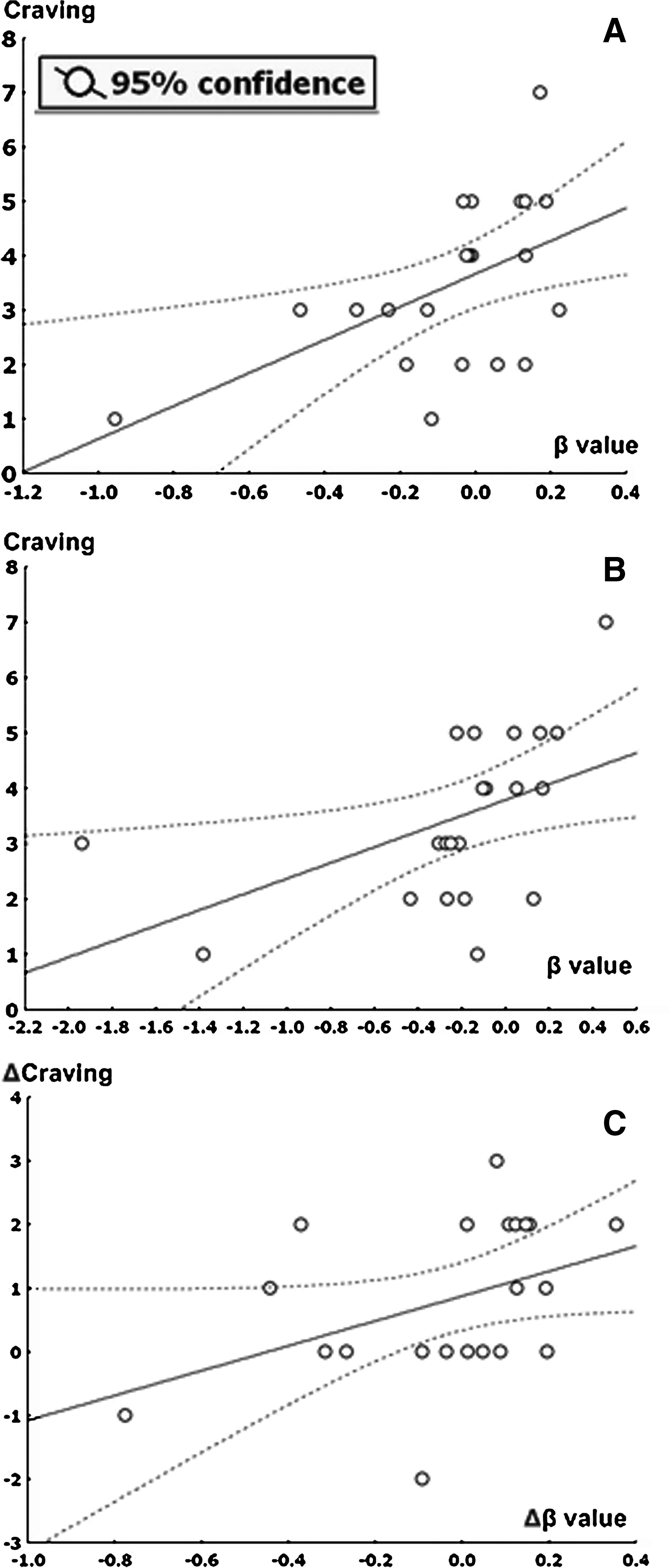
Correlations between clusters and craving (mean ± 0.95 C.I.).
Discussion
The current study observed changes in brain activity in healthy university students in response to Internet video-game cues following an extended period of game play. In response to video-game cues, contrasted with neutral stimuli, the EIGP group showed less activity in the prefrontal cortex, particularly the anterior cingulate and orbitofrontal cortex, compared to the GP group. However, following 6 weeks of game play, the activity in the anterior cingulate and orbitofrontal cortex of the EIGP group increased, while the activity in these two clusters of the GP subjects either did not change or decreased. In addition, the change of craving for the Internet video game was positively correlated with the change of the activity of the anterior cingulate in all subjects.
The activity of the prefrontal cortex during Internet video-game cue stimulation
During cue exposure, the prefrontal cortex is frequently reported as an area of activation in substance dependence and Internet video-game addiction. The prefrontal cortex is thought to be an important area with respect to drug-seeking behavior and craving.1–3 The activity of the prefrontal cortex, particularly the orbitofrontal cortex and anterior cingulate cortex, has been positively correlated with craving for alcohol, cocaine, marijuana, and tobacco during cue presentation.4,5,15–17
However, there were some different regions of activation between previous studies and the current research. Ko et al. 12 reported increased activity of the nucleus accumbens and caudate nucleus in an Internet addiction group compared with healthy comparison subjects. In our previous report, 13 the left parahippocampal gyrus and right thalamus were also noted to respond to Internet video-game cues. The reason for these different regions of activation between Ko et al.'s and current results may be due to subject differences (patients with Internet addiction vs. healthy comparison subjects) and game genre (real-time simulation game, World of WarCraft, vs. fight action game, Lost SAGA). The temporal-lobe regions, including the amygdala and hippocampus, are part of a circuit involved in learning and memory that has been associated with the intense craving in response to drug-associated cues. 18 Differences between previous and current results in these regions may be due to differences in duration of playing the Internet video game and the genre of the Internet video game. Previous research used a first-person shooting game over 10 days of play (with about 1,000 minutes of total play) while the current research involved fight action game play over a period of 6 weeks (more than 3,000 minutes).
The change of brain activity before and after Internet video-game playing
Most studies of substance addiction have noted increased craving and brain activity in response to substance cues after a small dose of substance infusion.7–11 Functional imaging studies during craving provocation have postulated that the increased activity of the orbitofrontal cortex and anterior cingulate, which are involved in inhibitory control, 19 would be associated with the subjective experience of drug craving in addicted subjects. 20 Especially, the ventral part of the anterior cingulate has been associated with craving for cocaine and mood elevation in cocaine abusers after injection of methylphenidate. 15 The ventral aspect of the anterior cingulate is known to mediate the emotional responses to salient stimuli (reward vs. aversive) and is activated by natural and drug rewards.7,21,22 In addition, the medial orbitofrontal region is involved with assessing the reward value of stimuli and motivating behavior in response to reward. 23
Although there are few cohort studies showing the long-term effects of playing Internet video games on brain activity, Green et al. 24 have reported results that indirectly suggest changes in the brain in response to game stimulation. During 10 days of action video-game play, Green et al. 24 reported that habitual game play activated preattentive processing. Preattentive processing is thought to be associated with the activity of the prefrontal cortex within the inferior frontal gyrus and the anterior cingulate cortex.25,26
The changes in the brain after 6 weeks Internet video-game play are similar to those observed in the brain after administering a small dose of a substance. Within an addiction cycle, “craving” that is associated with preoccupation and anticipation for a drug is regarded as a key element in the transition stage from abuse to dependence. 27 In addition, the medial prefrontal cortex is thought to involve cue-induced reinstatement.7–11 We cautiously suggest that brain changes after 6 weeks of excessive Internet video-game play may be similar to those experienced in the early stages of addiction.
Limitations
There are several limitations to the current study. First, the sample size and the duration of game play may not have been sufficient to show the exact response and change of brain activity in response to Internet video-game cues. In addition, the subjects enrolled in this project represented a convenience sample. Although there was no statistical difference between the EIGP and GP groups, subjects with social alcohol drinking and smoking could have had a differential effect on the observed changes in brain activity. A larger sample, a longer duration of play, and well-controlled subjects and design would be important in future studies.
Conclusion
Over a 6-week period of video-game play, brain activity was increased in the anterior cingulate and orbitofrontal cortex of subjects with excessive Internet game play in response to Internet video-game cues. These findings are similar to those observed in patients with substance abuse in response to substance cues after a small dose of substance infusion. We suggest that excessive Internet video-game play may change brain activity in ways that are similar to those observed in individuals with substance abuse or dependence.
Footnotes
Acknowledgments
This work was supported by the Korea Research Foundation Grant funded by the Korean Government (KRF-2008-331-E00177) and by NIDA (8K24DA015116). We are also grateful for the cooperation with the game company, the game company IO-entertainment Co., Ltd., and Samsung Electronics Co., Ltd.
Disclosure Statement
No competing financial interests exist