




Abstract
Abstract
Based on existing research on social networking and information seeking, it was proposed that
Introduction
Recent research on Facebook can be loosely divided into three areas: its uses and gratifications at both intrapersonal and interpersonal levels,3–10 its sociopolitical and psychosocial influences,11–15 and the privacy implications of its form and function.16–22 In this article, we attempt to build on recent research exploring the uses and gratifications of Facebook use. First, we try to conceptually describe Facebook use by combining two frameworks: Ramirez et al.'s information-seeking strategies, 23 and Lampe et al.'s 7 use functions. We propose that these frameworks suggest two prominent Facebook activities: social browsing and social searching. We then describe the results of an experiment in which we recorded and coded participants' Facebook use to assess the frequency and duration of social browsing and social searching. We also recorded participants' physiological responses time-locked to their Facebook use in order to determine to what extent these different uses moderated physiological indicators of motivation and emotion.
Much of the research on Facebook invokes a uses and gratifications perspective of media effects in which participants are asked to retrospectively infer the antecedents and consequences of Facebook use. One application of the uses and gratifications approach that is particularly relevant to online social information seeking is Rubin's
24
conceptualization of instrumental and ritualized media use. Ritualized use is the habitual use of a particular medium to pass time or as a diversion, while instrumental media use is deals with acquiring specific information. Recent research on online news consumption25,26 conceptualized surfing and searching as ritualized and instrumental media use respectively, and found that these two different activities lead to different cognitive and emotional outcomes. To the extent that a distinction between ritualized and instrumental Facebook use can be applied, it is possible that different outcomes might appear there as well. The following discussion develops this distinction. Two different conceptual frameworks are followed to categorize the tasks carried out by users when navigating
Information-seeking strategies
Ramirez et al. 23 proposed a conceptual model of different online social information-seeking strategies. They suggested that when communicating online, people seek to reduce the uncertainty about members from their real-life and virtual social groups. They proposed four types of social information-seeking strategies used to facilitate uncertainty reduction: interactive, active, extractive, and passive. Interactive strategies entail direct interaction between parties (i.e., e-mail, instant messaging). Active strategies entail “acquiring information from other individuals but without direct interaction with the target.” 23 This strategy also involves direct interaction, but with parties associated with the target rather than the target itself. Clearly both of these strategies could be utilized in today's popular social-networking sites. While Facebook has in-house e-mail and instant-messaging applications that could be used as part of either interactive or active strategies, extractive and passive strategies are more relevant to the idea of instrumental and ritualized Facebook use. Extractive strategies utilize communications posted by the target in other contexts (i.e., blogs, comments to other Web sites) as information sources. Passive strategies include surveying messages posted to a central location (like a “Wall” or status-update page, studying user profiles, and lurking in discussion forums without participating).
For the purpose of this research, we are conceptualizing information-seeking behavior through Facebook as exemplifying extractive and passive strategies. Extractive strategies refer to actions taken where users seek direct interaction with their Facebook friends by acquiring specific information about them (i.e., visiting a friend's profile page) and communicating with them (i.e., writing on friend's wall). On the other hand, passive strategies are indicative of seeking general information about friends in a collective manner (i.e., newsfeed page). While these different strategies were proposed several years before the growth of social-networking sites, they have been mentioned in more recent research devoted specifically to this new media phenomenon. Such research suggests that these strategies have analogues specific to what Lampe et al. 7 refer to as Facebook use functions. More specifically, extractive strategies are analogous to social searching, while passive strategies are analogous to social browsing as described below.
Use functions
Lampe et al. 7 identified two related use functions of Facebook that people employ in online social information seeking: social searching and social browsing. Social searching refers to the act of looking for specific information about offline acquaintances with the goal of knowing them better. Social browsing, on the other hand, is a less particular act of “surfing” general information about both friends and strangers that is made available on social-network sites. Other research has proposed impression formation/management as an important affordance of social-networking sites. Walther et al. 9 conceptualized impression formation and management on Facebook by looking at how the profile owner portrays herself (i.e., status update, background information, etc.), and how others perceive her (wall postings that talk about the profile owners). To distinguish impression management from social information seeking, we propose that impression management refers to activities carried out by the profile owner to alter the impressions about him or herself (i.e., updating Facebook status).
Another function deals with direct communication and interaction with other users, whereby participants initiate or respond to another user (i.e., user writing on a friend's wall, and sending or receiving messages through the Inbox section of Facebook). While these functions abstractly define how people use Facebook, the development of the Web site introduced a more diverse set of use functions. Joinson 21 identified seven different uses and motivations for Facebook, ranging from: using Facebook to connect and “keep in touch” with others (social connection); expression of shared identities; viewing and sharing pictures; using specific content features (i.e., applications, games, and quizzes); using Facebook to “meet or view new people and to find out more about people who are met offline” (social investigation); surfing Facebook; and updating one's status and viewing friends' updates. These uses are parallel to the functions outlined above. For example, social investigation is similar to social browsing, surfing indicates social searching, status updates deal with impression management, and social connection roughly refers to communication. For the purpose of this study, we conceptualize Facebook use as consisting of four primary use functions: social browsing, social searching, impression management, and communication. We focus on social browsing and social searching here, and next describe how these use functions map onto Ramirez et al.'s 23 social information-seeking strategies.
Social browsing, which we suggest is a passive social information-seeking strategy, is conceptualized as the selection of general pages, when participants were not looking at information about a particular person but rather browsing through a pool of information that involved more than one person or one type of information (e.g., the newsfeed page, all events page, all friends page, etc.). On the other hand, social searching, which we suggest is an extractive information-seeking strategy, is more concerned with goal-oriented surveillance, where participants moved from the general content to the pages belonging to a particular person. Each Facebook user has their own profile page where they display and disclose information related to their age, gender, educational background, employment, and romantic-relationship status, in addition to their pictures (either self-posted or ‘tagged’ by others), videos, and blog-like notes. The only difference between social searching and interactive information-seeking strategies is the latter's latitude that permits us to include interactive communication activities, such as writing on a friend's wall, sending him/her a Facebook message, or commenting on someone's picture.
In this exploratory study, we observed people's Facebook behavior to see the extent to which it exhibits the functions of social browsing and social searching:
If social browsing and social searching accurately describe Facebook use, an obvious question is whether there are different outcomes associated with these activities. In this study, we looked at physiological indicators of motivation and emotion developed from a limited capacity model of motivated mediated message processing. 27
According to the Limited Capacity Model of Motivated Mediated Message Processing (LC4MP), people have limited cognitive resources for processing media content. These resources can be elicited automatically by features of the media, or they can be controlled through the conscious effort of the person using the media. The allocation of both automatic and controlled processing resources is a function of many different elements of the medium, content, person, and situation. One determining factor in how processing resources are allocated is through general motivational activation, as well as more specific activation of the appetitive and aversive systems. In the laboratory, we can measure general motivational activation through skin conductance, which is an indicator of sympathetic-nervous-system activity. Activation of the appetitive and aversive systems may be indicated by pleasant or unpleasant emotional experience, which is measured by looking at changes in activation of the muscles involved in smiling (obicularis oculi) and frowning (corrugator supercilii). 28 By time-locking these physiological responses with exposure to Facebook screens associated with social browsing and social searching, we aim to explore the following research question:
This study addressed these questions through a laboratory experiment in which people spent some time on Facebook while a screen recorder captured their activities, then linked the record of their on-screen activities with second-by-second physiological measures of emotion.
Method
Participants
Thirty-six undergraduates were recruited from an introductory advertising class at a large Midwestern university to participate in this study. Students received course credit for their participation. Physiological and/or screen capture data from seven participants had to be discarded because of experimenter error, equipment malfunction, or excessive noise in the data resulting in a significant number of missing values. Therefore, final analyses reflect data from 29 participants.
Stimuli
Participants spent 5 minutes on each of three common Web sites:
Independent variable
Each participant's on-screen activity was recorded with CamStudio 2.5 screen-recording software (
Coding
Based on Lampe et al.'s 7 conceptualization, we coded screens according to their indications of social browsing, social searching, communication, and impression management. Social-browsing screens were those in which participants were surfing through an array of options. In the case of Facebook, such a page could include the participants' main home page (news feed), or pages with a list of the participants' friends (All Friends), friends' photo albums, Facebook group lists, and events. Generally, social-browsing screens had different snapshots of information about different friends of the participants.
Social-searching screens were devoted to visiting pages related to a specific friend of the participant, such as visiting a friend's profile page, reading their wall posts, going through a specific photo album of a friend, and/or looking at a specific event page attended (or to be attended) by a friend. What differentiates the social-browsing from social-searching pages is that browsing pages were not specific to a single friend of the participant, but rather contained aggregate information about a number of friends, while the specific social-searching pages were navigated when the participant would select a friend and navigate through their own personal pages (e.g., profile page, wall, pictures, etc.). When participants were directly communicating with other participants (i.e., writing on someone's wall, and sending or receiving an ‘Inbox’ message), the screen was coded as communication. When participants were changing something about their ‘virtual appearance,’ the screen was coded as impression management. Screen shots of exemplar pages are included in Figure 1.

Examples of Facebook screen shots representing social browsing (i.e., newsfeed) and social searching (a friend's profile page).
Intercoder reliability
A trained student research assistant coded all pages. To ensure that this coding reflected the aforementioned definitions of social browsing and social searching, one of the authors independently coded pages corresponding to 22 of the 34 participants for whom screen-capture data were acquired. The agreement between these two was 86.5%, indicating that the student assistant's coding accurately reflected our conceptual definitions of social browsing and social searching.
Dependent variables
Time spent on each page
We coded time spent on each page by simply subtracting the time point of a page's onset from the time point of its offset.
Physiological signals were measured, amplified, and recorded using Coulbourn V-series modules (Coulbourn Instruments, Whitehall, PA) linked to a PC computer. The WinDaq software program (DATAQ Instruments, Akron, OH) coordinated the sampling and storage of physiology data. All physiological signals were sampled at 167 Hz.
Skin conductance
Skin conductance was measured by placing two 8-mm Ag/AgCl sensors (In Vivo Metric, Healdsburg, CA) on each participant's left palm after the area was wiped down with distilled water to control for hydration. The skin-conductance signal was sampled at 167 Hz and averaged offline over each second of data collection.
Corrugator supercilii/obicularis oculi activation
Corrugator supercilii and obicularis oculi activation were recorded by placing two 4-mm Ag/AgCl (InVivo Metric, Healdsburg, CA) electrodes over each participant's left eyebrow (corrugator supercilii) and two identical electrodes under each participant's left eye (obicularis oculi). Each signal was sampled at 167 Hz and averaged offline over each second of data collection.
Procedure
Each participant entered the laboratory, provided informed consent, and sat down at a computer terminal with a 15-inch monitor. The experimenter prepared the participant's skin, attached the necessary sensors, and ensured that the data-acquisition computer was capturing a clear physiological signal. The experimenter then explained that the participant would be spending several minutes doing some common online activities. Participants were instructed to stay inside the particular Web domain they were at for each task, but within that domain they could do whatever they wanted for the entire duration. In other words, once people were navigating
At the end of each task, participants were briefly interviewed and then moved on to the next task. Upon completion of the final task, each participant was debriefed, thanked, and dismissed. The entire experiment lasted approximately 1 hour.
Data reduction
Response curves were created for all three physiological signals by computing change scores across the period when participants read each story. To use time as a repeated measure in these analyses, it was necessary to transform the data collected during each screen into an equal number of segments, which was done by dividing each period into thirds (i.e., beginning, middle, and end), and then averaging the particular signal for each third. The baseline signal was subsequently subtracted from the average level during each of the three segments, yielding change scores for each third of the time that a participant spent on an individual screen. This technique yielded four data points for each segment (counting the onset of each screen), allowing repeated measures analyses of physiological signals as participants navigated each screen.
Results
Descriptive statistics
The coding of participants' on-screen activity yielded a total of 312 unique screens. Of these screens, 116 screens (37.2%) were coded as being devoted to social searching, 114 screens (36.5%) to social browsing, 28 screens (9.0%) to log-in, and 27 screens (8.7%) to communication and impression management respectively. Participants spent an average of 30.37 seconds (SD = 27.26) on social searching, 21.49 seconds (SD = 19.31) on social browsing, 23.11 seconds (SD = 10.57) on log-in, 45.78 seconds (SD = 65.05) on communication, and 29.30 seconds (SD = 31.03) on impression-management screens.
The first research question asked how people spend their time on Facebook based on use function (social searching vs. social browsing). An independent-samples t test was conducted to test for differences between both the total time spent as well as the average time per screen spent on social browsing compared to social searching. The results indicate that participants spent both more total time and more time per page on pages devoted to social searching (M = 121.48, SD = 67.45 for total time; M = 34.59, SD = 23.57 for time per page) than they spent on pages devoted to social browsing (M = 84.48, SD = 48, t(28) = 2.21, p < 0.05, d = 0.63 for total time; M = 22.06, SD = 9.62, t(28) = 2.69, p < 0.05, d = 0.70 for time per page).
Emotional responses during Facebook use
RQ2 concerned general emotional responses during Facebook use, as well as whether those responses would be modulated as a function of whether people are socially browsing or socially searching. To address RQ2, physiological signals were analyzed using a 2 × 4 (Use Function: Social Browsing/Social Searching × Time) repeated measures ANOVA. The Huynh-Feldt degrees of freedom correction was used for univariate analyses that violated the sphericity assumption.
Skin conductance
As shown in Figure 2, skin conductance diminished during navigation of all Facebook pages. This is statistically demonstrated by a significant cubic trend for the main effect of time, F(1, 202) = 64.27, p < 0.05, ηp2 = 0.24, observed power = 1.00. There were no significant trends for the use function by time interaction, indicating that this downward pattern was not moderated by the category of use.

Change in skin conductance during Facebook screens devoted to social browsing and social searching.
Facial EMG
As shown in Figure 3, corrugator activation diverged as a function of use function. During the course of each page, corrugator activation increased for social-searching pages but decreased for social-browsing pages. However, neither the main effect of time, F(2.09, 466.03) =0.565, observed power = 0.15, nor an interaction between time and networking function, F(2.09, 466.03) = 1.92, observed power = 0.41, were significant.
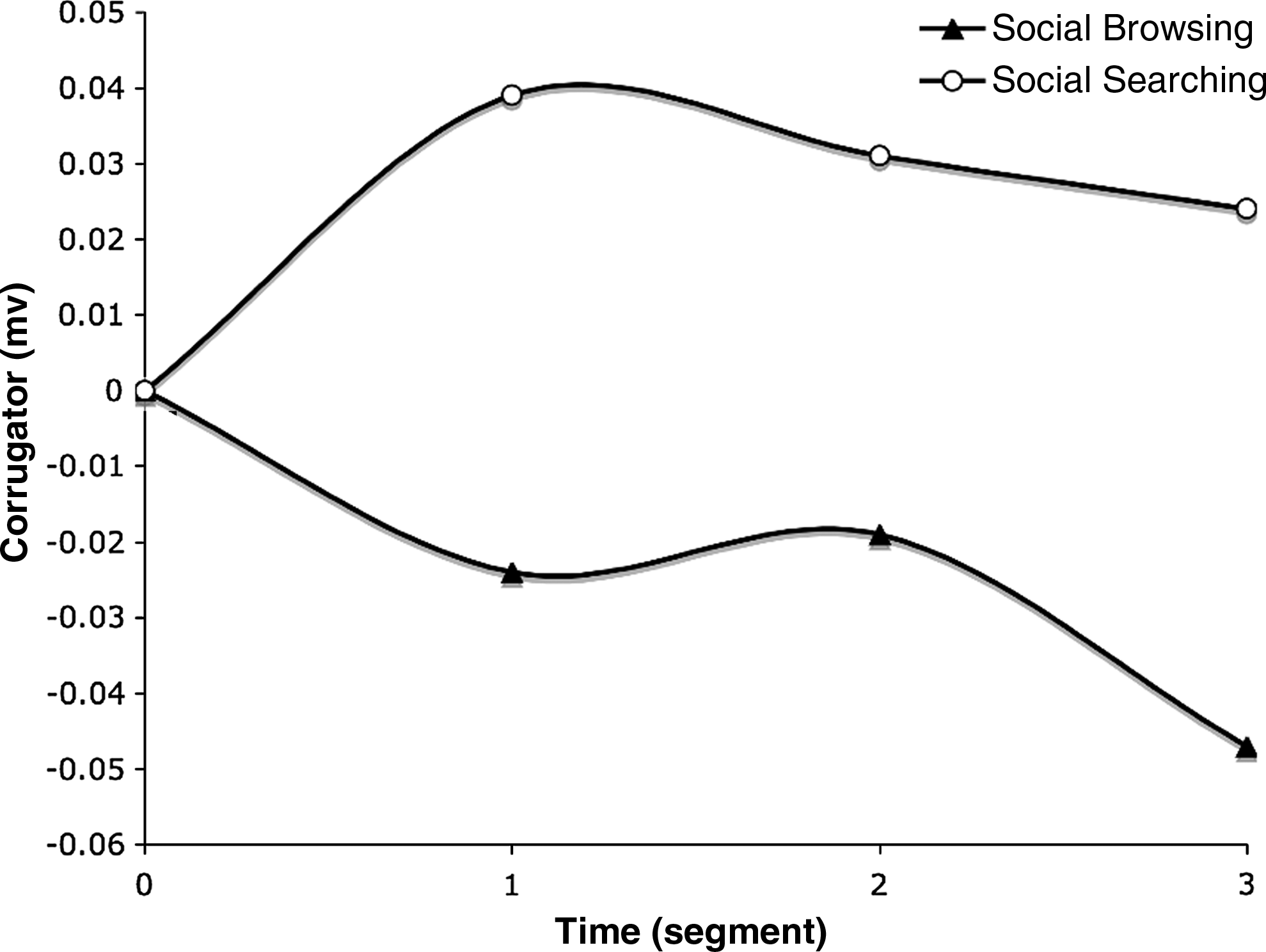
Change in corrugator supercilii activation during Facebook screens devoted to social browsing and social searching.
As shown in Figure 4, orbicularis oculi activation also diverged as a function of use function. During the course of a visit to each page, orbicularis oculi stayed relatively steady for pages devoted to social searching. For social-browsing pages, however, it decreased during the first and second time periods and increased in the last period. This is statistically demonstrated by a significant quadratic trend for the page type by time interaction, F(1, 220) = 4.22, p < 0.05, ηp2 = 0.02, observed power = 0.53. This indicates that navigating social-browsing pages elicited less pleasant emotion than navigating social-searching pages.
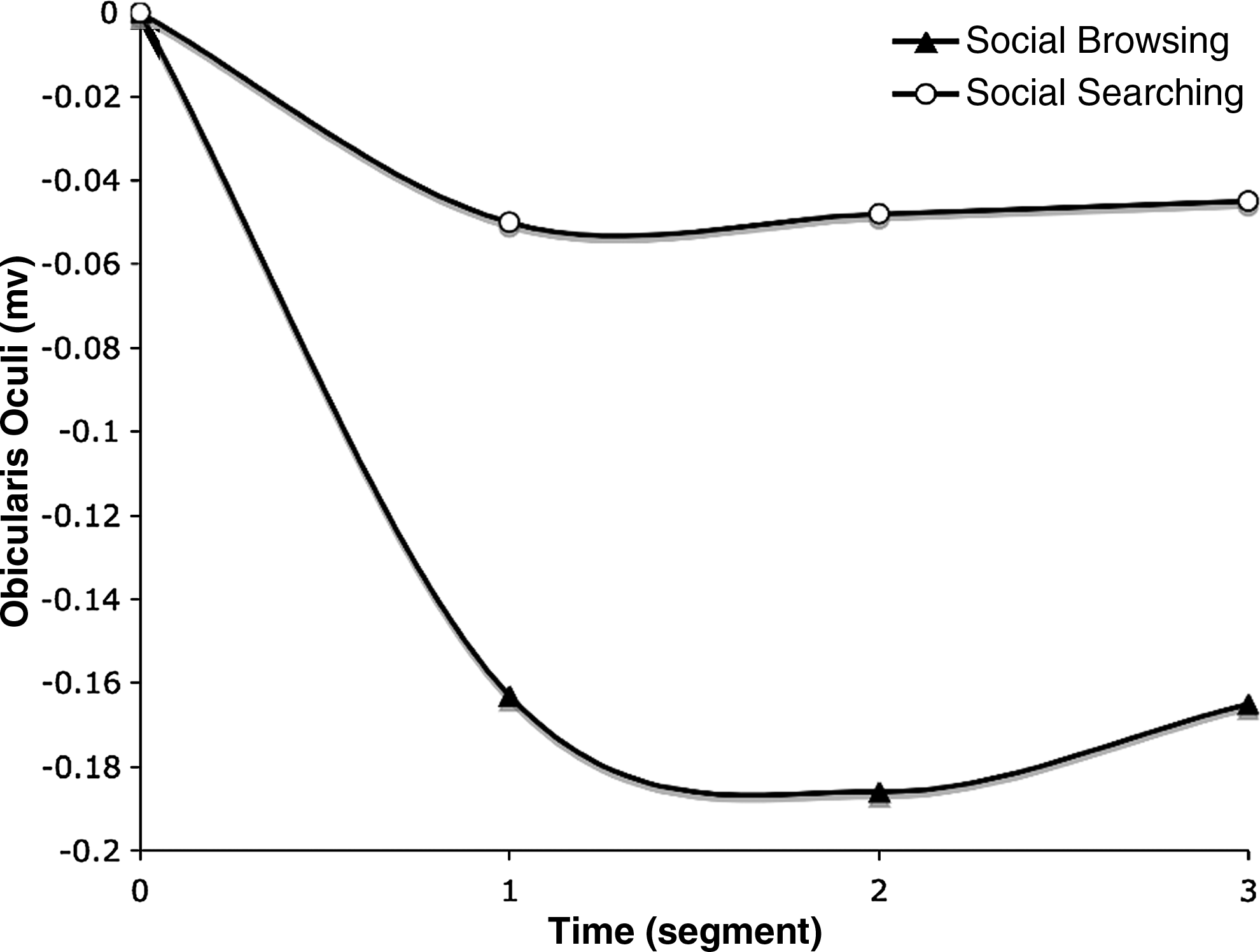
Change in obicularis oculi activation during Facebook screens devoted to social browsing and social searching.
Discussion
This study provides a preliminary conceptualization of how users' time is spent on Facebook, and how different uses of Facebook affect physiological responses associated with emotion. We conceptualized social browsing as a passive social information-seeking strategy, and social searching as an extractive social information-seeking strategy. Video data of participants' behavior while navigating Facebook showed that they devoted most of their time to either social browsing or social searching, relative to direct communication and impression management. Furthermore, people spent more time (both overall and per page) on pages coded as social-searching pages than they spent on those coded as social-browsing pages. Sympathetic arousal diminished across time for the different tasks carried out on Facebook, regardless of how they were categorized. There was no meaningful difference between social browsing and social searching on physiological evidence of unpleasantness. On the other hand, participants showed greater physiological evidence of pleasantness during social searching than they did during social browsing.
Theoretical implications
In this paper, we attempted to explicate the use of online social networks like Facebook through the different lenses of uses and gratifications, 24 social information-seeking strategies, 23 and self-report accounts of online social-networking use. 7 We suggested that social browsing is a non-specific passive social information-seeking strategy indicative of ritual media use, while social searching is a more goal-directed extractive social information-seeking strategy indicative of instrumental media use. This is a preliminary attempt to come up with some general categories of Facebook use and connect them with earlier more general discussions of online information seeking. It has been theorized elsewhere that interactive media meet a need for connectivity. 29 In this study, we have tried to focus on connectivity via indirect passive and extractive information-seeking strategies, as described by Ramirez et al. 23
Ramirez et al. 23 suggested, “the implications of gathering target information primarily through interaction versus observation for approach–avoid decisions online have not been documented.” In this study, we have looked at two different ways of gathering such information via observation and linked them to emotional responses associated with approach and avoidance behavior. We did this based on an evaluative space model 30 that conceptualizes emotion and motivation as consisting of two separate systems: an appetitive system and an aversive system. This model proposes that, at rest, the appetitive system is more active because it is responsible for sniffing out things in the environment that promote species survival (i.e., food, shelter, sexual mates). This phenomenon is called positivity offset. The aversive system, on the other hand, while less active at rest, ramps up faster in the face of stimuli that inhibit species survival. This phenomenon is called negativity bias. In other words, given positive and negative stimuli of equal magnitudes, the aversive system will exhibit higher activation than the appetitive system.
What does this mean for this study? The finding that social searching elicited greater pleasantness than social browsing suggests greater appetitive activation during the more specific social searching. This finding makes sense in light of the evaluative space model and, more specifically, the idea of positivity offset: the possible consequences of social information seeking seem unlikely to compel activation of the aversive system—they just are not that motivationally relevant. However, the greater obicularis oculi activation during the social searching may be consistent with a more focused surveillance of the environment that would be associated with mild appetitive activation, relative to the less focused social browsing. Perhaps the presence of a target during the more specific social searching compels appetitive activation. It makes sense that the appetitive system would be more active during more social searching, when people are browsing information that pertains to a particular target that they have already deemed as motivationally relevant by virtue of choosing it in the first place.
The finding that social searching was more pleasant is consistent with the finding that people spent more time on screens devoted to social searching than those devoted to social browsing. This result also reinforces the findings of Lampe et al., 7 who found that respondents reported spending more time social searching compared to social browsing. With the current study, we now have both self-report and observational data suggesting that people spend more time on social searching than on social browsing.
Lang et al. 30 explained that skin conductance could be utilized as a measure of motivational activation. The lack of a meaningful difference between motivational activation during social-browsing and social-searching pages may be a result of participants taking part in routine tasks. Intuitively, one might expect social searching to be more motivationally relevant in that there is an informational goal, thus requiring more effort to be dedicated toward the task. However, this was not the case here.
Practical implications
One practical implication of this study is the utility of unobtrusively observing behavior rather than relying on self-report, as has been done in a great deal of previous research on social networking.6–8,11,12,21 Easily (and freely) available screen-capture software makes this possible; we feel that this is a worthwhile tool for studying online behavior that complements methods that rely on self-report. One potential downside of gathering data in this fashion is that it lacks a priori manipulations, random assignment of participants to conditions, and experimental control. A potential upside is the ability to acquire data that are not constrained by experimental manipulations, which in our experience can sometimes impose rigidity upon what is naturally a very dynamic process.
There are a few limitations that are worth noting. We relied exclusively on physiological measures of emotional response because, as mentioned previously, there is already a fair amount of self-report data in the literature. In future research, we hope to augment the physiological measures employed here with subjective accounts of people's experience while social browsing and social searching. We also hope to add measures of cognitive resource allocation such as secondary task reaction time (STRT), as well as stronger measures of appetitive and aversive activation such as the postauricular and startle reflexes. In addition, future research could employ implicit measures pertaining to answer questions related to the individual's level of interaction through online social networking, as well as measuring the relationship closeness among the participants and those whom they interact with during the experiment.
This study is also limited in our somewhat narrow definition of Facebook use. We tried to conceptualize Facebook use in terms of an existing theoretical model of online social information seeking. In doing so, we neglected to include other popular domains of Facebook use like social gaming (e.g., Farmville, Mafia Wars) and commerce (e.g., Facebook Marketplace). These activities are fertile ground for further research on the use of online social networks.
In spite of these limitations, this study offers a preliminary conceptualization of Facebook behavior generated from real-time screen captures rather than retrospective reports. These data suggest that social browsing and social searching do comprise a great deal of Facebook activity, and that these different ways of fulfilling the need for connectivity lead to different physiological outcomes that may reflect a tendency for appetitive behavior while browsing for social information rather than conducting a more direct search for such information.
Footnotes
Disclosure Statement
No competing financial interests exist.