




Abstract
Abstract
Many studies have investigated how different technological features impact the experience of playing video games, yet few have focused on how control schemes may affect the play experience. This research employed a between-subjects design to explore the relationship between the type of console played (Nintendo Wii, Playstation 2) and feelings of flow and enjoyment during the game-play experience. Results indicated that participants reported greater feelings of control and enjoyment with a traditional control scheme (Playstation 2) than with the more technologically advanced control scheme (Nintendo Wii). Further mediation analysis showed that enjoyment was driven by the sense of control that participants experienced and not simply by whether they won the game. Theoretical and practical implications are discussed.
Introduction
Literature Review, Hypotheses, and Research Questions
With the exception of a few studies,5,6 little empirical research has directly compared players' enjoyment of popular games across platforms or technologies. Researchers have compared old and new versions of video games and have sought to understand how traditional game platforms compare with immersive virtual gaming technologies.7,8 Generally this research has shown that more enhanced gaming technology leads to greater enjoyment. However, other research focused on advanced controllers in driving simulation games has revealed that enhanced technology can actually hinder enjoyment of games. 9
Clarifying the relationship between technology and enjoyment requires considering how advancements in game controllers affect the player's experience. One possible explanation lies in the theory of natural mapping, which refers to “the ability of a system to map its control to changes in the mediated environment in a natural and predictable manner.” 10 (p47) A few studies have compared naturally mapped controllers (e.g., a steering wheel to play a driving game; a bongo-drum control for a rhythm game) versus traditional controllers (e.g., joystick and buttons) and have found that the more naturally mapped controls lead to greater experiences of enjoyment.6,11 Enjoyment is thought to be a result of more natural movement and interaction with the game. 11 Thus the limited literature on technology in gaming suggests that better graphics and more “realistic” controls might enhance enjoyment, but also point out that technological advances do not automatically prompt more positive or intense responses. Given this, the Wii control scheme appears suited to provide an enjoyable and engaging gaming experience. Instead of focusing on processor speed or pixel counts, it uses technology to provide a means to enact physically the movements conveyed on screen. This suggests that playing a game on the Wii using motion controls would be more enjoyable than playing the game on a console without these controls.
However, natural mapping is not the sole factor theorized to lie behind enjoyment, which may result from a variety of psychological responses, including feelings of involvement or presence.5–7 In this study, we specifically explore the prospect that control schemes influence flow states, and subsequent enjoyment. Flow is a psychological state of immersion that occurs when a person experiences optimal balance between their skill and the challenges presented during an activity. 12 Sherry 13 suggested that video games create optimal levels of flow, and that flow could be used to explain enjoyment of video games. Flow states are often characterized by feelings of control, time distortion, loss of self-consciousness, and intense absorption into an activity. Although there are many conditions in which people may experience flow, researchers have suggested that players who find games sufficiently exciting and challenging tend to experience flow more than those who find games to be difficult or complex. 13
Several scholars have proposed ways flow may function in the context of games, but there is no clear consensus regarding measurement.14,15 Due to the absence of established observational or physiological measures, it is common practice to rely upon a self-report, multidimensional measure of flow. In this study, we focus on four aspects of flow identified as part of a larger set of items in various domains: control, challenge–skill balance, concentration, and transformation of time.16,17 Although control aspects of flow seem to be most important in the game literature, each of these dimensions may influence enjoyment of games, and by considering all four, it allows us to evaluate better the mechanisms linking control scheme to enjoyment, leading to the first research question:
Emerging research suggests that technological features of games affect flow states and enjoyment.13,14 Flow theory suggests that while a task can be challenging, those performing it need adequate ability to focus on and meet that challenge. In turn, this implies that in games involving movement, invisibility of control is important to creating flow states.
18
If the Wii controls successfully mimic natural movements, they should be more effective at creating flow states and subsequent enjoyment than traditional control schemes. Given this, we proposed the following hypotheses:
The increased enjoyment predicted for the Wii could result directly from the motion-sensing capabilities of its controller, as well as indirectly through the influence of flow. Intuitively, sense of control is the most likely dimension of flow to be directly influenced by control-scheme differences. However, the other dimensions of flow may also play an important role in explaining enjoyment. For example, Sherry
13
emphasizes that flow states only occur in optimally matched conditions of task difficulty and user ability, so the challenge–skill balance dimension may prove critical to enjoyment. Similarly, measures of concentration or time distortion may more directly indicate the actual experience of a flow state, making them more direct predictors of enjoyment. Therefore, we consider this final research question:
Methods
Undergraduate students were recruited from two communication courses at a large northeastern university. Participants were first asked to complete an online questionnaire assessing their experience with games and knowledge of American football. The sample included 139 participants (72 females; 67 males). Participants were randomly assigned to play Madden on either the Wii (n = 78) or the Playstation 2 (n = 61). Four male undergraduate students served as confederates in sessions where participants played a multiplayer game mode. They were trained to play at a consistent level of difficulty and were asked to follow a set of rules in order to minimize any confounding factors across the play sessions.
During the scheduled session, participants were given a tutorial on game controls and then played one half of Madden football. Upon completion, participants were given a questionnaire. In all sessions, participants played with assigned NFL Europe teams in order to minimize the impact of any dispositions towards NFL teams. To capture a variety of play situations, we varied the mode of play, as well as the personality of the confederate in multiplayer situations. While all confederates played at similar levels of difficulty, they were instructed to act either friendly (n = 54) or unfriendly (n = 50) toward participants (e.g., to either strike up conversation or remain silent). Also, mode of play was manipulated by assigning participants to play alone against the computer (n = 35), head-to-head against the confederate (n = 51), or cooperatively with the confederate against the computer (n = 53). Although these manipulations were built into the design, they were not the central focus of this investigation and did not influence the results. However, they increased the ecological validity of the study by capturing a range of game-play situations. Depending upon the specific game events, the actual play session times ranged from 7 to 18 minutes (M = 9.75, SD = 1.67).
Madden 2008 was chosen as the playing stimulus for several reasons. It was one of the top-selling video games in 2007; it has relatively common gaming conventions and controls; and it allows players to have a complete game experience in a short time. In addition, Madden 2008 is available across all gaming platforms, allowing us to select the most graphically similar versions of the game for testing control-scheme differences.
All dependent variables were measured on 7-point Likert scales with anchors of 1 = “strongly disagree” and 7 = “strongly agree.” Enjoyment was developed based on McAuley et al.'s 19 and Deci et al.'s 20 studies. Enjoyment was measured by an index of seven items (α = 0.94, M = 4.75, SD = 1.22). We employed an adapted version of Jackson and Marsh's 16 Flow State Scale. From the original nine dimensions of the scale, four seemed particularly applicable to video-game enjoyment, and the wording of these items was adapted to suit the game context. There were 12 total items included in the scale, and each dimension was reliable: challenge–skill (two items; M = 3.96, SD = 1.35, r = 0.60, p < 0.01), concentration (four items; M = 4.83, SD = 1.32, α = 0.88), sense of control (four items; M = 4.21, SD = 1.36, α = 0.85), and transformation of time (two items; M = 3.66, SD = 1.35, r = 0.45, p < 0.01).
In addition to the dependent measures, we measured participants' prior experience playing Madden. Approximately 29% (n = 40) participants had experience with Madden before the play session. Approximately 27% of the participants in the PS2 condition (n = 17) and 32% of those in the Wii condition (n = 23) reported previously playing Madden. Gender was also included as a control variable, given the differences between males and females identified in the video-game literature.21–23 As mentioned earlier, confederate personality and mode of play were independently manipulated. Because it is possible for these manipulations to impact the results of the study, these two factors were also controlled for.
Although our study is primarily focused on explaining enjoyment in terms of control scheme and flow experiences, it is also possible that game performance (i.e., winning or losing) might impact game-player enjoyment. Thus we considered game outcome as an additional mediator to enjoyment. By addressing whether control scheme affected game outcome and whether outcome influenced any mediating effects of flow on enjoyment, we can be assured that flow states are the predominant factor in explaining game enjoyment, rather than the final game score. The final score for each participant's team and the opponent were noted during sessions, and the difference between scores was calculated such that positive scores indicated victory for the player and negative scores defeat, serving as a measure of game outcome (M = −1.25, SD = 13.29).
Results
To assess the first research question and the hypotheses, a series of ANCOVAs were conducted to examine whether participants' feelings of concentration, challenge, control, time transformation, and enjoyment while playing Madden were influenced by control scheme. Participant gender, Madden experience, game mode, and personality were included as covariates.
Table 1 summarizes the means and standard errors associated with the following analyses. The first research question asked whether enjoyment and flow experiences differ as a function of control scheme. Hypothesis 1 predicted that levels of enjoyment would be greater for those who played Madden football on Wii than for those who played Madden on PS2. The analysis revealed a significant effect of control scheme on enjoyment, F(1, 123) = 5.73, p < 0.05, ηp2 = 0.05, with individuals who played on PS2 reporting greater enjoyment than those who played on the Wii. Hypothesis 2 predicted that the four dimensions of flow we measured would be greater for those who played Madden on Wii than for those who played Madden on PS2. For feelings of control, a significant effect of control scheme emerged, F(1, 123) = 7.99, p < 0.01, ηp2 = 0.06. Those who played on PS2 experienced greater feelings of control than those who played on the Wii. Addressing the remainder of RQ1 and H2, there were no effects of control scheme on concentration, time transformation, and challenge. Although our results demonstrated significant effects of control scheme on enjoyment and the control dimension of flow, neither H1 nor H2 were supported. Contrary to our predictions, enjoyment and control were greater for PS2 than Wii. We considered whether this might reflect frustration by experienced players dealing with the novelty of the Wii, but additional analyses found no significant interaction effects of prior Madden experience on any of the DVs.
Note. Within rows, means for enjoyment and control (**p < 0.05, *p < 0.01) differ significantly between with regard to game system (Nintendo Wii and Playstation 2). In each ANOVA for the dependent variables, confederate personality, mode, gender, and prior experience with Madden were controlled for.
Only one control variable influenced some of the outcome measures: gender. A main effect of gender on enjoyment emerged, F(1, 123) = 5.76, p < 0.05, ηp2 = 0.05, with males (M = 5.09, SE = 0.16) reporting greater feelings of enjoyment than females (M = 4.59, SE = 0.15). For the dimensions of flow, main effects of gender emerged for feelings of control, F(1, 123) = 29.24, p < 0.001, ηp2 = 0.19, with males (M = 4.86, SE = 0.17) reporting greater feelings of control than females (M = 3.68, SE = 0.16), and optimal skill/challenge, F(1, 113) = 12.58, p < 0.01, ηp2 = 0.05, with males (M = 4.39, SE = 0.19) reporting greater feelings of optimal challenge than females (M = 3.70, SE = 0.18). Additional tests of the gender by system interaction term revealed no significant effects on enjoyment or any of the flow variables, suggesting that gender did not moderate the system effects reported above.
To address whether game outcome might provide an alternative explanation for our findings, we first evaluated the effects of control scheme on score differential, controlling for gender, prior Madden experience, mode, and personality. Results indicated that participants performed better when they played on PS2 (M = 3.95, SE = 1.54) rather than Wii (M = −5.89, SE = 1.37), F(1, 118) = 25.31, p < 0.001, ηp2 = 0.18. A main effect of gender was also revealed, F(1, 113) = 10.33, p < 0.01, ηp2 = 0.08, with males (M = 2.21, SE = 1.50) showing greater net scores than females (M = −4.15, SE = 1.42). Prior experience was not a significant predictor. These results suggest that participants won more often and scored more when playing on PS2 than on Wii, which could account for the control scheme differences on enjoyment. Further analyses were conducted to evaluate whether performance, flow, or both might play a mediating role in connecting control scheme to enjoyment.
Sense of control appeared to be the only viable mediator, since the relationship between control scheme and the remaining flow measures was not significant. To answer RQ2, we employed a bootstrapping approach using the SPSS macro developed by Preacher and Hayes 24 to provide a confidence interval reflecting the indirect influence of control scheme through each mediating variable. Figure 1 shows the results of these analyses, along with the relevant path model indicating each step in the proposed relationship. As the model shows, while control scheme influenced both performance and sense of control, only the latter influenced enjoyment (b = 0.55, p < 0.001). Not surprisingly, the bootstrap analyses revealed that while the total indirect effect of control scheme on enjoyment was significant (b = 0.40, CI = 0.14 to 0.73), only feelings of control demonstrated a significant indirect effect (b = 0.41, CI = 0.18 to 0.75). Sense of control acted as a mediator between control scheme and enjoyment in these data, and game performance did not. Extended models with the other dimensions of flow (as mediators) were conducted, and none of the results were significant. Furthermore, the significant path through control and the non-significant path through game performance remained unchanged.
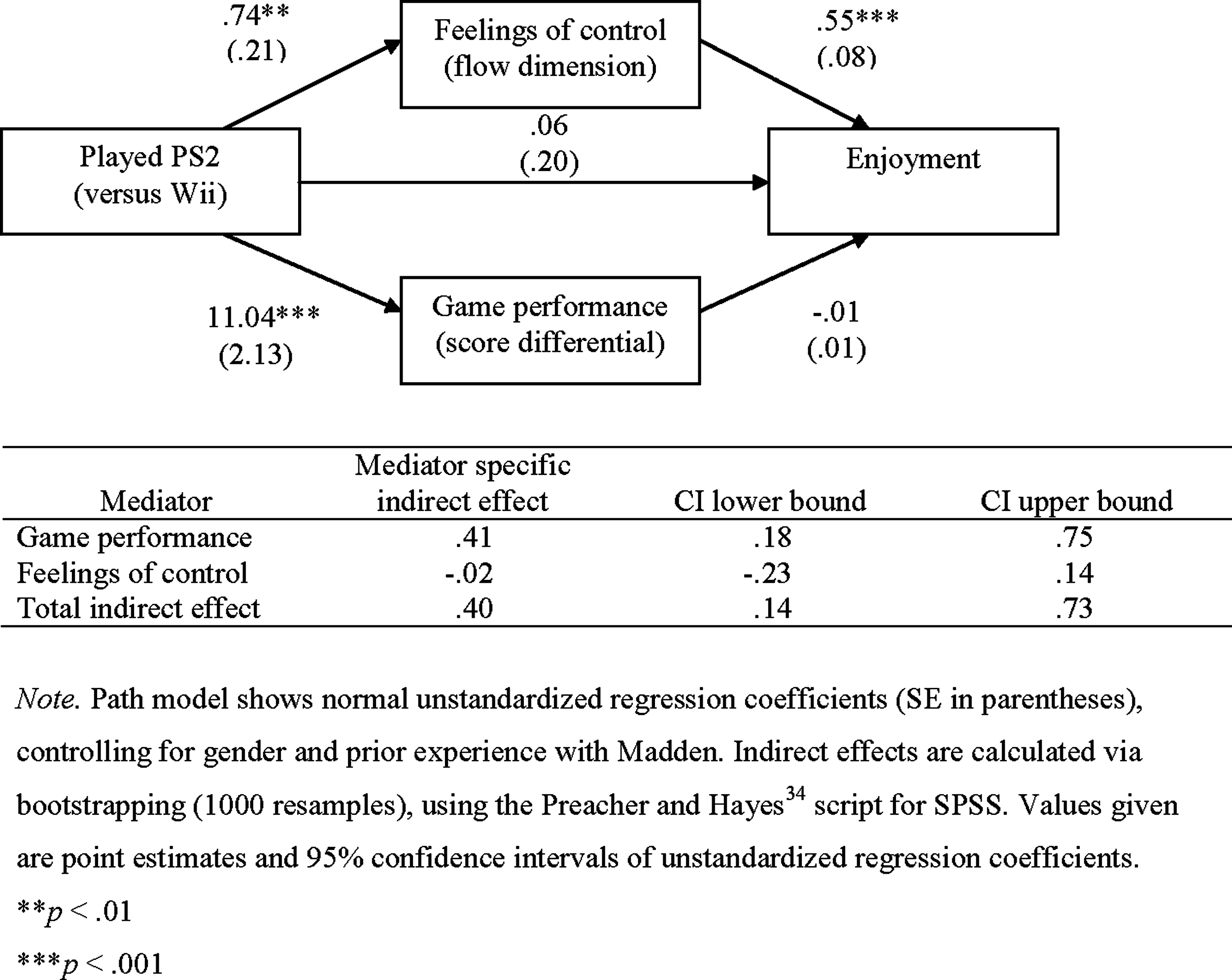
Path model and mediation analysis relating system, control, outcome, and enjoyment.
Discussion
This study sought to understand how differences in control scheme affect game-play experiences. In the current landscape of game research, this is an underdeveloped area, resulting in numerous calls to continue research on the topic.6,25,26 The current investigation suggests that advanced motion-sensing technology may actually detract from enjoyment. Based on the literature, we hypothesized that Wii controls would elicit greater flow experiences and enjoyment than a traditional controller, but this was not the case. Players had more fun and felt more in control on the PS2. They also won more often on the PS2, but the more influential factor appeared to be the control dimension of flow. Additional analyses showed it was control, not performance, which mediated the relationship between control scheme and enjoyment. It appears that the more “advanced” technology did not actually create greater flow or more enjoyment. One possible explanation for this is that the Wii may not actually offer the “natural mapping” aspects of gaming that have been found to increase enjoyment in previous research.6,11
Another explanation may lie in the newness of the “Wiimote.” Because the Wii controller is different than traditional game controllers, the learning curve may have been overwhelming for participants. The control scheme for the PS2 may be less “natural,” but for most people, more familiar, as it represents the typical interface conventions of the video-game medium. As a result, people may have enjoyed playing the Wii less because the unfamiliar control scheme proved harder to master. Though novelty may be driving Wii's market dominance, its control scheme could make some games less enjoyable.
Flow is commonly offered as an important explanation for enjoyment. This study suggests that flow may indeed be critical to enjoyment, showing a stronger mediation effect than actual game performance. However, this influence was limited to a particular dimension of flow: feelings of control. Perhaps flow is not a one-dimensional state or experience but rather a conglomeration of several factors that operate in distinct ways. Similar to the findings of Klimmt et al., 27 this study suggests that feelings of control are important to understanding why people enjoy games, as well as why they succeed when playing them. Also, this study is consistent with the idea that playing video games is an intrinsically motivating activity.28,29 Sense of control can be likened to feelings of competence, a key construct in self-determination theory, and this study is consistent with the idea that enjoyment is due in part to feeling confident in one's abilities.
Although gender is not the central focus of this study, male participants generally experienced greater flow states, performed better, and reported greater enjoyment than females. Fully explaining the reasons for these distinctions is beyond the scope of this study, but it is worth noting that gender differences do not appear to translate into different reactions to control scheme.
Since the initial release of Madden for the Wii in 2007, EA has included different game-play features called “family play” and “all play” in its follow-up efforts. 30 These features were largely designed to make the games more accessible for “casual” gamers. 31 Despite this, sales remain relatively low on the Wii. Developers modifying titles for the Wii need to be mindful of the complexity posed by motion controls and must find ways to ensure that the game feels both natural and accessible.
With regard to limitations, our results are specific only to the sample population. Even though we utilized a popular game, it is possible that different games may lead to differential results. Madden was designed for systems that use traditional game controllers. This could be one of the reasons that responses to Madden on Wii were not as positive as those on PS2. If we were able to simulate the popular “Wii Sports” game with PS2 controls, the results of this study might have been different. This question of port effects must be addressed more carefully in future research. Also, we relied on a retrospective measure of in-game flow. Although theory suggests that feelings of control occurring during the game should precede enjoyment, it is possible that people matched their reported flow state to their in-game enjoyment or performance.
As the field of gaming research continues to grow, our findings suggest that researchers must look beyond game content, instead exploring the psychological mechanisms and effects of technological features. This study illustrates the importance of flow states (specifically sense of control) on enjoyment. While there is still much work to be done regarding why people enjoy games, the relationship between control scheme, sense of control, and enjoyment reported in this article sheds some light on both the game features and theoretical mechanisms that contribute to enjoyment.
Footnotes
Disclosure Statement
No competing financial interests exist.