




Abstract
Abstract
This study examined whether actual-ideal self-discrepancy (AISD) is related to pathological gaming through escapism as a means of reducing depression for adolescent massively multiplayer online gamers. A Discrepancy-reduction Motivation model of pathological video gaming was tested. A survey was conducted on 161 adolescent gamers from secondary schools. Two mediation effects were tested using path analysis: (a) depression would mediate the relationship between AISDs and escapism, and (b) escapism would mediate the relationship between depression and pathological gaming. Results support the hypotheses stated above. The indirect effects of both AISD and depression were significant on pathological gaming. AISD and escapism also had direct effects on pathological gaming. The present study suggests that pathological behaviors may be over-regulated coping strategies of approaching the ideal self and avoiding the actual self.
Introduction
MMO games provide both opportunities and risks for adolescents who are undergoing the process of identity development. According to Erikson, 6 the central developmental task of adolescents is the search for their identity. One way for adolescents to resolve their identity crises is to find the time to get to know themselves better and make choices of who they want to become. MMO games provide such opportunities for adolescents to explore and develop their identity within the game world. They could create different virtual selves with different appearances and personalities; they could interact with different people in different worlds; they could even experiment with or explore aspects of the self that are potentially undesirable in real life. 7
This phenomenon is also prominent in Singapore, where video games have become a major part of the lives of children and adolescents. 8 Given the high broadband penetration rate in Singapore, with 88 percent of households having broadband access, 9 MMO games are becoming increasingly popular. In an Asian society with a collective culture and multiple ethnicities, the task of individual identity formation as well as integration into society may lead to conflicting selves. 10 These conflicts may also lead to stress and depression. Adolescents may deal with the negative affect caused by these conflicting selves by engaging in activities such as video gaming.
Self-discrepancy theory has been used in various studies to explain pathological behaviors, such as eating disorders, 11 alcohol abuse,12–14 and compulsive buying. 15 More recently, the theory was used in video game research to explain pathological gaming. 16 According to the theory, there are three domains of self, namely, the actual self, ideal self, and ought self. The actual self refers to the representation of the attributes that someone (yourself or another) believes you actually possess; the ideal self is the representation of attributes that someone (yourself or another) would like you, ideally, to possess; and the ought self is the representation of the attributes that someone (yourself or another) believes you should or ought to possess. 17 The theory proposes specific relationships between different types of self-discrepancies and certain kinds of emotions. For example, the discrepancy between actual self and ideal self is associated with dejection-related feelings, such as depression. On the other hand, the actual–ought self-discrepancy is related to agitation-related feelings, such as fear. 17
One way of reducing the negative affect is to avoid awareness of the actual self or to distort perceptions of the actual self. For instance, research has supported the finding that bulimics usually show a hyperinternalization of the thin ideal, and that bulimia nervosa and binge eating may serve a role of avoiding the awareness of the fact that the actual self is too far away from the thin ideal.18–23
In media research, problematic use of media as discrepancy-reduction strategy has been documented. The avoiding strategy is usually termed “escapism,” which refers to the behavior of avoiding real-life problems by engaging in media such as TV and video games. 24 For example, Internet addicts were found to have a higher tendency to access the Internet when they were depressed. In other words, there were more Internet addicts who tried to escape from reality than nonaddicts. 25 Escapism is also related closely to mood management theory, 26 which proposes that individuals consume media entertainment purposively to regulate moods.
Video gaming is known to be a gendered phenomenon; past studies have shown that boys usually played more often than girls27,28 and that more boys than girls were addicted.8,29,30 An early study on self-esteem and gratification of needs for adolescent gamers showed that girls with lower self-esteem had higher needs to escape but not for boys. 31 However, these results were usually based on all types of video games. For MMO games, previous studies showed no gender difference on addiction. 32 As for escapism, the gender difference for adult gamers was significant with a rather small effect size. 33 As results are inconsistent, it seems prudent to include gender in this present study. In addition, gender differences are often found in affect-related outcomes such as depression that was examined in this study; the impact of gender in Asian countries may differ from Western studies in that boys report higher levels of depression than girls. 34
Based on the review, a Discrepancy-reduction Motivation (DrM) model of pathological video gaming was proposed. The main hypothesis of the model was that among gamers, higher levels of actual–ideal self-discrepancy (AISD) would be related to higher levels of depression that would then be related to higher levels of escapism into MMO games. Finally, higher levels of escapism would be related to higher levels of pathological gaming symptoms. To be specific, the main hypotheses to be tested are two mediation effects: (a) depression would mediate the relationship between AISD and escapism, and (b) escapism would mediate the relationship between depression and pathological gaming. As gender was not the primary concern of this study, it was to be controlled in the model due to its possible effect on the dependent variable.
Methods
Sample
Questionnaires were administered to 161 students who reported having MMO gaming experiences from two Singapore secondary schools. Prior permission to conduct the study was given by the school principals. Informed consents were sought from the parents through the schools. Students without parental consent were excluded from the study. The students were informed that the study was anonymous and voluntary. Privacy of the students' responses was assured by requiring the teachers to seal collected questionnaires in the envelopes provided in the presence of the students. It was also highlighted on the questionnaires that the students' responses would be read only by the researchers.
The age range of the students was from 13 to 15 years with a mean age of 14.04 (SD = 0.73). Majority of the students were of Chinese ethnicity (90.1 percent), followed by Malay (8.1 percent) and Indian (0.6 percent). This sample comprised 49.1 percent boys and 50.9 percent girls.
Instruments *
The selves questionnaire
In this study, the Self Attribute Statement Scale, adapted from previous studies on self-discrepancies, 15 was used to measure actual–ideal self-discrepancies. The participants were asked to provide five paired attributes to complete the following statement regardless of grammatical errors: “I am … , and/but I would like to … .” Then, the participants were asked to rate on a six-point scale about how much they would like to change from the actual trait to the ideal trait generated, as well as perceived competence in making the changes. The product of these two ratings was averaged across five statements. The Chronbach's alpha was 0.86 in this study.
Escapism
Items on escapism from the MMO player motivation scale 33 were included in the study with minor revisions to the wording of the items to suit the Singapore sample. Responses on the five-point scale ranged from “strongly disagree” to “strongly agree.” The scale included items such as “I often play to avoid thinking about some of my real-life problems or worries” and “I play to escape from the real world.” The Chronbach's alpha was 0.79 in this sample.
Pathological game use
Pathological gaming was measured with a 10-item scale that was developed based on DSM-IV-R pathological gambling items. 8 Participants could respond “no,” “sometimes,” or “yes” to each of the 10 symptoms. Similar to the approach taken in other studies, 30 “sometimes” responses were scaled as halfway between no and yes. This approach yielded acceptable reliability (Chronbach's α = 0.75).
Depression
The Asian adolescent depression scale was used to assess the students' level of depression. 10 Students responded to each question on a five-point scale from “strongly disagree” to “strongly agree.” The scale includes items such as “I have thought about dying” and “I often feel like crying.” The Chronbach's alpha in this study was 0.96.
Data analysis
As the effects of gender were planned to be controlled in the model, preliminary t tests were conducted on all the endogenous variables. If gender had no significant effects on these variables, it would be dropped from further analysis. Path analysis using Analysis of Moment Structures (AMOS 16) was then used to test the main hypothesis that AISD was related to pathological gaming through escapism as a way to reduce depression.
Results
Gender differences
Independent samples t tests were conducted to investigate differences between boys and girls in mean scores on all variables (AISD, depression, escapism motivation, and pathological gaming). The results showed a significant gender difference in depression [t(159) = −2.65, p < 0.01], and a marginally significant difference in escapism motivation [t(159) = 1.72, p = 0.09].
The significant results indicated that, on average, boys experienced significantly less depression than girls, and had marginally significantly higher escapism motivation in this sample. There was no gender difference for AISD and pathological gaming. The means, standard deviations, and T statistics from this analysis are presented in Table 1.
p < 0.09; **p < 0.01.
AISD, actual-ideal self-discrepancy.
Path analysis
The main purpose of the study was to test the DrM model of pathological gaming. A path analysis using the maximum likelihood method in AMOS 16 was conducted for this purpose.
Six direct relationships were first tested among AISD, depression, escapism, and pathological gaming. The zero-order correlations are presented in Table 2. Correlations between all variables were significant with magnitude between 0.18 and 0.44. The significant results supported the hypothesis on the six direct positive relationships.
p < 0.01; *p < 0.05.
Two basic models were then tested for the mediation hypothesis. The first model is the default model that included both direct and indirect effects as follows: AISD would influence all dependent variables; depression would mediate the effects on escapism and pathological gaming; escapism would mediate the effects on pathological gaming. The second model is a full mediation model, in which the direct effects between AISD and escapism, AISD and pathological gaming, and depression and pathological gaming are constrained to 0.
Fit indices of the two basic models are presented in Table 3. Comparing the statistics, the default model showed substantial data model fit, whereas the full mediation model did not fit well. Nested model comparisons showed a significant difference between the two models (chi-square difference = 47.22, df = 3, p < 0.01). An examination of the default model regression weights revealed that all paths are significant at p = 0.05 level, except two marginally significant paths: AISD with escapism (p = 0.07) and depression with pathological gaming (p = 0.08). The result suggested that the mediation effects in this model were only partial to the total effects. In other words, the full mediation model is not supported.
p < 0.05.
CFI, comparative fit index; GFI, goodness of fit index; RMSEA, root-mean-squared error of approximation; SRMR, standardized root mean of the residual.
In the default model, pathological gaming was explained as a function of AISD, depression, and escapism. As expected, the strongest direct influence on pathological gaming was escapism. This direct influence is greater than the direct influence of AISD and depression. On the other hand, AISD and depression also contributed indirectly to pathological gaming through escapism. As shown in Table 4, a decomposition of effects from the path analysis showed that the indirect effects of both AISD and depression were significant on pathological gaming. The variance of pathological gaming explained by this model was 24 percent. The standardized regression weights and the default model are presented in Figure 1.
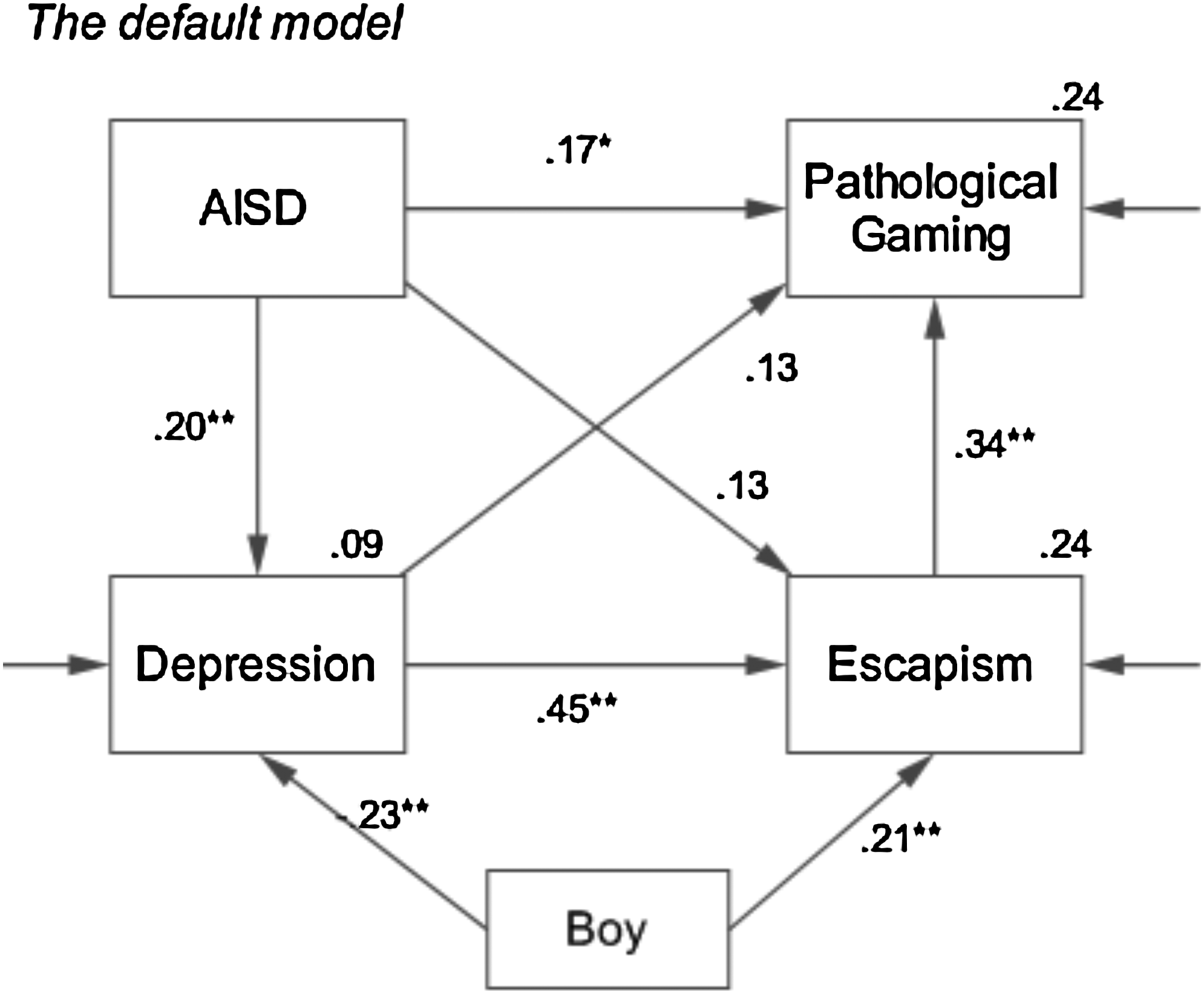
The default model. **p < 0.01; *p < 0.05.
p < 0.01; *p < 0.05.
Discussion
There have been studies illustrating the relationships between unrealized goals and use of the Internet. For example, Armstrong et al. 35 found that those with poorer self-esteem were more likely to use the Internet excessively. Wan and Chiou 36 found in their study of Taiwanese adolescents that online gamers turned to gaming for excitement, challenge, emotional coping, and escape from reality. Other researchers37–39 found relationships between anxiety disorders, depression, and pathological gaming. Yee 33 also found that gamers high on escapism motivation were more likely to be pathological gamers. However, how all three factors of self-discrepancy, depression, and escapism relate to pathological gaming was not made clear.
The results of this study provided a more comprehensive picture by showing how self-discrepancy, depression, and escapism were related to pathological behavior in the mediational models. Depression mediated the relationship between actual–ideal discrepancies and escapism, and escapism in turn mediated the relationship between depression and pathological gaming. Gamers who had higher levels of AISD and higher levels of depression tended to have higher escapism, and these gamers were more likely to engage in pathological gaming behaviors. AISD and escapism had a direct influence on pathological gaming. AISD also indirectly influenced pathological gaming through depression and escapism. Among all factors, escapism emerged as the best direct predictor on pathological gaming.
This study offered support for the other affect control models in addiction research, such as the affective processing model of negative reinforcement on substance addiction 40 and the hedonic management model of behavior addiction. 41 In these models, escape and avoidance of negative affect was the prepotent motive for addictive behavior. These findings provide valuable implications for understanding and the treatment of pathological gaming. For example, to pinpoint the causes of negative affect and to differentiate between self-discrepancies and other external stressors might be a useful way to guide the pathological gamers into learning more effective coping strategies.
Any effort to help adolescents with pathological gaming must take escapism into consideration as well. It may not be sufficient to address the issue with treating depression and the symptoms of pathological gaming alone. Counselors and youth workers need to help pathological gamers narrow the gap between their actual and ideal selves. They would need to have an empathetic understanding of pathological gamers' need to escape into the virtual world of videogames. In such cases, meeting the pathological gamers in the virtual worlds may provide a better understanding of their problems as well as the attraction of the virtual game environment before providing alternative coping strategies.
Because this research merely employed the survey method, no causal inferences could be drawn from the path analysis. Future studies could employ experimental or longitudinal design to further confirm the DrM model of pathological gaming. Future studies could also explore whether the strategies of using gaming to reduce self-discrepancies and negative feelings is a failed strategy, for example, whether depression is also an outcome of pathological gaming.
The present study suggested that pathological behaviors may be over-regulated coping strategies of approaching ideal self and avoiding actual self. For adolescents who are in the process of self-exploration and development, indulging in MMO games maybe one of the various ways to decrease the awareness of AISD and reduce the negative affects associated. Evaluations of self-discrepancy, depression, and escapism may help in the prevention of pathological gaming for adolescents.
Footnotes
Acknowledgments
The authors would like to thank the Ministry of Education, Singapore, and the Media Development Authority for jointly funding the research project (Project # EP 1/06 AK) as well as the National Research Foundation for funding the research project (NRF-20008-IDM-001-MOE-014).
Disclosure Statement
No competing financial interests exist.
*
All scales used in this study were in English. They were pilot tested and used in a larger project on a sample of similar background. 8 The Flesch Reading Ease for the four scales were 92.6, 84.4, 68.7, and 100, respectively.