




Abstract
Abstract
Numerous recent studies have examined the impact of video gaming on various dependent variables, including the players' affective reactions, positive as well as detrimental cognitive effects, and real-world aggression. These target variables are typically analyzed as a function of game characteristics and player attributes—especially gender. However, findings on the uneven distribution of gaming experience between males and females, on the one hand, and the effect of gaming experience on several target variables, on the other hand, point at a possible confound when gaming experiments are analyzed with a standard analysis of variance. This study uses simulated data to exemplify analysis of regression residuals as a potentially beneficial data analysis strategy for such datasets. As the actual impact of gaming experience on each of the various dependent variables differs, the ultimate benefits of analysis of regression residuals entirely depend on the research question, but it offers a powerful statistical approach to video game research whenever gaming experience is a confounding factor.
Introduction
These findings point at a possible confound: as prolonged experience and training is a major determinant of both performance 14 and affective reactions, 15 gender differences in any measured variable related to video gaming might also partly reflect differences in video game experience. An example for this speculation is a recent study by Bourgonjon and colleagues, 16 who used path modeling to identify predictors for secondary-school students' preference for using video games as an educational tool in the classroom. Even though gender differences in the assessed variable were present, path modeling showed them to be mediated by gaming experience, rendering conclusions about gender differences per se difficult.
Whenever gender effects are investigated in video game studies, differential gaming experience should thus be taken into consideration. This can be achieved by multiple regression analysis 1 or analysis of covariance (ANCOVA).17,18 However, because the assumptions of ANCOVA are routinely violated by datasets concerning gender and video game performance, authors often report standard analysis of variance (ANOVA) for their data. 19 The purpose of the present study was to exemplify the alternative strategy of analyzing the residuals of a pooled linear regression to control for the influence of gaming experience. Following the terminology of Maxwell and colleagues, 18 this approach will be referred to in the present study as analysis of regression residuals (ANORES).
The underlying rationale of ANORES can be depicted in Venn diagrams of unique and shared variance proportions of the variables of interest: the participants' gender, gaming experience, and the dependent variable in question (Fig. 1). The overall variance of the dependent variable will always be caused by several factors and only a portion of this variance will be due to the participants' gender. This shared variance, in turn, can be dissected in parts that are uniquely caused by the participants' gender and other parts that are confounded with other variables such as gaming experience. ANORES removes this confounded part of the variance to analyze only those proportions of the shared variance that are uniquely caused by the participants' gender.
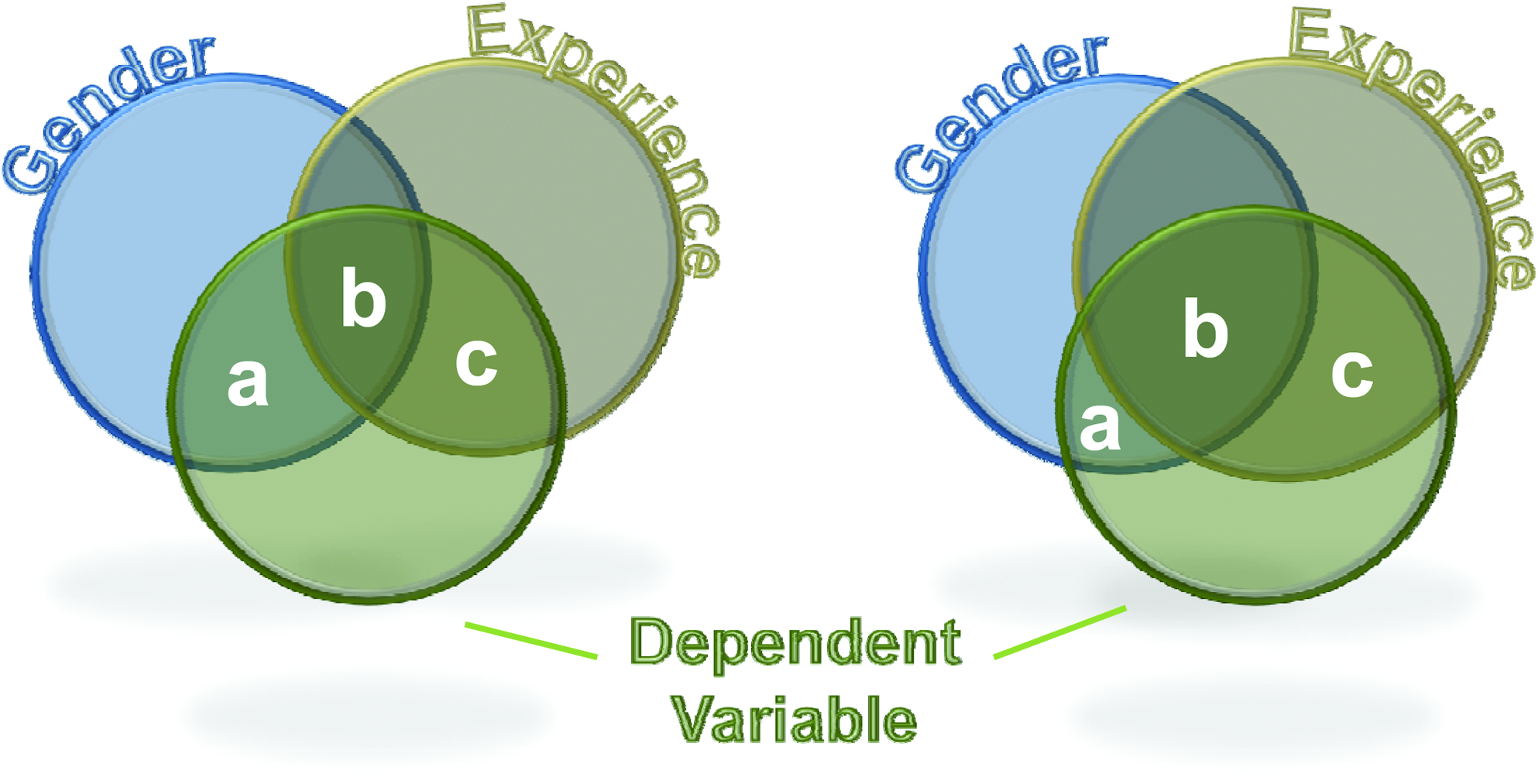
Variance components in an analysis targeting the impact of gender on the dependent variable of interest. Left panel: The Venn diagram shows a modest correlation of gender and gaming experience. In this case, both gender and experience share a considerable unique proportion of the dependent variable's variance (a and c) whereas the confounded portion of the variance (b) is comparatively small. Thus, controlling for the correlation of gender and gaming experience will only have limited impact on the results of the statistical analysis. Right panel: Although gender explains the same portion of the dependent variable's variance as in the left setting, most of this shared variance is confounded with the variance due to gaming experience (b). Controlling for the correlation of gender and experience will have a profound effect on the results of any statistical test and might even show the unique impact of gender (a) to be nonsignificant. Color images available online at
In a nutshell, the basic procedure of ANORES follows two simple steps. First, a (linear) regression identifies the impact of the confounding variable on the dependent variable. Regression residuals can then be computed by subtracting the predictions of the regression equation from the participants' actual scores. These residuals resemble scores where the (linear) impact of the confounding variable is entirely removed. In a second step, the regression residuals enter a typical ANOVA with those factors that are of interest to the analysis, including the participants' gender.
The impact of gaming experience or any other confounding variable will vary from experiment to experiment and its actual impact depends on several factors. It is thus impossible to predict whether ANORES will produce qualitatively different results than the standard ANOVA approach for an individual experiment and researchers have to judge whether their data are best analyzed with the former or latter test. For this reason, the present study relies on two simulated datasets to provide prototypical examples for situations showing the potential value as well as the limitations of ANORES. A step-by-step description of how to perform ANORES with the SPSS software package (IBM Corp.) is available as Supplementary Data (Supplementary Data are available online at
Methods
Each simulated dataset comprises 20 men and 20 women that we assume to have played Solitaire and another 20 men and 20 women that we assume to have played Tetris right before a mental rotation test (Fig. 2A; higher scores indicate better performance; arbitrary scaling). Each participant provided a rough estimation of his gaming experience in hours per week (mimicking typical questionnaire data). Assume that we were interested in the impact of gender and game type on the participants' ability to perform mental rotation.
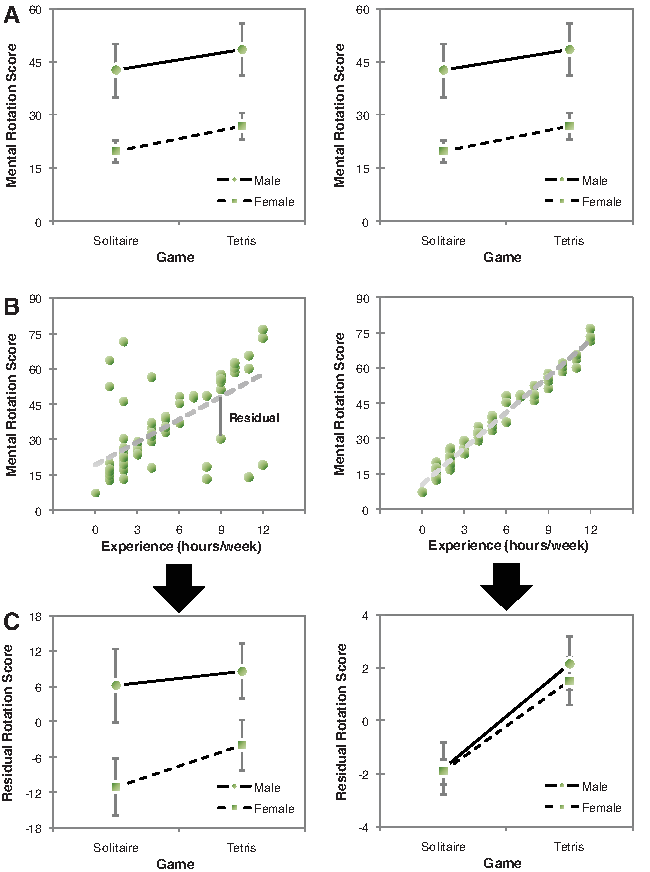
Dataset 1 was created to show only a moderate correlation of gender and gaming experience (cf. Fig. 1, left panel), an assumption that might hold true for most studies targeting gender effects in video gaming. Dataset 2 was explicitly created to show a manifest impact of gaming experience and clearly exaggerates its impact in empirical studies (cf. Fig. 1, right panel). Most importantly, both datasets feature the same data except for a different assignment of years of experience to the participants—creating identical situations when analyzed with ANOVA (Fig. 2A) but showing more subtle differences when analyzed with ANORES (Fig. 2B, C).
Results
Dataset 1
A 2×2 between-subjects ANOVA on the mental rotation scores (Fig. 2A) showed both, the main effect of gender (F(1, 76)=63.64, p<0.001, ηp2=0.46) and the main effect of game to be significant (F(1, 76)=5.57, p=0.021, ηp2=0.07). Both main effects were additive as qualified by a nonsignificant interaction (F<1). Playing Tetris improved its players' mental rotation score in comparison to Solitaire (38 vs. 31). However, gender seems to be a more important predictor, as male players scored nearly twice as high as female players did (46 vs. 23).
The reported analysis, however, does not account for the impact of gaming experience as a possible confound for the observed gender effects. Indeed, a closer look at the data revealed a positive correlation of mental rotation scores and gaming experience (r=0.662, t(78)=7.80, p<0.001; Fig. 2B, left panel) as well as a significant point-biserial correlation between gaming experience and gender (r=0.354, t(78)=3.34, p=0.001). To deconfound the effects of gaming experience and gender, dataset 1 was reassessed with ANORES.
In a first step, gaming experience served as a linear regressor for mental rotation scores (Fig. 2B). The residuals of this regression analysis were then analyzed with the same 2×2 ANOVA as earlier. The overall pattern appears similar: males still outperformed females (F(1, 76)=37.70, p<0.001, ηp2=0.33) and the game played had at least a marginally significant influence of mental rotation scores (F(1, 76)=3.86, p=0.053, ηp2=0.05). The interaction between both factors remained far from significance (F<1). Interestingly, a closer look at the main effect of gender reveals that its effect size was reduced by about 30% from ηp2=0.46 to ηp2=0.33.
Dataset 2
As described in the Methods section, the 2×2 ANOVA on the participants' mental rotation scores yielded the same results as for dataset 1 (Fig. 2A, right panel). This pattern of results again effectively obscures the impact of gaming experience, which did not enter the initial ANOVA even though it is the most powerful predictor in dataset 2 (r=0.99 between experience and mental rotation scores). Further, point-biserial correlation analyses showed that gender was significantly correlated to gaming experience, with men having greater experience than women (r=0.66, t(78)=7.80, p<0.001).
To control for the confounding influence of gaming experience, gaming experience and mental rotation scores again entered a linear regression analysis as independent and dependent variables, respectively. The regression model was used to compute residual scores for each participant to arrive at a deconfounded measure. Indeed, the ANORES showed a different pattern than the initial analysis: the main effect of game remained significant (F(1, 76)=79.73, p<0.001, ηp2=0.51), whereas the previously found main effect of gender did not approach significance (F(1, 76)=0.86, p=0.356, ηp2=0.01). The interaction of both factors remained nonsignificant (F<1).
Discussion: Benefits and Limitations of ANORES
The present analysis aimed at applying ANORES to data of video gaming experiments, which are typically analyzed with ANOVA. Two simulated datasets served this purpose. Both datasets yielded the same ANOVA results but featured a different pattern of intercorrelations of the participants' gender, gaming experiments, and mental rotation scores. For dataset 1, a moderate correlation of gender and gaming experience yielded comparable results for ANOVA and ANORES. However, even though the qualitative pattern looked identical, the effect size of the participants' gender was reduced by about 30%, indicating that even a medium-sized correlation can distort the statistical analysis. Dataset 2 exemplified a situation wherein a standard ANOVA would indicate a massive impact of gender on the dependent variable that was, in fact, driven by the male player's pronounced experience in video gaming. When the residuals of a linear regression were analyzed instead (ANORES), the main effect of gender turned out to be nonsignificant.
The striking difference between standard ANOVA and ANORES for dataset 2 of course resulted from the artificial nature of the dataset, and in most studies on gender effects in video gaming, gender does explain a unique portion of the criterion variance that is not due to differences in experience.1,15 However, considering the close relation of gender and video game experience, on the one hand, 16 and video game experience and performance and affective reactions, on the other hand,2–4 the present study might indeed overestimate gender effects. The results of the two datasets point at a continuum of settings wherein ANORES will have a different impact on the statistical analysis—ranging from a mere adjustment of statistical parameters such as effect sizes (dataset 1) to profound changes in the pattern of results (dataset 2). The fact that the present analysis relied on simulated rather than empirical data points out that any actual experiment might show a different pattern of intercorrelations and it has to be evaluated whether ANORES provides a more accurate picture than standard ANOVA does individually.
Taken together, the potential danger of experience-related confounds in video game research could easily be avoided, if authors reported the bivariate correlation of gaming experience and the respective dependent variable. If this correlation indicates a medium or stronger association of both variables (r≥0.30 in Cohen's terminology 20 ), it might be worth reporting ANORES instead of standard ANOVA—at least if an ANCOVA is inappropriate for the data in question.17,18 Further, ANORES as a data analysis strategy is of course not limited to gender effects or video gaming research. It can be easily employed to other settings, including other types of experimental design such as within-subject designs or different types of regression analysis. 18 ANORES thus provides a flexible statistical tool with valuable applications in the social and behavioral sciences.
Disclosure Statement
No competing financial interests exist.
References
Supplementary Material
Please find the following supplemental material available below.
For Open Access articles published under a Creative Commons License, all supplemental material carries the same license as the article it is associated with.
For non-Open Access articles published, all supplemental material carries a non-exclusive license, and permission requests for re-use of supplemental material or any part of supplemental material shall be sent directly to the copyright owner as specified in the copyright notice associated with the article.
